

Words by Andrew Newton | Published 18.11.2026One of the first things my brother-in-law ever said to me was “Newcastle are the biggest team in the North-East, aren’t they?”
It was clearly banter, designed to welcome me, a Sunderland fan, to the family of my West Ham supporting in-laws. I just laughed and said “no, of course not!”
If it hadn’t been at the first family event I’d been invited to, I would have explained that Sunderland and Newcastle United are two large clubs, from similarly passionate areas. I would have said that Sunderland have been league champions more times than Newcastle but Newcastle have won the FA Cup more times than Sunderland.
I might even have talked about the social, geographical, and historical differences between the cities of Newcastle and Sunderland but that wasn’t appropriate at the time and is perhaps best saved for another Football Heritage article.
I didn’t say so at the time but, grudgingly, I have to admit that there is a good reason why my brother-in-law would believe that Newcastle are the biggest team in the North-East.
Part of that reason is to do with his age and part of it is that he was born and raised in Essex and didn’t grow up understanding the subtleties and nuances of life in the North-East.
But to understand the main reason he might think that, we have to travel back to 1992.
A number of notable events occurred in 1992. The Borough of Sunderland was finally given City status; Durham County Cricket Club played their first game at First Class level; Durham Wasps Ice Hockey Club won the Heineken Premier League, the Heineken British Championship, and the Castle Eden Cup; and, Sunderland AFC reached the FA Cup Final, facing Liverpool at Wembley.
However, for the purposes of this story, the most significant thing that happened in 1992 was Sir John Hall finally taking control of Newcastle United.
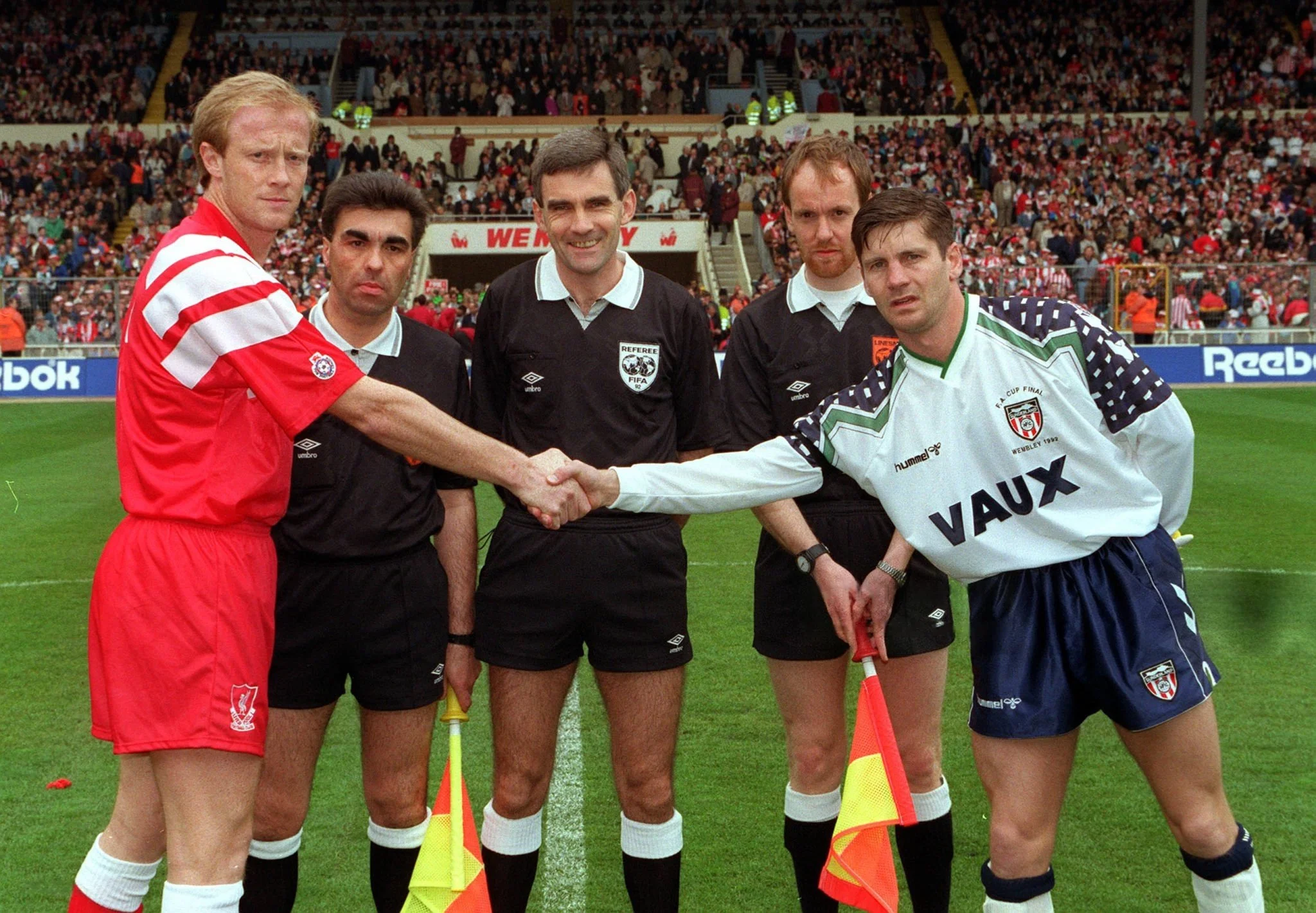
Mark Wright shakes hands with Sunderland captain Paul Bracewell ahead of the 1992 FA Cup Final.
Photo Credit: Getty
Sir John Hall made his name as a property developer. He was famed as the man behind Gateshead’s MetroCentre, at the time, the largest indoor shopping centre in Europe, and he became known as ‘Margaret Thatcher’s Favourite Businessman’.
Hall was born in 1933, in North Seaton, near Ashington in Northumberland, the son of a minor. He began his working life as a mining surveyor.
Eventually, he qualified as a chartered surveyor and by the 1960s was working as an Estate Agent in Sunderland. Having taken out a loan, Hall began buying houses in Sunderland, modernising them, and selling them for a profit.
From there, he moved into commercial development, starting with a new Co-Op in Gateshead.
Following a trip to the United States and Canada, he became interested in the idea of developing shopping malls. He took advantage of the Enterprise Zones, a concept incorporated from America and introduced by Thatcher’s Conservative government, which consisted of specially designated areas offering tax breaks, simplified planning, and economic incentives to boost local business growth, to develop an area of former industrial land on the south bank of the river Tyne.
This became the MetroCentre, which opened in stages from 1986 onwards.
The MetroCentre caused great excitement and was welcomed as a positive development within the region. I remember being taken as a very young child, just after it opened, by my grandparents and being aware of it being a big deal.
It wasn’t just for shopping either. ‘Ganin’ te th’ Metro’ was something all kids my age wanted to do in the late 80s and early 90s due to the presence of MetroLand, the indoor theme park, the cinemas, Lazer Quest, the SX Superbowl bowling alley, and the host of fast food restaurants.
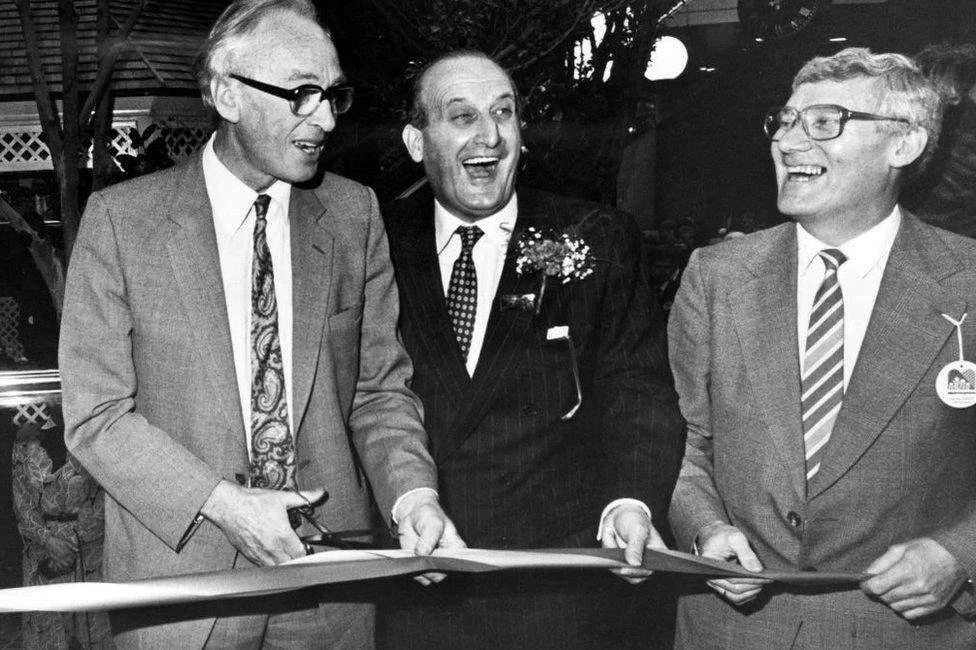
Sir John Hall (centre) at the opening of the MetroCentre.
Photo Credit: BBC News
In his book Work and Play: the Industrial Roots of English Football, my Football Heritage colleague Dave Proudlove referred to Hall as a ‘Thatcherite T. Dan Smith’.
I like Dave’s description, but to understand Hall’s impact on the North-East, there are some other events that we need to explore.
Despite his well-known political allegiances (which have more latterly been transferred to Reform UK), Hall has stated that he greatly admired Clement Attlee’s post-war Labour government which brought great social and economic change to the North-East, hugely benefitting the mineworkers of the area in which he grew up.
However, he saw the Conservatives and Thatcherism as the vehicle to continue driving the North-East forward in a post-industrial world.
The other thing to consider is that unlike Smith, the original ‘Mr. Newcastle’, Sir John Hall was interested in the economic improvement of the wider North-East region. Not just one city.
Outside of the sphere of football, there exists a sort of pan-North-Eastism. North-Easterners are proud of their region in a way that goes beyond district and county boundaries.
The type of people that have an affection for places like High Force and Barnard Castle on the southern edge of the North-East region are just as likely to hold the same affection for Bamburgh and the Farne Islands on the North Northumberland Coast.
These people want the best for the entirety of their region and it seems that Sir John Hall was motivated, at least in part, by sympathies of this kind.
Hall enjoyed quite a high degree of popularity in the North-East during the mid to late 1980s. Newspapers on both Tyneside and Wearside claimed him as their own, describing him variously as a ‘Sunderland businessman’, ‘Tyneside businessman’, and ’North-East Entrepreneur’.
Hall was involved with developments across the North-East and has regularly talked publicly of the region’s potential and talent. He made philanthropic gestures to causes across the area, including donating money to the Torrens Maritime Trust, an organisation that sought to rebuild the famous sailing clipper, originally built by James Laing & Co of Deptford, Sunderland, to demonstrate Wearside’s shipbuilding expertise to the wider world.
At some point Hall clearly developed the idea that a successful football club would be beneficial to the North-East.
This is a reasonable conclusion for him to reach. It is widely accepted that a popular and winning football team can boost an area’s economy, create jobs, improve local morale, and raise global visibility.
Local folklore suggests that at one time he was interested in becoming involved, at boardroom level, with Sunderland. After all, he had lived in Sunderland for some time.
It’s possible that he may have been put off by the ongoing mid-80s power struggle between Sunderland director Barry Batey and Chairman Tom Cowie, which ultimately led to Bob Murray taking control of the club.
Other rumours suggest that he had season tickets for both Sunderland and Newcastle. This is not necessarily surprising; tickets for both may have been useful for entertaining business associates but he was also from a generation in which people happily went to watch Sunderland one week and Newcastle the next.
However, in his book Newcastle United: the Day the Promises had to Stop, former Newcastle board member and chairman, Denis Cassidy, goes further and states that, in 1984, John Hall said to him “I am not a Newcastle supporter, if anything I was a Sunderland fan”.
By November 1986, Hall had developed an interest in Newcastle United. Following their AGM on the 25th November he confirmed that he was interested in becoming involved with the club and was linked with a consortium also involving Brian Johnson of AC/DC and Newcastle Breweries.
He told the local press “I look at the club in relation to how it benefits the North-East. I look towards Newcastle being part of an overall regeneration of [the] region”.
From about 1988, Hall tried to encourage fans to buy shares in the club but, he claims, “they didn’t trust the board- and I know why. We ended up with a fractured board who disagreed with one another”.
On this basis, he decided that the only way to move Newcastle United forward was to carry out a takeover. Gordon McKeag, the existing chairman, and other board members were unwilling to relinquish control, however, and this resulted in a long and bitter share war between the original board members and Hall’s Magpie Group, which had been formed to challenge them.
The Magpie Group’s members travelled the country seeking out shareholders willing to sell their stakes in the club.
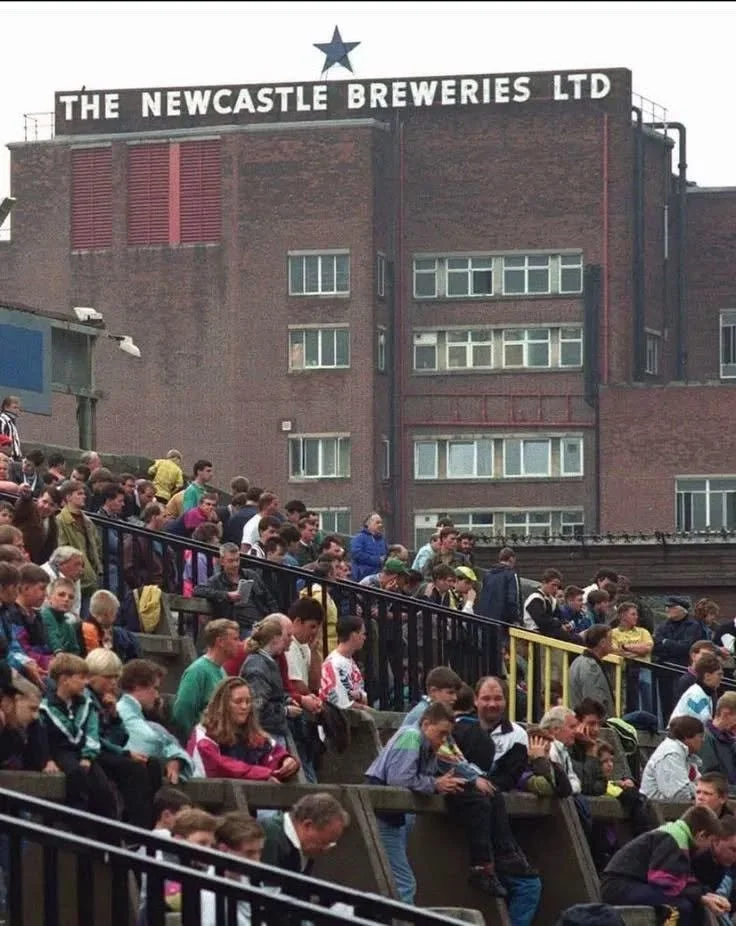
Newcastle supporters on the Gallowgate End terraces in 1992.
Photo Credit: David Davies
This share war resulted in the board accumulating heavy debt leading to chairman McKeag resigning in 1990.
The following year, the bank pulled the club’s daily operating overdraft and Hall was able to buy 72.9% of the club for £3million.
In February 1992, Hall effectively gained complete control of Newcastle. By July of that year Hall had managed to hoover up the majority of the remaining shares and a formal statement was released stating that “Newcastle United is now a subsidiary undertaking of Cameron Hall Developments Ltd”.
That February, when Hall took control, Newcastle were in dire straits, staring relegation to the old Division 3 in the face.
They’d already lost 4-0 at Southend, let slip a 3-0 lead at home to Charlton to lose 4-3, and been beaten 5-2 by Oxford at the old Manor Ground.
One of Hall’s first moves was to sack manager Ossie Ardiles.
Hall’s choice of successor to Ardiles was a masterstroke. The man selected to replace the Argentine was Kevin Keegan.
Keegan had finished his playing career at Newcastle. He became hugely popular with the Newcastle fans and achieved a level of some influence within the club during his two seasons as a player there.
He famously left the pitch in dramatic fashion, following a farewell game against Liverpool which ended in a 2-2 draw, by boarding a helicopter direct from the centre circle.
The optimism that Keegan’s appointment brought helped to turn things around and, with only the addition of Brian Kilcline, he led them to safety.
There was a little wobble, where Keegan, concerned at the ongoing lack of transfer funds, walked out after just 40 days. Hall, however, persuaded him to return with the promise of bankrolling the club using personal guarantees.
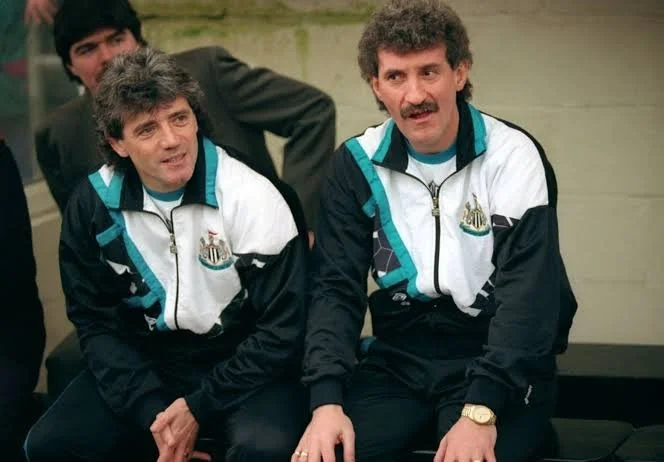
Kevin Keegan with Terry McDermott pictured on the bench ahead of his first game as Newcastle United manager.
Photo Credit: Chronicle Live
The 1992-1993 season was vastly different for Newcastle. With Hall’s money to spend, Keegan was able to bring in several players, including two former Sunderland captains; Barry Venison from Liverpool, and Paul Bracewell direct from the Wearsiders.
The most significant signing perhaps occurred towards the end of the season. In March 1993, Keegan paid Bristol City £1.75million for Andy Cole who went on to score 12 goals in 11 starts.
Keegan’s improved squad won the new First Division, finishing eight points ahead of West Ham, meaning that they would compete in the second season of the Premier League.
With only minimal changes to the squad, which included the return of Peter Beardsley, who formed a successful partnership with Cole, Keegan’s Newcastle were an instant hit in the Premier League.
They finished third behind Manchester United and Jack Walker’s Blackburn Rovers, and just ahead of Arsenal.
At the end of that season, in an interview with The Independent on the 21st June 1994, Hall told Angela Lambert “Newcastle United means so much- it fills with you with pride. The Geordie Nation- that’s what we’re fighting for”
Hall was making a very specific statement by equating ‘Geordie’ with fans of Newcastle United.
He was, in fact, co-opting a regional identity and deliberately applying it to supporters of his football club.
As Dr. Bill Lancaster, director of the Centre for Northern Studies at Northumbria University, told Michael Walker for his book Up There: the North-East Football Boom and Bust “the whole idea of Geordie culture being confined to Tyneside is very new”.
The etymology of the term ‘Geordie’ is not clear and several explanations have been offered, ranging from Royal associations to the use of a particular type of safety lamp.
It was originally associated with the Northumberland and Durham coalfield. Up until the 1950s, if not much later, Geordies were pitmen, regardless of which bit of the North-East they came from.
This identity was accepted across the region. When the Northumberland Plate horse race was moved from Newcastle’s Town Moor to Gosforth Park in 1882, the local press wrote of ‘the Geordies coming over from Sunderland’.
Sunderland fans regularly sang about being Geordies, including at the 1973 FA Cup Final. Indeed, my aunt and uncle, both Sunderland born and raised, but who moved away in the early 80s, had a sticker in the back of their car which read “Gan canny, we’re Geordies” well into the 1990s.
Hall later repeated the ‘Geordie Nation’ line, disingenuously comparing Geordies with the Basque people.
Despite it being a hugely inaccurate claim, it was an exceptional piece of propaganda. Geordies all supported Newcastle and they were separate from the rest of the country. The national media lapped it up.
Hall was aided by the emergence of a new word; Mackem, meaning residents of Sunderland. This provided a different and distinct label for Sunderland supporters.
The exact origins of this word are also disputed. Academic research suggests that it first appeared in the late 1970s or 1980s. It didn’t come into widespread usage until the late 1980s at the earliest.
It is generally agreed that it’s derived from the term “make them” rendered in a Sunderland accent.
To outsiders, the idea that there is more than one North-East accent might seem strange but to locals, aspects of speech like the rolling ‘R’s’ of the Rothbury area and Ashington’s strange vowels are distinct.
When I was younger, there was a clear difference in accent between Derwentside, where I went to school, and Weardale, where I went to Scouts.
My Dad recalls being able to tell which of the surrounding pit villages lads that travelled into Sunderland, to attend the school he went to, came from based on their accents.
Most explanations suggest that the term ‘Mackem’ is related to shipbuilding, Sunderland’s major industry for much of its history.
A 1953 article in the Sunderland Echo reports that, on Tyneside, Sunderland is known as the place where they ‘mak ‘em and tak ‘em’, meaning that the shipwrights make the ships and the maritime pilots and tugboat captains take them down the River Wear to the sea.
So, like ‘Geordie’, it has its origins in the North-East’s heritage of heavy industry. All of this means that the term ‘Geordie’ has contracted to mean solely residents of Tyneside.
However, this still encompasses large numbers of Sunderland supporters. Places on the south bank of the Tyne, such as Hebburn, Jarrow, and particularly South Shields, all historically part of County Durham, have long been places with large numbers of fans of the Wearside club.
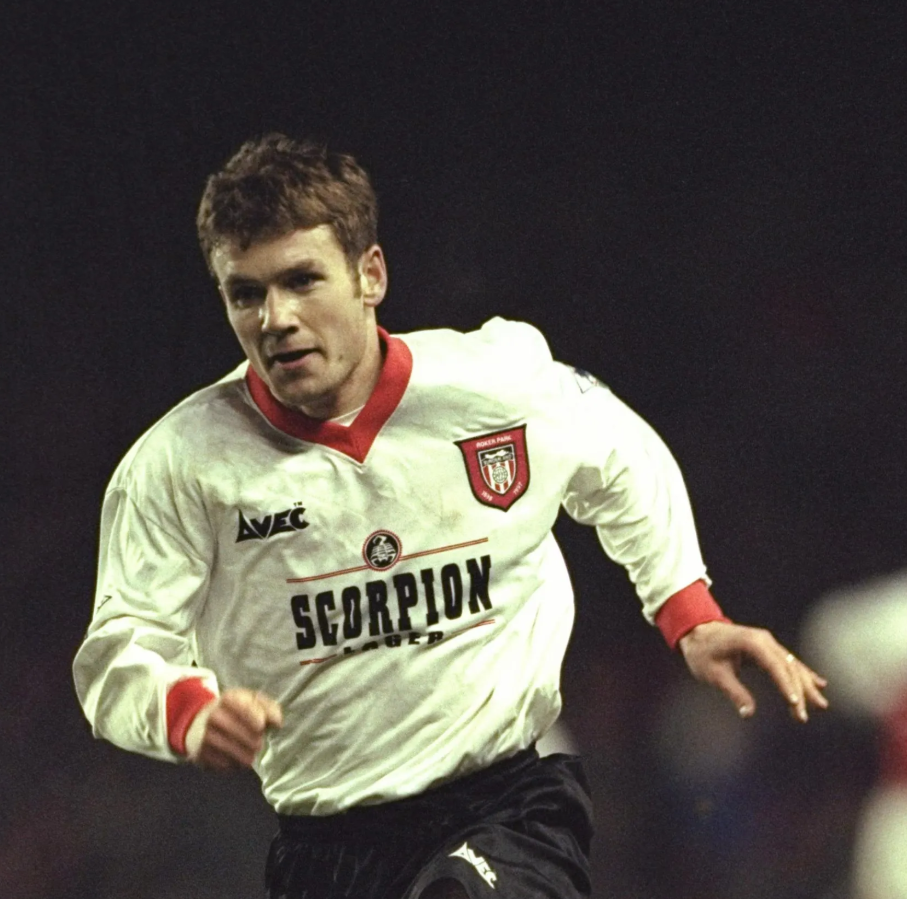
Craig Russell, the ‘Jarra Arra’, Sunderland’s Jarrow-born Sunderland-supporting centre forward of the mid 90s.
Photo Credit: Roker Report
For this reason, and because of the historic uses of the word, many Sunderland supporters do not refer to Newcastle supporters, or their team, as Geordies.
Instead, they refer to them as Magpies or ‘Mags’, a term that relates directly to the team rather than to their geographic origins.
For similar reasons, not all Sunderland supporters identify themselves as Mackems.
However, John Hall’s PR campaign would not have been as effective if his team wasn’t any good. Even as a Sunderland fan, it’s hard to argue that the side that Kevin Keegan put together, coupled with his gung-ho approach, was not, objectively at least, an exciting team.
Few football fans would argue that players like David Ginola and Faustino Asprilla were not fun to watch. Although they never won anything, they regularly finished in the top quarter of the Premier League and qualified for European Competition.
There was also their compelling title race collapse during the 1995-1996 season.
Hall’s prediction that a successful football club could provide a boost to an area was proven to be right. Newcastle became known as a party town in the late 90s and early 2000s; it was a popular destination for stag and hen weekends.
The people of the city accrued a kind of glamour and several professional Geordies, such as Ant and Dec, Jayne Middlemiss, and the voice-over bloke from Big Brother, became popular on television.
Geordies were lovingly mocked in Reeves and Mortimer’s ‘Geordie at the Antarctic’ sketch and through Harry Enfield’s ‘Julio Geordio’ character. Newcastle had certainly shaken off the grim (and probably unfair) image that was depicted in films like Get Carter.
Hall’s plans, however, were much more grandiose than simply establishing a successful football club.
In 1995, he launched his ‘Newcastle Sporting Club’ scheme; a multi-sports organisation under the Newcastle United banner, which he claimed was based on Barcelona.
Rather than establish new teams, Hall bought up existing ones. This included the basketball team, the Newcastle Comets, which had only just moved to Newcastle having been founded in Sunderland in 1976.
He also bought Newcastle Gosforth rugby club, just at the time that Rugby Union was becoming professional.
The renamed Newcastle Falcons became the first fully professional Rugby Union club, and England fly-half Rob Andrew was installed as both a player and director of rugby.
Founded in 1947 by John Frederick James ‘Icy’ Smith, a local businessman who sold blocks of ice to people without fridges, Durham Wasps had become one of the most dominant teams in British Ice Hockey by the late 1980s.
They developed a fierce local rivalry with Whitley Warriors, from Whitley Bay. Derby matches attracted crowds far in excess of the stated official capacity of Smith’s Durham Ice Rink.
They were a much-loved Durham-based sporting institution. They were so big that they could attract the first Russian player to British Hockey, Alexander Kozhevnikov, a former World and Olympic champion.
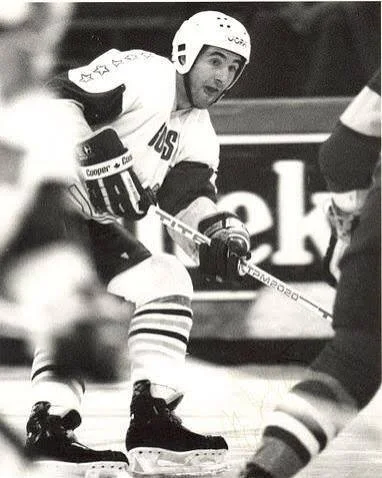
The Wasps too, renamed as the Newcastle Cobras, became engulfed by the Newcastle Sporting Club project.
Hall bought them in 1995 and uprooted this great flowering of County Durham sport literally from the banks of the Wear to transplant it to the banks of the Tyne.
Tragically, after a couple of further name changes, the Ice Hockey club had withered and died by 2001.
Was Hall’s involvement in sport solely altruistic? Was it solely about providing a boost to regeneration of the North-East? It’s hard to say but, according to a Guardian article from February 2006, Hall, his son Douglas, and their fellow investor Freddie Shepherd had made, between them, more than £44million since Newcastle were floated on the stock market in 1997.
However, a 2019 article in the Newcastle United fanzine, The Mag, suggested that anything that Hall had made from the club was justified because of what he’d done to propel them to the upper reaches of the Premier League and into Europe.
Hall had successfully transformed Newcastle United from the club that it had been in 1992. Although silverware evaded them, they were, during much of the time that he was in charge, seen as belonging amongst the upper echelons of English football.
He contributed to changing the perception of Newcastle as a city across the rest of the country. The success of the football club reflected well on other aspects of the city and helped to make it a popular destination for partygoers, keen to experience the delights of the Bigg Market and the Quayside.
He also substantially altered the landscape of North-East sport beyond football.
Events surrounding Hall’s reign at Newcastle have also played a role in changing perceptions around North-East identities.
At least to the outside world, the terms ‘Geordie’ and ‘Mackem’ now relate to allegiances to certain football teams rather than to the industries from which these terms derived and which shaped the North-East region.
This is perhaps a reflection of the vacuousness of our age. Dividing people along such lines is also, perhaps, typical of a zeitgeist which, despite loudly proclaiming the opposite, seeks to create distinct groupings of people based on the most minimal of differences.
Sir John Hall wanted to promote the North-East. He seemed to have a vision of what it could be. Whether you see Hall’s legacy as good or bad clearly depends on your perspective.
What is undeniable is that he helped to change the way the North-East is perceived and to change the way the North-East thinks about itself.
Even nearly 35 years since he took over at Newcastle, the things that Hall did still shape the way that people, including my brother-in-law, see the North-East.
Aleksander Kozhevnikov in Durham Wasps colours.
Photo Credit: Durham Wasps