

Words by Andrew Newton | Published 09.05.2026If you voyage north from Scrabster, across the Pentland Firth, you will come to an ancient and beautiful land; green and gently rolling countryside with golden beaches and the occasional dramatic cliff. Place names are drawn straight from myth and legend; the Old Man of Hoy, the Stones of Stenness, Skara Brae, the Ring of Brodgar, Maes Howe, and the Dwarfie Stane. It is the setting for epic tales of Norse Earls, their bitter feuds, brutal battles, bloody murders, political ambitions, and acts of sorcery.
This land is Orkney, an archipelago of approximately 70 islands around 10 miles north of Caithness, off the Scottish coast. Orkney has a population of approximately 22,000 people, with the majority of those living on Mainland, the largest of the islands. With a fairly mild climate and extremely fertile soils, agriculture is the mainstay of the economy in Orkney, with fishing and aquaculture also playing an important part.
Since the 1970s, oil and gas have also become important, with the Flotta Oil Terminal processing up to 400,000 barrels at its peak. Over the last 20 years or so, other sectors have become increasingly important, including manufacturing, food and drink production, renewable energy, and tourism.
“The Orkney I was born into was a place where there was no great distinction between the ordinary and the fabulous; the lives of living men turned into legend.”
- Edwin Muir, poet and novelist (1887-1959)
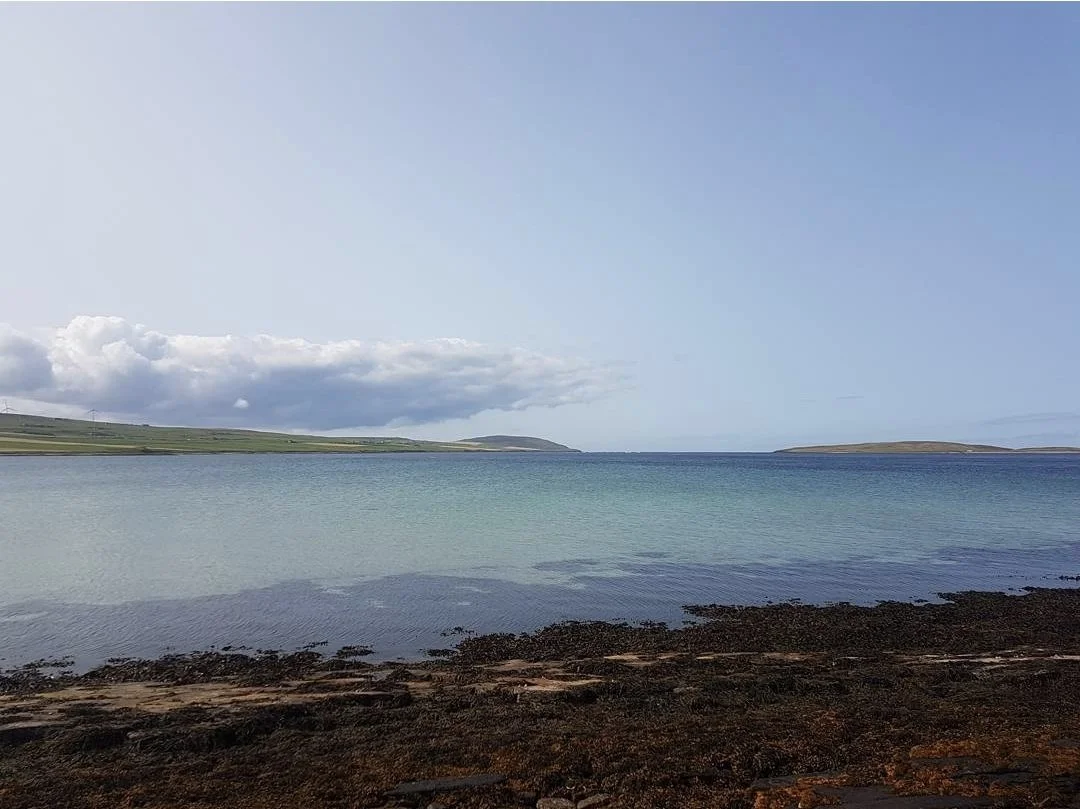
The Orkney seascape.
Photo Credit: Andrew Newton
If you’re interested in history, then Orkney is a must visit. The islands have been inhabited since at least the Mesolithic period.
There are several significant and world famous prehistoric sites across Orkney, including the Neolithic village at Skara Brae, the communal tomb of Maes Howe, the Bronze Age grave site at the Knowes of Trotty in Harray, and the Iron Age fortified structures at the Broch of Gurness and the Broch of Midhowe. Pictish settlements are known at the Brough of Birsay and at St Boniface Kirk on Papa Westray.
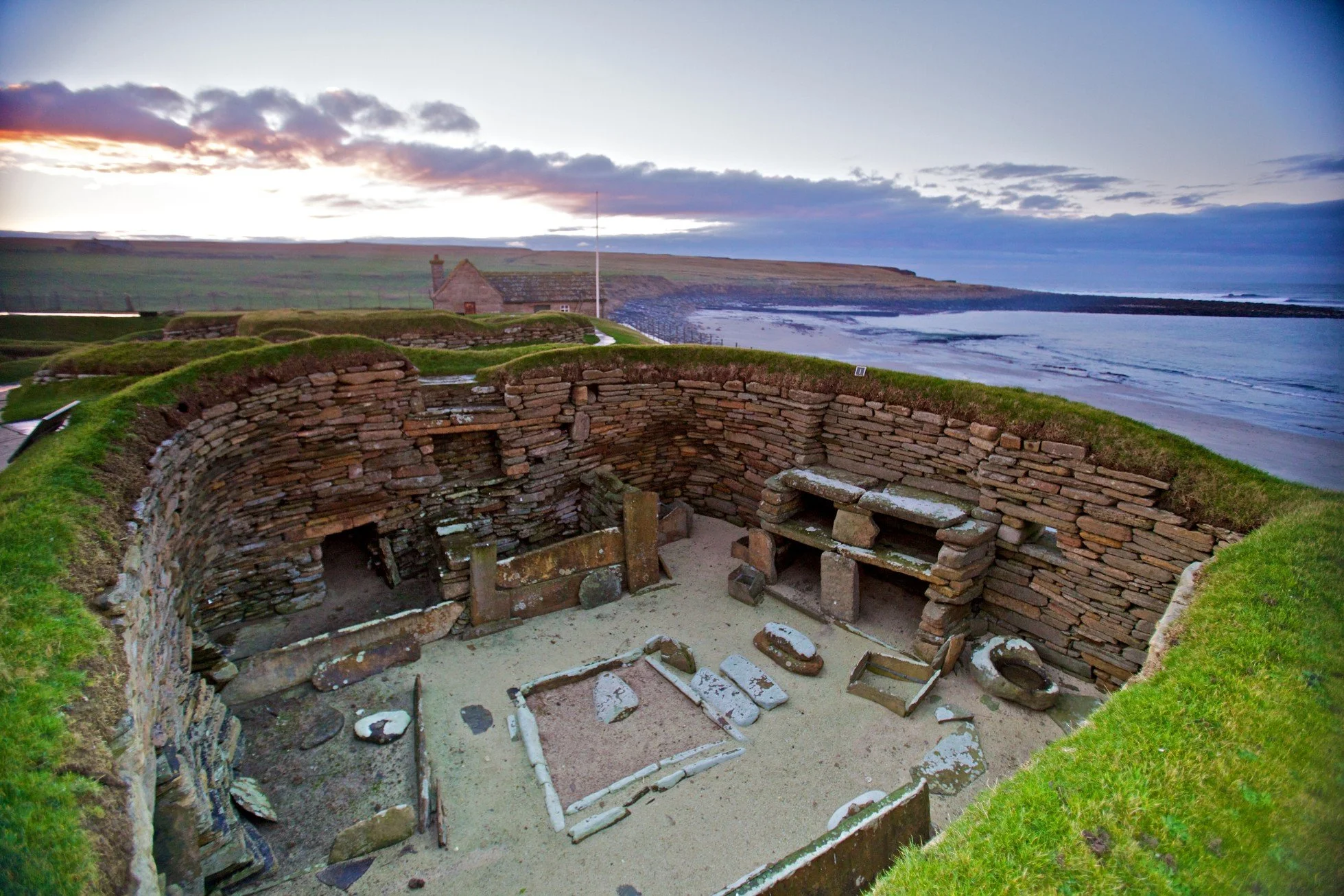
Skara Brae.
Photo Credit: The Ness of Brodgar Project
From about 800AD, Norse settlers arrived in Orkney and the islands became part of the Kingdom of Norway, operating as an Earldom under the Norwegian Crown.
Events in this period are recorded in the Orkneyinga Saga, although as this is comparable to the other Norse or ‘viking’ sagas, it is not necessarily completely historically accurate and contains myth and storytelling, and some jokes that aren’t completely obvious to a modern audience.
Orkney’s Viking past is still celebrated today. Norse rule lasted until 1468, when along with Shetland, Orkney was gifted to Scotland as part of the wedding dowry of Margaret of Denmark, daughter of Christian I of Denmark, Norway, and Sweden, when she married King James III of Scotland.
The Islands’ capital, Kirkwall, contains St Magnus Cathedral, which was founded under Norse rule in 1137, the adjacent Bishop’s Palace, which was built at the same time, and the Earl’s Palace, a Renaissance-style building built under Scots rule by Patrick, Earl of Orkney in 1607.
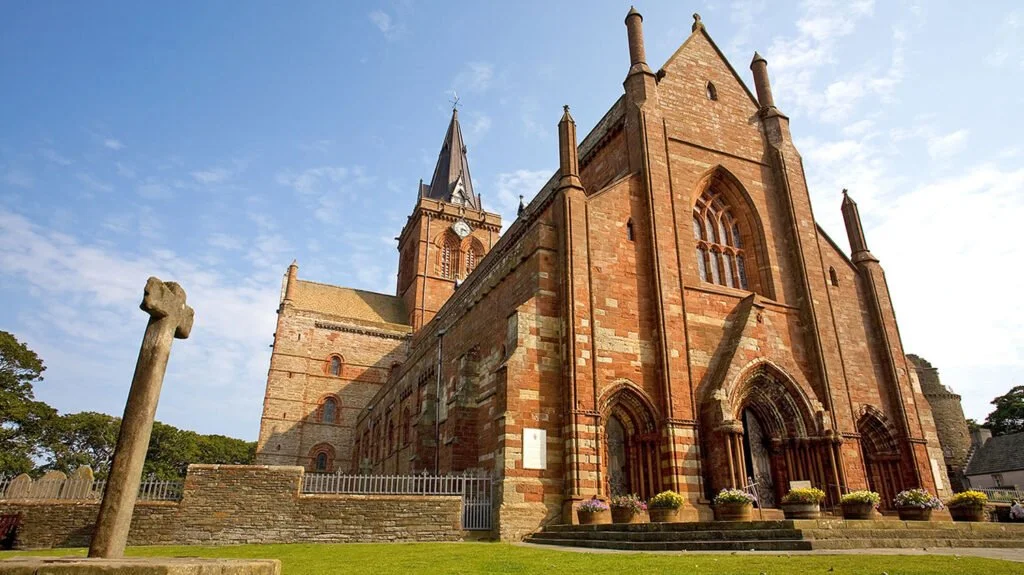
St Magnus Cathedral.
Photo Credit: North Link Ferries
From the 17th century, Orkney became an important stop for Transatlantic shipping, where British ships would take on provisions for the long crossing. The town of Stromness, in the south-west of Mainland, grew rapidly in this period.
In the early 19th century, the herring boom saw large numbers of people arriving in Orkney to work in this trade. Whitehall village in Stronsay became Orkney’s largest herring port. Scapa Flow, the large natural harbour formed by the configuration of the islands meant that Orkney became Britain’s chief naval base during the First and Second World Wars.
It is possible to visit several sites associated with this period, including the beautiful Italian Chapel, a Nissen Hut decorated by Italian POWs to look like a traditional, stone-built chapel. Scapa Flow is popular with scuba divers as it is possible to dive on several of the shipwrecks from the war years.
Orkney isn’t, however, just one big open air museum, a Disneyland for history enthusiasts. It’s a living, breathing, modern community and so the things that are important in any other community are important. Including sport. And, like in many other places, football is amongst the most popular of sports.
One of the earliest references in the press to Orcadian football comes from an announcement in the Orkney Herald newspaper stating that a cricket match between Academy Cricket Club, Wick and St. Magnus Cricket Club, Kirkwall would take place at 10.30am on Thursday 6th June 1889.
The announcement also stated that “A [football] match has been arranged to take place at 4pm immediately after the above cricket match in the same field under the Association rules between Rovers FC, Wick and St. Magnus FC, Kirkwall.”
Later that year, The Orkney Herald reported on another football match, between a team from the St. Magnus club and a “Scratch-15”, indicating that Rugby was also popular in Orkney at this time and that, as was common in the Victorian era, the term “football” was used to refer to both the Association and Rugby codes.
Like elsewhere, the late Victorian period was one in which football in Orkney was growing quickly. One of the islands’ most successful clubs, Thorfinn Football Club, was founded on 15th April 1891.
The announcement in the Orkney Herald stated that “At a meeting held in the Temperance Hall, Kirkwall, on Wednesday, steps were taken for the inauguration of an Association Football Club, when upwards of 40 youths were enrolled as members”. Later that month Stromness Rovers were established; this club “chose to play under the Rugby rules”.
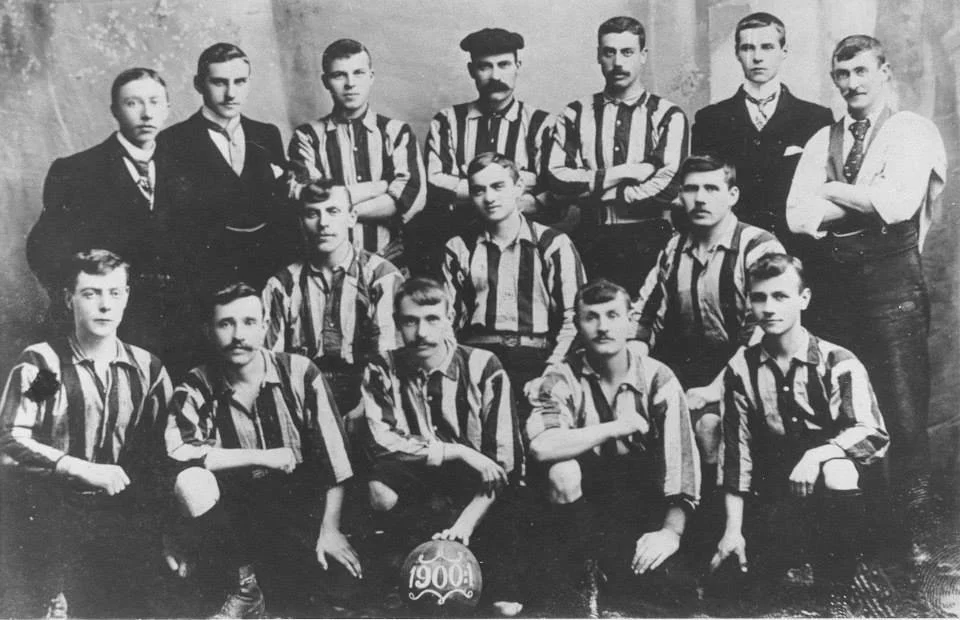
The Kirkwall Thorfinn FC team of 1900.
Photo Credit: Thorfinn FC
Thorfinn F.C.’s first game was played on Saturday 2nd May 1891. A team chosen by the Captain, John Dearness, faced a team chosen by E. Brough, the Vice-Captain. This type of game, played between members of the same club, were not particularly unusual in the Victorian period. Clubs were established as clubs to play football, so that’s what they did; there wasn’t necessarily a requirement to play fixtures against other clubs, although that did happen, of course.
A year after their foundation, Thorfinn played an interesting fixture against St Magnus. This match, played on 26th March 1892, was played under the Association rules and ended in a 0-0 draw. However, the Orkney Herald noted that “St. Magnus is a Rugby club, and have had little or no practice in playing the Association game”.
In 1894, a merger of the Stromness Cricket Club and Stromness Football Club created Stromness Athletic. It was agreed that this club would play both Association and Rugby Football.
Like many European sporting organisations, Stromness Athletic had departments for several different sports in addition to both codes of football, including cricket and tennis, and there was even a dramatic section.
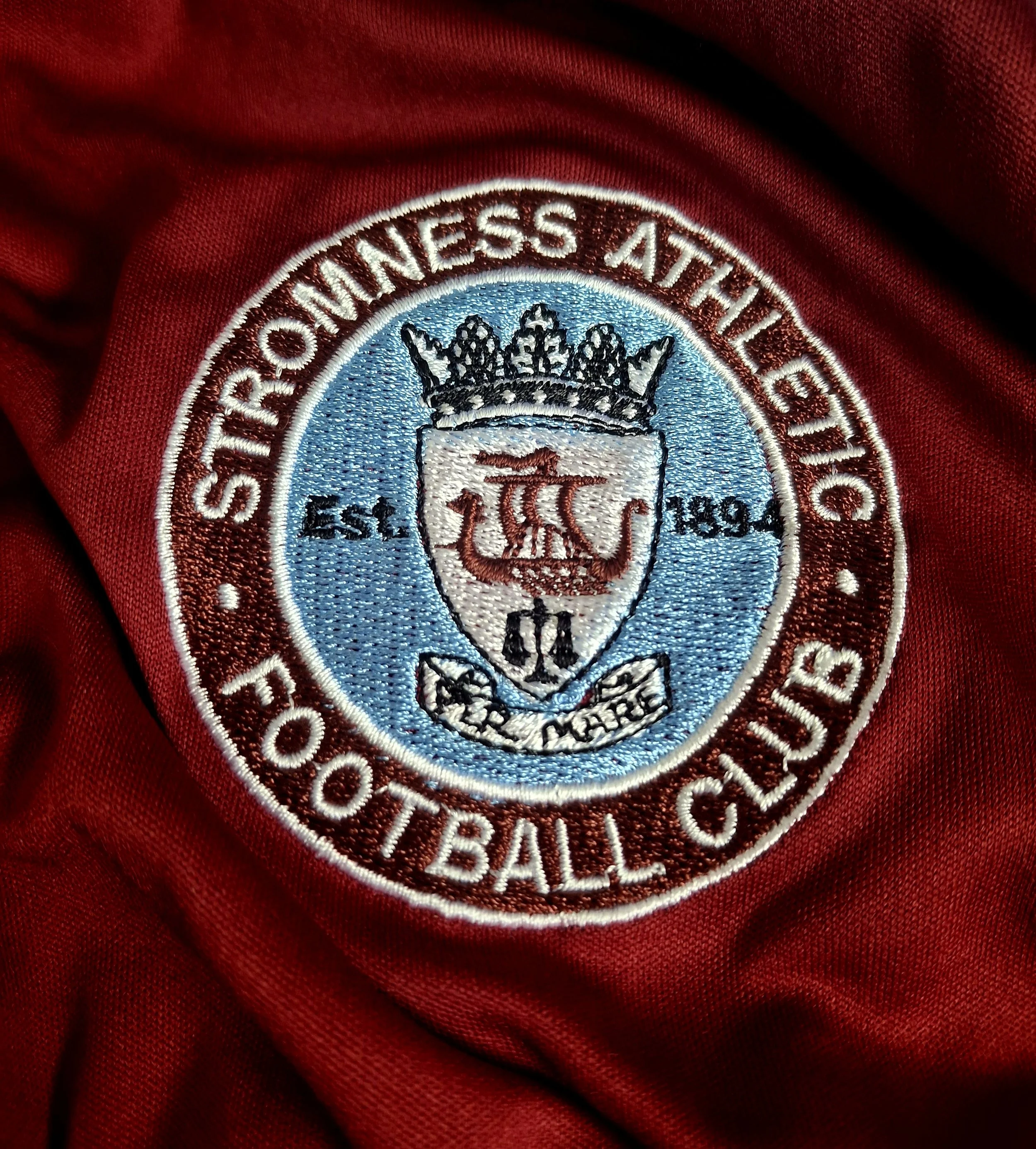
The claret and blue colours of Stromness Athletic FC.
Photo Credit: Andrew Newton
Orcadian interest in football even led to the formation, in 1900, of Norse Rovers Football Club, an Edinburgh-based organisation composed of Orkney lads resident in the Scottish capital.
The Orkney Herald of 3rd April 1907, describes a match between teams known as Rangers and Rovers. These were ‘selects’; teams made up of players from other clubs already in existence in Kirkwall. The Rangers team was composed of players from the Thorfinn and Britannia clubs, while the Rovers team consisted of players drawn from Norsemen and St. Magnus.
The following month, a team from Lerwick in Shetland played two games in Orkney, against Thorfinn and Stromness. This led to suggestions that there should be a formal contest between clubs from the two sets of islands with a cup or shield awarded to the winners. The following year, a team representing Kirkwall travelled to Shetland to play Lerwick in what was the first Milne Cup fixture.
This annual game is played to this day, having only been interrupted by the war years and Covid. An annual Rugby fixture between teams from Shetland and Orkney appears to have been played from around 1891.
This is how football appears to have been organised in Orkney throughout the Victorian period and up to the First World War. Fixtures consisted of friendlies, organised on a fairly ad hoc basis, between local sides, between teams drawn from the members of the same club, between ‘select’ teams drawn from several clubs, against teams from the various ships that were docked in the islands, or against teams visiting from elsewhere.
In 1901, there was great excitement when, as part of a larger excursion from Thurso, Thorfinn played Thurso Swifts, who had been Thurso League Champions the previous year. During the early 20th century Thorfinn, at least, played teams from Thurso, including Thurso Academicals, Thurso Britannia, and Thurso Swifts, on a fairly regular basis.
Football was most popular in Kirkwall and Stromness, the two main towns in Orkney. In 1910, a meeting was held at Stromness Town Hall, which led to the organisation of a local Stromness league, formed of three teams named ‘The Wanderers’, ‘The Rose’, and ‘1st Stromness’, the last of which was composed of members of the local Boy’s Brigade. It is possible that this was organised as an equivalent to the Kirkwall Challenge Shield, which was well-established by this time.
However, it took nearly another 10 years for an Orkney-wide league to be established. Following the grim years of the First World War, it seems that people’s appetite for the game had increased.
The Orkney Herald reported on the first game in the league, which took place on 1st November 1919 between Kirkwall City and Rovers and which took place at the Bignold Park, Kirkwall. City won 2-0. Late in the first half, D. Wooldrage scored with a header from a right-wing cross that hit the crossbar and crossed the line.
Just before the whistle went for half-time, there was a ‘scuffle’ in the Rovers goalmouth and J. Learmonth reacted quickest “with the result that the ball again found repose between the uprights”. The Orkney Herald report was quite critical of the standard, opining that “there is plenty of room for improvement in the art of combination” and that “a good deal of energy was wasted by players running all over the field” rather than sticking to their individual positions.
Seven teams entered the league in that inaugural season. These clubs were Stromness United, the Kirkwall sides Rovers, Kirkwall City, and Britannia, and three teams made of military personnel stationed in Orkney, RAF Houton, Lyness United, and Red Triangle Northern.
The trophy to be presented to the league winners was known as the Orkney Challenge Shield. The league proved popular; 500 spectators were in attendance to see Stromness United play Kirkwall City at the Market Green, Stromness drew sizeable and enthusiastic crowds wherever they went. Their support was rewarded at the end of the season as Stromness United became the first winners of the Orkney Challenge Shield.
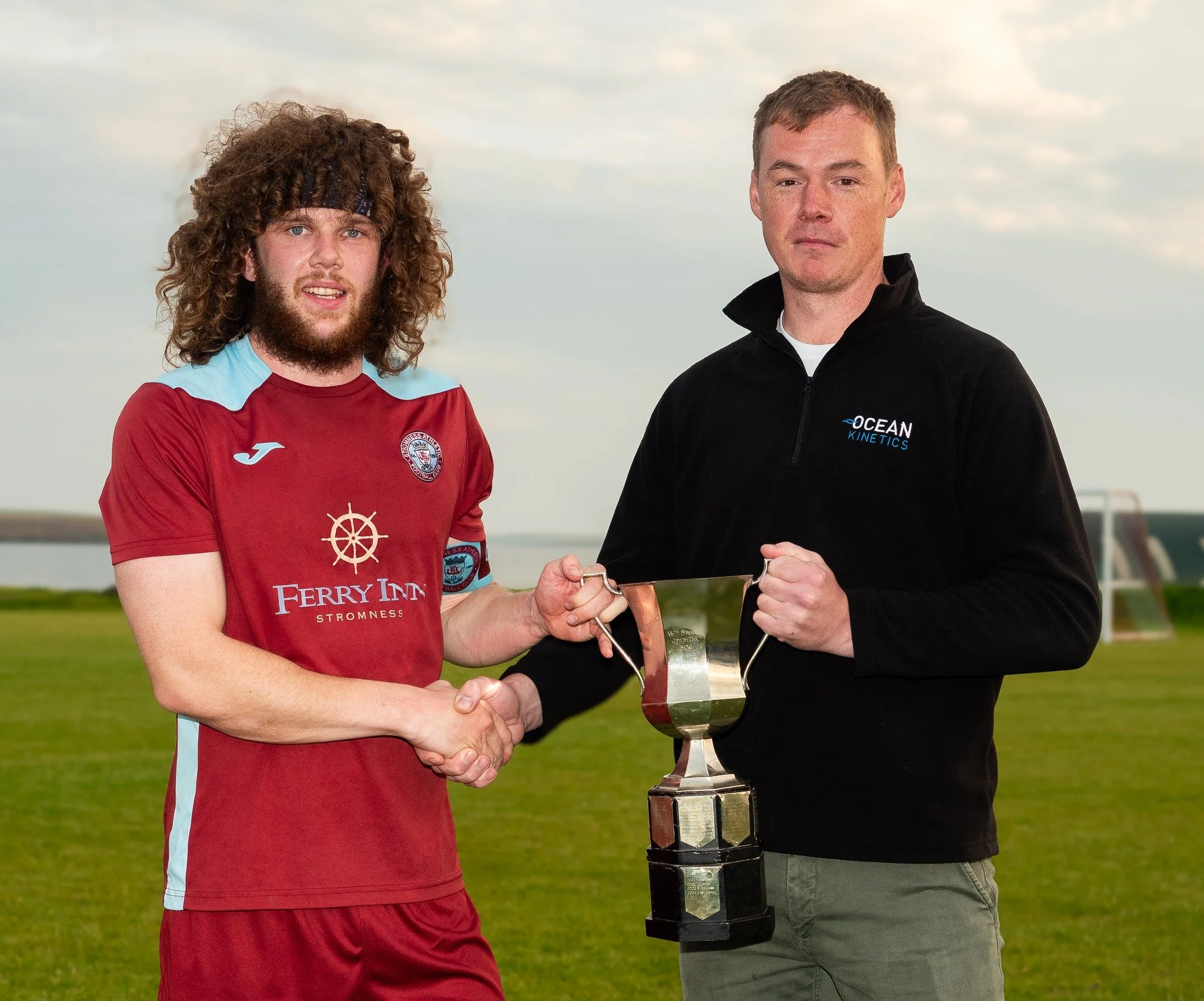
Captain of 2025 league champions Stromness Athletic, Toby McLeod, with the League trophy presented by Garry Stevenson of league sponsor Ocean Kinetics Ltd.
Photo Credit: Orkney Amateur Football Association
Today, the Orkney Football League consists of two divisions; a six-team A-League and a seven-team B-League. Like the Scandinavian leagues, the Orkney football season takes place during the spring and summer months.
The reigning champions are Stromness Athletic, who finished three points ahead of East United at the end of the 2025 season. South Ronaldsay were B-League winners, running away with the title, having won eleven and drawn one of their twelve league games. Of the 89 league seasons that have been competed, Kirkwall sides have won fifty-five.
Thorfinn are the most successful club in league competition, with 30 titles. Rovers have won fourteen and Hotspurs eleven. Dounby, however, are the second most successful club, with 18 league titles. Stromness have won only eight. Other clubs to have been named champions of Orkney are Rendall (three titles), Hatston (two titles), and Birsay, East United, and St Andrews (one title each).
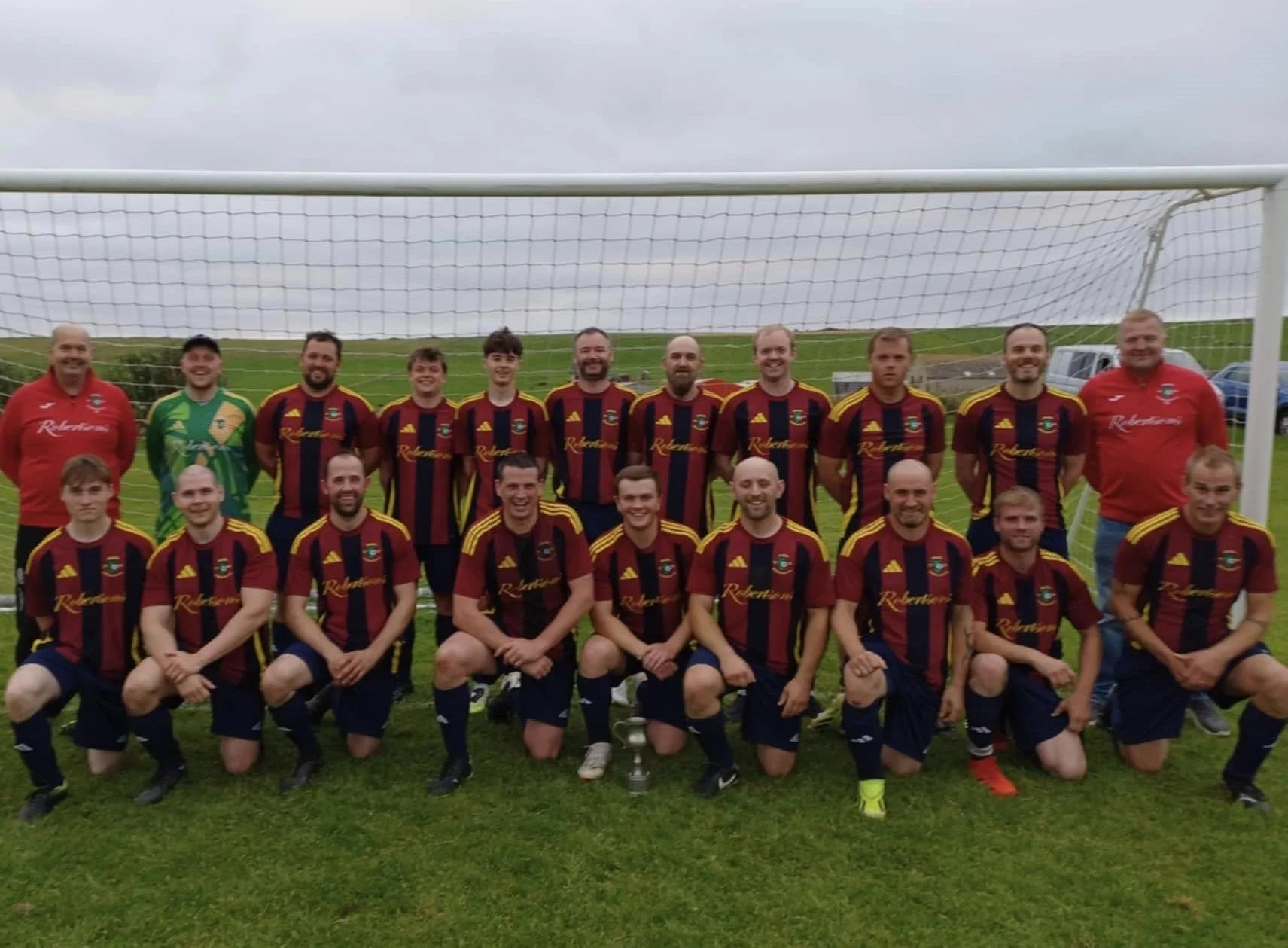
2025 B-League winners South Ronaldsay FC.
Photo Credit: Orkney Amateur Football Association
Although, as part of Scotland, Orkney technically comes under the auspices of the SFA, the Orkney league (and its under-18 and reserve equivalents) and as many as 12 domestic cup competitions, are organised by the Orkney Amateur Football Association.
The first clear documentary mention of this body comes from the Orkney Herald on the 24th March 1920, in an announcement stating that entries for the Shield (i.e. the second season of the league competition) should be in the hands of the secretary on or before the 27th March.
In addition to domestic football in the islands, the OAFA is responsible for the Orkney representative team. This team fulfils some of the functions of a national team but, as Orkney is part of Scotland, it is not affiliated with FIFA or UEFA, or even CONIFA.
Since 1913, it has been this team that competes against their Shetland equivalent for the Milne Cup, replacing the Kirkwall and Lerwick teams which originally played each other for the footballing honour of the two archipelagos. Between 1935 and 1967, the Orkney representative team also regularly played the Faeroe Islands for the Adam Shield. In 1968, a new competition, the North Atlantic Cup, was introduced and this would see Orkney, Shetland, and the Faeroes playing each other annually for the next five years. In the final year of this competition, Orkney beat the Faeroes to win it outright.
In 1985, the Orkney Island Games Association joined the International Island Games Association allowing them to participate in the inaugural Island Games, held on the Isle of Man. In 2001, the Orkney representative team made their debut in the men’s football competition of the Island Games.
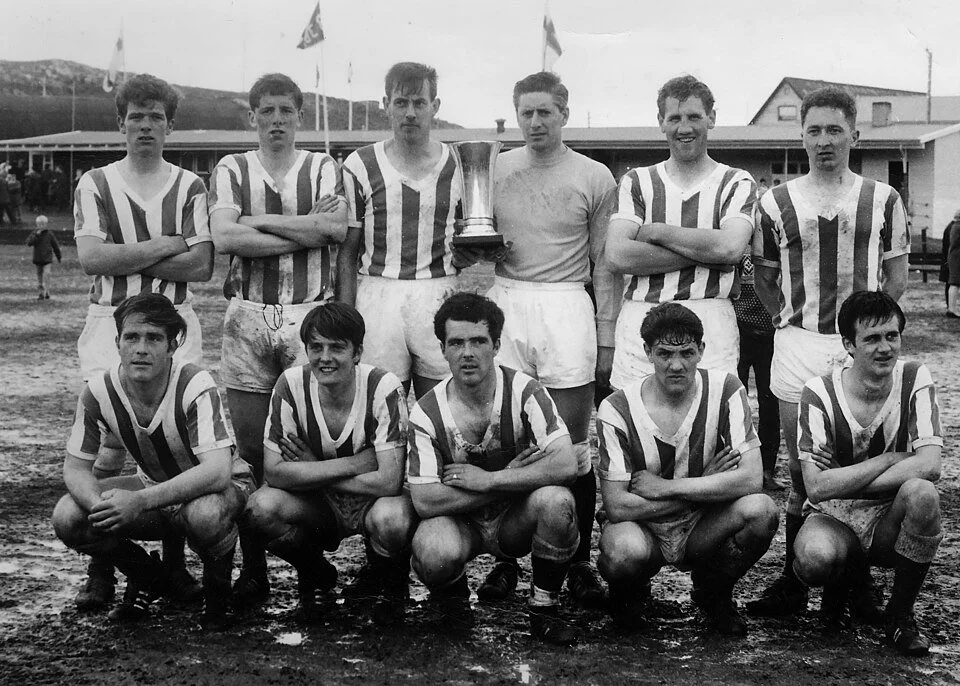
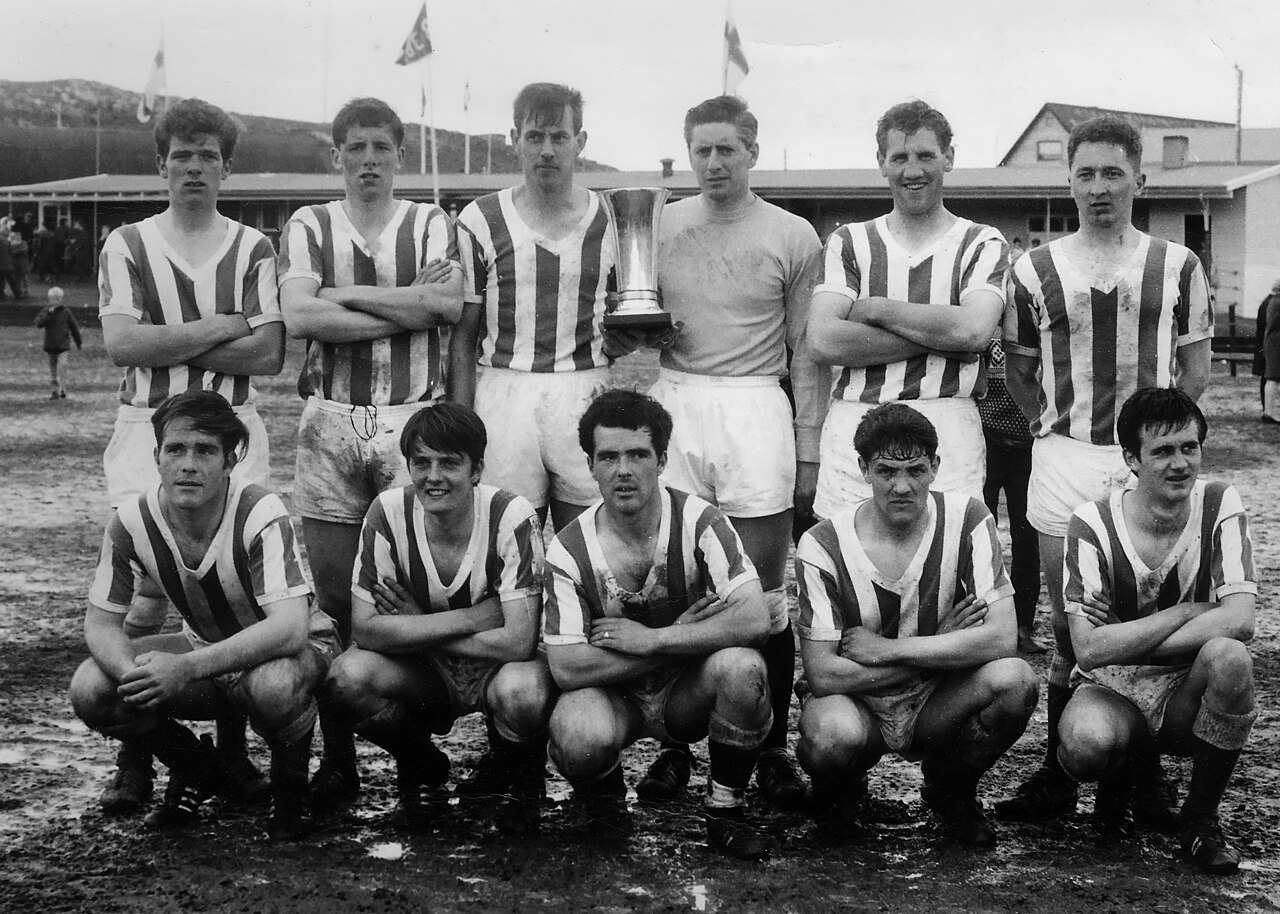
The Orkney Representative Team that faced the Faeroe Islands in their first North Atlantic Cup game in 1968.
Photo Credit: Wikipedia
In 2012, the OAFA sought to play further games against teams from the Highlands and Islands. It had long been their aim for Orkney’s footballers to be given greater opportunities to compete at a higher level in order to improve the overall standard of Orcadian football.
As a result, Orkney Football Club was founded for entry in the North Caledonian Football Association’s cup competitions. Ahead of the 2014/15 season, Orkney FC had become an entirely separate entity to the OAFA and gained full membership of the North Caledonian FA.
This meant that they became the first non-mainland club to play in the North Caledonian League and the most northerly senior football club in the British Isles. Orkney made an impact straight away, finishing as league runners-up and winning the Ness Cup in their first season. In 2017/18, Orkney won the league and cup double. They finished the 2024/25 season in 5th place.
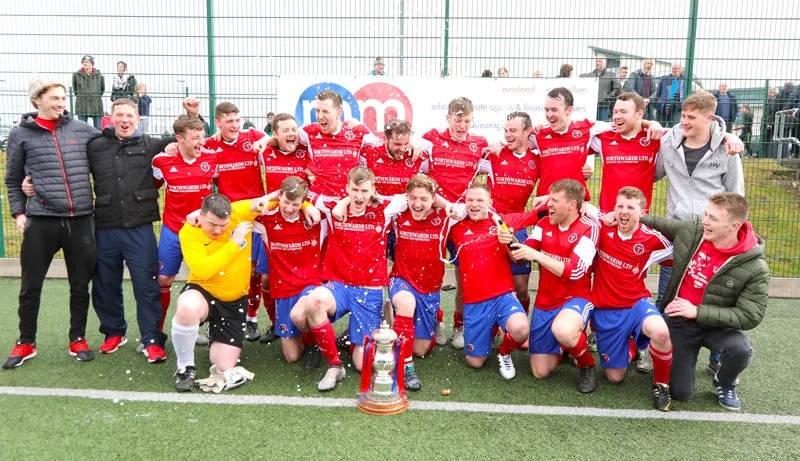
The Orkney FC team that won the North Caledonian League in 2018.
Photo Credit: Orkney FC
The existence of such an extensive and vibrant football scene in such a small place is truly astonishing. This should come as no surprise as almost everything about Orkney is astonishing. There are, however, some aspects of football in Orkney that are even more remarkable.
The strong uptake of both soccer and rugby in Orkney during the Victorian era might well be due to the presence of a significant pre-existing football culture in the islands.
The Kirkwall Ba’ is well-known as one of the UK’s famous games of mob football. The Ba’ game is certainly of some antiquity but its exact origins are unclear. The earliest reference to football in Kirkwall is in St Magnus’ Cathedral’s Session Book and dates to 7th December 1684.
It is sometimes claimed that the Ba’ originated during Scandinavian rule of Orkney. This is perhaps due to a myth based on the tale of Earl Sigurd Eysteinnsson in the Orkneyinga Saga. Sigurd travelled south to Scotland to meet a native ruler, Máel Brigte the Buck-Toothed, in battle.
Once he had defeated his enemy, Sigurd strapped Máel Brigte’s severed head to his saddle. When he spurred his horse, a tooth in the severed head scratched his leg and the wound became infected, killing Sigurd while he was still on Scottish soil. This story has developed in to the legend of Sigurd and Tusker, in which Sigurd is a young boy and the rival earl is known as Tusker.
In this version, everything is much the same except the young Sigurd manages to return to Kirkwall, with the severed head, before dying heroically at the Mercat Cross, next to St Magnus’s Cathedral. The people of Kirkwall were so enraged by his death that they kicked Tusker’s head through the streets in anger, thus beginning the tradition of the Ba’.
The two competing factions in this contest are the ‘Up-the-Gates’ and the ‘Doon-the-Gates’; often shortened to ‘Uppies’ and ‘Doonies’. Originally, the factor that decided which team you were eligible to play for depended on your place of birth, either north or south of Kirkwall’s Post Office Lane, a route which runs to the west from the Mercat Cross.
Birthplace is, however, no longer the deciding factor, mainly because people are usually born in hospital now, rather than at home. Another reason is Kirkwall’s geography; Doonie territory is limited by the harbour and so the town can only expand inland to the south, meaning that more people now live in Uppie territory. Family origins and historical allegiance is now the way an inhabitant of Kirkwall chooses their team.
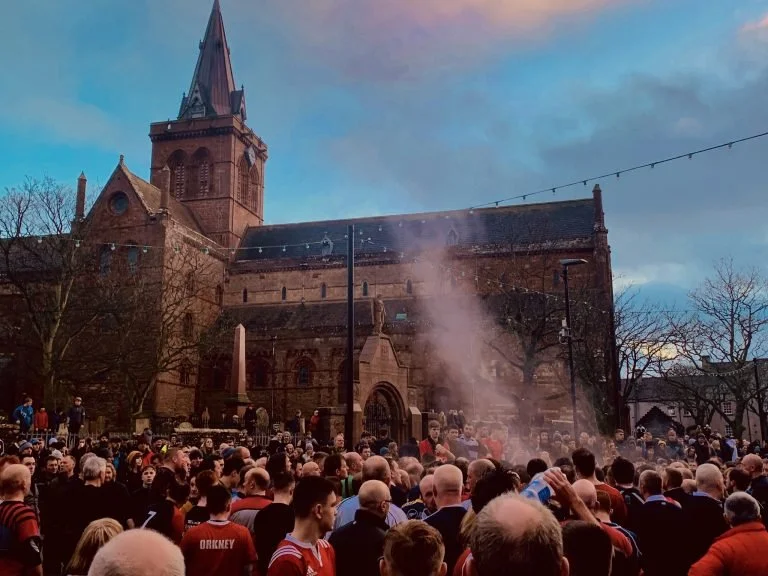
Waiting for the Ba’ to be thrown up.
Photo Credit: The Orcadian
The game is played on Christmas Day and New Year’s Day. At 1 o’clock in the afternoon, at the Mercat Cross, next to St Magnus’ Cathedral, the ball is thrown into the waiting throng, which can be as many as 350 men.
The aim for the Up-the-Gates is to take the ball to the gable end of a house, known variously as Mackinson’s, Sandison’s, or the Long Corner, at the point where Main Street joins New Scapa Road. This used to be the southern extent of Kirkwall.
In the past, other locations were used as goals for the Uppies, including points on Wellington Street and High Street, and a location called Burgar’s Bay. The Doonies aim to transport the ball to the sea and dunk it in the water at any point between Shore Street and Ayre Road, either side of the harbour.
The Uppies consider this to be an unfair advantage as the Doonies have a much wider area to aim for. In reality though, they usually end up putting the ball in the water in the inner basin at the harbour.
The game can last for hours; on New Year’s Day 1975 it took 7 hours for a goal to be scored; or it can be over in minutes, as it was on Christmas Day 1952 when the quickest recorded goal was scored after four minutes.
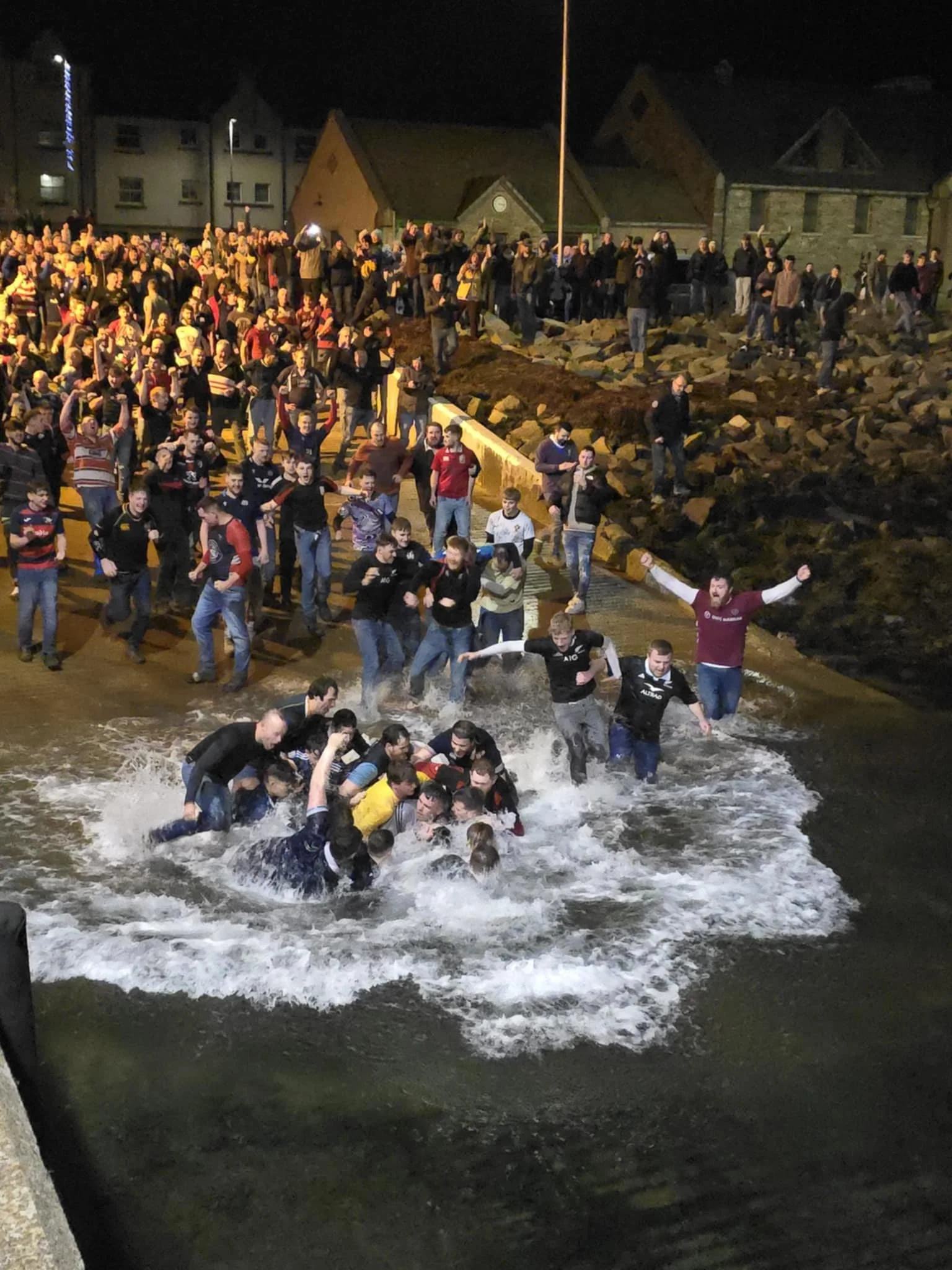
The Doonies wet the Ba’ in the harbour to win the Christmas Day Ba’ 2025.
Photo Credit: The Orcadian
A boy’s game for under 15s is also played and, for this, the ball is thrown up at 10.00am on the same days as the men’s game. At the end of World War II, a women’s game was played but only two instalments ever took place, on Christmas Day 1945 and New Year’s Day 1946. The game was discontinued due to public dislike and because it was ‘unladylike’.
The Ba’ hasn’t always been appreciated and several moves to ban it have been made. One such attempt was made in 1826 because ‘the inhabitants and community have been much annoyed and molested, and their persons and property hurt and endangered’.
On Christmas Day 1871, Kirkwall Football Club organised a game of rugby to start at the same time the Ba’ would start. The Uppies won by a goal to a try in what The Northman newspaper described as ‘more civilised’ in comparison to ‘the usual street riot’. Supporters of the Ba’, however, were not happy to have their game usurped and they vowed not to let it become diluted; the following year, the Ba’ was back to normal.
Nonetheless, another attempted distraction appears to have been made on Christmas Day 1891, when St Magnus Football Club and Thorfinn Football Club played a fixture on the same day as the Ba’.
Today, the game is popular and well-attended with plenty of participants. An article in the Orkney Herald from 4th January 1888, another period when the Ba’ was in rude health, suggests that during the late 1860s, it almost died out.
This was due to the fact that the Doon-the-Gates had such a long winning streak that the result was looked upon almost as a foregone conclusion. The article goes on to state that a few wins for the Up-the-Gates and an unspecified ‘half-failed attempt to ban the practise’ had given it a new lease of life.
The middle decades of the 19th century appear to have been a period of significant upheaval in the Ba’. It was in this period that the game changed from one in which the ball was kicked to one based on handling and carrying the ball (although kicking was still permissible).
An article in The Orcadian newspaper in January 1889 recalled what the game had been like in the 1840s, and described how one Uppie, James Mowat, could kick the ba’ the length of broad street and no one would try to pick it up. Writing in 1900, B. H. Hossack noted that, prior to 1850, ‘to have lifted the ball would have been very risky for the lifter; the ball was kicked or dribbled but never held, so it went all over the street or green’.
As the 19th century progressed, and Kirkwall became more built up, handling became more important, partly because it limited the risk of damage to properties but also because it made it easier to control the ball. This shift was almost universally accepted and reflected a trend also recognised in the traditional ball games of the Scottish Borders at about this time. In 1888, an attempt to curb handling was made by making the ball larger, and theoretically harder to carry, but the players soon adapted.
Even before the increase in size, kicking the ba’ would not have been done lightly. Those Orkneymen who routinely kicked the thing prior to the shift to a handling game must have been made of stern stuff. The current version of the ba’ weighs approximately 1.4kg and measures 22.6cm in diameter.
It is made of eight leather panels, alternatively black and brown in colour, stitched together using flax and tightly stuffed with cork dust, which used to be scraped from the grape barrels of local fruiterers but is now imported directly.
Each ba’ takes four days to make and four are made each year, two for the mens’ and boys’ games on Christmas Day and two for the games on New Year’s Day. The scorer of the winning goal in each game gets to keep the ball they scored with forever. This is a source of great pride and it used to be common for the winner to hang their ball in their front window for passers-by to admire.
The names of the scorers are recorded in the annals of the Ba’ and they pass into the folklore of the game. These winners achieve fame locally and, due to interest in the game from around the world, sometimes further afield; the winner of the Ba’ on Christmas Day 2003, Raymie Stanger, has been immortalised in English Heritage’s Played in Britain book series about the sports and games of the British Isles.
The names Barbara Yule and Violet Couper will forever be remembered as the first, and so far only, winners of the women’s Ba’. The most recent winners of the mens’ Ba’ are Danny Bain (Christmas Day 2025), a Doonie and the craftsman who made the ba’, and James Bailie (New Year’s Day 2026), an Uppie.
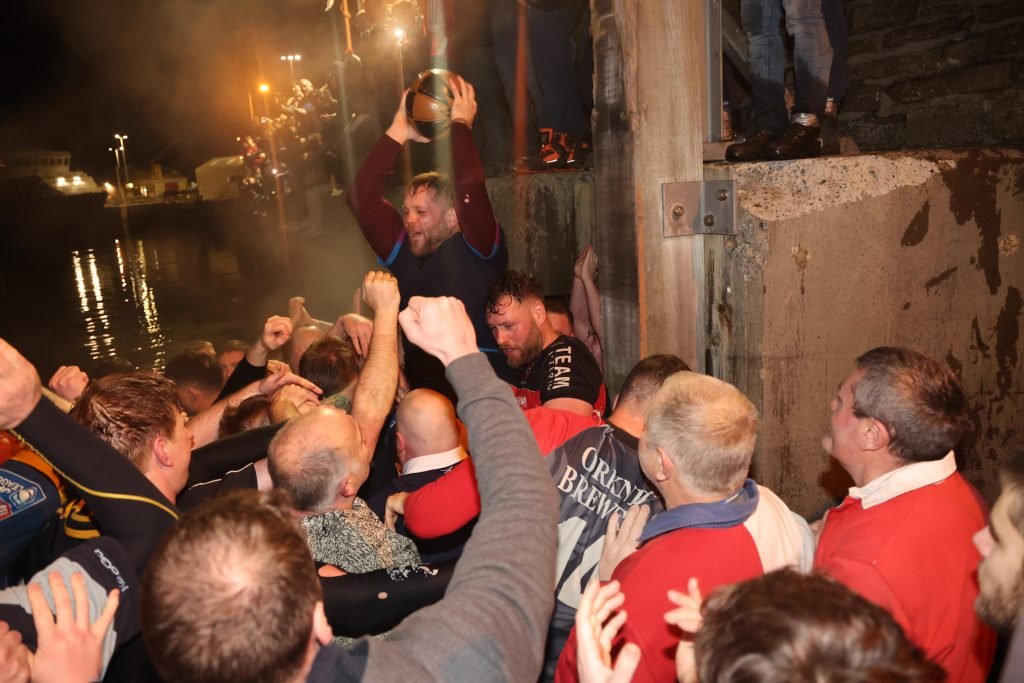
Danny Bain, winner of the 2025 Christmas Day Ba’.
Photo Credit: The Orcadian
The Ba’ might be thriving in the 21st century but it’s the sole survivor of a tradition of football that was popular and widespread in Orkney prior to the introduction of the codified Association and Rugby versions.
This game is often referred to as ‘Old Style Football’ (at least by Jockie Wood and John Robertson, the noted historians of Orcadian football) and was played in virtually every Orkney parish and island during the 19th century. It generally took place on Christmas Day or New Year’s Day at an appointed location in each parish.
In Birsay, this was the Palace Green; in Harray, it was a field opposite the Post Office and known as ‘Jobel’; in Westray, where the game was played between men from the south end of the island and men from the north end of the island, the game was played on the links north of Pierowall.
The Orkney Herald of 11th January 1870 reports on a game played at North Walls where ‘the young men of the parish turned out and played a keenly contested match at foot-ball’. The game began at 11am and lasted for four hours. Fortunately ‘abundant refreshments were on the ground, which added spirit to the match’.
Football also appears to have been played at other times- on Thursday 15th September 1870, The Band of Hope Organisation organised an excursion for young members to play sport in South Ronaldsay, including football.
‘Old Style Football’ was, like the Ba’, a fairly violent affair, with no limit on numbers. The only generally agreed upon rule appears to have been a prohibition on ‘lifting’ of the ball; in short, it was a kicking game, not a handling one. By the 1890s, however, newspaper reports from Orkney begin to suggest that this form of football was decling.
The introduction of the more organised, modern versions of football appears to have had an impact on the existence of ‘Old Style Football’ although it seems to have clung on in the more rural parts of the islands, with Rugby and Soccer initially being a game played mainly in the towns.
Jockie Wood, author of the book Birth, Blood and Boundaries, suggests that the widespread enthusiasm for this type of football, in each and every parish in the islands, laid the foundations for one of the most unique Association Football competitions in the world.
That competition is the Orkney Parish Cup, a knock-out competition with each round, with the exception of the final, played over two legs. The competition is run by the OAFA but its participants are not the clubs that compete in the Orkney Football League and the other cup competitions.
This competition is played between teams representing the different parishes of Orkney. These parishes are the result of land divisions which have been in existence for centuries. Parish names in existence today can be found in the Orkneyinga Saga, albeit usually rendered in their original Scandinavian spelling, or close to it.
Sandvik, Orfjarao, and Rognvaldsey, for example, which appear in the saga, can be identified as the parishes of Sandwick, Orphir, and South Ronaldsay. These are, therefore, areas whose antiquity can be traced back well over 1000 years.
Each parish consists of various districts and ‘tounships’. There are 13 parishes on Mainland and each of the larger islands, such as Sanday, Westray, and Stronsay, constitutes a parish in its own right. There are two parishes, Hoy and Walls, on the island of Hoy.
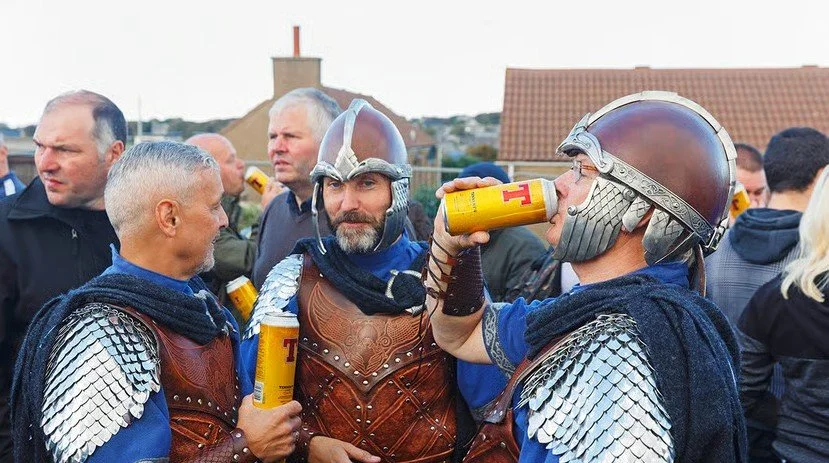
Viking re-enactors in modern-day Orkney.
Photo Credit: The Economist
To represent a parish at football you have to meet the eligibility criteria. The rules of the Parish Cup state that either a player must have been born in the parish, or his mother’s usual address, as recorded by the register of births, must have been in the Parish for which he plays.
As most people are born in hospital in Kirkwall these days, the rules had to be amended slightly to incorporate the mother’s address component but this ensures that players play for their home parish. The only other way to qualify is through residence, and for this a player must have been resident in the parish for three consecutive months immediately prior to and at the time of playing.
This ensures that players can’t flit from parish to parish and they must prove that they are an established presence in the community before they can represent it. There have been occasional confusions and complications regarding eligibility, leading to close scrutiny of maps showing the parish boundaries and, on one occasion at least, team officials resorting to tape measures to determine precisely which parish one player’s house was in.
The Parish Cup was introduced in 1929, 10 years after the foundation of the OAFA and the Orkney Football League. A significant event in the concept of representing your home parish may have come following the successes of Orphir Wanderers, a club team from a parish in the southern central part of Mainland, in the mid 1920s.
The Thornley Binders Cup was a knock-out competition for the member clubs of the Orkney League, with a trophy provided by Thornley Binders, a local business that produced chemicals from seaweed. In 1924, Orphir Wanderers won this competition with a team composed, with one exception, of men from Orphir parish.
They retained the trophy in 1925 but, keen to build on their success, they had recruited a number of players from beyond the parish. This led a local newspaper reporter to lament that “it would have been better if they had restricted their team to local lads”.
At the same time, however, the enthusiasm for football in Orkney meant that teams were popping up all over the islands. Some parishes even had their own internal leagues, in which the different districts of the parish competed against each other.
This football rush also led to the organisation of teams representing the different parishes. Games between parishes were organised on a friendly basis. However, following the success, in 1929, of the three team league in the parish of Holm, footballers from this area suggested a formal competition between teams representing the individual parishes of Mainland.
Given the number of inter-parish matches already being played, it seems that it was a popular idea. Seven teams signed up for the first edition, which in its first season only was a one-legged knock-out affair.
Appropriately, as it was their idea, the first winners were Holm, who beat Deerness 3-2 in the final. The competition was not played between 1940 and 1945, due to the Second World War, or in 2020, due to Covid 19.
Sandwick, a parish in the western part of Mainland are the most successful parish, with 23 wins and a further 8 appearances in the final. St Ola, the parish around Kirkwall, are second in the all-time list of winners with 14 wins and 15 losing final appearances. Harray, from the central western part of Mainland are the third most successful parish having won the cup 11 times and appeared in the final a further 10 times.
The most successful of the island parishes is Shapinsay, who have lifted the Parish Cup on 5 occasions and lost in the final 3 times. The first winners, Holm, are the current holders; they beat Sandwick 4-2 in the 2025 final. Of their 8 Parish Cup triumphs, 4 have come since 2021. The only time in that period that they haven’t won was in 2023 when Westray beat Stenness in the final by a single goal.
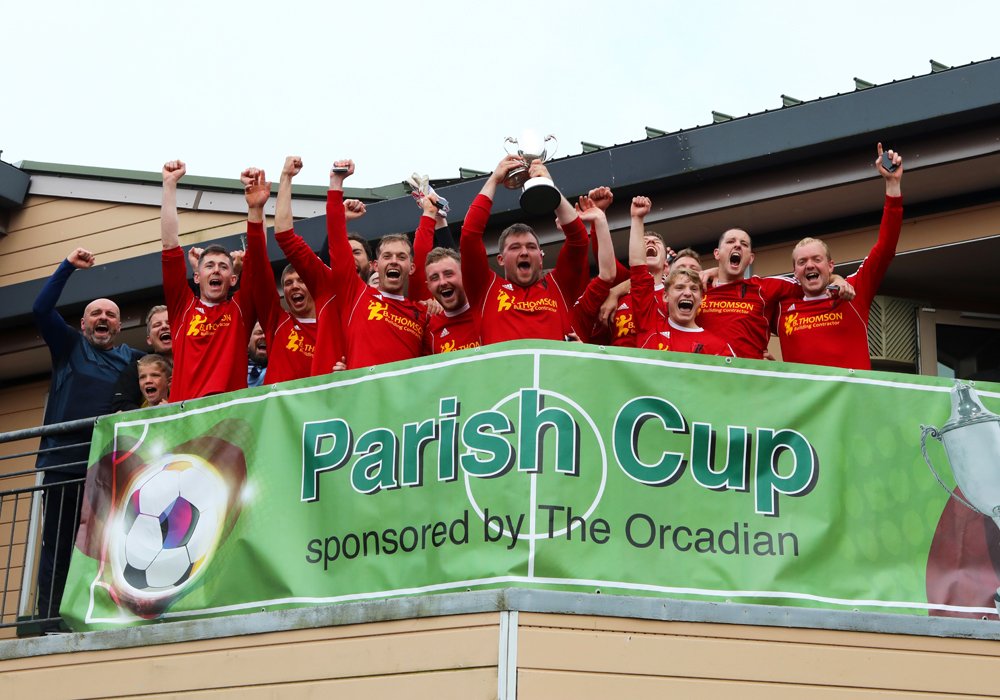
Holm lift the 2021 Orkney Parish Cup.
Photo Credit: The Orcadian
With the possible exception of the Ba’, the Parish Cup is the competition which captures the imagination, engages the emotions, and raises competitive spirit most in the Orkney Islands. Parish Cup matches are better attended than any other sports event, including the representative team’s games against Shetland.
Many of those who go to watch Parish Cup games don’t attend any other football and it’s always advised to arrive early due to the large crowds that these games attract.
With its specific eligibility rules and the importance it has to the people of Orkney, the Parish Cup is something special. It is a competition in which you represent your own locality, the land in which you grew up, and, often, the land from which your forebears hailed. By playing in the Parish Cup a player has an almost unique opportunity in football; to truly represent his roots and to become a real local hero.
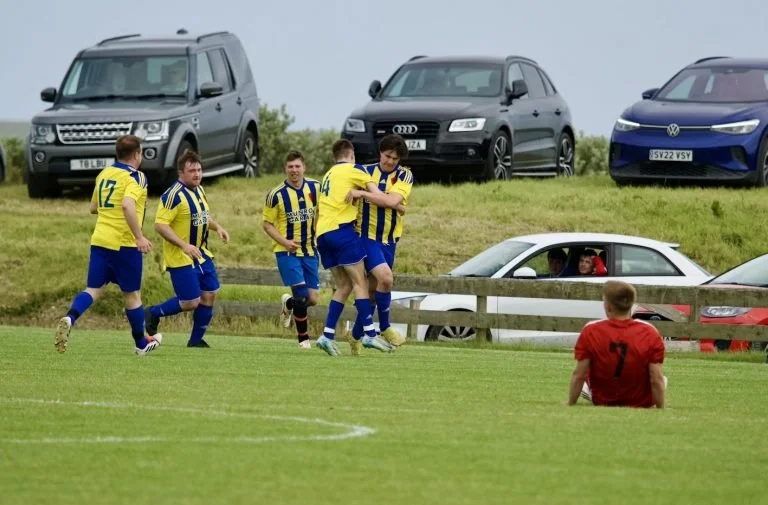
Holm's Finn Hancock celebrates his goal in a 2-0 win in the first leg of their 2025 semi-final meeting with St Andrews.
Photo Credit: The Orcadian
The unique character, geography, and demographics of Orkney mean that through an obscure annual tradition and through something as mundane as amateur football, the lives of its living men can be turned into legend.
Go to Orkney, experience it, understand its history and society, and walk amongst its legends, whether those are legends made a thousand years ago with axes and swords made of iron or legends made a few weeks ago with a ball made of leather.
Many thanks to the Orkney Amateur Football Association for their help answering questions for this article and for their permission to use images from their Facebook page.
The ultimate source regarding the history of the Orkney Parish Cup is Jockie Woods’ book Birth, Blood and Boundaries.
The supreme authority on the history of the Kirkwall Ba’ is John Robertson’s The Kirkwall Ba’: between the Water and the Wall.