

Words and Photos by Tomasz Kosiński | Published 20.05.2026I was inspired to write this article by my recent trip to Italy, during which I visited several places in Lombardy, a region regarded as the economic heart of the country. It is not hard to see that the economic strength of this area is also reflected in football. Several clubs from this region regularly compete at the highest level of the Italian pyramid.
Lombardy lies in northern Italy and has remained one of the driving forces behind the country’s development for decades. It is home to Milan, the country’s financial and industrial capital, and one of Europe’s most important cities. As early as the 19th century, the region became part of the so-called Italian industrial triangle, comprising Milan, Turin and Genoa.
Heavy industry, the automotive sector and the textile industry flourished in these centers. Thanks to an extensive transport network, its proximity to the Alps and easy access to European markets, Lombardy quickly rose to become one of the continent’s most important industrial regions. To this day, the region is regarded as a symbol of Italian enterprise, work ethic and a modern economy.
In the shadow of Milan, other cities also flourished: Bergamo, Brescia and Como. Factories, craft workshops and family businesses sprang up there, which over time grew into major companies. This dynamic development gave rise to a strong working class and an ambitious middle class.
Alongside modern industry, local communities and civic pride emerged. In such conditions, a sporting culture naturally developed, particularly football. Clubs became more than just teams — they were a symbol of the city, a meeting place for residents and a part of local identity.
Bergamo lies about 50 kilometers north-east of Milan. The city itself has a population of just under 120,000, but the entire province has over a million inhabitants. It is a medium-sized city, but one of far greater significance than its population figures alone would suggest.
The most distinctive feature of Bergamo is its division into two parts: the Upper Town (Città Alta) and the Lower Town (Città Bassa). The Upper Town, situated on a hill and surrounded by Venetian defensive walls, has retained its medieval and Renaissance character. The Lower Town developed later — particularly in the 19th and 20th centuries, as Bergamo increasingly entered the industrial era.
The city’s history dates back to ancient times. The first settlements existed here as far back as the Iron Age Celtic era, and later Bergamo was incorporated into the Roman Empire. For centuries it was an important trading centre, but the real turning point came only in the 19th century with the industrialization of northern Italy.
Textile factories, metalworks, mechanical workshops and construction firms began to spring up in the city. To this day, Bergamo remains a major industrial centre in the region. Economic development attracted workers from the surrounding rural areas, and with them came the growth of new residential districts and transport infrastructure.
It is worth remembering that the local labour movement had two sides. Alongside socialist currents, Catholic circles and organizations linked to the Church maintained a strong position.
This blend of class solidarity, religion and pragmatism aptly reflected the character of the city. During the Second World War, both the communist Brigate Garibaldi and the Catholic Fiamme Verdi were active in the Bergamo area and fought against Italy’s fascist regime. Even then, the local resistance took various forms, yet shared a common goal. In the 20th century, local identity often proved more important than grand ideologies imposed from outside.
After the Second World War, Bergamo, like the rest of Lombardy, developed rapidly. The traditional textile industry gradually gave way to modern manufacturing, services and technology. The city, however, retained its hard-working, disciplined and strong local character.
Atalanta remains the club most closely associated with Bergamo. In many ways, its history mirrors that of the city itself — from a provincial town to a place recognized throughout Europe.
Atalanta was founded on 17 October 1907 by a group of students from the Paolo Sarpi high school. The club’s name derives from Greek mythology and refers to Atalanta — the legendary runner symbolizing speed, determination and the spirit of competition. This is also the origin of the nickname La Dea, meaning “The Goddess”.
The club’s origins also had a social dimension. Atalanta was a project initiated by young people from Città Bassa who wanted to create their own sporting space, independent of the elite circles associated with Città Alta. Football thus became not only a game but also a form of civic identity.
In 1920, the club merged with Bergamasca di Ginnastica e Scherma. The new entity adopted the name Atalanta Bergamasca Calcio and the black-and-blue colors, which remain the club’s hallmark to this day.
In 1928, a new stadium was opened under the name Stadio Mario Brumana; after the war, it was renamed Stadio Comunale, and today it is known as Gewiss Stadium. A few years later, in 1937, Atalanta were promoted to Serie A for the first time.
After the Second World War, the club earned a reputation as a stable mid-table side and was nicknamed the ‘Queen of the Provinces’. The greatest success of that period was winning the Coppa Italia in 1963 following a 3–1 victory over Torino in the final.
Over the following decades, Atalanta regularly fluctuated between Serie A and Serie B, but at the same time consistently invested in youth development. The training centre in Zingonia eventually grew into one of the most highly regarded football academies in Italy. It was there that many players developed, going on to enjoy careers in Serie A and the national team.
A new era began under Antonio Percassi and the appointment of Gian Piero Gasperini in 2016. The manager transformed the team’s style of play, basing it on intense pressing, courage and modern tactical organization. The results came quickly: top-three finishes in Serie A, regular appearances in the Champions League and a rise to the forefront of European football.
The greatest success in the club’s history came on 22 May 2024. In the Europa League final in Dublin, Atalanta beat Bayer Leverkusen 3–0, winning their first international trophy.
The history of Atalanta’s supporters is inextricably linked to the identity of Bergamo itself — a city built on a work ethic, local pride and a strong attachment to its roots. From the very beginning, the club represented the city’s residents, particularly those from Città Bassa, who wanted their own symbol as a counterpoint to the more elite circles of Città Alta.
Football quickly became an important part of social life in Bergamo. As early as the beginning of the 20th century, matches drew crowds, and the stadium was not only a venue for sporting competition but also a space for gathering and expressing a sense of community.
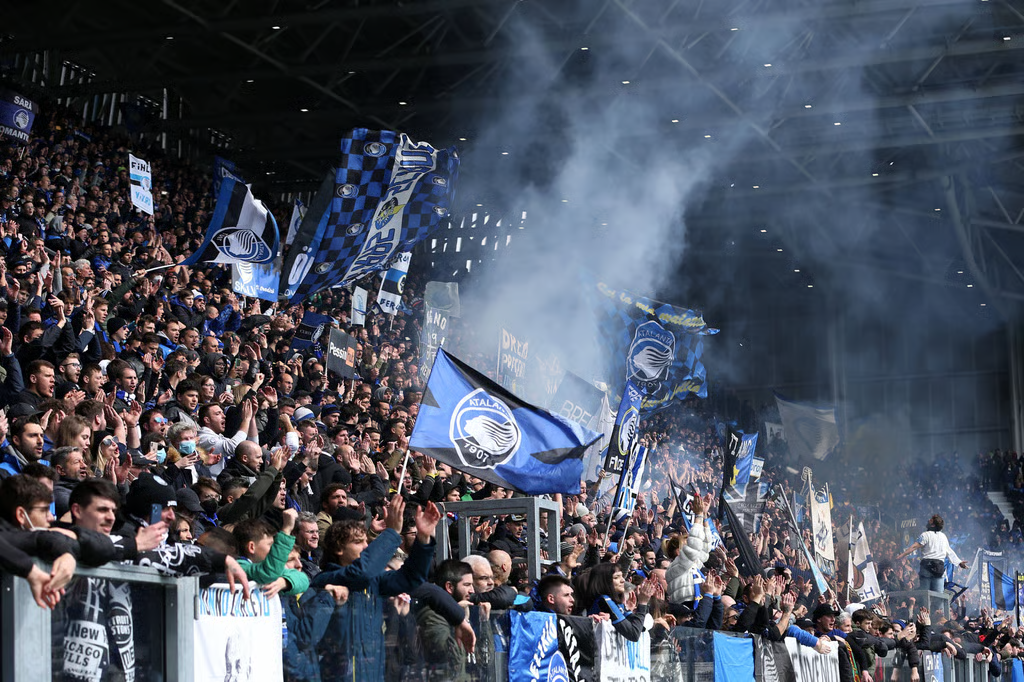
The modern ultras movement was born here in the early 1970s, during a period of rapid social change in Italy. For many young people, the stands became a place of expression, loyalty and rebellion against the established order. One of the first significant groups was the Atalanta Commandos, founded after an away match in Verona in 1971.
Over time, the Curva Nord became the heart of the stadium and a symbol of Atalanta’s fan identity. The following decades brought new groups, internal divisions and political differences, but one value remained paramount: unconditional devotion to the club and the city. Among the most recognizable groups were the left-leaning Brigate Nerazzurre and Wild Kaos, formed in the late 1980s, which eventually came to sympathize with the regionalist Lega Nord. In Bergamo, support has never been merely an accompaniment to the spectacle — it has been an integral part of the local culture and a source of daily pride for the residents.
In 1998, the Curva Nord 1907 group was formed, which dominated the stands for years to come. One of the most recognizable figures in this community was Claudio Galimberti, known as ‘Il Bocia’, regarded by many as a symbol of Bergamo’s football fandom.
Atalanta’s ultras became famous not only for their displays and fanatical support, but also for cherishing their own traditions. One of the most distinctive events is the Festa della Dea — a pre-season fan festival during which the team meets with the local community and new players are officially presented to the fans. It is a blend of a local festival, a football celebration and a demonstration of loyalty to the club’s colors.
Atalanta’s ultras have also become renowned for their community involvement. During the COVID-19 pandemic, they were actively involved in helping the local community, supporting hospitals and taking part in voluntary work.
At the same time, this community has maintained a reputation for being tough, uncompromising and highly organized. Atalanta fans are regarded as people who are proud of their identity, intolerant of hypocrisy, the commercialization of football, and outside attempts to impose rules on them.
Bergamo is a city where medieval walls meet industrial history, and local pride permeates everyday life. Atalanta has become a natural extension of this character — a combative, disciplined club, faithful to its roots.
This time, I wasn’t able to watch the match at the stadium in Bergamo. While Atalanta were playing Juventus, I was fulfilling another childhood football dream — I was at San Siro. But that’s just another reason to return there one day.
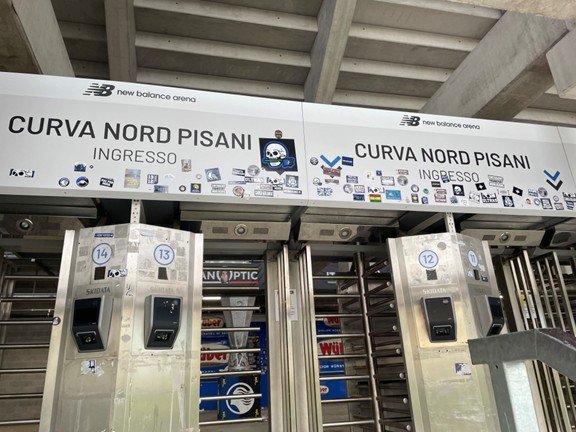
Entrance to the Curva Nord at Stadio Atleti Azzurri d'Italia.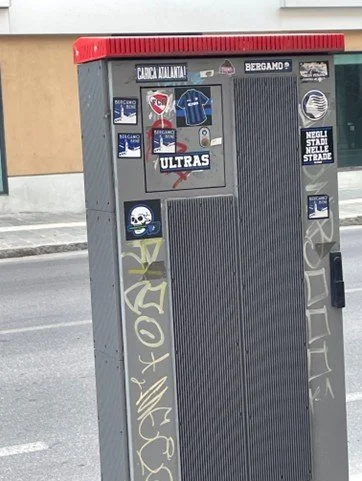
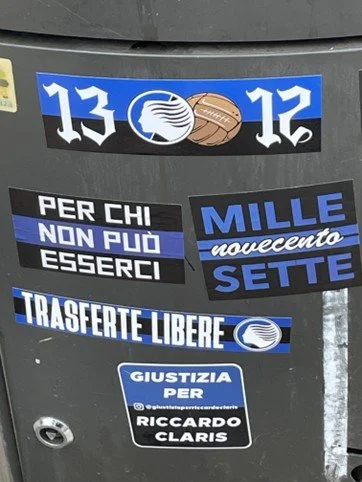
You can find Atalanta stickers everywhere in the city.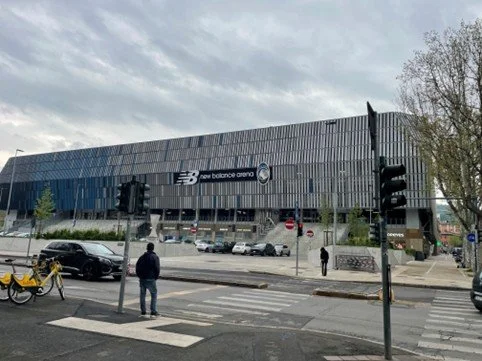
The old facade of Atalanta's home ground.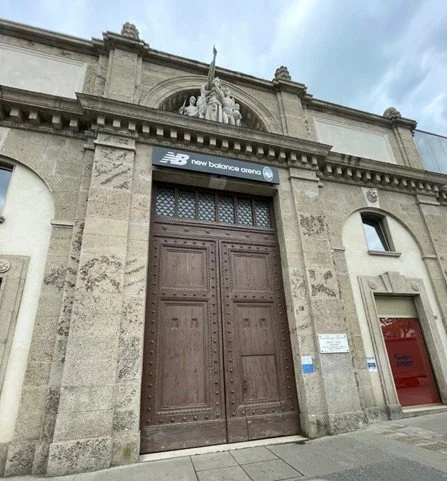
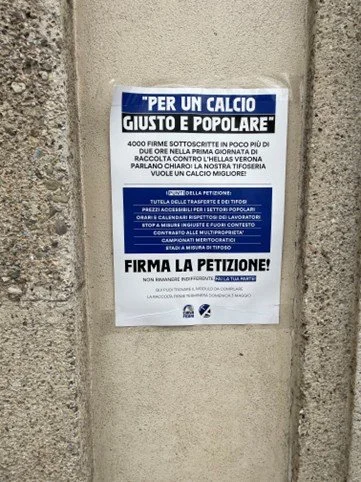
Atalanta fans support country-wide protests against the commercialisation of football.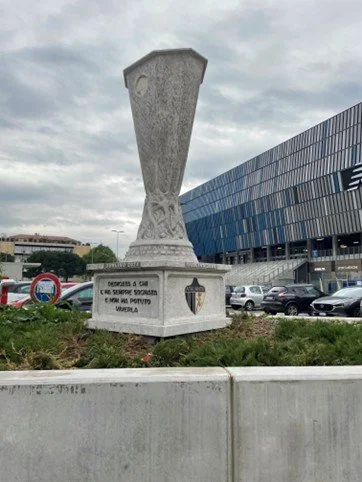
A monument to Atalanta's greatest success - winning the 2024 Europa League.