

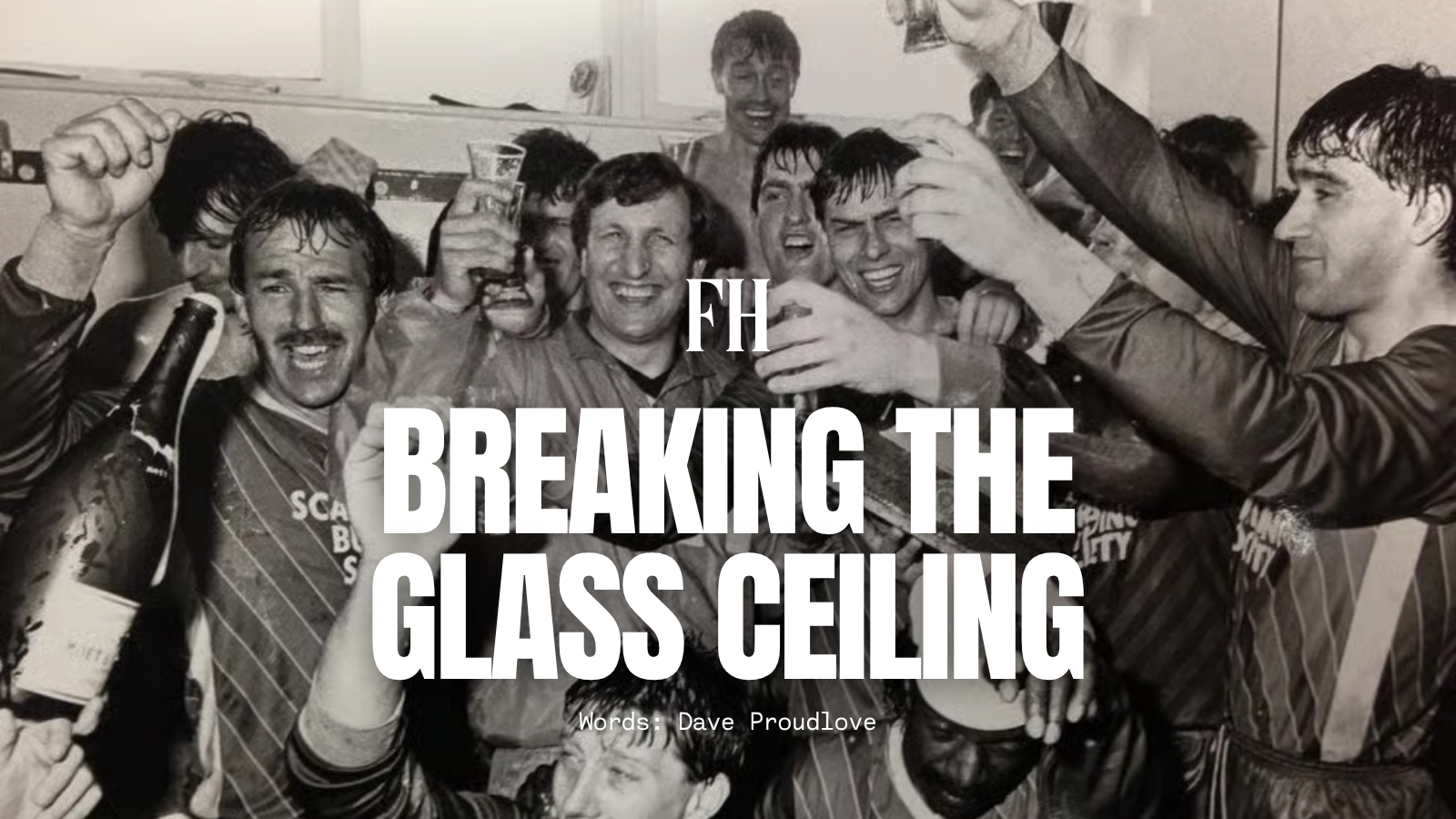
Words by Dave Proudlove | Published 13.11.2026There are football seasons that belong to champions, seasons that belong to great teams and seasons that belong to moments when the structure of the game itself changes. The 1986-87 season was all three.
At the top of the Football League, the Everton team that Howard Kendall built became champions. New play-offs were introduced to reshape promotion battles. English football was beginning to emerge, slowly and painfully, from the aftermath of the Heysel disaster and the financial turmoil of the mid-1980s.
But further down the Football League, something far more revolutionary was happening.
For generations, the Football League had virtually been a closed shop. Non-League clubs could dream of joining it, could win their competitions, could build better teams and could even establish themselves as the strongest side outside the League. But there was no sporting guarantee that any of it would be enough.
Then came 1986-87 and Scarborough.
Led by a young, ambitious and already highly distinctive manager called Neil Warnock, Scarborough won the GM Vauxhall Conference title in 1986/87 and in doing so, became the first club to gain automatic promotion into the Football League from the non-League game.
It was the breaking of a glass ceiling. And behind that achievement was one of the most significant institutional changes in the history of English football: the abolition of the re-election system.
To understand what Scarborough achieved, it is necessary to understand what came before.
For most of the Football League's history, the boundary between the Football League and non-league football was not a sporting ladder in the modern sense.
There was no properly integrated pyramid in which success at one level automatically opened the door to the next. The Football League was, in effect, a members' club.
The system of re-election had existed almost from the League's earliest years. By the time the Fourth Division was established in 1958, the bottom four clubs were required to apply for re-election to the Football League each summer, while non-league clubs could also apply.
The Football League's existing members then voted on who should retain or gain membership.
It created a curious situation. A club could finish bottom of the League and remain in it. A club could finish top of the leading non-League competition and remain outside it. There was therefore a glass ceiling above the non-league game. It was not necessarily visible, but it was real.
The system was particularly frustrating for ambitious non-league clubs because sporting achievement alone could not determine their fate. A club needed to secure votes.
Altrincham's experience became one of the great symbols of that frustration. In 1980, after winning the Alliance Premier League, they narrowly missed out on election to the Football League, receiving 25 votes to Rochdale's 26.
For clubs outside the League, the message was unmistakable: you could be the best on the pitch and win the championship and still be told that you were not wanted.
That was the system that was finally dismantled in 1986.
The change was revolutionary. From the 1986-87 season, the champions of the then GM Vauxhall Conference would be promoted automatically to the Fourth Division, provided they met the necessary ground requirements.
At the other end, the bottom Football League club would be relegated. For the first time, the door was genuinely open, and Scarborough were the first club to walk through it.
Scarborough were not an obvious Football League club. The seaside town had a proud footballing history, but Scarborough FC had spent the preceding years in the Alliance Premier League without threatening to dominate it.
In 1985-86 they had finished only 15th, with 40 points from 42 games.
But then came Neil Warnock.
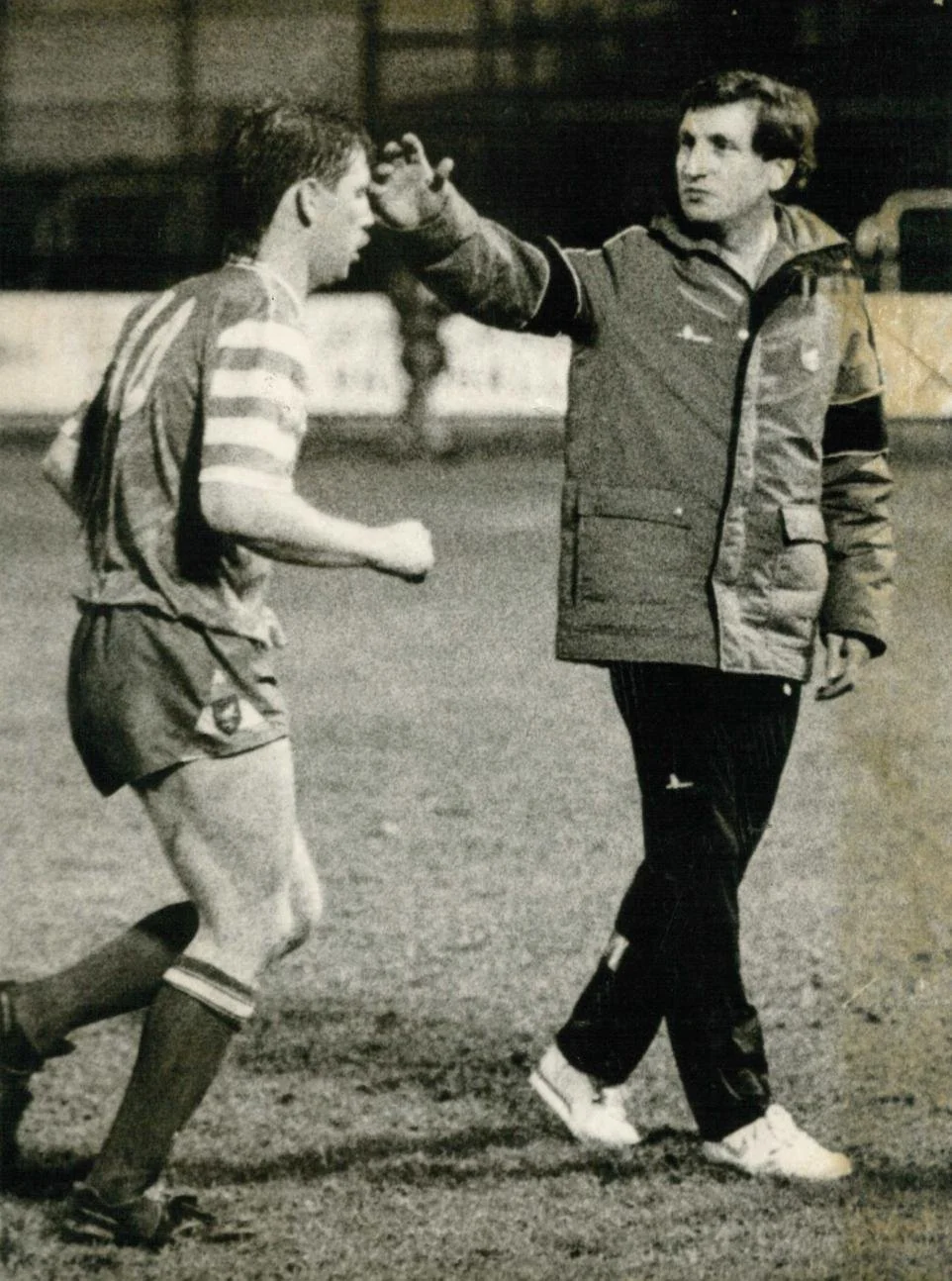
Neil Warnock was just setting out on his managerial journey when he took the reigns at Scarborough.
Photo Credit: Northern Echo
Warnock had begun his managerial career at Gainsborough Trinity and had subsequently managed Burton Albion. His appointment at Scarborough represented another step in the career of a man who would eventually become synonymous with promotion.
He was not yet the Premier League personality familiar to later generations. There was no eight-promotion record. No television celebrity. No reputation for theatrical touchline performances. But the essential Warnock was already there.
He understood footballers. He understood dressing rooms. He understood motivation. Above all, he understood that promotion was not achieved by simply assembling the most talented players. It was achieved by creating a group that believed it could win.
Decades later, Warnock repeatedly identified the Scarborough dressing room as one of the foundations of his managerial career. The players remembered the camaraderie, humour and determination that characterised that group. That was a culture that translated into results.
Scarborough began the 1986-87 season with a simple opportunity that had not existed before.
If they were good enough, they could go up.
There would be no election. No lobbying or chairmen to persuade. No annual meeting where their fate would be determined by the preferences of other clubs. Instead, and for the first time, the league table would decide.
And Scarborough proved emphatically that they were good enough. Over 42 Conference matches, they won 27, drew 10 and lost just five. They scored 64 goals and conceded only 33, finishing on 91 points. Barnet were runners-up on 85.
Six points may sound modest by modern standards, but the achievement was substantial. Scarborough were not simply the beneficiaries of a rule change, they were also the best team in the competition.
Their defensive record was particularly impressive. Across 42 league games they conceded fewer than a goal a match. At the other end, they possessed enough attacking quality to turn consistency into dominance.
Stewart Mell was their leading league scorer with 16 goals, while the wider Conference scoring chart was headed by Kidderminster Harriers legend Kim Casey with an extraordinary 38.
The significance of Scarborough's title, however, went far beyond the statistics. When the final table confirmed them as champions, they became the first club to earn automatic promotion from the non-league game into the Football League. The rule change had been theoretical but Scarborough made it real.
For thousands of players and supporters in non-League football, that mattered enormously.
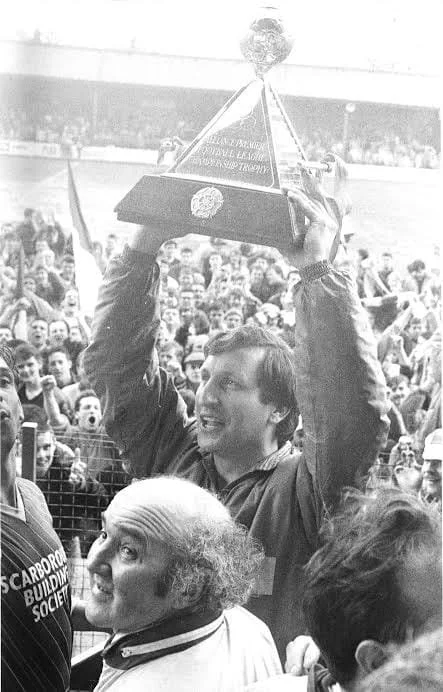
Neil Warnock during Scarborough's famous 1986-87 title-winning celebration.
Photo Credit: Scarborough Athletic
The beauty – and cruelty – of the new system was that the door now opened in both directions. If Scarborough could come up, someone had to go down. And that someone was Lincoln City.
The circumstances were remarkable because Lincoln had only been relegated from the Third Division the previous season.
Now, just 12 months later, they were fighting to avoid falling straight through the newly opened trapdoor into non-League football. And around them were clubs whose names carried far greater historical weight.
Among them was Burnley.
The Clarets had won the Football League championship as recently as 1960. They had been one of English football's great traditional clubs.
But by 1987 their decline had been extraordinary. They were now struggling at the bottom of the Fourth Division, just 27 years on from being champions of England.
The new system meant that reputation counted for nothing, history counted for nothing. A club had to finish above the line.
And on the final day, the tension became almost unbearable.
Going into the final Saturday, Lincoln were bottom, and Burnley were only one place above them.
The possibility was extraordinary: one of English football's founding giants could be relegated from the Football League, while a seaside club from the Conference was preparing to replace them.
But there was another twist. Torquay United were also in danger. The final-day drama became a three-way struggle for survival, with Burnley needing to win at home to Leyton Orient.
The match was played at Turf Moor on 9 May 1987. Burnley won 2–1, and that victory saved them. Not comfortably, and not elegantly, but decisively.
There was, however, another extraordinary subplot to the final afternoon, one that has become part of modern footballing folklore.
At Plainmoor, Torquay United were fighting for their Football League status against Crewe Alexandra. Torquay knew that defeat could send them down, and for long periods it appeared that their fate was sealed.
Then, late in the match, came one of the strangest incidents ever to influence a relegation battle.
A police dog named Bryn became involved in an altercation with Torquay players and bit the club captain, Jim McNichol. The incident stopped play and created a substantial amount of additional time.
Years later, Torquay's eventual rescue became so synonymous with the episode that the consortium which later attempted to revive the club was named the Bryn Consortium, after the police dog. It was football theatre of the most unlikely kind.
With the clock already beyond the scheduled 90 minutes because of the incident, Torquay were given an extended opportunity to find the goal they desperately needed. And they took it.
Torquay scored in stoppage time to secure the point that ultimately kept them in the Football League.
The goal transformed what had looked like relegation into survival, while elsewhere the results were condemning Lincoln City to history as the first club automatically relegated from the Football League into the Conference.
The episode has acquired an almost mythical quality because of its absurdity. The first season of automatic relegation was supposed to demonstrate the cold logic of sporting merit: clubs would rise and fall according to their league position.
Instead, the decisive afternoon also contained a police dog, an injured captain, an extended stoppage and a last-minute goal.
Yet there was something profoundly appropriate about it.
The new system had stripped away the old certainties. Reputation could no longer guarantee survival. Nor could membership of the Football League be protected by a vote.
Every point mattered, every minute mattered and, on this extraordinary afternoon, even an unexpected intervention from a police dog mattered.
The image of Bryn the police dog therefore belongs in the story of 1986-87 not merely as an amusing anecdote, but as a symbol of the extraordinary uncertainty created when the Football League finally opened its doors to automatic promotion and relegation.
For Scarborough, it was the beginning of a new world. For Lincoln, it was the end of their Football League status. For Burnley, it was a reprieve. For Torquay, it was survival by the most improbable means imaginable.
And for English football, it was the first dramatic demonstration that the pyramid was no longer simply a metaphor. It had begun to work.
The result left Burnley on 49 points, one clear of Rochdale and Tranmere, two clear of Torquay and, crucially, one point ahead of Lincoln City, who finished bottom on 48.
Lincoln were therefore relegated. Burnley and Torquay survived by the narrowest of margins. And Scarborough went up.
The symbolism was irresistible.
A club whose supporters had spent decades watching Football League clubs from the outside had finally entered through the front door, while one of the League's founding giants had come within minutes of being expelled from it.
The old order had been turned upside down.
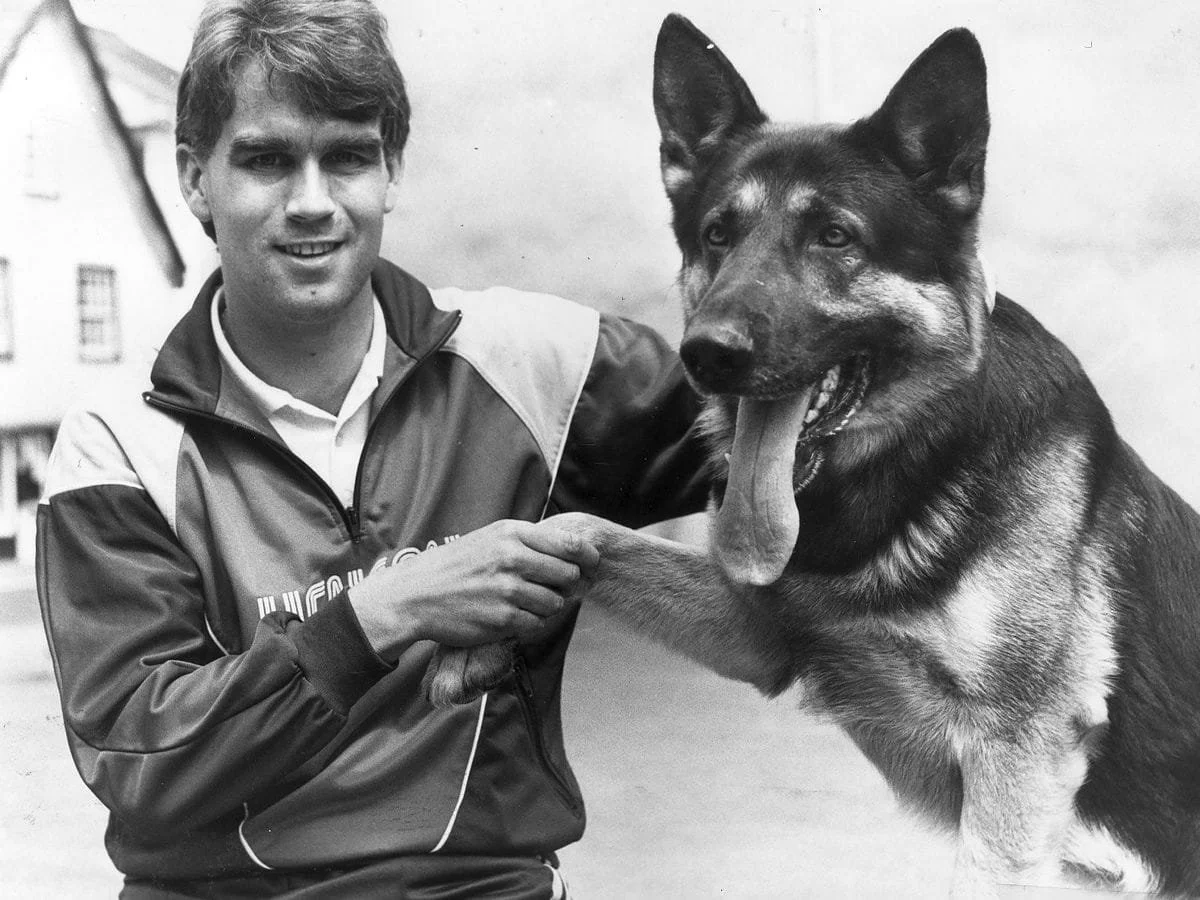
Bryn the police dog.
Photo Credit: Devon Live
Lincoln City's fate deserves particular attention because they became the first club to suffer automatic relegation from the Football League into the Conference.
They were not voted out, rejected by their peers. They did not have to plead their case. They simply finished 24th and that was enough.
The final table showed Lincoln and Torquay both on 48 points, but Lincoln's inferior goal difference left them bottom. Burnley's final-day victory lifted them to 49 points and safety. It was brutal, but it was sporting.
The significance of that distinction should not be underestimated. For almost a century, the Football League had effectively determined its own membership. Now the results on the pitch were becoming the mechanism by which clubs entered and left.
Scarborough's promotion and Lincoln's relegation were therefore two sides of the same historic event. One club crossed the boundary upwards, another crossed it downwards, and the pyramid as we know it had begun to function.
The irony of the situation was obvious. Had the old re-election system still been in place, Scarborough could have won the Conference and still been denied promotion.
Had the bottom-four re-election system remained, Burnley and Lincoln would not necessarily have been fighting for survival in quite the same way.
Indeed, Lincoln's own circumstances demonstrate why the old system could produce a different kind of football politics.
The club was a founding member of the Football League Second Division and had only recently returned to the Fourth Division. Indeed, the Imps were Bradford City’s opponents on the final day of the 1984-85 season when the Bantams’ day of celebration turned to tragedy at Valley Parade.
In the closing stages of the season, there was considerable opposition among threatened clubs to the new automatic relegation regulations. A contemporary appeal from Lincoln argued that the new arrangement was unfair and asked for the rules to be reconsidered.
It is easy, with hindsight, to regard the abolition of re-election as inevitable. It was not. There were clubs who did not want it and who feared what it meant. And there were supporters who suddenly realised that their club's very existence in the Football League could now be decided by a single league position rather than a vote.
But the principle was transformative. Football became more meritocratic. Not perfectly meritocratic – money, facilities, geography, ownership and infrastructure would continue to matter – but the fundamental principle had changed.
For the first time, the route from non-league to the Football League was genuinely based upon achievement.
For Scarborough, the reward for Warnock's players was a place in the Fourth Division.
Scarborough's first Football League campaign began on 15 August 1987 against Wolverhampton Wanderers at the Athletic Ground. The occasion attracted national attention because Scarborough were making their Football League debut. The fixture could hardly have been more evocative.
Wolves were a club with a rich First Division history and a huge national following. Scarborough had been playing non-league football only months earlier. Now they were opponents. The symbolism was enormous.
And Scarborough did not merely make up the numbers during their debut Football League campaign. They finished 12th, winning 17 of their 46 matches and collected 65 points. In 1988/89 they went even better, finishing fifth, reaching the Fourth Division play-offs.
Warnock remained with the club until November 1988, when he left for Notts County.
The rest, in many ways, became history.
His career subsequently turned him into one of the great promotion specialists in English football. He would eventually record eight promotions, taking clubs including Notts County, Huddersfield Town, Plymouth Argyle, Sheffield United, Queens Park Rangers and Cardiff City upwards.
But the first one remained different. Scarborough was the breakthrough. It was the promotion that proved that the new system worked.
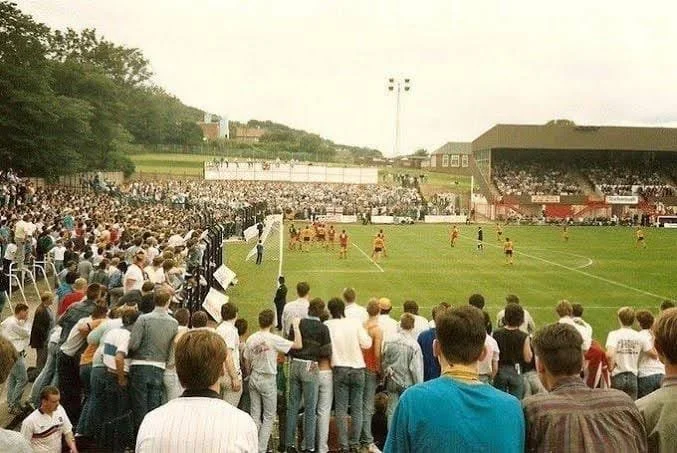
Scarborough's first ever Football League match against Wolves, 15 August 1987.
Photo Credit: Casual Chaps
The deeper legacy of 1986-87 was that Scarborough did not remain an isolated curiosity. Once the barrier had been removed, other ambitious non-league clubs could see a route upwards.
The Conference became something more than a competition to be won for prestige; instead it became a gateway.
The following years would see the emergence of clubs whose ambitions had previously seemed impossible: clubs that could build, invest, improve their grounds, attract better players and genuinely contemplate Football League status.
Scarborough were followed by a generation of clubs that demonstrated the power of the pyramid.
The promotion of Scarborough also helped change the psychology of non-League football. For years, supporters of non-league clubs could dream about reaching the Football League, but it was essentially a romantic dream.
After 1987, it became a practical objective. A chairman could say: ‘if we win the league, we go up.’
A manager could recruit players with the promise of League football. A supporter could look at the table and know exactly what was at stake.
The glass ceiling had been removed.
And 1986-87 also created a personal legacy. Neil Warnock's career became a study in the mechanics of promotion. His teams were often organised, competitive and emotionally invested.
He understood that football clubs could achieve disproportionate things when players felt they belonged to something. His Scarborough side of 1986/87 was the prototype. It was not assembled with the resources of a Football League club.
It did not need to be. It simply needed to be better than the teams around it, and that distinction is central to the story.
Warnock was later promoted from the Championship to the Premier League. He became the manager who could take struggling clubs, create a siege mentality, generate belief and turn promotion into a collective mission.
But every subsequent success carried a trace of Scarborough. The journey from the Conference to the Football League was the first chapter in a managerial career built around breaking barriers.
The 1986-87 season is much more than a footnote in Scarborough's history. It was a constitutional moment in English football.
Before it, the Football League was effectively a closed shop with a controlled entry system. After it, the relationship between Football League and the non-league game began to resemble the pyramid we recognise today.
Scarborough became the first beneficiaries, Lincoln became the first casualties, and Burnley became the great escapees. And Neil Warnock became the first manager to take a Conference champion into the Football League through automatic promotion.
There is something almost perfectly theatrical about the way the season ended. At one end of the country, Scarborough were celebrating a title that represented a century's worth of non-league frustration finally being answered.
At Turf Moor, one of the Football League’s founder members Burnley were fighting for survival against Leyton Orient, and when their 2–1 victory was confirmed, the Clarets had survived, and Lincoln became a non-league club.
The following season, Scarborough would walk out for their first Football League fixture and the impossible had become ordinary. That is perhaps the greatest legacy of all.
Today, promotion and relegation between divisions are accepted as the natural grammar of English football. Clubs rise, clubs fall, and the league table is supposed to decide their fate.
A non-league club can climb from the regional leagues towards the National League, the Football League and beyond.
But it was not always so. There was a time when winning was not enough. There was a time when the Football League could say no.
Scarborough's triumph in 1986/87 changed that. They did not simply win the Conference; Scarborough demonstrated that a club outside the Football League could earn its place inside it.
They showed that the boundary could be crossed.
And in doing so, a club from the Yorkshire coast, guided by a manager at the beginning of an extraordinary career, helped transform English football's idea of who belonged.
The glass ceiling was broken at Scarborough. And once it was broken, the whole pyramid looked different.