

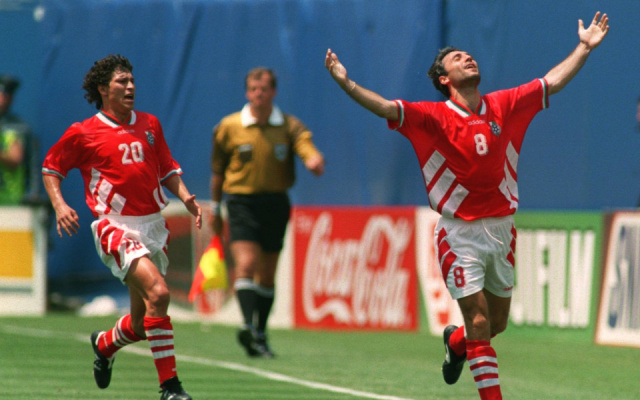
Words by Chris Kelly | Published 08.07.2026The 1994 World Cup, hosted in the United States, is memorable for a plethora of reasons; be it Diana Ross’ and Roberto Baggio’s misplaced penalties at either end of the showpiece, John Aldridge and Jack Charlton’s touchline frustration in Orlando, or the wonderful solo goal from Saudi Arabia’s Saeed Al-Owairan against Belgium, football's four-yearly get together really captured the imagination in the North American heat.
It was also the finest footballing hour for an Southeastern European nation that flattered to deceive somewhat, both before and after that sweltering summer - the Lions of Bulgaria.
Surrounded by the likes of Turkey, Greece and Serbia, and with the River Danube flowing through its northern border with Romania, Bulgaria itself has, fundamentally, Slavic cultural leanings, though its history is rich and varied, having been conquered by both the Roman and Ottoman empires in its past.
Like many modern-day Balkan areas, the country, and region in general, certainly has its obstacles, but there’s a deeply entrenched sense of identity that sweeps in off the Black Sea, and that pride swells when looking back at a time when their representative football team came close to ruling the world.
Having qualified in dramatic fashion, as an added time equalising goal from a countering Emil Kostadinov, on the books of Porto at the time, in Paris saw the Trikolyorite (the Tricolours) leapfrog France into second place behind Sweden in their group and acquire a ticket to the following year’s finals.
The fallout of the above events brought about a long-term resentment between then French boss Gerard Houllier and winger David Ginola, who was blamed for the late leveller on that November night in 1993. That’s a story for another day.
It was of no concern to Bulgaria, however, who had reached their sixth World Cup finals, having been present previously in 1962, 1966, 1970, 1974, and 1986.
On many of these occasions, they had crashed out in the group stages, and though they’d reached the Round of 16 in their last appearance at Mexico 1986 (where they would be eliminated 2-0 by the hosts), there was little to indicate what was on the horizon for the Lavovete (the Lions) eight years later.
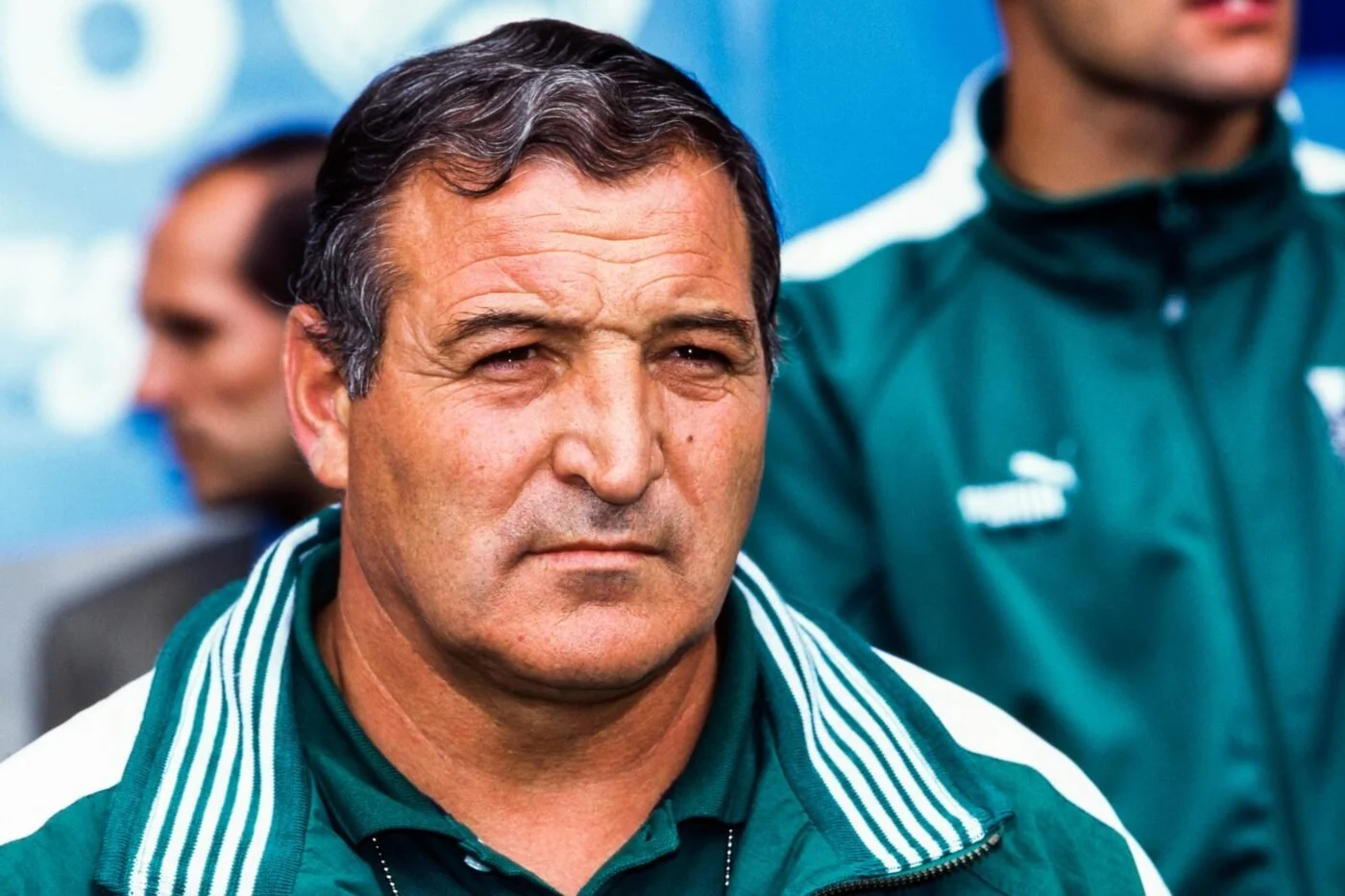
Three-time Bulgaria Head Coach Dimitar Penev.
Photo Credit: So-Foot
Under the stewardship of boss Dimitar Penev, himself a decorated Bulgarian international defender with 90 caps earned between 1964 and 1977, the outsiders would punch above their weight like never before at the mid-90’s tournament which perfectly encapsulated its era and host nation in equal measure.
Throughout his 35-year managerial career, Penev coached in his homeland with the likes of CSKA Sofia (on four separate occasions), Dimitrovgrad, and Spartak Varna, along with three spells in charge of the national team and brief, sporadic periods in Kuwait, Saudi Arabia, and China with Al-Yarmouk, Al-Nassr, and Liaoning respectively.
Over this time, he acquired a reputation for unearthing many of his country’s greatest players, with the likes of dynamic midfielder Stilyan Petrov, ex- Leverkusen, Tottenham and Manchester United forward Dimitar Berbatov, fellow attacker Kostadinov, and national hero and long-time talisman Hristo Stoichkov benefitting hugely from his tutorage throughout the years.
The latter two of those played a huge role in Bulgaria’s success in 1994, with Stoichkov in particular marking himself out as one of the nation’s - and the world’s - top performers across the decade.
Starring for the likes of CSKA Sofia, Barcelona, and Chicago Fire, the bright, diminutive gamechanger would win multiple league titles throughout his career, both in his homeland and Spain, along with the European Cup and European Cup Winners Cup during his time in Catalonia.
Heading into the tournament at the age of 28, Stoichkov was at the peak of his powers. And it showed. Renowned for his technical qualities, clever movement, and searingly accurate left foot, 1994 was quite the year for the Plovdiv-born man, who earned multiple individual awards, including the much-coveted Ballon d’Or.
Despite all their idol’s abilities and stature in the game, plenty believed an unfancied Bulgaria would have their work cut out to progress from a difficult looking Group D which contained 1986 champions Argentina and a highly-regarded Nigeria, along with outsiders Greece.
Ahead of the tournament, two new rules would be implemented by FIFA’s lawmakers in an attempt to encourage attacking impetus. Teams would be awarded three points for a victory, rather than just the two previously on offer, while goalkeepers were no longer able to pick up deliberate backpasses made by the feet of their teammates; changes that have continued to reshape the game as a whole ever since.
Penev’s men got off to a thoroughly inauspicious start, too, as the Super Eagles from Africa proved far too powerful for them in front of just under 45,000 at Dallas’ Cotton Bowl.
First-half strikes from Rachidi Yekini and forward Daniel Amokachi, who’d later be snapped up by English Premier League club Everton, were added to after the break with a far post header from Emmanuel Amunike to give Dutchman Clemens Westerhof’s side a comfortable 3-0 victory in the stifling Texan conditions.
With Argentina, thanks largely to a Gabriel Batistuta hat-trick, dispatching Greece 4-0 in the group’s other game, the pressure was already on the Eastern Europeans to get a result in their next game and stave off the possibility of a very early exit.
They did just that in style. Coach Penev chose to change approach, adopting a front three of sorts, and bringing in the experienced Nasko Sirokov to form a potent attacking trio alongside Stoichkov and Kostadinov.
The alteration proved inspired (and something that would act as a tactical blueprint for the remainder of the tournament), as Bulgaria ran riot against the Greeks at Chicago’s Soldier Field stadium. Two penalties from Stoichkov at the start of each half were added to by a wonderfully worked Yordan Letchkov goal and a late strike from Daniel Borimov, the midfielder reacting quickest to a poorly parried out free-kick from the opposing goalkeeper Ilias Atmatsidis to score from close range.
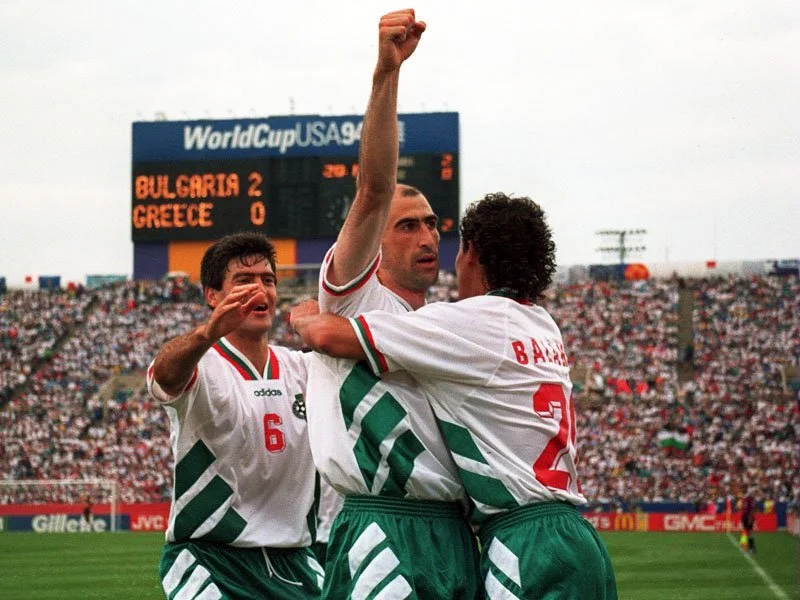
Bulgaria celebrate during their convincing win over Greece.
Photo Credit: Metodi Shumanov
With a Claudio Caniggia double helping the Argentines to a narrow 2-1 victory over Nigeria in their second game, the pressure remained on Penev and his men, who’d need something, preferably a win, from their daunting final group match against the South American heavyweights.
The Trikolyorite would receive an unexpected boost before the clash in Dallas, however, when the aging, yet still much-revered La Albiceleste man Diego Maradona was expelled from the tournament (and subsequently from football as a whole for the following 15 months), having tested positive for banned stimulants following his side's success in their second game.
Maradona, one of the greatest to ever kick a ball, held almost God-like status among the Argentine people, and while heading into the twilight years of his career at the time, it was believed his absence and the impact of his departure may work in Stoichkov’s and co’s favour.
That proved to be the case as the Lavovete were able to get on top of an under-par La Selección side and grab a famous win courtesy of second-half goals from Stoichkov and Sirakov, the latter clinching the win in added time with a header from a corner.
A red card issued to defender Tsanko Tsvetanov by Tunisian referee Neji Jouini with over 20 minutes to play did little to change the outcome or dampen the mood, as joy spilled out on the pitch and in the stands at the final whistle.
Nigeria saw off a disappointing Greece team at the same time as they, Bulgaria, and the Argentines all finished on six points.
The Africans took first place on goal difference, while Penev’s side’s victory over Argentina saw them pinch second as a result of that head-to-head success.
In a tournament comprising 24 teams, however, all three would ultimately qualify for the next stage, as the four best third-placed finishers joined those that had come in the top two of their respective six groups.
Bulgaria’s prize for reaching the knockouts was a meeting with Mexico in the Round of 16 at East Rutherford’s Giants Stadium.
They’d get off to a great start, too, as Stoichkov’s devilish finish having been played into the right hand channel of the 18-yard box gave them a sixth-minute lead.
That was quickly wiped out, though, as a coming together in the penalty area saw the Mexicans awarded an 18th-minute spot-kick; duly converted by Garcia Aspe.
Both sides were somewhat harshly reduced to 10 men after the break, as Bulgarian full-back Emil Kremenliev and Mexican forward Luis Garcia received their marching orders for separate offences before the hour mark.
The game headed to extra-time, and with both sides failing to find a winner in the baking New Jersey sunshine, it fell to penalty kicks to decide who would make the last eight.
Despite midfield play-maker and former Sporting CP and VfB Stuttgart man Krasimir Balakov missing early on, wig-wearing goalkeeper and ex-Reading man Boris Mihaylov and his colleagues held their nerve, with Ipswich Town attacker Boncho Genchev, Borimov, and Letchkov finding the back of the net in a 3-1 success.
With excitement levels back home rising, the Lions of Bulgaria would be pitted against reigning world champions Germany at the Quarter-Final stage; Jürgen Klinsmann, Lothar Matthäus, Rudi Völler and all, again at the Giants Stadium over towards the West coast.
Adorning their changed kit of red shirts and white shorts (rather than their famous white and green ‘home’ colours) in a classic 90s era Adidas template, Penev’s side would head into the contest as firm underdogs against Berti Vogts’ powerhouses.
They’d receive an early helping hand however, as opposing defender Thomas Helmer was shown a 15th-minute red card. But despite that, and a battling first-half showing that included Balakov agonisingly striking the upright, things looked to be following the expected script early in the second period as the dynamic German midfield general Matthäus dispatched a 47th-minute spot-kick.
Bulgaria stayed in the game, however, before a moment of magic from Stoichkov brought the scores level with 15 minutes to play, as he thundered home a free-kick that left the opposing stopper Bodo Illgner standing. Just three minutes later, one of the tournament's most memorable goals would turn the game on its head completely.
Anybody who watched events unfold that summer 32 years ago remembers Yordan Letchkov’s far post diving header that sent his nation into raptures, and shocked the footballing world.
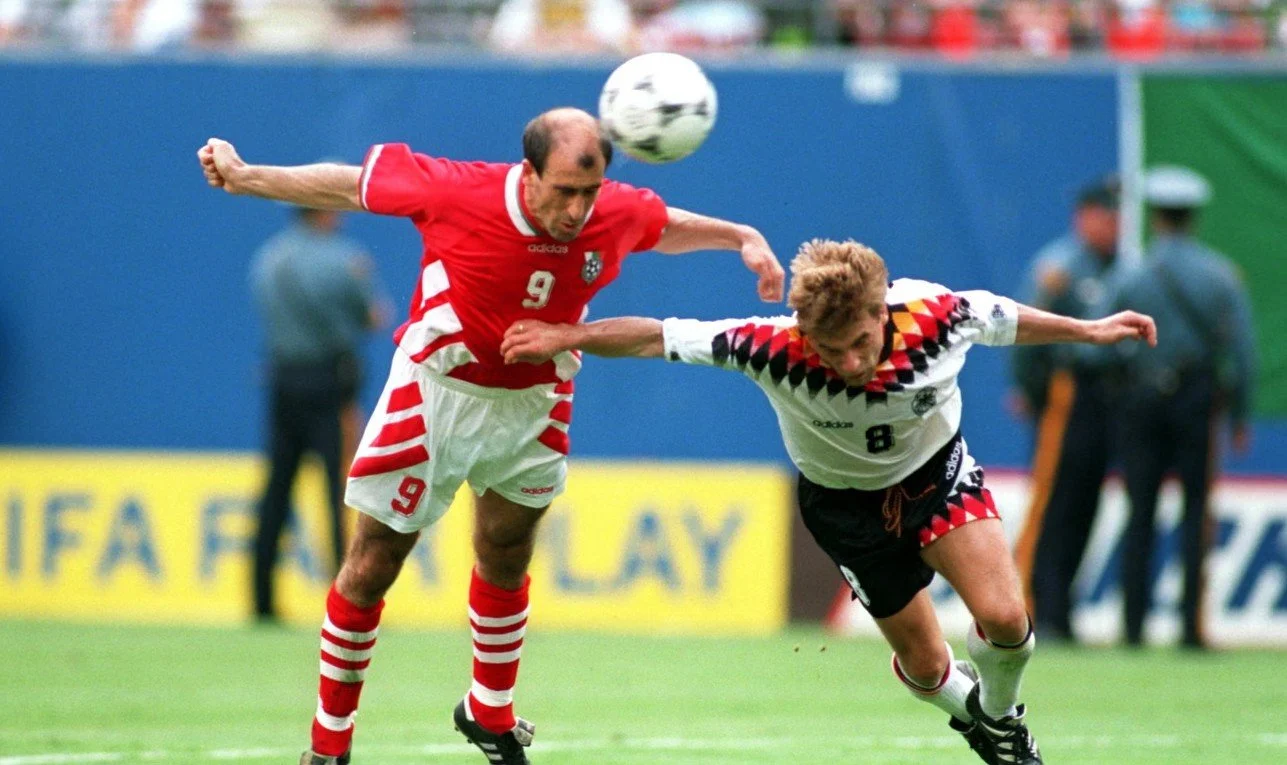
Yordan Letchkov heads in Bulgaria’s winner against Germany.
Photo Credit: The Guardian
Midfield technician Letchkov, 26-years-old at the time, but looking significantly older and like he’d had the toughest of paper rounds back in the day, rose like a salmon to meet a teased diagonal cross into the box to bullet home past Illgner.
It was one of ‘the’ moments of the summer; one of those memories that will remain in World Cup folklore for eternity, and the decisive blow that took the SV Hamburg man and his colleagues to the brink of footballing immortality.
Alas, it wasn’t to be in the end. Staying in New Jersey once more, Bulgaria would be edged out by a Roberto Baggio-inspired Italy in the semi-finals. The majestic Juventus maestro tore the Lavovete defence apart to score two quickfire first-half goals, and despite a calmly finished Stoichkov penalty to pull one back just before the break, it wasn’t enough as the Azzurri dashed those Eastern European dreams at the last to set up a final showdown with Brazil.
Carlos Alberto Parreira’s men had seen off Sweden in the other last four clash, as a late goal from Stoichkov's Barcelona teammate Romário separated the sides.
Prior to the final, a tight match ultimately decided by a crestfallen Baggio blazing over from 12 yards to end the penalty shootout and give the Seleção their fourth triumph on the world stage, Penev’s side would then finish their tournament as they’d started it, with a heavy defeat to the Swedes in the Third/Fourth Place Play-off.
Indeed, it was an afternoon to forget for Bulgaria, who found themselves four goals down before the break as strikes from Thomas Brolin, Håkan Mild, Henrik Larsson, and Kennet Andersson saw Tommy Svensson’s side run riot at Pasadena’s Rose Bowl arena.
While they’ll have few positive memories of that particular match, Bulgaria had plenty to cling onto in what had been a magical, unexpected journey deep into the sport’s pinnacle for the very first (and only) time.
It certainly eclipsed all their previous (and future) appearances by some distance, and holds far more weight than their 1968 run to the summer Olympic Final in Mexico.
Stoichkov took home the Golden Boot with six goals, sharing the award with Russian striker Oleg Salenko who had famously netted five times in a dead-rubber group stage game against Cameroon as both sides were eliminated.
The Lavovete’s main man was also awarded the Bronze Ball (the tournament’s best player) as well as taking his place in the All-Star Team of the tournament.
It was also an event that raised the profile of plenty of others who’d played their part. Midfielder Letchkov, like many before and since, became a figure largely remembered solely for his efforts at football’s global showpiece that summer, despite plying his trade for clubs such as Marseille and Beşiktaş, along with Hamburg, throughout his career.
Mulleted no-nonsense defender Trifon Ivanov stood out, as did the aforementioned Mihaylov - a real character in the Bulgarian goal.
Those mentioned above would feature in what would be Penev’s final stand (in his first spell) at 1996’s European Championships held in England, where his Bulgaria side would revert to their pre-94 type and exit the tournament at the group stages.
A pattern followed in their last appearance on the global stage at the World Cup held in France 1998, where an opening game draw with Paraguay was followed up with setbacks against Nigeria and Spain; the latter ending in a 6-1 thumping.
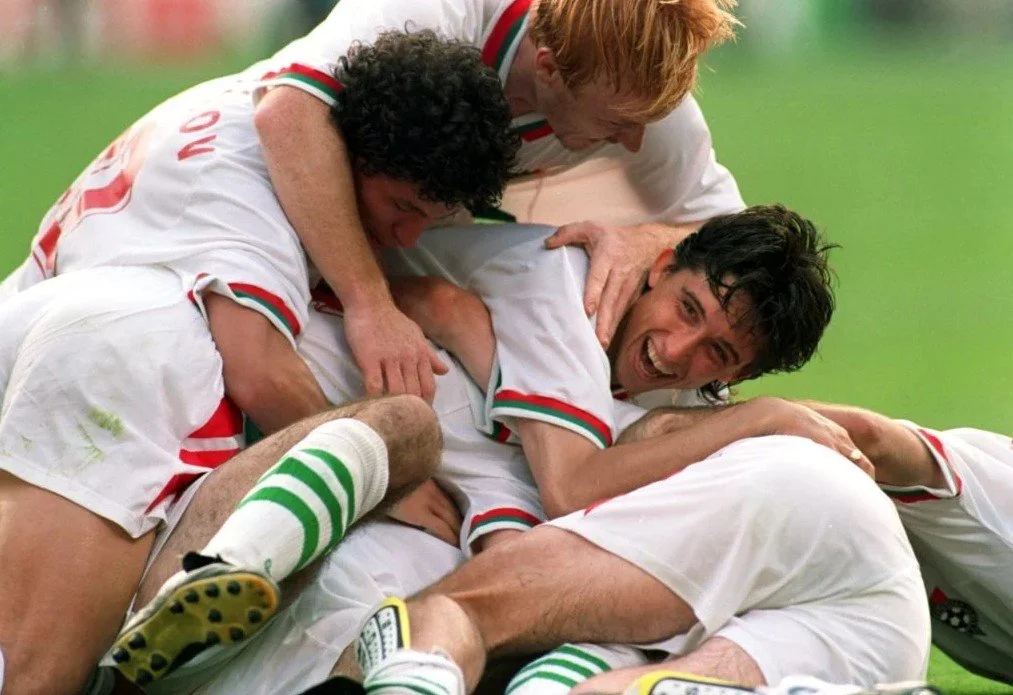
Bulgaria's run during USA '94 remains their best in any international competition.
Photo Credit: HITC
The Trikolyorite ‘s last appearance to date at a major tournament came at the Euro’s in Portugal in 2004, where it was hoped a new generation containing the likes of Stiliyan Petrov, Martin Petrov, Radostin Kishishev, and the mercurial Dimitar Berbatov could push the boundaries of success again, just as their compatriots had done a decade earlier.
The opposite would transpire, however, as then boss Plamen Markov’s men had a miserable Iberian summer, comfortably losing all three Group C matches against Sweden, Denmark, and Italy respectively.
Berbatov would go on to have a stellar club career with top clubs in some of Europe’s finest leagues, and, indeed, would eventually become the country’s joint leading all-time goalscorer (along with Hristo Bonev) with 48 goals.
Despite their new talisman’s best efforts, and those that have worn the nation’s colours since his retirement, the Lavovete have rarely come close to qualifying for either a World Cup or European Championships finals since.
There is currently no Stoichkov, or Balakov to lead the way. No Berbatov type figure on the horizon to give genuine hope. No Penev, who sadly passed away earlier this year at the age of 80, to discover and improve talented youngsters.
That, combined with an ever-weakening domestic league due in part to structural and organisational issues, along with the lack of funding attributed in today’s global footballing landscape that opts to share its plentiful wealth with only the few rather than the many, a factor that has seen the once formidable top club sides from Eastern Europe understandably, yet worryingly, fall away from football’s top table.
Ludogorets of Northeastern city Razgrad, under the ownership of pharmaceutical chief Kiril Domuschiev, have dominated the Bulgarian football scene of late, but have largely done so by investing heavily in overseas talent, predominantly from South America and Africa.
While the title has returned to the capital this year, with Levski Sofia winning their first league title in 17 years, they too have followed a similar recruitment model, and this recent trend, along with those other aforementioned factors, could be having a detrimental effect on the breakthrough and progression of local talent on the same scale as yesteryear.
Domestic league attendances and particularly crowds to watch the national team have also shrunk of late, in line with that widespread dearth of finance, structure, and in-turn, talent and belief. Therefore, realistically there remains more hope than expectation among the Bulgarian public as to whether they’ll see their national team rise again.
They will, however, always have the summer of 1994. Those halcyon days in the Dallas and New Jersey heat. Letchkov, Ivanov, Sirakov and co. An era when they had one of the world’s greatest players in Hristo Stoichkov, and a time when what would have been a footballing miracle came close to reality.