

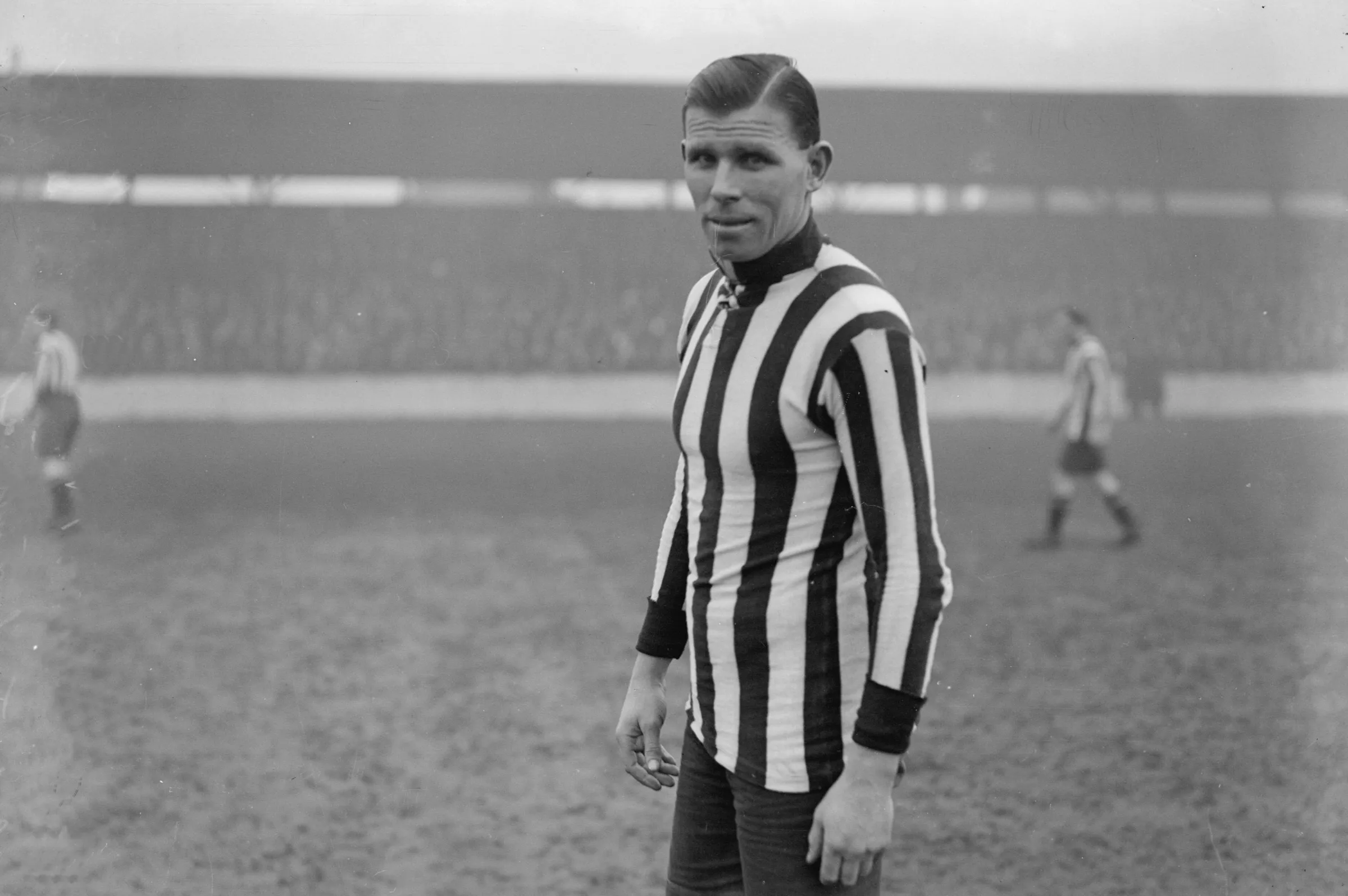
Words by Andrew Newton | Published 25.07.2026All Sunderland supporters love the king. They all know that Charlie could never be replaced by some pretender, some usurper, someone without his God-given grace and Majesty.
But did you know that before Charlie Hurley (who did you think I was talking about?), there was another King Charlie of Roker Park?
Charles Murray Buchan signed for Sunderland towards the end of the 1910-11 season. Following his home debut for the club, a 3-0 win over Middlesbrough on 8th April, inside-left Jimmy Gemmell walked up to Buchan and told him ‘if you keep playing like that you’ll be king of Sunderland’.
It was an accurate prediction; no player has ever scored more league goals for Sunderland than Charlie Buchan. He scored 209 goals in the 379 league games he played for the club and, overall, scored 222 goals in 411 appearances for Sunderland.
Buchan’s impact on the football world, however, extends way beyond his goalscoring record for the Wearside club. As well as being one of the greatest players of his era, he would go on to be a hugely influential figure in British football for the next 50 years.
Buchan was born in Plumstead, east London, on 22nd September 1891, to Scottish parents who had moved south from Aberdeen. His father had been in the army and later settled in London to work as a blacksmith at the Woolwich Arsenal.
Although Mr Buchan senior did not play football, Charles’ two older brothers, Will and Tom, and younger brother, Jack, were all keen footballers. Tom went on to play for Blackpool and Bolton Wanderers and Jack, who Charles described as a “harum-scarum lad who could never settle in one place long” played for Bolton and Charlton Athletic. Will joined the Navy.
During his youth, Buchan would run to school, racing the horse trams that ran along Woolwich High Street. He carried a ball, often a tennis ball, with him wherever he went. He would run along the road, passing the ball against the kerb and controlling the rebound. He claimed that he could run at full tilt, knocking the ball against the pavement edge and receiving it again, without slowing his pace at all.
Every Saturday afternoon, he would head to Woolwich Arsenal Football Club’s Manor Ground for their league and reserve games. However, as he couldn’t afford the threepence entry fee, he had to make do with listening to the sounds of the crowd, waiting until 10 minutes from the end when the gates would be opened and he, and loads of other kids, could rush in to catch the end of the game.
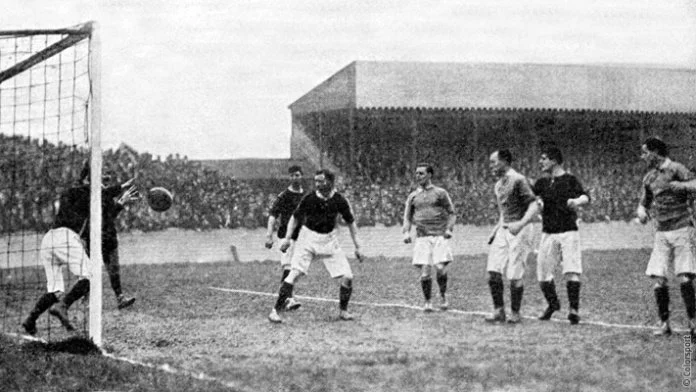
Woolwich Arsenal in action vs Everton at the Manor Ground.
Photo Credit: Wikimedia Commons
As a lad, Buchan played for a variety of teams, including his school, his church team, Woolwich St Nicholas, and a senior team, Woolwich Polytechnic, who were so named because they used that institution as their headquarters and who played in the Kent Senior League. Buchan would become a student at Woolwich Polytechnic School, where he appears to have taken his studies seriously as he intended to become a schoolteacher.
During this period he was involved with a team called Plumstead, a nomadic side with no home ground of their own, who played fixtures against the best amateur sides in the Home Counties. He later found out from Charlie Paynter, a man who served West Ham as a player, trainer, and manager for 50 years, that the Hammers had been interested in him at this time. However, having watched him play for a team called Elder Tree on the public grounds at Boleyn Castle, Paynter had dismissed Buchan as too small and frail.
It was while a student at Woolwich Polytechnic that Buchan was approached by Woolwich Arsenal to play for their reserve team. His first game was away to Croydon Common, at the Nest, in the South-Eastern League. It was a mid-week game and getting to the ground meant that Charles would have to miss an afternoon of his studies at the Polytechnic.
Any problems this might cause didn’t enter his mind, such was his eagerness to play. The game went Buchan’s way; Woolwich Arsenal won 3-1 and he scored a goal. Newspaper headlines that evening read “Schoolboy scores for the Arsenal”.
On his return to the Polytechnic School, the headmaster, Dr. W. Bain, asked Buchan to explain his absence. When he couldn’t give a satisfactory answer, the teacher produced a copy of the newspaper and “the next few minutes were very uncomfortable” for Buchan. Many years later, in 1927, he was able to make up for his misdemeanour by sending Dr Bain tickets for the FA Cup Final between Arsenal and Cardiff City.
Having signed on as an amateur, Buchan played four times for Woolwich Arsenal reserves during the 1909-10 season. He was also selected as a reserve for the first team on two occasions. Although he acknowledged that this was an honour and that it demonstrated that the club thought he was a good player, he didn’t particularly enjoy this role as it meant idle Saturday afternoons with no game to play.
One day in November 1909, Buchan went to see George Morrell, Arsenal’s secretary-manager. He’d played four times for the reserves, trained two evenings a week at the Manor Ground, and paid his own way to away games. He had an expenses bill to claim. It came to 11 shillings.
Morrell was not impressed and questioned how an 18 year old could have spent such a sum on the club’s business. In response, Buchan gave a detailed breakdown of the account which led not only to an argument, but also to him walking out of the office, “very hurt”, without the money, and also minus his place as part of the Woolwich Arsenal playing staff.
Buchan referred to this incident as “the first of many arguments that seemed to dog me throughout the years”. A similar incident occurred on the occasion that he made his England debut. He tried to claim expenses in advance for a cab from Sunderland railway station to his home as the last leg of his return journey.
“Don’t they have trams in Sunderland?” asked the FA official, “not on Sundays” was Charlie’s response. It seems that Buchan was a strong-willed man, often opinionated, and some might even say, a difficult one.
He, himself, considered that he was “blessed with a placid temperament” but “could not keep out of an argument where soccer was concerned”. Later in his career, he walked out of a club he’d just signed for because he didn’t think the kit was up to standard.
Having presumably had a change of heart, he arrived for training the next day but refused to take part when he found a lump of congealed Vaseline in what was supposed to be a freshly laundered sock.
The day after he left Woolwich Arsenal, Buchan signed for Northfleet, who played in the Kent League. For the remainder of the 1909-1910 season, he was Northfleet’s inside right. Northfleet were very successful that season, winning the Kent Senior League, the Kent Senior Cup, and the Thames and Medway Combination.
As a result of these successes, Northfleet’s players, including Buchan, attracted significant interest from Football League clubs. Bob Dunmore, who had been trainer at Woolwich Arsenal during Buchan’s short-lived spell there, had moved to Bury, who were then in the First Division.
Dunmore offered Buchan £3 a week to sign on as a professional with his new club. However, as it was still Buchan’s intention to become a teacher, he did not wish to accept such an offer. The next club to approach him were Fulham, who were aware of his ambition to teach. Their directors offered to find him a job where he could continue his teacher training and pay him 30 shillings a week to play as a professional footballer for Fulham.
Buchan didn’t think the offer was good enough and asked for £2 a week. The directors left the room to confer and when they returned, they told him that they thought that the teaching job was more valuable than a higher wage as it would assure his future. Headstrong as ever, Buchan turned down the offer.
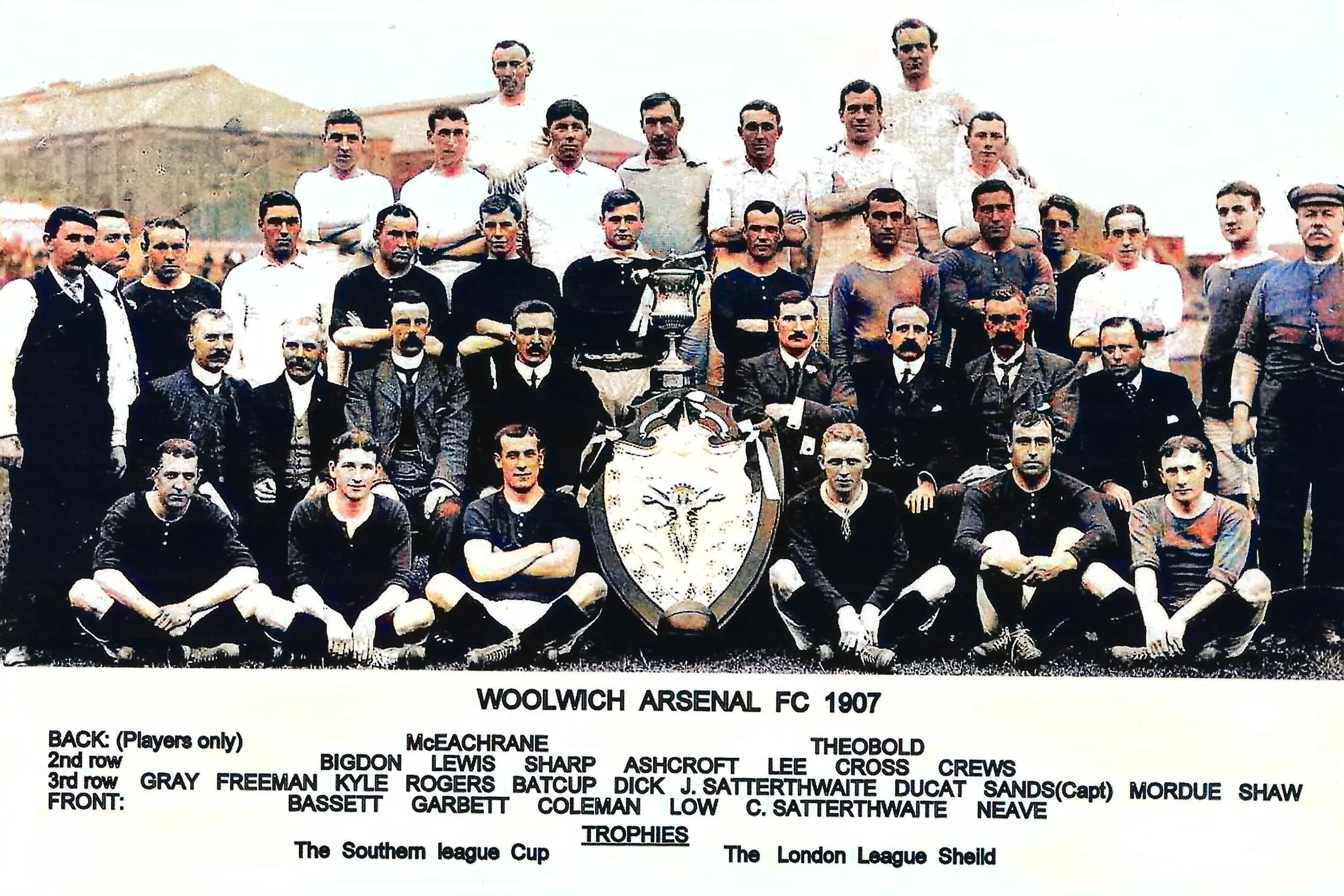
Bob Dunmore's Woolwich Arsenal team. Bob is standing on the far right.
Photo Credit: Find A Grave
After the Fulham disappointment, Buchan went back to his normal job but was eventually approached by Micky Busby, a player and coach for Leyton FC. Leyton were then a professional side playing in the Southern League. Some sources erroneously state that Buchan signed for Leyton Orient but Orient didn’t move to Leyton until 1937, didn’t become known as Leyton Orient until after the Second World War, and were based in Clapton during the period that Buchan was negotiating with Leyton.
Perhaps the confusion comes from the fact that Leyton played at Brisbane Road in the first part of the 20th century, moving to the Hare and Hounds Ground when Clapton Orient took over their previous home. Leyton offered Buchan £3 a week and told him he could live at home in Plumstead.
Feeling that these terms were acceptable to him, he agreed to go for an interview with Leyton’s player-manager, Dave Buchanan. Buchanan told him, “well, I can guarantee you a place in the first team for the opening games. No other manager can offer you that guarantee”. Although Buchan still wasn’t keen to be a professional, he felt that the offer was too good to refuse.
Pre-season with Leyton was hard, and training was twice a day. Buchan described it as his first experience of “systematic training”. As the first game of the season approached, Buchan found that, as he’d been promised by Dave Buchanan, he would be starting.
However, before he could play, he had to attend a meeting of the League Management Committee. Because he’d signed with Arsenal on amateur forms, there were issues with him signing for Leyton. The paperwork he’d signed with Arsenal made him their player until they agreed to release him and they evidently wanted to retain a claim to his services. Eventually, the Southern League decided that because Buchan had signed as a professional with Leyton, he was their player.
Buchan considered his time at Leyton to be a period during which he learnt a lot. At this time the Southern League was of a standard comparable to the Football League; many of the clubs were professional. Players regularly moved from Football League clubs to Southern League clubs. Buchan played inside-right for Leyton, and his partner at outside-right was Jimmie Durrant who was “almost international class”, and had played for Leicester Fosse in the Football League and for Luton Town.
Playing behind him at right half-back was Rev. Kenneth R. G. Hunt, the big, strong cleric, noted for his vigorous charging, who two years previously had been in the Wolverhampton Wanderers side that defeated Newcastle United 3-1 in the FA Cup Final at Crystal Palace.
Irish international Tommy Shanks, who joined Leyton from Brentford and had previously been at Woolwich Arsenal, was particularly generous with his time, and enjoyed passing on his skills and experience to the younger players. Buchan said that Shanks “taught me things with a ball I would never have dreamed of myself”.
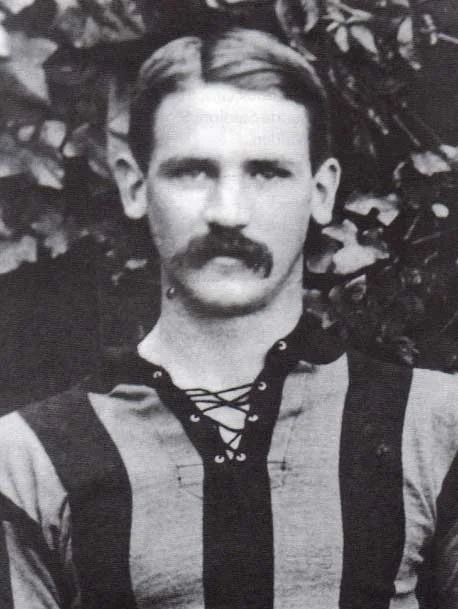
The Rev. K.R.G Hunt, Buchan’s team mate at Leyton.
Photo Credit: Spartacus Educational
Buchan’s first few months at Leyton went very well and, by the start of March 1911, he felt like he was “sitting on top of the world”. Manager Dave Buchanan had promised him the maximum wage of £4 a week for the following season and he was planning a summer holiday.
Leyton were due to play Southampton on 4th March. Prior to the game, Southampton made it widely-known that they were prepared to sell their inside-right, Frank Jefferies, and their left half-back, Harry Trueman.
Managers flocked from all over the country to see the game and run the rule over the available Southampton players. Buchan had a really great game, to the extent that he felt that luck was on his side and he could do nothing wrong; if the ball hit him on the shin, it turned into an inch-perfect pass. Leyton won by four goals and Buchan scored two of them.
Thanks to this performance, it was Buchan’s signature that the visiting managers sought, rather than those of the Southampton players. Throughout that weekend, numerous managers visited Leyton’s ground and Buchan’s home, trying to sign him.
Some of these managers were put off by Buchan’s father, who told them that he wouldn’t leave home, others were deterred by the transfer fee Leyton were asking. Nonetheless, on the following Tuesday, Buchan arrived at the ground to be told that he was wanted in the office.
There he met Bob Kyle, Sunderland’s manager, who offered him maximum wages and a £10 signing on fee to play for Sunderland in the First Division. Leyton received £1200 for selling Buchan but, sadly, within 15 months, they were in financial difficulties.
Buchan’s first game for Sunderland came within a few days and was a friendly against Distillery, in Belfast. His second game was away to Tottenham, so Buchan was able to go home to Plumstead in the lead up to the game.
Despite scoring on his home debut against Middlesbrough, and the complimentary comments from Jimmy Gemmell, his first few months on Wearside weren’t a roaring success.
As a 19 year old kid, Football League defenders tried to intimidate him. In an early game against Notts County, he raced past burly full-back Jack Montgomery. “Don’t do that again, son”, the Notts player told him. When Buchan tried the same thing again, Montgomery hit him with a huge shoulder charge that left him sprawled on the floor by the perimeter fence. After picking himself and returning to the pitch, Montgomery growled, “I told you not to do it again”.
To make things worse, the Roker Park crowd didn’t particularly take to Buchan in those early months, and he was barracked a lot. By his own estimation, the eight games he played before the end of the season, following his arrival from Leyton, consisted of “one good game and a lot of moderate ones”.
During the summer months, as well as playing a lot of cricket for Kent Club and Ground, Buchan reflected on his first experience of the Football League. He considered that the main difference between the First Division and the Southern League was in positioning; his opponents anticipated the next move and were always in the right place to stop him. He decided that he needed to speed up his play and think two moves ahead, rather than just one.
Unfortunately, things didn’t immediately go as planned. Buchan had a growth spurt, going from 5ft 9in at the start of August to 6ft by the end of November, but didn’t bulk out in proportion. He felt weak after training and the standard of his play wasn’t up to much.
He asked Bob Kyle to drop him but the manager refused. After one game in November, in which he performed so badly that the crowd (with good reason, admitted Buchan) were vociferously critical of him. As was, perhaps, typical of him, Buchan stormed into the dressing and announced loudly “I’ll never kick another ball for Sunderland”. He was overheard by a reporter and his outburst appeared in the papers. Buchan packed his bags and ran home to London.
Sunderland were due to play Woolwich Arsenal the following Saturday at the Manor Ground. Buchan didn’t expect to be in the team. Two days before the game, Bob Kyle arrived at his parents’ house and persuaded Buchan to play.
He scored twice in a 3-1 win, which restored his confidence to some extent. This proved to be a turning point. He began to put on weight, became used to the physical demands of the First Division, and no longer got “the bird” from the Sunderland fans.
The Sunderland side that Buchan joined contained some of the leading players in the country at the time. These included England international Jackie Mordue, who could play on either wing, George Holley, another England player and one of the leading goalscorers of the era, the imposing centre-half and Scotland international, Charlie Thomson, and right-half Francis Cuggy, who won two caps for England and later coached Celta Vigo.
Buchan only just missed out on playing with one of the biggest football stars of the Edwardian era, the highly eccentric amateur and Welsh international goalkeeper, Leigh Richmond Roose, who left the club in 1910.
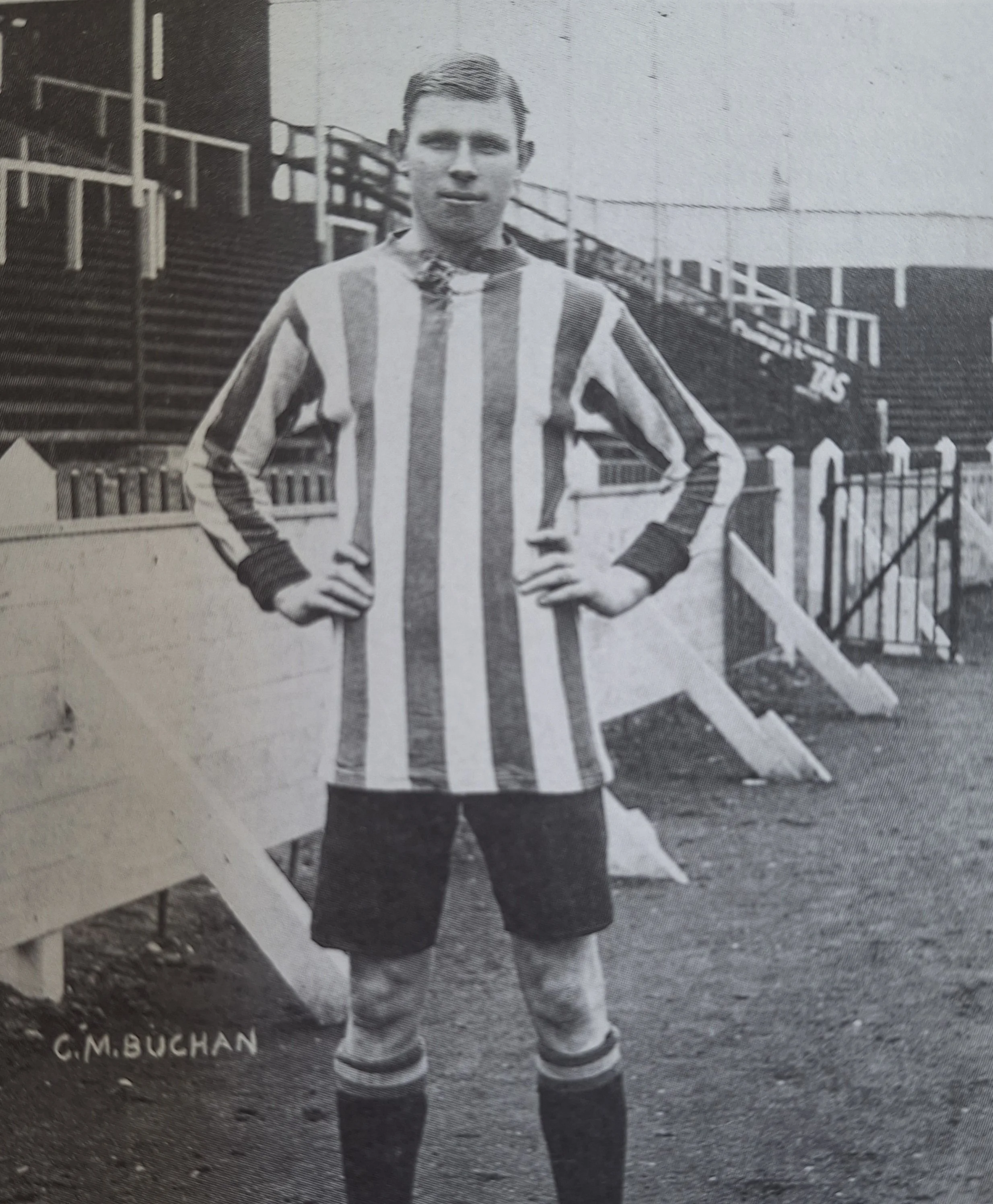
Charles Buchan in Sunderland kit.
Photo Credit: The Daily Telegraph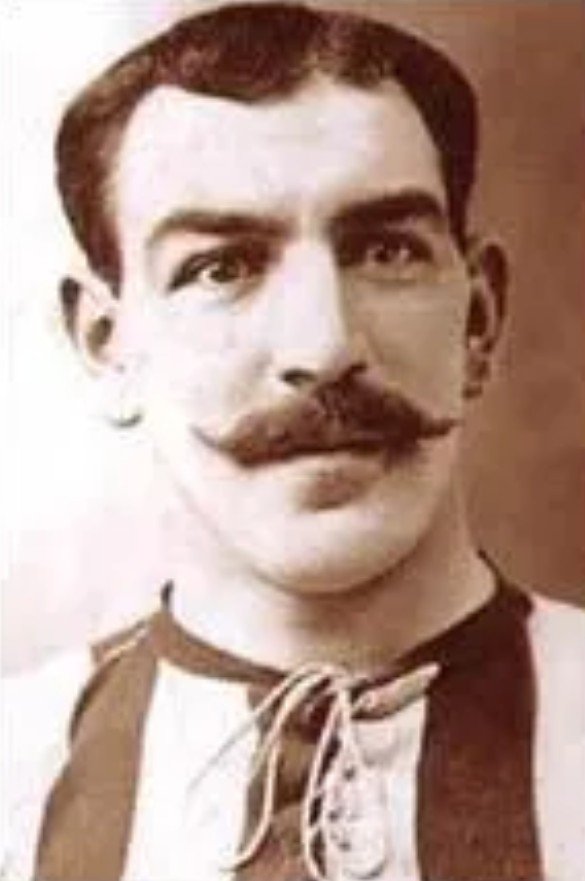
Charlie Thomson, Sunderland’s uncompromising centre half and Buchan’s team mate
Photo Credit: Spartacus Educational
Once he found his feet, Buchan was not out of place in this illustrious company. During his time with Sunderland he became known as one the finest players in the country, and is often described as the best of his era. He became known for his close control, his reading of the game, and the glancing header, his speciality.
Particularly noted was his quick thinking, which sometimes led to him being several moves ahead of even his own team mates. His fluid style was favourably compared to the outstanding amateurs of the Corinthians. The great Hungarian manager, Béla Guttmann, later winner of two European Cups with Benfica, compared him to the greatest players of the period from across the world “Scarone, Petrone, Rydell, Andrade, and the rest may have some virtuosity, but what lifts [Gyuri] Orth, [Kálmán] Konrad, and Buchan above them is artistic intuition and the depth of content.”
Buchan was Sunderland’s top scorer during the two seasons prior to the First World War and the first five seasons after it. Such was the public’s desire to see the star man play, Sunderland employed a sandwich-board man each match day to publicise that Buchan would be playing. It was suggested that his presence in the team could add 5000 to the attendance.
At the end of the 1911-12 season, Buchan went on holiday to Canada where he was invited to play for a local side. A photo of him in the jersey of the Canadian team made its way back to Bob Kyle and when Buchan returned to Sunderland, he found himself in trouble again.
The 1912-1913 season was, however, one of great success for both Buchan and Sunderland. Amazingly, though, it had started terribly. After an opening day draw away at Newcastle, the team only took one point from the next six games and after defeat to Chelsea, Sunderland were second bottom.
Following this defeat, a new goalkeeper, Joe Butler, and dominant right full-back Charlie Gladwin were drafted into the side. Although uncompromising on the pitch, Gladwin needed to calm his nerves before each game by putting his fingers down his throat to make himself sick.
Gladwin commanded the penalty area, which allowed half-backs Low and Cuggy to go forward safely. His introduction injected confidence into a side that already had abundant talent.
The turnaround was kick-started with a 4-0 win at home to Middlesbrough and Sunderland won their next five games, including a memorable 5-1 over Bradford City.
On 7th December 1912, Buchan produced one of his most remarkable performances for Sunderland in a 7-0 win over Liverpool.
He opened the scoring in the 17th and two minutes before the interval, after Harry Martin and Jackie Mordue had each found the net, he got his second of the game. His third came from close range midway through the second half
His fourth and fifth goals, and Sunderland’s 6th and 7th, came as the afternoon light was fading. He’d completely outclassed Liverpool. Sunderland won their 5th League title that season and nearly did the double.
As well as racking up wins in the league, Sunderland progressed steadily in the FA Cup, although they required replays against Manchester City, against Newcastle in the fourth round, and against Burnley in the semi-final.
The win over Burnley set up a meeting with Aston Villa. The two top clubs in the country would face each other in the FA Cup Final.
This fixture attracted a record crowd of 121,919. It was, apparently, a sensational game; Villa missed a penalty, there was a long delay when their goalkeeper Sam Hardy was injured, and there was a ruckus between Sunderland centre-half Thomson and Villa centre-forward Hampton, which, although neither were sent off, led to them both being suspended for the first month of the following season.
Early in the game, Villa’s inside-left, Clem Stephenson, told Buchan that he’d dreamt that Villa’s County Durham-born right-half, Tommy Barber, would score the winning goal. Stephenson’s prediction came true and Barber scored with a long range header from a corner 12 minutes from time.
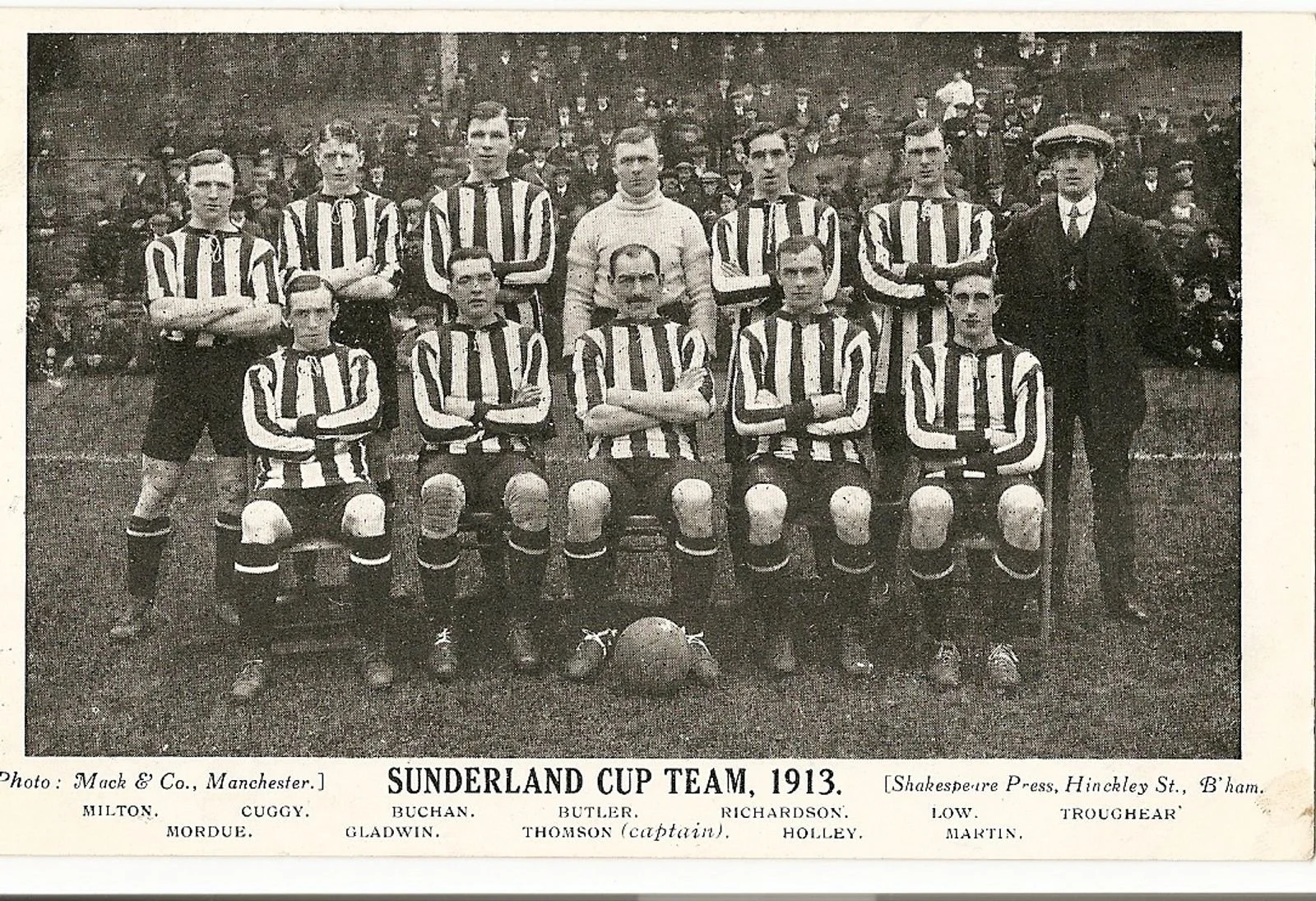
The Sunderland team for the 1913 FA Cup Final. Buchan is back row, third from the left.
Photo Credit: Sunderland AFC
As well as the title and the FA Cup Final appearance, the 1912-1913 brought Buchan international recognition when he was called up to play for England against Ireland in Belfast on 15th February 1913.
This was the occasion when he had the argument with the FA official over his advance claim for his cab fare home from Sunderland railway station. Some sources suggest that this argument limited the number of caps he won.
Despite his parents being Scottish, Buchan could not play for the country of his ancestors. This was not his choice; the eligibility rules of the time meant that because he was born in England, he was only eligible to play for England.
Describing this situation in his 1955 autobiography, Buchan recounts the story of Falkirk outside-right, and resident of that town from childhood, Jocky Simpson, who was denied a call up to the Scotland team because his Scottish parents had briefly been in Manchester at the time of his birth.
Buchan finished the season with 31 goals to his name and the 1912-1913 Sunderland side has gone down in history as the club’s finest ever team.
It didn’t last long though, as the following season Sunderland finished 7th and then, in the 1914-1915 season, the final one before League football was suspended for the duration of the First World War, they finished 8th. Buchan finished that last season off in style, scoring a hat-trick on the final day, the last of which proved to be Sunderland’s last League goal until 1919.
Once the season was over, Buchan joined up, leaving behind his wife Ellen, who he’d married at Bishopwearmouth Church in February 1914.
He was posted to the Grenadier Guards. In his autobiography, Buchan gives very little detail about his war service, concentrating mainly on his exploits playing football for the Guards Depot, as a guest player for Chelsea in one of the wartime competitions that were staged for purposes of morale, and in a wartime international against Scotland.
He glosses over the fact that he fought at the Somme, Cambrai, and Passchendaele, noting that he was there but not going into any detail. He does, however, recount that he was later sent to Officer Cadet School at Catterick, after which he was commissioned as a Lieutenant in the Sherwood Foresters.
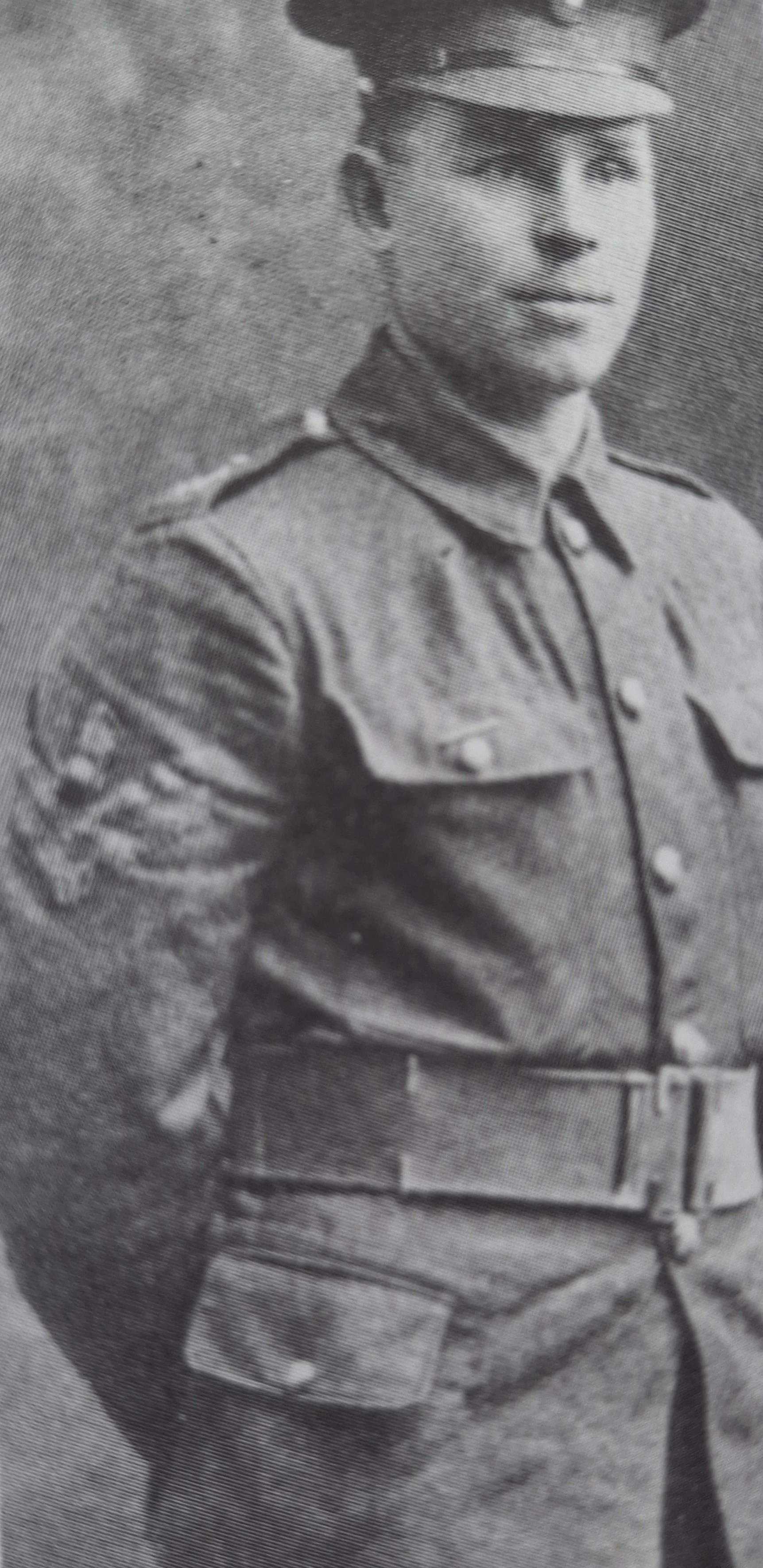
Buchan in the uniform of the Grenadier Guards during the First World War.
Photo Credit: The Daily Telegraph
While still in the Grenadier Guards, Buchan won the Military Medal, a gallantry decoration awarded to warrant officers, NCOs, and other ranks for bravery in battle on land. The best account of how he won this comes from an online source which otherwise makes some errors about Buchan’s career (stating that he played for Leyton Orient and that it was his choice to play for England) but which claims to have the story from Buchan’s granddaughter.
According to this, Buchan’s unit was pinned down in battle. In an effort to save his men, their captain stormed a German lookout post with his men, including Buchan, close behind. They took the post but in doing so, Buchan was bayoneted in the foot by one of the remaining defenders.
Fortunately for his football career, the bayonet entered his boot and went straight through the gap between his toes. His Military Medal was secured when, under enemy fire, he went back to their mess tent to get food for the men of his unit as their rations had run out.
Competitive football returned for the 1919-1920 season and Buchan picked up where he left off, finishing again as Sunderland’s top scorer, and delighting the Roker Park crowd.
They finished 5th in the league and were knocked out of the FA Cup by eventual winners, Aston Villa. Buchan, a man of sharp intellect and many interests, took on additional pursuits to professional football when he returned to civilian life.
Prior to the war, he had written for newspapers on both Wearside and Tyneside. Now he took up a teaching post at Cowan Terrace School in Sunderland. Cowan Terrace, the street on which the school stood, was named after one James Cowan, who had opened a boarding school in William Street in 1822. In 1824, larger premises were required and the school moved to Green Street.
This became the largest boarding school in the north of England and Cowan placed great importance on sport. Cricket and handball formed part of the syllabus and football, several decades before the codification of Association Football, was introduced as an organised sport.
It is then, a neat coincidence that one of Sunderland’s greatest ever players taught at a school named after one of its greatest teachers, who had placed such importance on football.
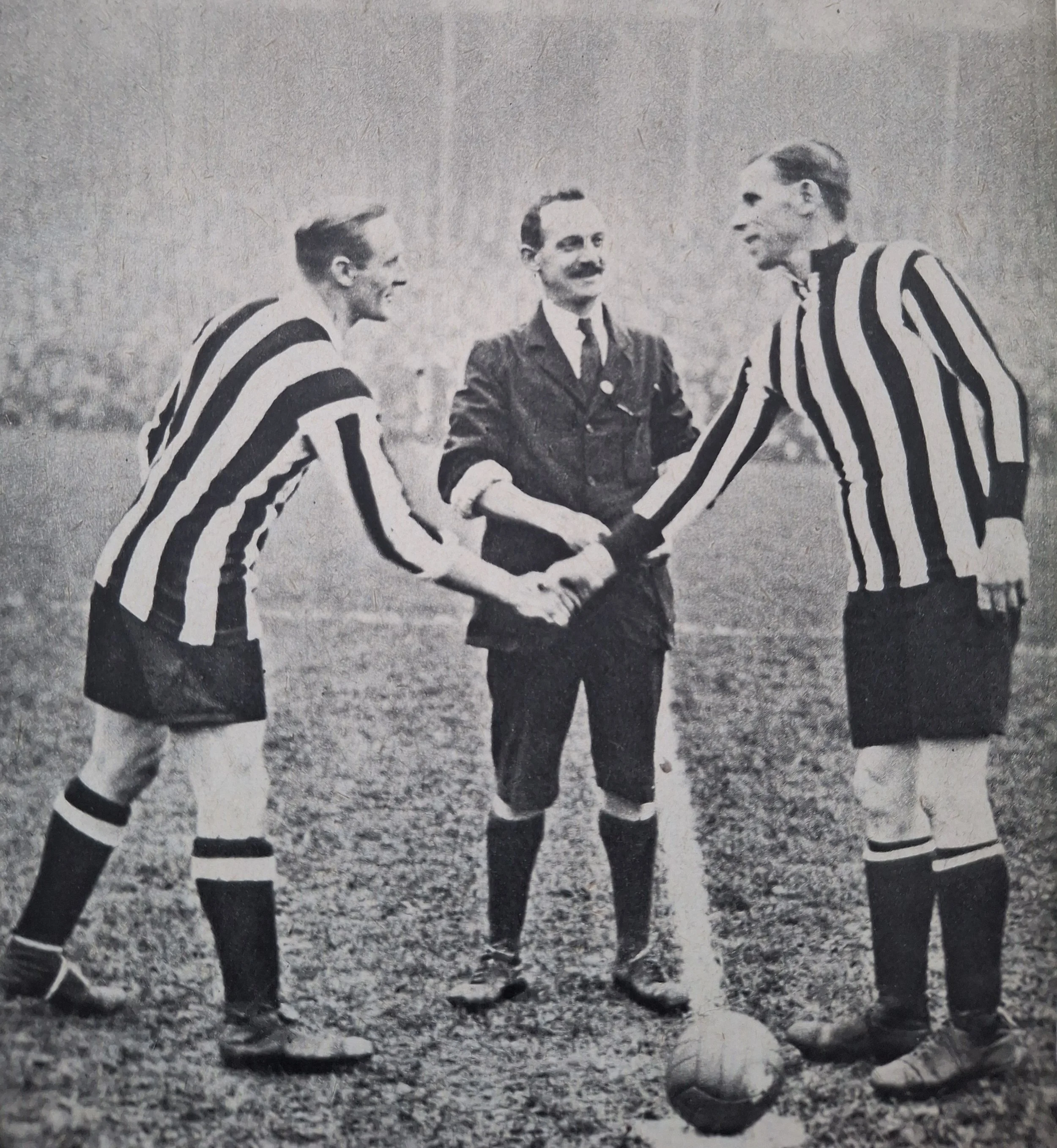
Sunderland captain, Charles Buchan (right) shakes hands with Frank Hudspeth, captain of Newcastle Utd.
Photo Credit: Charlie Buchan's Football Monthly, 1927.
Sadly, in 1845, a tragedy occurred when members of Cowan’s school went swimming at Hendon beach and two pupils and a teacher drowned.
These sad events had a terrible effect on the school and James Cowan was forced to retire and sell the school. Although it remained open under another proprietor for a few years, it was eventually sold and the whole area redeveloped with Cowan Terrace being one of the new roads built.
Cowan Terrace School opened on 29th June 1903 as Bede Higher Grade Junior School, but changed in 1904 to Cowan Terrace Council Mixed School when Sunderland Local Education Authority took over responsibility from the School Board.
Buchan’s pupils were delighted to have him as a teacher. They were keen to talk to him about football, waiting after school for descriptions of matches and some even following him home, bombarding him with questions.
Eventually, however, he came to the realisation that professional football and teaching didn’t mix. By the time Friday came round, he felt he could hardly talk to the class and couldn’t concentrate on both his football career and teaching.
The post-war period saw Buchan once again come into favour with the England selectors. Following two appearances in trial matches for England, first against The South and then against The North, in February 1920, he was picked for England’s game against Wales at Highbury on 15th March.
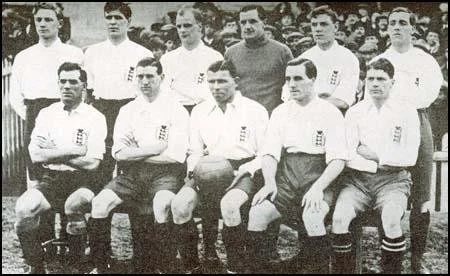
He scored England’s goal in a 2-1 home defeat. On 14th March 1921, he was selected at centre-forward for a 0-0 draw with Wales at Ninian Park in Cardiff and was named captain, becoming the 38th player to captain England and the first Sunderland player to do so.
On 21st May that year, he played again at centre-forward in a 2-0 away win over Belgium at the Charles Malis Stadium, home of Daring Club de Bruxelles, scoring once. His next England appearance didn’t come until 10th May 1923, when he again captained the side and scored, playing at inside-right, in a tour game against France at Stade Pershing in Paris.
The visitors won 4-1. He was a reserve for the two games that were played against Sweden as part of the same tour. Buchan’s final game for England was a 1-1 draw with Scotland at the Empire Stadium, Wembley. He played at centre-forward but failed to score.
A talented all-round sportsman, Buchan played club cricket in the North East during the summer, and went on to play for Durham in the Minor Counties Championship in 1920. He also played golf; everyone has their flaws.
The same year that he represented Durham, he embarked on another venture outside of football. In partnership with cricketer Amos Lowings, he opened a sports outfitter’s shop at number 24 Blandford Street in Sunderland.
By 1928, players at Sunderland, Arsenal, and Newcastle United were all said to be using the ‘Buchan’ football boot, which had models called ‘Wearsider’ and ‘Skora’. Lowings later went solo, with premises in Frederick Street (a street that was later the subject of a song by the Sunderland punk band, The Toy Dolls), and supplied the kit worn by Sunderland in the 1937 FA Cup Final.
The England team that played Wales on 14th March 1921, Buchan’s first game as England captain.
Photo Credit: Spartacus Educational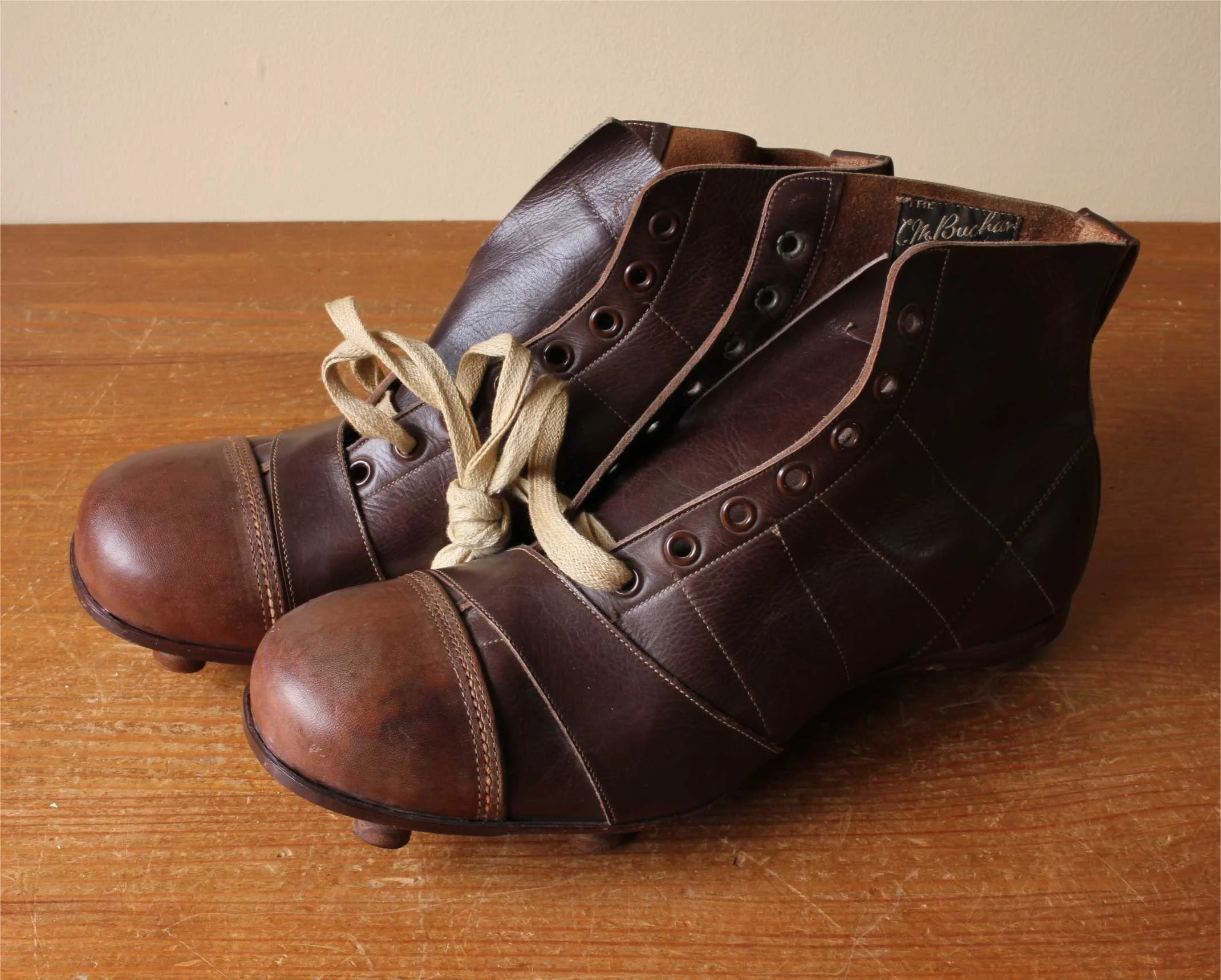
Charles Buchan football boots c.1930, the label can just be seen in the top of the left boot.
Photo Credit: Krave Antiques
1920 was a busy year for Buchan. As a member of the committee that ran the Association Footballers’ Union (a precursor to the PFA) he was highly vocal in his opposition to the Football League Management Committee’s proposal that year to reduce the maximum wage from £10 a week to £9.
Buchan was one of those that called for strike action in response. Unfortunately, he didn’t receive much support and large numbers of players resigned from the union, allowing the Football League to push through the reduction. The following year it was reduced again, to £8 during the season and £6 during the close season.
In 1925, Herbert Chapman had just arrived at Arsenal. Twelve years after Arsenal had left Woolwich and moved to Highbury and sixteen since Buchan had left Woolwich Arsenal. Chapman told Chairman Sir Henry Norris that if he wanted Arsenal to win anything, he would have to spend money.
He also told him that Charlie Buchan was the man to transform the club. In May of that year, Chapman walked into Buchan’s sports shop on Blandford Street in Sunderland and told him that he planned to sign him.
After two months of negotiations, Buchan agreed to sign for Chapman. Despite being 34 years old, Sunderland valued Buchan at £4000. Arsenal weren’t willing to pay this much and Sir Henry Norris managed to negotiate a deal whereby Arsenal paid £2000 up front and £100 for each goal Buchan scored in his first season for them.
It is generally accepted that Buchan scored 21 goals in his first season and that Arsenal ended up paying more than Sunderland’s asking price. However, research by thearsenalcollection.org.uk indicates that Arsenal actually paid a total of £3900.
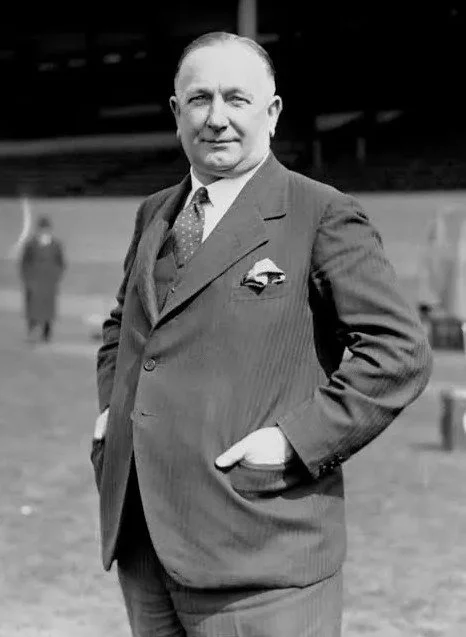
Herbert Chapman.
Photo Credit: Wikimedia Commons
The transfer caused some furore. This was, after all, one of the leading players of the period moving from one of the country’s biggest clubs to one that hadn’t yet become what it is considered to be today. A Sunderland director apparently resigned over the matter.
Buchan’s move to Arsenal upset Warney Cresswell so much that he asked to leave Sunderland too. He eventually moved to Everton, where he won the league championship in 1928 and finished that title-winning season with a fixture against Arsenal, in Buchan’s last game before retirement. Sunderland replaced Buchan with Dave Halliday, who scored 10 goals, including two hat-tricks, in his first four games.
Arsenal fans were massively excited about the signing of Buchan but, like at the start of his Sunderland career, things didn’t go well to begin with. He failed to score in his first four games and, while travelling on the tube, he overheard criticism from Arsenal fans. He decided to leave the club, just as he had in his first few weeks at Sunderland. Indeed, it was Sunderland that he wanted to return to.
Buchan’s arrival at Arsenal coincided with a change to the offside law. From this point on, there only needed to be two opponents between the attacker and the goal, not three. This effectively made it easier to score; George Camsell scored 63 goals in the 1926-1927 season for Middlesbrough in the Second Division and, a year later, Dixie Dean scored 60 goals in the First Division for Everton.
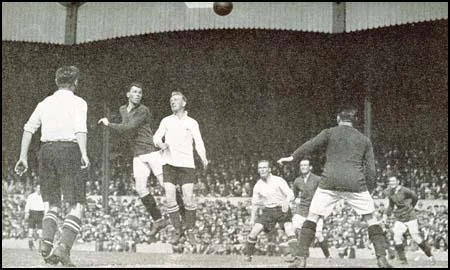
Buchan leaps for a header during his first game for Arsenal after leaving Sunderland.
Photo Credit: Wikimedia Commons
Following a 7-0 defeat to Newcastle during Buchan’s early days at his new club, Arsenal’s tactical approach was discussed in depth during a heated team meeting.
Herbert Chapman admired Buchan for his independence of thought about the game, something that was not common in players of that era, and was willing to listen to his thoughts.
Buchan argued that the change in the offside rule meant that the centre-half had to take on more defensive responsibility.
Although they weren’t exactly a new phenomenon, he had been alerted to the benefits of the ‘stopper’ centre-half by his former Sunderland team-mate, Charlie Thompson, who was a physical centre-half who could drop into the back line. It was notable that in the defeat to Newcastle, the black-and-white’s centre half had dropped very deep, offering little to the attack, but breaking up Arsenal’s attacks, allowing them to dominate.
Buchan also argued that withdrawing the centre-half left the team short in midfield. His solution was that he should play deeper than his usual inside-right role to provide an extra body in midfield. Chapman, however, valued Buchan’s goalscoring ability too highly, and instead gave the role of withdrawn inside-forward to Andy Neil.
This was the beginning of the W-M formation for which Chapman and his Arsenal team became known. The change in shape had an immediate effect and Arsenal and Buchan’s form picked up, helping Chapman to persuade Buchan to stay. They went on to finish second behind Huddersfield Town, which was the highest a London team had ever finished in the Football League.
Buchan stayed with Arsenal until 1928, when he retired. During that time, he helped Arsenal to their first FA Cup Final in 1927, where they lost to Cardiff City. He scored 56 goals in 120 games for Arsenal but it was his contribution to Arsenal’s tactical approach that directly led to the success they had in the 1930s, with Alex James taking on Buchan’s role in the team.
After retiring, Buchan resumed the journalistic career that he’d started while he was still playing at Sunderland. Initially, he wrote about for football for the Daily News, which was later renamed the News Chronicle. He also wrote about other sports and commentated for the BBC. In 1938, he co-founded the Association of Golf Writers and in 1947, he was one of the originators of the Football Writers’ Association.
In 1951, Buchan went into publication himself, launching the magazine Charles Buchan’s Football Monthly. This period saw a surge in sports publications in response to increased public interest following the 1948 Olympics.
The aim of Buchan’s magazine was “to provide a publication that will be worthy of our National game and the grand sportsmen who play and watch it”. The publication made extensive use of colour and was printed on better quality paper than other magazines. Buchan wrote columns for the magazine on subjects such as the state of the game and tactics.
One of the early contributors was Brian Glanville, who would go on to become one of Britain’s best-known football journalists. Glanville would later describe Buchan’s prose as “plodding” and his broadcasting as “pedestrian”.
This seems somewhat unfair as Buchan was unafraid to express his strong opinions about the game, and was a highly respected authority. He was always worth paying attention to.
He is, however, one of the British football establishment that has gone down in history as being smug and complacent about the standards of English football due to his comments in the lead up to the famous 1953 game between England and the great Hungarian Aranycsapat team. He had said that “the clever ball-control and close passing of the Hungarians do not alarm me in any way”.
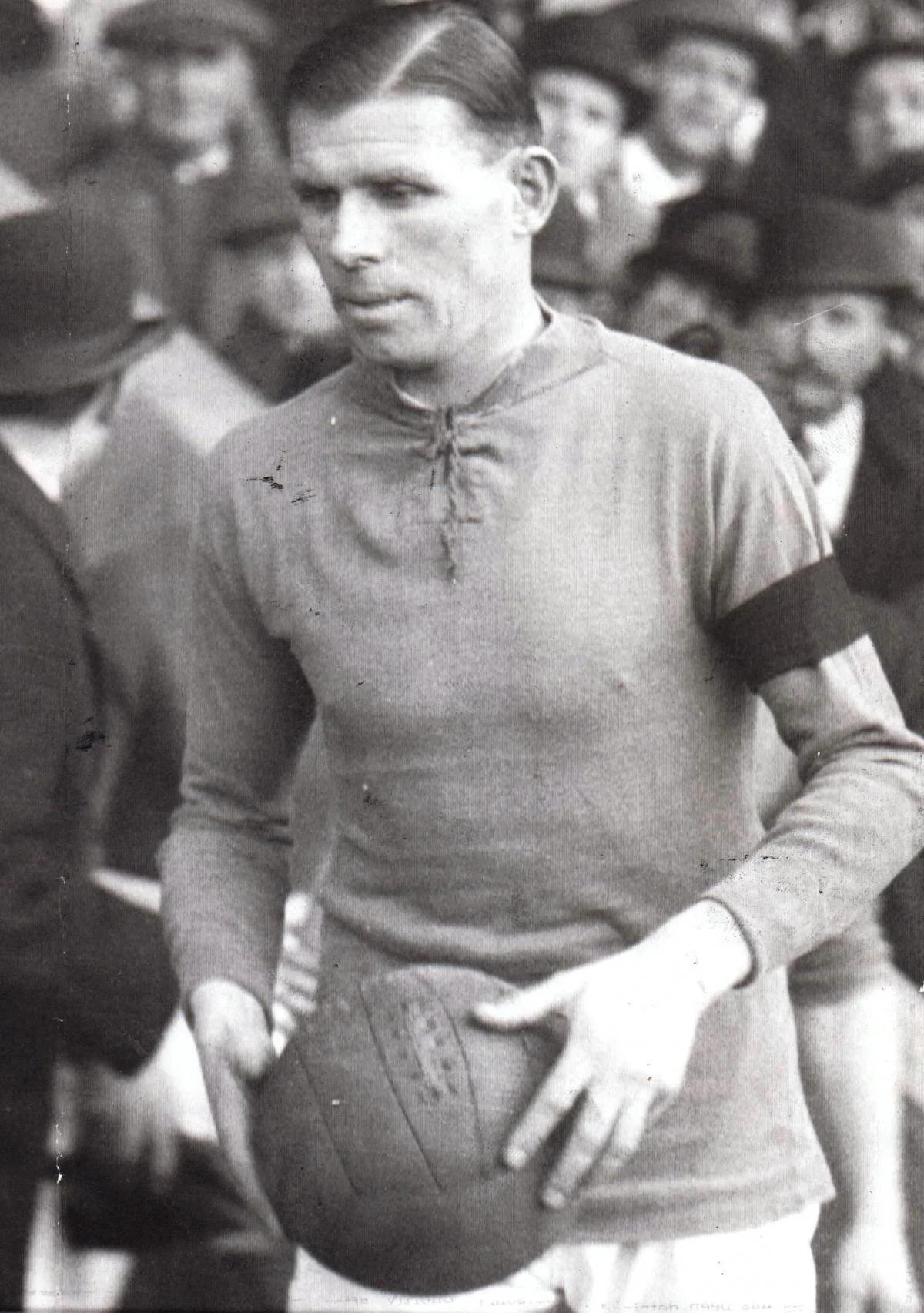
Buchan in Arsenal colours in 1925.
Photo Credit: The Northern Echo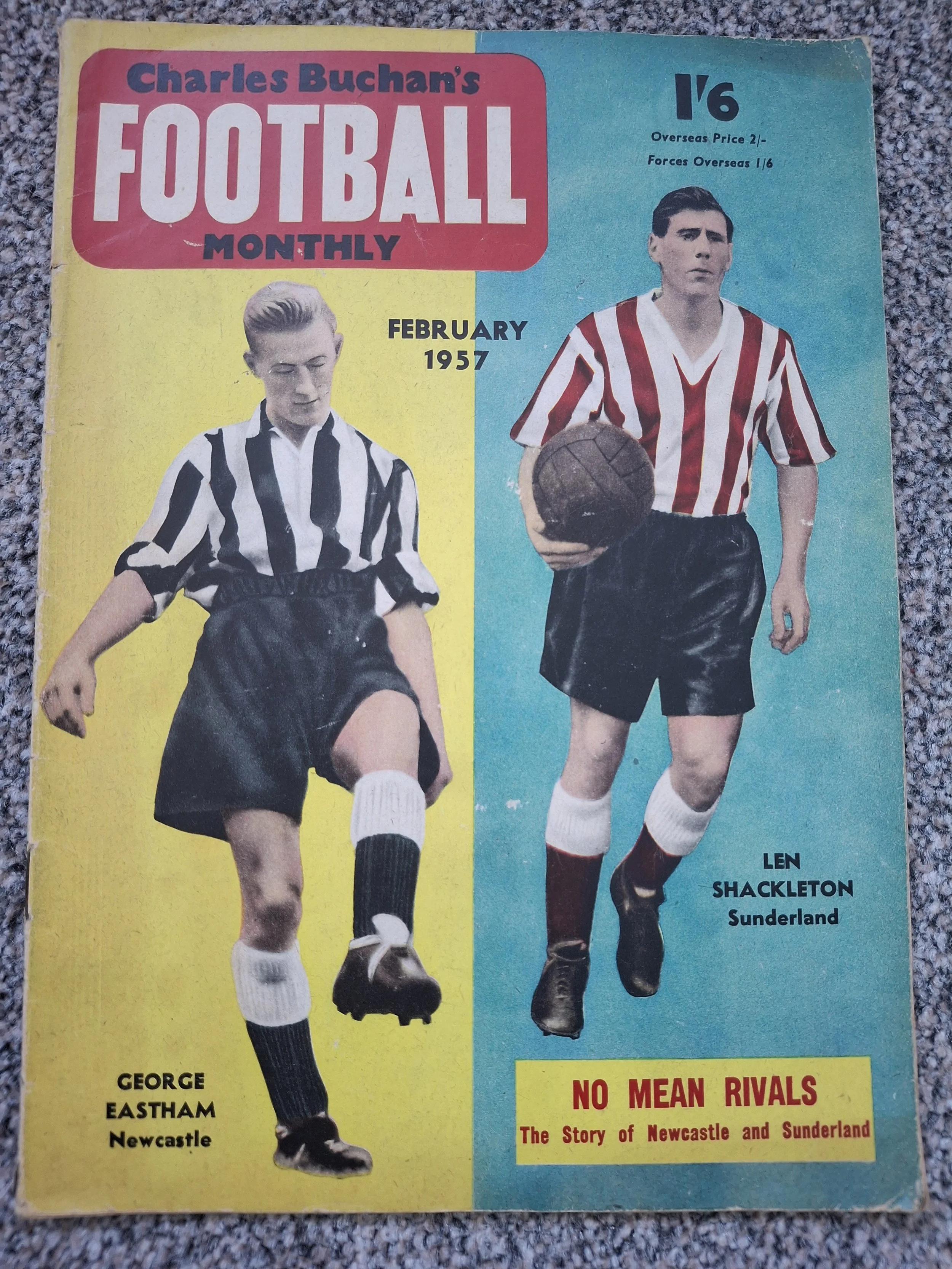
The cover of Charles Buchan’s Football Monthly from February 1957. Buchan was not, however, as insular, short-sighted, or dismissive of continental football as his comments in 1953 would suggest; he later described Hungary’s victory as a “rhapsody”. When Dynamo Moscow beat Arsenal (including guest players Stanley Matthews and Stan Mortensen) during their famous 1945 tour of Britain, Buchan stated that “The Russians were worthy of their victory” and that, although their defence had been troubled by Matthews, their attack had been “superb”.
Later in that tour, a conference was arranged between representatives of Dynamo and various luminaries from the British game which was intended to be an interchange of experiences, opinions, and hints. Buchan was impressed by the Dynamo contingent, and critical of the British football establishment, noting that “unlike a lot of our experts, the Russians are quite willing to learn from experience”.
Writing in 1955, he said “As reigning World Champions, Germany must be given No. 1 in the world soccer ranking list, but I rate both Hungary and Uruguay above them.” He ranked England not just behind these three teams but also behind Brazil and Austria.
He was also quick to give his opinion on matters outside of, but related to, football. In the March 1956 edition of Charles Buchan’s Football Monthly, he wrote “Though I am by nature a mild-tempered man, I got very angry when reading reports I received from South Africa which made it painfully clear that the ‘colour bar’ has crept into soccer.
Competitive football under the South African FA is closed to coloured people. The happy spirit of a game played throughout the world is being sullied by racial prejudice”. The following year, he was critical of the “rough play” of the England team that toured South Africa, and was happy to conduct his resulting disagreement with the FA on the pages of Charles Buchan’s Football Monthly.
In addition to Football Monthly, Buchan also published music magazines Melody Maker and Disc. Buchan, apparently, briefly employed the young Cliff Richard as an office boy and it is claimed that John Lennon attended one of his publishing parties.
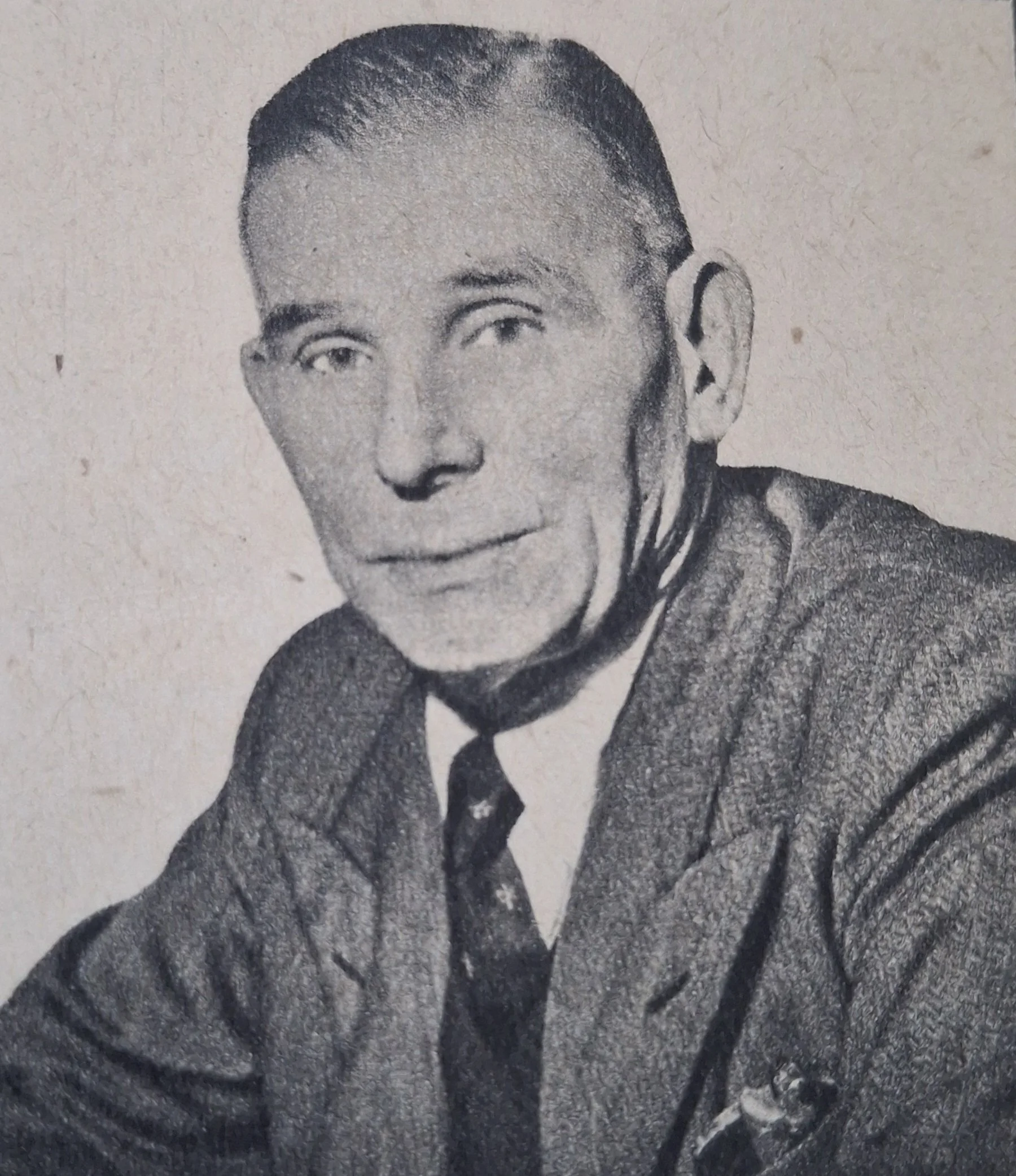
Buchan in later life.
Photo Credit: Charlie Buchan's Football Monthly
Charles Buchan died in 1960, aged 68, while on holiday in the South of France. Buchan and his wife, Ellen, were regular visitors to the Hotel Metropole in Beaulieu-sur-Mer. Every day at 11am, they drank champagne at the nearby casino. On the 25th June that year, following a win at the casino, Buchan, who had a pre-existing heart complaint, suffered a heart attack and died.
Following his death, the News Chronicle described him as “that rare combination, the complete footballer and the perfect gentleman.” Manchester United manager, Matt Busby said “Charles Buchan was not only a great player himself but a wonderful help to players and manager alike behind the scenes.
Throughout the years I have obtained very sound advice from him during our many conversations. He will be greatly missed in the future”. High praise also came from Chelsea’s Danish centre-half, Nils Middleboe “I say without hesitation that his all-round cleverness, both technically and tactically, was so formidable that all of the many great forwards of my time, both English and Scottish, Charles Buchan was the greatest”.
Former Sunderland chairman Bill Ditchburn’s tribute was particularly personal “He was the greatest player I ever saw. He was a gentleman footballer in every respect, a master of the ball with his head and either foot. He was an idol of the crowd and it was a sad day for the club and its supporters when he was transferred to Arsenal”.
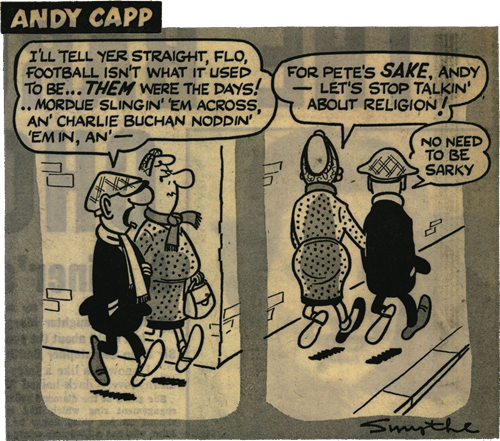
The local affection for the partnership between Charles Buchan and Jackie Mordue is immortalised in an Andy Capp strip, the cartoon about a working-class County Durham man that first appeared in 1957.
Photo Credit: The Daily Mirror
Charles Buchan’s autobiography, A Lifetime in Football, makes for fascinating reading. This is a player whose career began over 100 years ago, when the football world was quite different. For example, amateur footballers still played at the highest levels at this time.
He played, for a Football League XI, alongside the famous amateur and England international Vivian Woodward, an architect by profession who played over 100 games for both Tottenham and Chelsea.
On 14th March 1921, when Buchan became the first Sunderland player to captain England, the England goalkeeper was Bert Coleman of Dulwich Hamlet. As captain of England in the 4-1 win in Paris in May 1923, he was admonished for shaking hands with an amateur player while celebrating a goal.
It wasn’t the done thing for a lowly professional to show such familiarity with a gentleman amateur. Buchan also played alongside or against some legendary players of the era, like Steve Bloomer, George Hilsdon, and Billy Meredith and met historical figures such as Juan Perón, Benito Mussolini, and King George V.
Buchan’s book describes the conditions that footballers lived and worked under in the first half of the 20th century, particularly in terms of pay, contracts, and training. He recounts numerous stories and anecdotes, both sad and amusing, about the leading football managers, players, and administrators of his era.
As the book progresses, covering Buchan’s career in the media, his often strong opinions on football come to the fore. These include his opposition to coaching for professional clubs as “you can’t teach an old hand new tricks” and that the 1949 expansion of the Football League from 88 to 92 clubs was a bad idea, leading to the lowering of playing standards, because there weren’t enough players to go round.
It is particularly interesting to compare some of his opinions to the complaints that are often made about modern football, and particularly the Premier League. He considered that the price of attending football games in 1955, at 1 shilling and nine pence, was too high.
He bemoans the fact that there are fewer outstanding personalities in 1955 than in the “old days”, saying they have been “sacrificed in the craze for streamlined teamwork” (although he goes on to add that players were just as good as they ever were, but their individuality has become lost). He also asserts that “soccer in the old days was tougher”. Perhaps it’s natural to think that the game has lost some of its magic since your own youth.
Charles Buchan is a name that is rarely heard in the 21st century but he is amongst the most important figures in the history of football. He was one of, if not the, greatest players of his era. He was crucial in the development of the ‘W-M’, arguably the most important tactical innovation ever in football.
He was involved with the FA’s first organised youth coaching scheme, having written a ‘book of instruction’ for the News Chronicle. During his long post-playing career, he was highly influential as a journalist, broadcaster, and publisher, helping to shape the way in which the media presents football, and other sports, to the public.
Outside of football, he was a recipient of the Military Medal for bravery in battle. Much more than that, he was known as a gentleman, and a generous, caring man. On his return from the First World War, he was involved in efforts to support footballers wounded in battle, and the widows and families of footballers killed during the conflict.
In the words of former Irish international and Manchester United manager, Frank O’Farrell, whose football career overlapped with Buchan’s journalism career, and who wrote the foreword for the 2010 edition of Buchan’s autobiography, “the words ‘legend’ and ‘giant’ are overused these days, applied to personalities that don’t remotely deserve them. In my opinion, Charles Murray Buchan was both a legend and a giant of the game”.