

Words by Tommy Potter | Published 24.06.2026The World Cup is well upon us. With the regular season finished, world cup anticipation is in full-swing.
After all, football’s crown jewell is the greatest sporting event in the world. It's a tournament that captures global audiences and imaginations; a tournament steeped in cultural significance and reverence; a tournament that inspires thousands, if not millions, around the world. Winning a World Cup can prove elusive for even the best players - just playing at the tournament is often career defining.
In fact, such is the will and determination to represent their country on the ultimate stage, with a chance to write themselves and their team into the history books, some players will go to extreme lengths to get there.
The term ‘El Maracanazo’ can provoke feelings of shame and embarrassment in two South American countries, but for different reasons. In Brazil, it refers to their 1950 world cup final defeat to Uruguay in the stadium of which the term is derived. 173,000 expectant Brazilians filled the Maracana, with celebrations well underway, the atmosphere was carnival-like. However, what transpired was the ultimate lesson in humility.
After going a goal up 2 minutes into the 2nd half, Brazil inexplicably conceded 2 goals, and with those goals, the World Cup itself. It was a defeat so unexpected that it was traumatic; the loss damaged the national psyche of a country who prided itself on the exploits of its football team.
In Chile, ‘el Maracanazo’ stirs up those same feelings of humiliation, not due to a defeat, but because of the actions of a single player. A bizarre scheme hatched by Roberto ‘el Condor’ Rojas, Chile’s #1 and captain, to have Brazil expelled from qualification for Italia ‘90 would ultimately have the opposite outcome. Chile were banned from 2 World Cups (1990 and 1994), while Rojas’ career was left in tatters.
Roberto Rojas was born on the 8th of August 1957. The young Rojas started his career with the small Santiago based outfit Clube de Deportes Aviacion. The early promise he showed while at Aviacion earned him a move to Chile’s biggest and most popular football club, Colo-Colo, in 1982. Under the spotlight at Colo-Colo, Rojas really began to make a name for himself.
Known for his charisma and agility, his ability to pull off acrobatic and eye-catching saves earned him the nickname ‘El Condor’, a reference to the large Andean bird.
Rojas’s career at Colo-Colo was a fruitful one. He played for the club between 1982 and 1987, during this time he won 2 league titles in 1983 and 1986, as well as 2 cup titles in 1982 and 1985. In 1983, a year after his arrival at the Santiago giants, Rojas made his debut for the Chilean national team.
Such was the hype surrounding Rojas at the time, he was beginning to draw comparisons to the great Chilean goalkeeper of Scottish descent, Sergio Livingstone. High praise indeed.
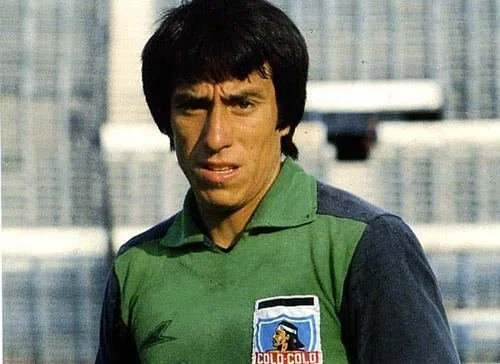
Roberto Rojas during his career at Colo-Colo.
Photo Credit: Alchetron
During the group stage of the 1987 Copa America , Chile put in arguably their greatest ever performance up to that point. A 4-0 demolition of Brazil saw Chile advance past the group phase at their rivals' expense.
With a Brazilian audience watching on, Rojas impressed, and shortly after Copa America ended, he signed with Sao Paulo - the club where his career would ignominiously end only 2 years later.
Chile had hosted the World Cup in 1962, finishing a very respectable 3rd. However, in the succeeding decades, international success eluded them. They only qualified for England ‘66, Germany ‘74, and Spain ‘82.
For a country whose people have a deep love for football, this was hard to take, especially when their more illustrious neighbours, Argentina and Brazil, were winning tournaments.
Even in the Copa America, Chile were perennial underachievers; always showing up, but rarely troubling the latter stages. The 1987 Copa America marked a turning point for Chile and their fans in terms of expectations and attitude.
The 4-0 battering of Brazil in the group was just the beginning, as they went on to be runners-up to Uruguay in the Argentinian hosted competition. The aim was to now qualify for italia ‘90.
In previous eras, CONMEBOL qualifiers consisted of 3 separate small groups where only the winners would advance and the best 2nd placed team would enter into a play-off with an Oceania nation.
To complicate matters further, ahead of Italia 90, Argentina were already guaranteed a spot as they were the defending champions, having won the World Cup in 1986. This meant that only the 2 group winners with the best record would qualify automatically, with the other group winner facing a play-off. No 2nd placed teams would have any chance of qualifying.
Chile were drawn in a group alongside Brazil and Venezuela. Venezuela didn’t have anywhere near the same pedigree as either Brazil or Chile, so it was a straight shoot out between La Roja and Selecao as to who would be travelling to Italy the following summer.
Passion for the beautiful game runs deep in South America, and often enough that ‘passion’ would boil over leading to very tempestuous games between competing countries.
Chile and Brazil were no exception; games between them were often played in a cauldron like atmosphere that would frequently descend into violence. Underhanded, unscrupulous tactics were regularly deployed by both teams in order to gain any advantage possible.
‘Mas bandidos que los bandidos’ (‘more bandits than the bandits’) was a motto coined by the Chileans, and it perfectly encapsulates the attitude of winning at all costs.
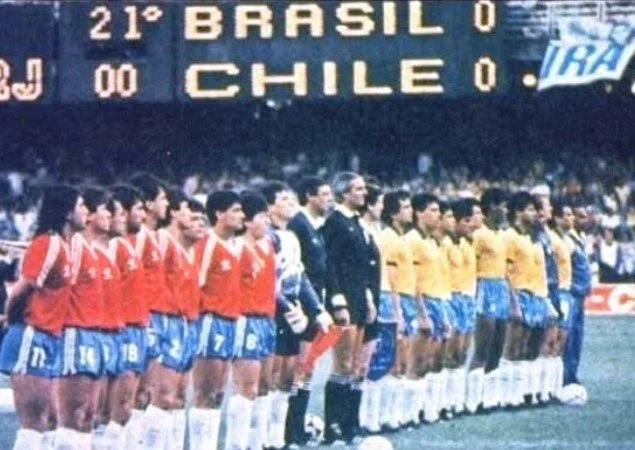
The team line-ups for Chile v Brazil.
Photo Credit: AS Chile
It is an attitude fostered by football's link to nationalism in many South American nations. Football and nationalism will always be linked; the very nature of international football makes this unavoidable. During the 80’s in Chile and Brazil (along with many other South American countries) football became the symbolic arena for many different political causes; from military dictatorships to the transition towards democracy; from economic and regional crises to notions of masculinity and national pride.
Football was, and still is, a malleable tool that can be used to influence and manipulate due to its vast popularity. However, this also meant that wholly unacceptable behaviour was excused, and even encouraged, when it came to football, such was the desire to win.
Before the now infamous ‘El Maracanazo’ incident in Rio, Chile and Brazil had already faced each other in the group at Chile’s Estadio Nacional in Santiago. Unsurprisingly, the game wasn’t lacking in drama and farce.
Before a ball was even kicked, the Chileans already had their backs up as they adopted a conspiratorial tone when talking about the upcoming matches against Brazil. In their eyes the 3 time World Cup winners were FIFA’s darlings.
They assumed everything would be weighted in their favour, and that there was no way FIFA would allow any other team to qualify ahead of the Selecao. The fact that the FIFA president was Joao Havelange, a Brazilian, simply confirmed Chile’s theory: by hook or by crook, Brazil would be at Italia ‘90.
With tensions in the build up to the first game in Santiago running high, FIFA introduced a protocol whereby both teams would line up together in the tunnel before kick-off and enter the pitch together.
The thought process being that if both sets of players exited the tunnel at the same time, the home fans would be less likely to try and physically assault the opposing team for fear of hurting their own players. It makes sense - in theory. However, it also relies on both teams honouring the protocol.
With the stakes so high and national honour on the line Roberto Rojas, never one afraid to push limits, decided it wasn’t a time for ‘niceties’ and led his team out first, leaving the Brazilians vulnerable and at the mercy of the baying Estadio Nacional crowd.
It set the tone for the game, as fights between players broke out before the match even started. The game itself was characterised by Chile’s ‘mean’ playing style that they hoped would disrupt Brazil’s natural flair and attacking talent.
Chile’s conduct didn’t quite have the desired effect as they left their own stadium with only a draw. A controversially taken quick free-kick levelled late for the hosts after they gifted Brazil a 1-0 lead with a ludicrous own goal.
It was not the outcome the Chile hoped for, or needed, with a group decider in Brazil still to play, and their fans took out their frustrations on the Brazilian players who needed to be protected by police shields as they left the pitch.
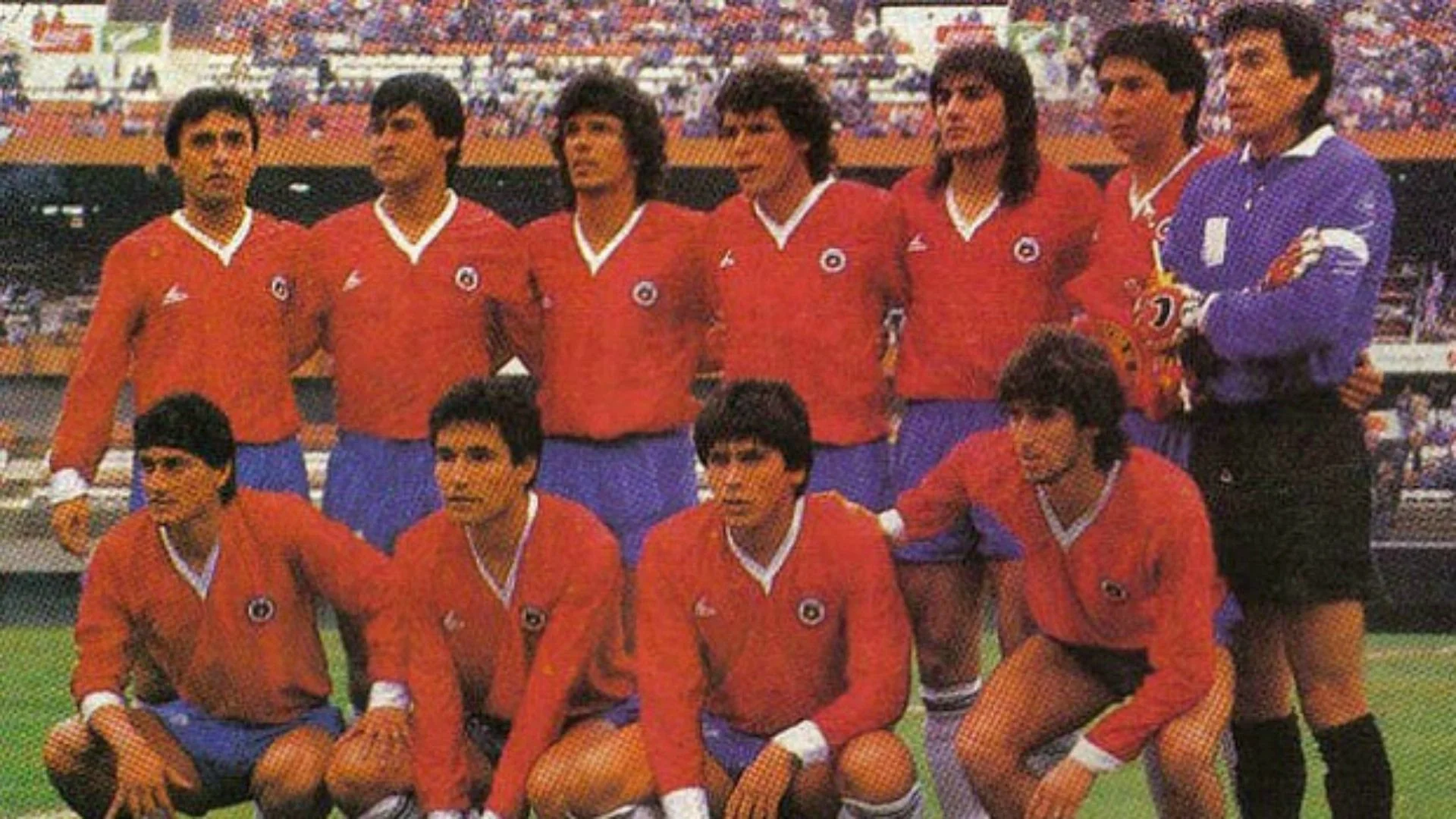
Rojas with the Chile squad.
Photo Credit: Goal
Brazil weren’t the only ones left unimpressed by the antics of Chile’s team and fans - FIFA decided to step in, and banned Chile from playing their next home game on their own soil, forcing them to play in Mendoza on the Argentinian side of the Andes.
To some it was FIFA finally showing some backbone and clamping down on unruly team practices. To the Chileans, though, it was more evidence of FIFA’s pro-Brazil agenda.
With everything that had happened in the aftermath of the Santiago game, the Chilean team arrived in Rio with a huge chip on their collective shoulders.
It also meant that tension was again running high, so much so in fact that the Chilean team bus was given a police escort from the airport to their hotel, arriving in the middle of the night with all the lights off, so as to not alert any Brazilian fans to their arrival.
Some in and around the Chile team likened the feeling to going to war, and it was this mentality that the Chileans had adopted: them against Brazil; them against Fifa; them against the world. It was the only way they could see themselves emerging victorious despite the perceived odds stacked against them.
In those days the Maracana’s capacity was enormous. 160,000 fans packed into the famous stadium, expecting to see a Brazilian victory. Confidence was sky high amongst the yellow clad home support. It appeared as if Rio’s legendary carnival had been condensed into the sloping stands.
The fact that the Brazilians weren’t showing an ounce of apprehension (apparently memories of their own ‘El Maracanzo’ had long faded) must’ve been jarring for the Chileans who knew they had to win (Brazil's superior victories over Venezuela meant a draw would be enough for them) and the arrogance they were witnessing only hardened their resolve.
Chile did at least play like a team in need of a victory as their attacking players tried to push forward whenever possible, but chances were few and far between. Rojas, however, was playing brilliantly.
His saves denied a Brazilian attack containing both Careca and Bebeto 4 times. Unfortunately for Chile, they couldn't keep the Brazilians at bay all night. With 59 minutes on the clock, Napoli’s Careca netted to give Brazil a 1-0 lead. Chile would now need 2 goals. Rojas and the rest of his La Roja teammates could feel their Italia 90 dream slipping away.
They needed a miracle, or some other kind of intervention.
10 minutes after the goal, as play continued at the opposite end of the pitch, Rojas cut a lonely figure standing in the penalty area watching as his world cup dreams crumbled in front of his eyes.
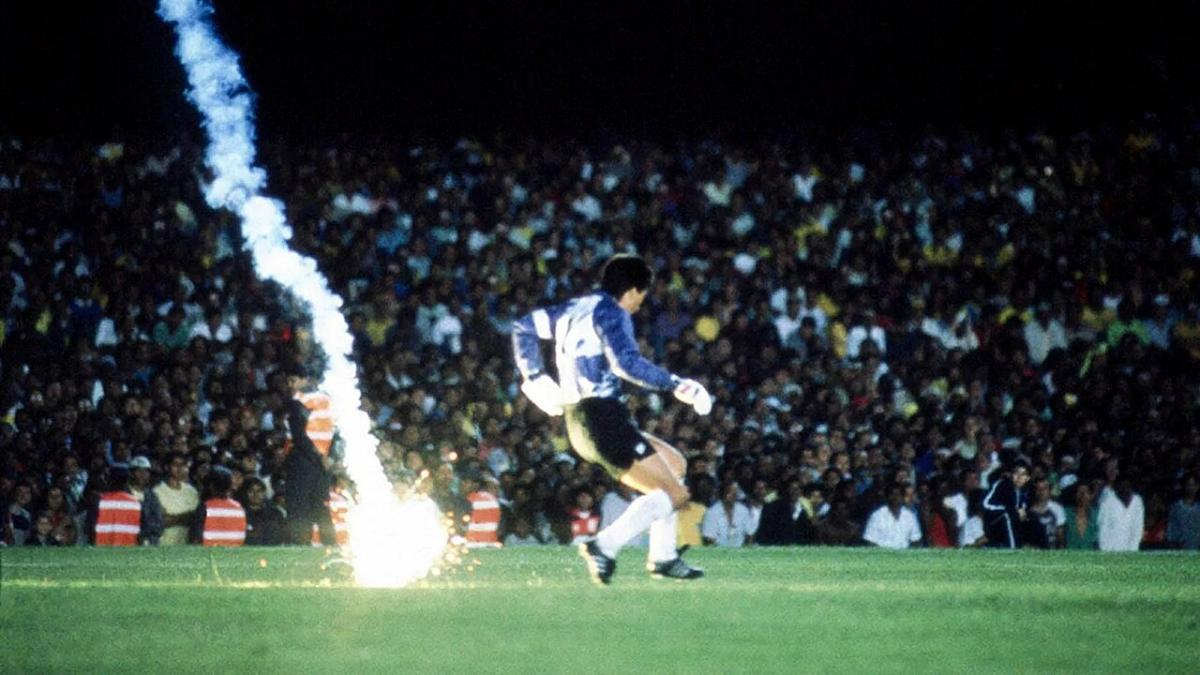
Within seconds, though, Rojas had fallen to the ground after becoming engulfed in smoke from a flare thrown by the Brazilian support. Rojas was holding in his head, writhing in apparent pain.
The referee halted the match as both teams either crowded around Rojas, or argued with each other and the referee. With the gaze of TV cameras fixed upon him, Rojas appeared to be bleeding as he exited the pitch assisted by his teammates.
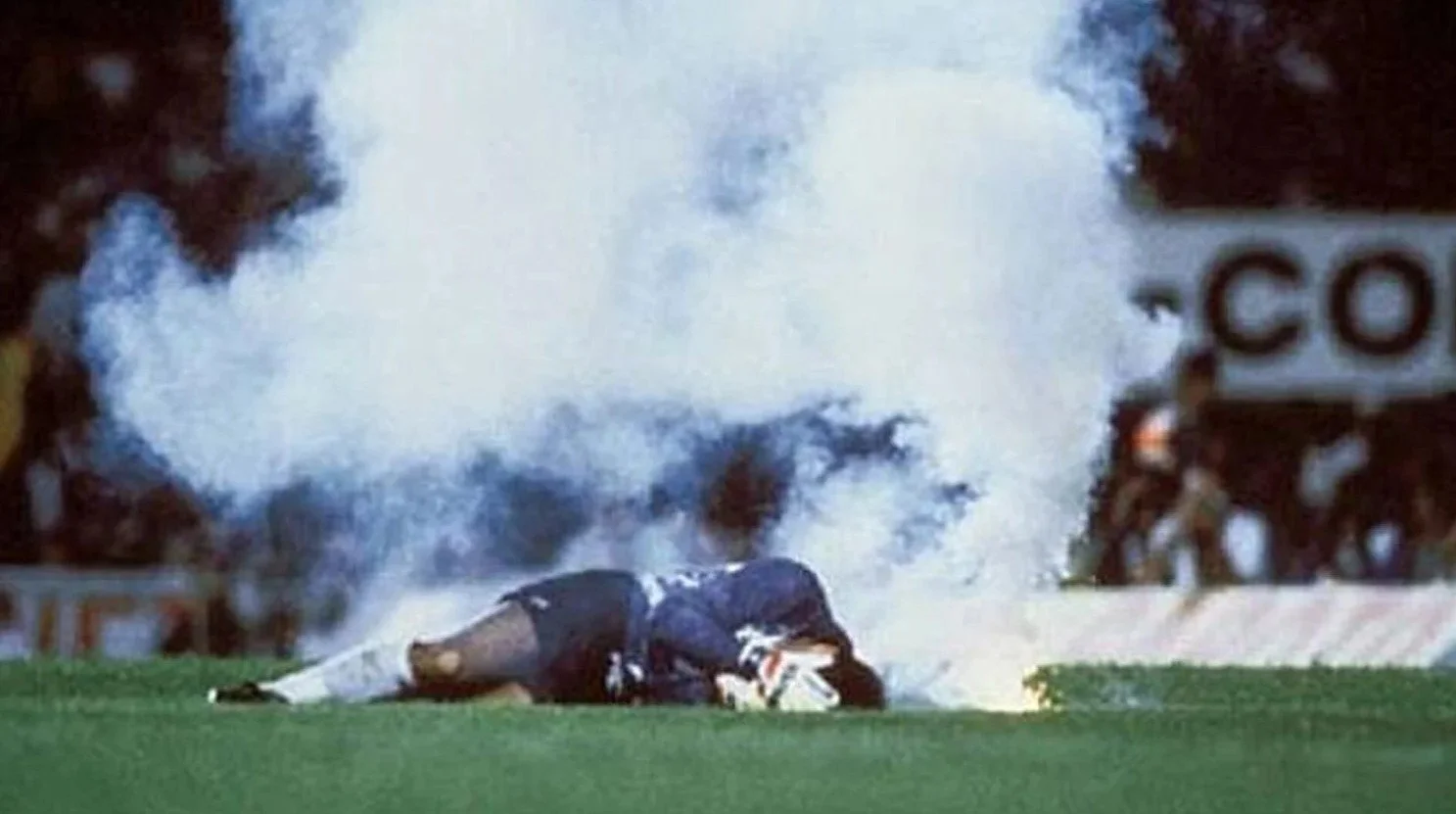
Rojas lying next to the flare thought to have struck him.
Photo Credit: The Scotsman
Incensed by what they’d seen happen to their captain, the Chileans refused to re-enter the pitch and the referee had no choice but to call the game off. An abandoned match often meant that a replay in a neutral country would be required.
It was now the Brazilians' turn to become incensed; they felt Chile had been looking for an excuse to protest, and now they had been conveniently given one.
As reporters followed Rojas back to the dressing room, it appeared that the blood and cuts were genuine. Not everyone was convinced, though. A reporter spotted Pele amongst the melee and asked what he thought of the incident.
Pele claimed the blood was fake and that it was iodine, therefore becoming one of the first people to publicly cast doubt on the veracity of what happened.
Pele may have been a dissenting voice, but the Chilean people were very much on Rojas’ side. He gave a television interview while bandaged up and everyone believed his version of events.
Why wouldn't they? He was a national hero, who, in their eyes, had put his body on the line for the country's cause. His team were also behind him, by walking off the pitch they had shown solidarity with their stricken captain.
The sense of injustice amongst the Chileans was simmering. Their captain had been subjected to a savage attack and the Brazilians couldn’t be allowed to go unpunished. As the Chileans saw it, it was only right that Brazil be disqualified from the World Cup in favour of themselves.
Protests began to take place outside the Brazilian embassy in Santiago and there were ugly scenes of people attacking anyone even vaguely Brazilian looking; the scenes were an aggressive display of nationalism that had become an extension of the game itself.
As the debacle rumbled on, more and more people began to suspect that all was not as it seemed. Why would a flare cause a cut? Surely a burn would be more likely? It was hard for people to see exactly what happened.
When the incident took place, the action was at the opposite end of the pitch from Rojas, meaning that all the cameras were facing away from him. In modern football, with the amount of different camera angles it would’ve been clear within seconds what had actually occurred. Football in 1989 didn’t have such luxuries.
Photographer Paulo Teixeira was pitchside and saw the flare fly over his head towards Rojas, but something was off. To Teixeira’s eye, the flare didn’t hit Rojas and actually landed about a foot behind him.
Teixeira didn’t manage to snap the moment with his camera, however, his friend and colleague, Ricardo Alfieri, had managed to capture the moment with his own camera.
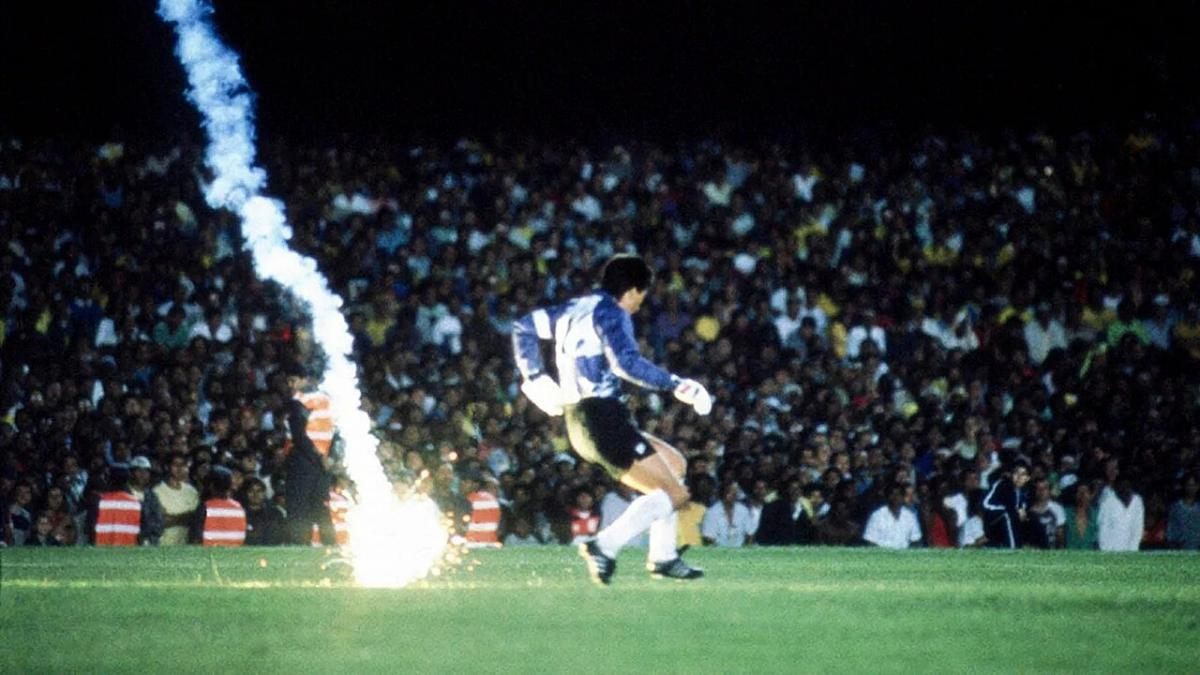
Where the flare truly landed near Rojas.
Photo Credit: Goal
Alfieri, who was there on behalf of a Japanese sports magazine, knew what he had was cast iron evidence, and with the help of Teixeira, they managed to persuade a local radio station to allow Alfieri to tell the audience about how his photos would show that Rojas was indeed faking his injury.
It was a revelatory admission that left everyone clamoring to see the photos. Knowing the importance of what they had, Teixeira and Alfieri were treated like royalty as various publications vied for the rights to publish Alfieri’s work.
Eventually, Globo, a Brazilian newspaper, won the bidding war with a bid of $5,000 USD, an enormous fee in those days. The colour photos ran the next day across Globo’s sports pages and it was clear to see that Rojas had not been hit. The first photo showed the flare landing on the pitch about a yard behind Rojas, and the next showed him rolling amongst the emanating smoke.
Inevitably, emotions ran high in the wake of Globo’s publication. Brazilians felt vindicated. They suspected something was awry, and now they knew for sure. The Chileans on the other hand struggled to come to terms with the new narrative.
They’d been so wedded to their status as victims that to see the tables turn was beyond their comprehension. Some refused to believe it, and those that did actually praised Rojas for his attempt at cheating, thus invoking the motto of being ‘more bandits than the bandits’.
With each telling of the incident, Rojas’s story became more muddled and contradictory, until finally he admitted what most already accepted to be true. In an interview, a defeated looking Rojas finally confessed to the hoax.
And when pressed on the issue of how he came to be bleeding despite not being struck by the flare, Rojas said that he concealed a razor blade in glove. It was a shocking confession, and not one his career would recover from.
FIFA came down hard on both Rojas and Chile. Brazil were granted a walk-over 2-0 victory, which saw them qualify for Italia ‘90 in place of Chile who were banned from that and the following world cup in ‘94.
Rojas was banned for life, until this ban was rescinded allowing him to coach in Brazil of all places. FIFA couldn’t establish if there were any co-conspirators alongside Rojas, but that, of course, hasn’t prevented conspiracy theories from swirling around the incident.
Chile being banned from both ‘90 and ‘94 may have meant a generation of talented Chilean players missing out on a World Cup, but some in Chile recognised the upsides.
The ‘El Maracanazo’ incident finally disavowed Chile of the toxic notion that anything could, and should, be done in the pursuit of victory.
At the time, Rojas’ and Chile’s moment of shame was a huge scandal, but looking back now it’s hard not to laugh at the absurdity of the incident.
And, frankly, it pales in comparison to the conduct surrounding the previous 2 World Cups in Russia and Qatar, as well as the upcoming one in the US (Mexico and Canada are also hosts, but funnily enough, they haven’t generated quite as much negativity as the US).
Those tournaments saw FIFA cosying up to dictators with atrocious human rights records. They allowed Qatar to build the infrastructure for their World Cup on the back of modern day slavery.
Now, this year the naked greed and corruption has ramped up even further as FIFA do their best to gouge fans at every turn, while trying to placate the whims of Donald Trump.
Compared to this, the attempted deceit from Roberto Rojas looks like mere highjinks.
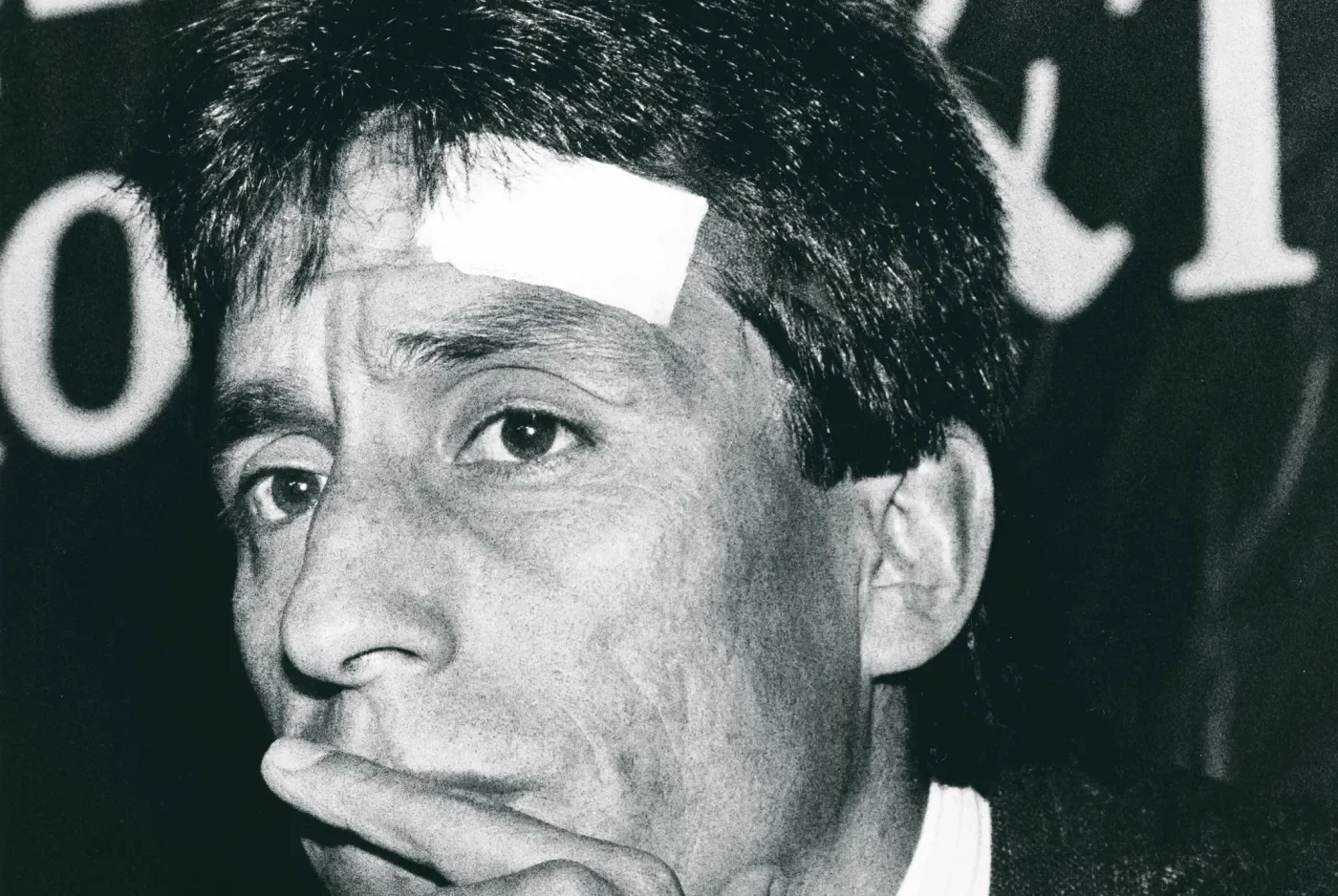
The bandaged Rojas following the incident with the flare.
Photo Credit: These Football Times