

Words by Jonee | Published 03.06.2026There are moments in football when success arrives so steadily, so clinically and so inevitably that it begins to feel less like triumph and more like confirmation, as though the outcome has been assembled in advance through repetition, control and optimisation rather than discovered through the messy unpredictability that once defined the sport, and Arsenal’s 2025–26 season sits precisely in that uneasy space where achievement and unease coexist, where dominance does not necessarily translate into joy, and where a team can be both highly effective and strangely difficult to love in the traditional sense of football romance.
It is a curious position for a title-winning side to occupy, because in most historical memory greatness is usually accompanied by a sense of emotional clarity, a feeling that a team has not only won but has done so in a way that feels expressive, inevitable or even beautiful in retrospect, yet this Arsenal team resists that kind of sentimental resolution, not because it is weak or flawed in competitive terms, but because it feels like the logical endpoint of modern football’s structural evolution, a side constructed around control, efficiency and minimisation of risk to such an extent that the experience of watching them can sometimes resemble observing a system functioning correctly rather than witnessing a team expressing itself freely within the chaos of the game.
There is a particular rhythm to their football that speaks to the era they represent; one defined by sustained possession, positional discipline, carefully choreographed pressing triggers and a striking emphasis on set-pieces and dead-ball situations as primary sources of advantage, to the point where matches are often decided less by spontaneous brilliance in open play and more by rehearsed patterns executed with precision, and while this is undeniably effective within the logic of the modern game, it also produces a curious emotional flatness, a sense that risk has been systematically engineered out of the performance wherever possible, leaving behind something functional, organised and deeply competent, yet not always alive in the older, more instinctive sense of the word.
In this respect, Arsenal become less an isolated case and more a symptom of where elite football has travelled, because the modern game increasingly rewards control over chaos, structure over improvisation, repeatability over spontaneity, and in doing so it has quietly shifted the meaning of excellence itself, so that success is no longer necessarily associated with expressive superiority but with the ability to impose order on matches until opposition resistance is gradually worn down through accumulation rather than broken through moments of individual or collective inspiration, and Arsenal, in their current form, embody this philosophy with remarkable consistency.
There is, of course, something undeniably impressive about it. No serious reading of football can dismiss the discipline required to maintain such levels of organisation across a full league campaign, nor the tactical intelligence needed to control space so reliably that opponents are often reduced to half-chances and set-piece dependency themselves, and in many ways this is football at its most advanced structural stage, where the game has been analysed, segmented and optimised to a degree that earlier generations could scarcely have imagined, yet it is precisely this sense of optimisation that creates the emotional tension, because optimisation and romanticism rarely coexist comfortably in sport, and Arsenal’s football often feels closer to the former than the latter.
This is where the bittersweet quality emerges, because it is possible to recognise the effectiveness of what they are doing while simultaneously feeling that something has been lost in translation from earlier footballing ideals, particularly those associated with expressive possession and creative risk-taking, the kind of principles often linked to Johan Cruyff’s footballing philosophy, where control was not an end in itself but a platform for creativity, movement and intuitive expression, whereas in this version of elite football control increasingly appears to be the destination, the final objective rather than the starting point for something more fluid and unpredictable.
The result is a team that often feels perfectly assembled for the demands of modern competition yet slightly distant from the emotional textures that traditionally defined great sides, those teams that linger in memory not only because they won but because of how they played while winning, and when one thinks back through football history the most enduring teams are rarely those defined purely by efficiency, but those who contained an element of risk, personality or stylistic excess, whether in the fluid attacking chaos of late twentieth-century international football, or the more expressive club sides that allowed individual brilliance to disrupt even the most carefully constructed tactical frameworks.
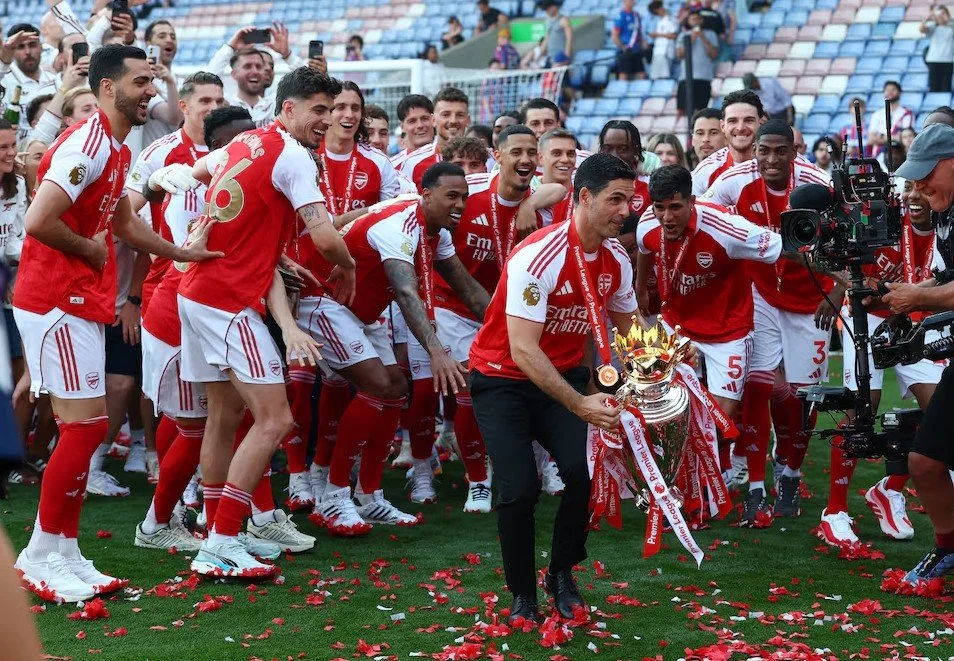
Arsenal celebrate winning the 2025/26 Premier League title.
Photo Credit: Reuters
Arsenal, by contrast, feel like a product of a footballing world that has increasingly removed that margin for disruption, where data-driven decision-making, structured pressing systems and set-piece optimisation have become central pillars of success, and where the margins between victory and failure are so fine that control becomes a psychological necessity rather than a stylistic choice, leading to a form of football that is undeniably modern but also somewhat constrained, as if every action on the pitch has already been filtered through layers of instruction and expectation before it is executed.
And yet, despite this critique, there is also a sense of inevitability about their success, because modern football does not reward aesthetic resistance in the way it once might have done, and the realities of competition at the highest level increasingly favour teams that can reproduce performance patterns consistently over long periods of time, even if those patterns do not always generate emotional exhilaration for neutral observers, meaning that Arsenal’s impending title is not an anomaly but rather a confirmation of the direction elite football has taken, where sustainability and control outweigh spontaneity and expressive variance.
This is what makes the situation so complex emotionally. It is entirely possible to acknowledge that Arsenal are doing exactly what modern football demands of champions while also feeling that the sport itself has shifted away from something more instinctive and open, and in that gap between effectiveness and enjoyment lies the central tension of their season, because success, in this case, does not automatically resolve into satisfaction, and victory does not necessarily translate into the kind of collective memory that traditionally elevates a team into myth.
In earlier eras, title-winning sides often carried a sense of personality that transcended results, whether through stylistic identity, individual brilliance or tactical innovation that still left room for unpredictability, but the modern version of elite dominance increasingly risks producing champions who are admired rather than adored, respected rather than remembered with affection, and Arsenal sit uncomfortably close to that category, a team whose excellence is difficult to dispute yet equally difficult to romanticise.
And so what remains is not a question of whether they deserved the title, but a more subtle and perhaps more interesting question about what kind of champions they will be remembered as, and whether future reflection will see them as a defining expression of modern football’s logical evolution, or as a sign of something more quietly troubling in the sport’s transformation, where winning has become increasingly detached from the aesthetic and emotional qualities that once made football feel like more than just an efficient contest of systems.
This Arsenal side represents something almost opposite, a moment of convergence, where the game has narrowed into a more unified language of control and optimisation, and while that language is undoubtedly effective, it is also less expressive, less chaotic, and perhaps less capable of producing the kind of enduring emotional mythology that once made teams unforgettable long after the trophies had been lifted.
And that, ultimately, is where the bittersweet truth sits. Arsenal have ended this season as champions, and rightly so, yet their legacy will not simply be measured in points or trophies, but in the quieter question of what their football felt like to watch, and whether success, in its most contemporary form, still carries the same emotional weight it once did, or whether football has entered an era where winning is no longer enough on its own to guarantee meaning.
In that sense, Arsenal’s 2025–26 side begins to resemble not so much an artistic project as a fully professionalised cultural product, a team in which every component is technically excellent, every movement is rehearsed, every structural detail refined to maximise probability rather than expression, and yet precisely because of that perfection it begins to feel curiously predictable, as though the emotional range of the team has been compressed into a narrower band of outcomes that prioritise control above surprise, and reliability above revelation.
The comparison to other dominant modern sides becomes almost unavoidable because it helps clarify what is missing rather than what is present. The great Manchester City teams under Pep Guardiola operated with a kind of inevitability that bordered on musical composition, each phase of play building towards chance creation with such fluid precision that even their most complex attacking sequences often felt strangely effortless, as if the system itself had absorbed improvisation into structure, producing what could only be described as controlled genius, a footballing equivalent of The Beatles at their peak, where innovation and accessibility existed simultaneously, and brilliance arrived so frequently that it began to feel normal.
By contrast, Jürgen Klopp’s Liverpool side operated in an entirely different emotional register, closer to something raw, distorted and physically overwhelming, where matches were often defined by emotional surges, transitional chaos and moments of explosive brilliance that felt almost confrontational in their intensity, like a Black Sabbath record in footballing form, less polished perhaps, but charged with volatility, danger and sudden shifts in emotional rhythm that made even imperfect performances feel alive in a way that lingered long after the final whistle.
Arsenal, in this context, occupy a more difficult and less easily romanticised space, because they do not possess the inevitability of City at their most fluid, nor the emotional volatility of Klopp’s Liverpool, instead existing in a zone of extreme competence where control is maintained so consistently that deviation itself becomes rare, and matches are often managed rather than transformed, with outcomes shaped heavily through structure, discipline and set-piece efficiency rather than spontaneous disruption or expressive overload.

Jürgen Klopp's style of play at Borussia Dortmund was often called 'Heavy Metal Football'.
Photo Credit: Daily Sundial
It is here that the “safe bet” analogy becomes more than just a stylistic observation and begins to function as a cultural critique of modern football itself, because what Arsenal represent is not simply one club’s tactical identity but a wider shift in how elite teams are constructed and rewarded, where the emphasis has gradually moved away from aesthetic risk-taking and towards minimising variance across an entire season, producing sides that are extremely difficult to beat but not always equally easy to fall in love with in the traditional sense of football romance.
There is a reason set-pieces occupy such a central role in their identity, and it is not accidental or incidental but structural, because in a league where open-play chance creation is increasingly difficult against well-organised defensive blocks, dead-ball situations become a rational and highly valuable source of advantage, yet the emotional consequence of this evolution is that goals themselves begin to feel less like spontaneous eruptions of creativity and more like the successful execution of rehearsed patterns, and while this is undeniably effective, it also shifts the emotional language of football away from improvisation and towards repetition.
None of this is to suggest that Arsenal lack quality, because that would be both inaccurate and unfair, nor is it to diminish the intelligence or discipline required to compete at the highest level of modern football, but rather to suggest that quality itself has been redefined, and that what once might have been expressed through individual brilliance, improvisational risk or stylistic excess is now increasingly channelled through systems designed to produce repeatable advantages over long periods of time, meaning that the very idea of what “beautiful football” means has become more contested than ever before.
In earlier eras of the Premier League, even dominant teams tended to carry stronger stylistic identities that translated into emotional memory, whether through Arsenal’s own late Wenger-era fluidity, Manchester United’s transitional chaos and attacking instinct, or even Chelsea’s more pragmatic but occasionally explosive directness, yet modern elite football increasingly compresses stylistic variation into narrower corridors of efficiency, where the difference between teams is often measured less by philosophical divergence and more by marginal superiority in execution of similar principles.
This is why Arsenal’s current position feels so interesting and so divisive at the same time, because it is entirely possible for a team to reach the summit of domestic football while simultaneously raising questions about what that summit actually represents, and whether reaching it through control-heavy, low-variance football produces the same kind of cultural and emotional legacy as teams whose greatness was inseparable from stylistic identity.
And so the discomfort that some observers feel when watching them is not rooted in failure but in completion, in the sense that so much of what they do feels already solved, already optimised, already reduced to repeatable mechanisms that function correctly under pressure but rarely exceed expectation in ways that feel emotionally transformative, and in that sense they become a mirror of modern elite football itself, a sport that has become increasingly successful at eliminating randomness while simultaneously narrowing the range of expressive outcomes that once gave it such unpredictable charm.
Because when one looks back at footballing history, the teams that endure most vividly in memory are rarely those that simply accumulated points with mechanical efficiency, but those that expanded the emotional vocabulary of the game while doing so, teams that made people feel something beyond certainty, whether that was admiration, shock, joy or even frustration, whereas Arsenal’s current iteration feels closer to certainty itself, and certainty, while comforting, is not always what creates memory.

How will Mikel Arteta's Arsenal side compare with Arsene Wenger's?
Photo Credit: Arsenal
And yet, the paradox remains unresolved, because this is still a team on the verge of winning the league, and in the modern game that is the ultimate currency, the final validation, the proof of superiority within the rules that now define elite competition, meaning that whatever emotional critique exists alongside them does not diminish the fact that they are operating at the highest level of effectiveness, only that the meaning of that effectiveness has changed, and perhaps narrowed, in ways that reflect the wider transformation of football in the twenty-first century.
There is, in the end, a simple honesty in recognising that preference itself is part of how football is experienced, because while the game is universal, the way it is felt is not, and just as music fragments into genres, subcultures and emotional temperaments, so too does football divide itself into those who value control above all else and those who still seek something more volatile, more expressive, more unpredictable in the way a team moves, reacts and imposes itself on a match.
As a confessed rock’n’roll lover, it feels almost inevitable that my instinct gravitates towards teams that carry a certain attitude, a sense of danger or unpredictability, something that feels slightly unpolished at the edges but alive with intention, because that is how I have always experienced the game at its most compelling, not as a perfectly engineered sequence of actions but as something closer to performance, where risk is not eliminated but embraced, where moments of chaos are not failures of structure but expressions of identity.
In that sense, football and music have always felt closely aligned, not in a literal way but in an emotional one, because both are languages of personality, and both allow for different interpretations of greatness depending on what the listener or observer values most, and there is room, of course, for every type of expression in both worlds, for precision and for distortion, for control and for improvisation, for technical perfection and for reckless genius, and none of these approaches is inherently superior in absolute terms, even if each of us inevitably finds ourselves drawn towards one more than the other.
That is why a team like Arsenal, even in a title-winning season, can feel emotionally distant despite its excellence, because excellence alone does not always guarantee connection, and while there is no question that winning the Premier League requires extraordinary levels of discipline, intelligence and resilience over a long and punishing campaign, both mentally and physically, there remains a difference between respecting a team’s achievement and feeling emotionally aligned with the way that achievement is constructed.
And I do respect it. That much is important. Because what Arsenal are doing is extremely difficult, and in many ways it represents the highest level of modern footballing competence, where games are managed with precision, where margins are controlled through structure, where set-pieces are maximised as strategic weapons, and where consistency itself becomes a form of dominance, yet even with all of that acknowledged, there remains a personal truth that cannot be engineered away, which is that I would always prefer to see a team with more visible character in the way it plays, more emotional variance in its rhythm, more unpredictability in its expression, more moments where control is temporarily abandoned in favour of instinct.
Because for me, football has always sat in the same emotional space as rock’n’roll, not in terms of aesthetics alone but in terms of attitude, in the sense that the most memorable teams, like the most enduring bands, are rarely those that simply execute everything flawlessly, but those that carry a sense of identity that is immediately recognisable, slightly imperfect, occasionally chaotic, but always unmistakably alive, and it is that quality, that sense of personality spilling beyond structure, that I find myself searching for whenever I watch the game.
There is a reason the Rolling Stones line resonates so strongly in that context, because it speaks to the idea of presence, of having seen enough, experienced enough, survived enough to understand the value of taste and instinct, of knowing what draws you in and what leaves you cold, and in footballing terms that same instinct applies, even if it is often dressed up in more analytical language than it is in music, because at its core it is still about feeling, about recognition, about whether what you are watching moves something in you beyond respect.
So, it is not a rejection of Arsenal, and it is not a denial of what they represent within the modern game, but rather an acknowledgement of difference, of taste, of emotional alignment, because just as not every band is for every listener, not every team is for every viewer, and there is something healthy in accepting that without forcing artificial admiration where it does not naturally exist.

The Arsenal side of 2025-26 have often been accused of playing a bland style of football.
Photo Credit: Arsenal Insider
And perhaps that is where the honesty of football ultimately lies now, in recognising that the game has expanded so far tactically, physically and commercially that it contains every possible version of itself at once, from hyper-controlled systems built on repetition and optimisation, to chaotic transitional sides driven by emotion and risk, and that within that spectrum each supporter inevitably finds their own place, their own rhythm, their own preference for how the game should feel when it is played at its highest level.
As for me, I will sit where I have always sat, with the misfits and the chaos lovers, with the slightly crooked, slightly unpredictable, slightly unbalanced sides that feel like they might explode into something unforgettable at any moment, because even in a sport that has become increasingly structured and refined, there is still something irresistible about the idea that football, at its best, should feel a little dangerous, a little uncertain, and a little beyond complete control.
And yet, even as that preference becomes clearer, it still feels necessary to ask what exactly has been traded in order for football to arrive at this point in its evolution, because no transformation in sport happens without consequence, and if modern elite football has indeed shifted towards greater control, greater structural precision and greater optimisation across every phase of the game, then it must also be acknowledged that what has been gained in reliability, consistency and competitive resilience may have come at the expense of something far more fragile, more intangible and ultimately more difficult to measure, but still deeply significant in the way the game is experienced and remembered.
Because control, in itself, is not inherently negative, nor can it be dismissed as a cold or sterile concept in isolation, since it is precisely what allows teams to dominate long and unforgiving seasons, to reduce variance across ninety minutes, to impose rhythm upon opponents regardless of external pressure or match context, and in that sense it represents a form of mastery that only the very best sides in any era are capable of sustaining, which is why Arsenal’s current position at the summit of the league cannot simply be framed as an aesthetic compromise without also recognising it as a demonstration of extreme competitive competence within the modern demands of elite football.
However, control also carries with it a structural tendency to smooth out edges, to remove irregularity and to reduce the space in which unpredictability can emerge, and it is often precisely within those irregularities, those moments of deviation from instruction or expectation, that personality in football most clearly reveals itself, because the unpredictable pass, the unexpected dribble, the sudden acceleration of tempo or the instinctive decision that cannot be traced back to rehearsal are the fragments of the game that tend to remain longest in memory, not because they guarantee success in a statistical sense, but because they interrupt expectation in a way that leaves a lasting emotional imprint.
Modern football, however, increasingly treats interruption as risk, and risk, within elite sporting environments, is something that is systematically reduced wherever possible in order to protect outcomes across an entire campaign, which means that the game itself gradually shifts away from moments of expressive disruption and towards patterns of repeatable control, where success is measured less by the presence of surprise and more by the absence of vulnerability, and while this produces teams that are exceptionally difficult to beat, it also produces a certain emotional uniformity in how matches unfold.
This is where the philosophical tension becomes most visible, because football has never been more intelligent, more physically demanding or more tactically advanced than it is in the present moment, and yet it is still reasonable to question whether it has simultaneously become more emotionally compressed, whether the range of expression between elite teams has narrowed, and whether the pursuit of efficiency has quietly reshaped the emotional language of the game into something more consistent, more controlled and more predictable, even if also more successful.
There was a time when even the most dominant teams carried a recognisable stylistic identity that extended beyond formations or tactical labels, when one could identify a team not only by how it defended or pressed but by how it fundamentally approached the act of playing football itself, whether through tempo, improvisation, individual licence or collective unpredictability, and although those elements still exist in modern football, they often appear more carefully contained within systems that allow less room for deviation than the sides of earlier eras.
Arsenal, in this sense, are not an anomaly but rather a refinement of this broader process, representing what happens when a long arc of tactical evolution reaches a point where almost every phase of play has been accounted for, rehearsed and structurally optimised, from build-up patterns to pressing triggers to set-piece routines, until the match itself becomes less about spontaneous invention in real time and more about the execution of pre-designed principles under pressure, which is why their football can feel so controlled, so coherent and so difficult to disrupt, even if it does not always feel emotionally expansive in the traditional sense.
And again, none of this is a criticism of their effectiveness, nor an attempt to diminish the intelligence required to sustain such levels of organisation across an entire season, because what they are doing is, by any serious measure, extremely difficult and entirely legitimate within the logic of modern competition, yet there remains a distinction between acknowledging competitive excellence and experiencing emotional resonance, and it is within that gap that the discomfort often arises for those who are more attuned to the expressive side of the game.
Because there is also a reason why certain teams outlive their trophy counts in collective memory, why they become reference points not only for what they achieved but for how they felt to watch, and it is because the emotional archive of football is built not solely on success but on expression, and expression itself requires moments where control is loosened just enough for something unexpected to emerge, whether that be through individual brilliance, collective improvisation or even tactical imbalance that creates space for spontaneity.
This is why even teams that fall short of ultimate success can, over time, feel more alive in memory than those who win everything, because they contain volatility, risk and identity that survive beyond the final standings, and it is also why discussions about great sides are rarely confined purely to trophies, but instead expand into questions of style, rhythm, personality, courage and imagination, all of which are more difficult to quantify but far easier to emotionally recall.
Which brings the argument inevitably back to Arsenal once more, and to the increasingly unavoidable question of what kind of champions they will come to represent.
While there is no doubt that they have succeeded in the most important metric that modern football offers, there remains a quieter and more subjective debate about what that success actually feels like, and what kind of footballing identity it contributes to the wider historical story of the game.
Not lesser champions in any meaningful competitive sense, but different ones in emotional and stylistic terms.
Champions of control rather than chaos, champions of minimised risk rather than maximal expression, champions of structure rather than spontaneity, and whether that distinction is considered significant or irrelevant ultimately depends on what one believes football is fundamentally for, whether it is a problem to be solved with maximum efficiency or an art form that still carries meaning in its imperfections.
And that, ultimately, is why this Arsenal team, for all its brilliance, for all its discipline, and for all its inevitability, is not quite mine.