

Words by Dave Proudlove | Published 11.02.2026Even though they’ve been a Football League club for almost 20 years now, it still sometimes surprises me when I hear the name ‘Burton Albion’ read out in the full-time scores.
Burton Albion is a relatively young football club but with historic roots, formed in 1950 when the original Burton Albion merged with Burton Town. They joined the Birmingham & District League, before joining the Southern League eight years later. The appropriately monikered Brewers became a much respected non-league club competing in both the Southern League and the Northern Premier League, and in the early 1980s, Neil Warnock took charge at Eton Park – the club’s former home – one of his first managerial roles.
The club changed forever though in October 1998, when Nigel Clough was named the Brewers’ player/manager. Clough Jr. set Burton Albion on an upward trajectory, and when he left for Derby County in January 2009, the club was on the brink of the Football League and in a new purpose built home, the Pirelli Stadium. Roy MacFarland eventually saw them over the line, and they have remained in the Football League ever since, at one point reaching the heights of the Championship. The rise of Burton Albion is one of English football’s greatest achievements, yet is perhaps a little overlooked.
Burton Albion may presently be the town’s senior football club, but they weren’t the first, and they weren’t the first to reach the second tier of English football. In 1871, both Burton Swifts and Burton Wanderers were formed, and the Swifts went on to join the Football League in 1892 before merging with Wanderers in 1901 to form Burton United. United remained in the Football League until 1907, and in 1910, they played competitive football for the final time. In 1924, the dormant Burton United was merged with another local club, Burton All Saints, and became known as Burton Town. The club eventually came together with Burton Albion in 1950 to become the club we know today.
While the home of football in Burton-upon-Trent today is the Pirelli Stadium, some argue that it could be nearby St. George’s Park, while the town’s original home of football was Peel Croft, Burton-upon-Trent’s first Football League ground where Burton Swifts played their football from 1890 until 1901, when the newly created Burton United moved in. Prior to Burton Swifts taking on Peel Croft, the ground was used for rugby union and was the home of Burton RFC. It was officially opened as a football ground in September 1891, with a friendly between the Swifts and Derby County on 2 September. The following year, Peel Croft’s record attendance of 5,500 was recorded for a local derby with Burton Wanderers in the FA Cup.
Disaster struck at Peel Croft in 1907 when a fire destroyed the ground’s main stand, which may have contributed to Burton United losing their Football League status, despite the club building a 600-seat replacement. Burton United remained at Peel Croft, but when the club ceased playing competitive football in 1910, Burton RFC returned and the ground hosted rugby union once again.
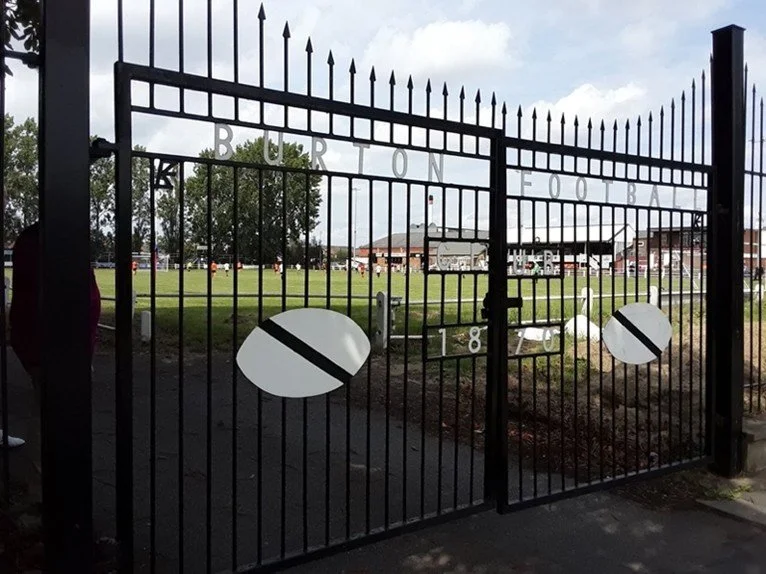
The entrance gates at Peel Croft.
Photo Credit: Heed Hopper
Burton RFC remained at Peel Croft for more than a century before announcing in 2017 that they intended to leave for a new modern facility in Tatenhill. Peel Croft finally fell silent in 2019, and was demolished in 2021, replaced by a Lidl supermarket.
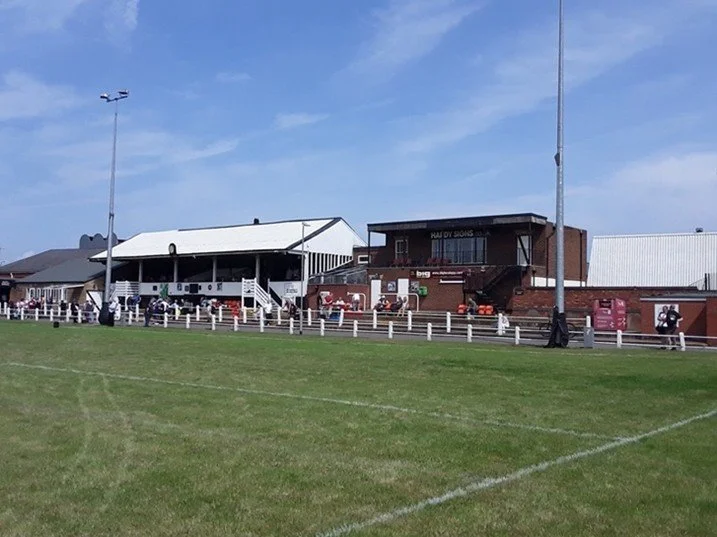
Peel Croft prior to its demolition.
Photo Credit: Heed Hopper
Burton-upon-Trent is most famous for beer of course, and central to the town’s brewing heritage is the Bass Brewery, founded in 1777 by William Bass. Within a century, it had become the biggest brewery in the world, with an annual output of a million barrels, and its famous red triangle logo became the world’s first registered trademark.
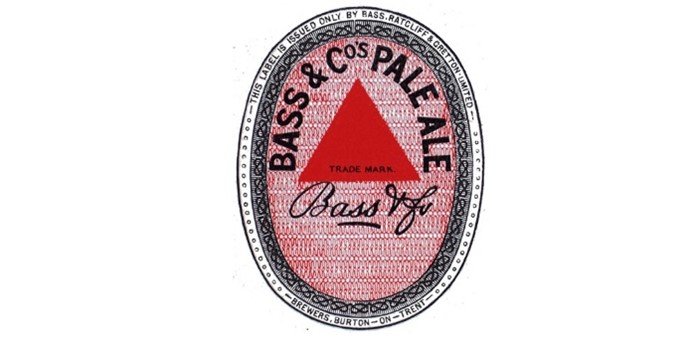
The famous Bass red triangle – the world’s first registered trademark.
Photo Credit: Beertonian
In 1889, with association football growing in popularity across the North and Midlands – and in Burton-upon-Trent – the Bass Charity Vase was launched, a friendly tournament designed to raise funds for medical and hospital charities. The trophy – one of the most valuable in English Football – was donated by Lord Burton and Hamar Bass, great-grandsons of William Bass, and it is the fifth oldest cup competition in England after the FA Cup, the Birmingham Senior Cup, the Lancashire Senior Cup, and the London Senior Cup.
Burton-upon-Trent is the spiritual home of the Bass Charity Vase, and today, the competition is exclusively hosted by Burton Albion as the town’s sole surviving professional club, with the trophy presented to the winner on the day, before being displayed year-round at St. George’s Park.
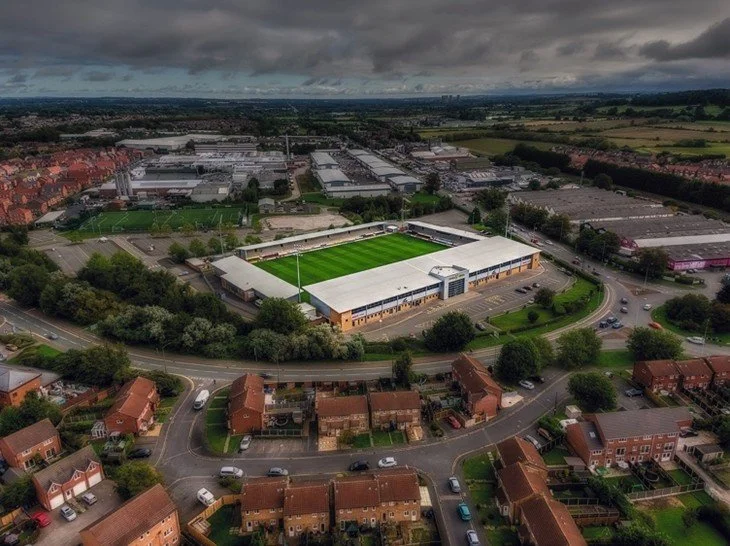
The Pirelli Stadium – home of Burton Albion and the Bass Charity Vase.
Photo Credit: Clubs From Above
Following the competition’s launch, the first final was held in 1890 at Peel Croft – one of the first games to be held there following Burton Swifts’ move – and saw Derby County take on Stoke City. The Rams lifted the trophy, running out 3-1 winners, and they followed this up with another three successive triumphs. Indeed Derby have gone on to become the competition’s most successful club, winning it on 20 occasions.
Although the Bass Charity Vase has mainly been a competition for clubs from the Midlands, occasionally clubs from farther afield have taken part, as have teams representing the forces. The first club from beyond the Midlands to lift the trophy was Liverpool, who beat Burton Wanderers 1-0 in 1897. The most recent non-Midlands clubs to compete for the trophy were Sheffield United in 2014, and Queens Park Rangers in 2016.
The competition’s centenary was celebrated in 1989, and saw two finals played, both at Peel Croft. The first – the usual annual fixture – saw Wolves take on Notts County with the Magpies running out 3-2 winners. The second was a celebratory match, and saw Gresley Rovers and Stapenhill play out a 1-1 draw; Gresley Rovers won a penalty shootout 6-5.
Predictably, Burton Albion are one of the Bass Charity Vase’s most prominent competitors and are the competition’s second most successful club behind Derby County, with the Brewers lifting the trophy 15 times. And that 15th triumph came in the most recent final ahead of the 2025/26 season when they beat Derby 2-1 at the Pirelli Stadium before a crowd of just over 4,000.
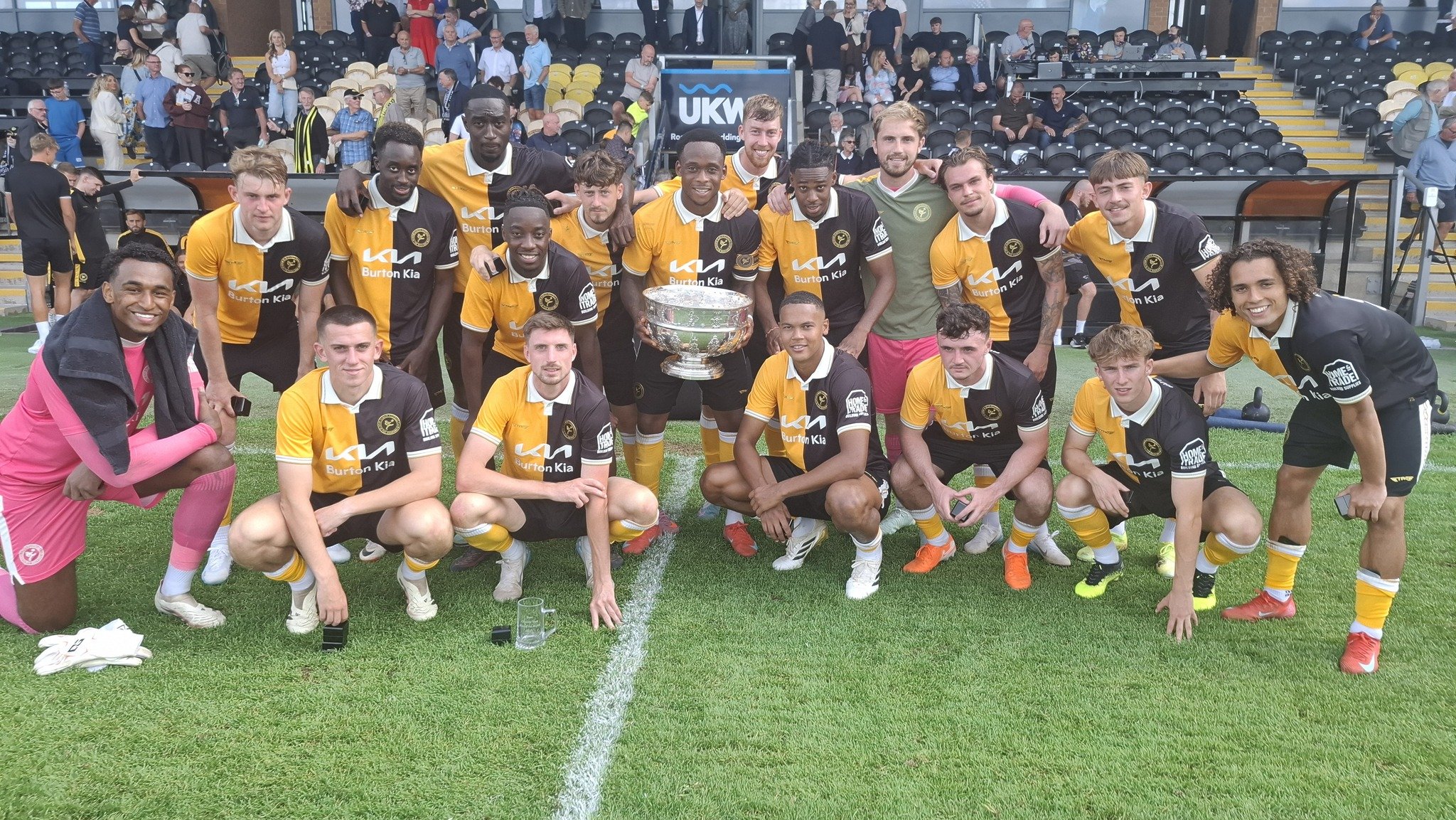
Burton Albion celebrate their 2025 Bass Charity Vase triumph.
Photo Credit: Burton Albion FC
As I often do with football heritage matters, I have naturally had to look at the Bass Charity Vase through a Stoke City lens. The Potters are one of football’s oldest clubs, and given their status as one of the Midlands’ most prominent names, their involvement in the Bass Charity Vase was inevitable.
Stoke took part in the competition’s first final in 1890, and again in 1894 when they were beaten 4-0 by Aston Villa, which preceded an 86-year absence from the final. The Potters’ next appearance in the final came in 1980 when they beat Burton Albion 2-1 at Eton Park to lift the trophy for the first time.
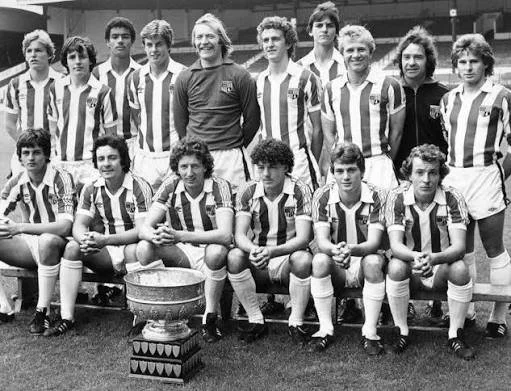
Stoke City – 1980 Bass Charity Vase winners.
Photo Credit: The Sentinel
The 1990s were a bit of a rollercoaster for Stoke City, falling into the third tier and experiencing the worst season in the club’s history, recovering under Lou Macari and looking towards the Premier League, before leaving their historic home - the Victoria Ground - for the brave new world of the Britannia Stadium and dropping into the third tier once again.
But when it came to the Bass Charity Vase, the 1990s were kind to the Potters who appeared in six finals, lifting the trophy on four occasions including three wins over old Staffordshire rivals West Bromwich Albion who Stoke had a bit of a hex over at the time. Stoke’s next – and also most recent – appearance in the Bass Charity Vase final saw them beat Burton Albion 1-0 in 2023 thanks to a Jacob Brown goal.
One of the competition’s most unique stories came about in 1918 during the First World War. Although the Bass Charity Vase continued in 1914 and 1915, in 1916 and 1917 there was a pause. But during the war effort, there was a mass mobilisation of women into the nation’s workforce, and as a result, interest in women’s football grew and many teams were founded – the most prominent perhaps being Dick, Kerr Ladies – and competitions formed. The women’s games often attracted large gates, and many were charity fixtures raising thousands of pounds.
One of the most celebrated women’s teams hailed from Leicestershire, and went on to make history in the Bass Charity Vase. By day, the Coalville Munitions Girls worked in incredibly harsh and dangerous conditions. But once their shifts were over, they took to the pitch, and in 1918, they won the Bass Charity Vase after beating Shobnall Girls 3-1 in the final.
The Coalville Munitions Girls remain the only women’s team in the competition’s 125-year history to have triumphed, and their name sits proudly on the trophy alongside some of English football’s biggest and most historic names.
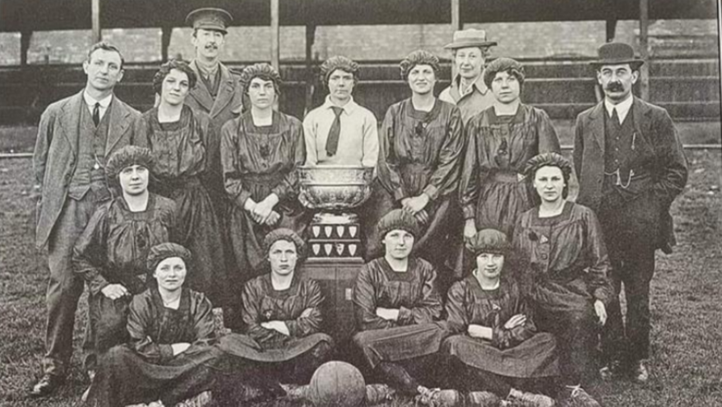
Coalville Munitions Girls – the only female winners of the Bass Charity Vase.
Photo Credit: Peter Trudge
The history of football in Burton-upon-Trent can be read in much the same way as the history of its beer: a long fermentation of local pride, hard work, and periodic bursts of heady success, all drawn from the same well of community spirit that made the town famous for brewing. During the late 19th century, as the town’s breweries were perfecting pale ale and exporting it across the world, football was beginning to bubble in much the same way. Local clubs such as Burton Swifts and Burton Wanderers rose like experimental brews, each testing its own recipe of players, tactics, and ambition, and the town briefly found itself sipping at the top table of the Football League, a rare strong ale among the giants of industrial England.
Though Burton-upon-Trent’s early clubs fell flat, what endured, however, was the culture. Football in Burton became something of a house beer: always present, always shared, even when not nationally fashionable. The game was played on recreation grounds and works pitches, often by men whose weekdays were spent among mash tuns and hop sacks. Brewing and football mirrored one another: both relied on teamwork, patience, and an understanding that results could not be rushed. Just as good beer needs time to condition, strong clubs needed roots in their community.
That connection was most clearly bottled in the Bass Charity Vase. Established by the Bass family in the Victorian era, the competition was laced with philanthropic flavour, designed to raise funds for local charities while giving the town’s teams something tangible to contest with others from farther afield. The Vase became football’s equivalent of a seasonal special: eagerly anticipated, fiercely contested, and proudly local. Winning it did not bring national fame, but it carried the warm satisfaction of a well-made pint enjoyed among friends. Each final was a reminder that football, like beer, tastes best when shared for a good cause.
As football in Burton-upon-Trent has matured during the 20th century and early 21st century, the Bass Charity Vase endures, symbolising both the town’s heritage in both brewing and football.