

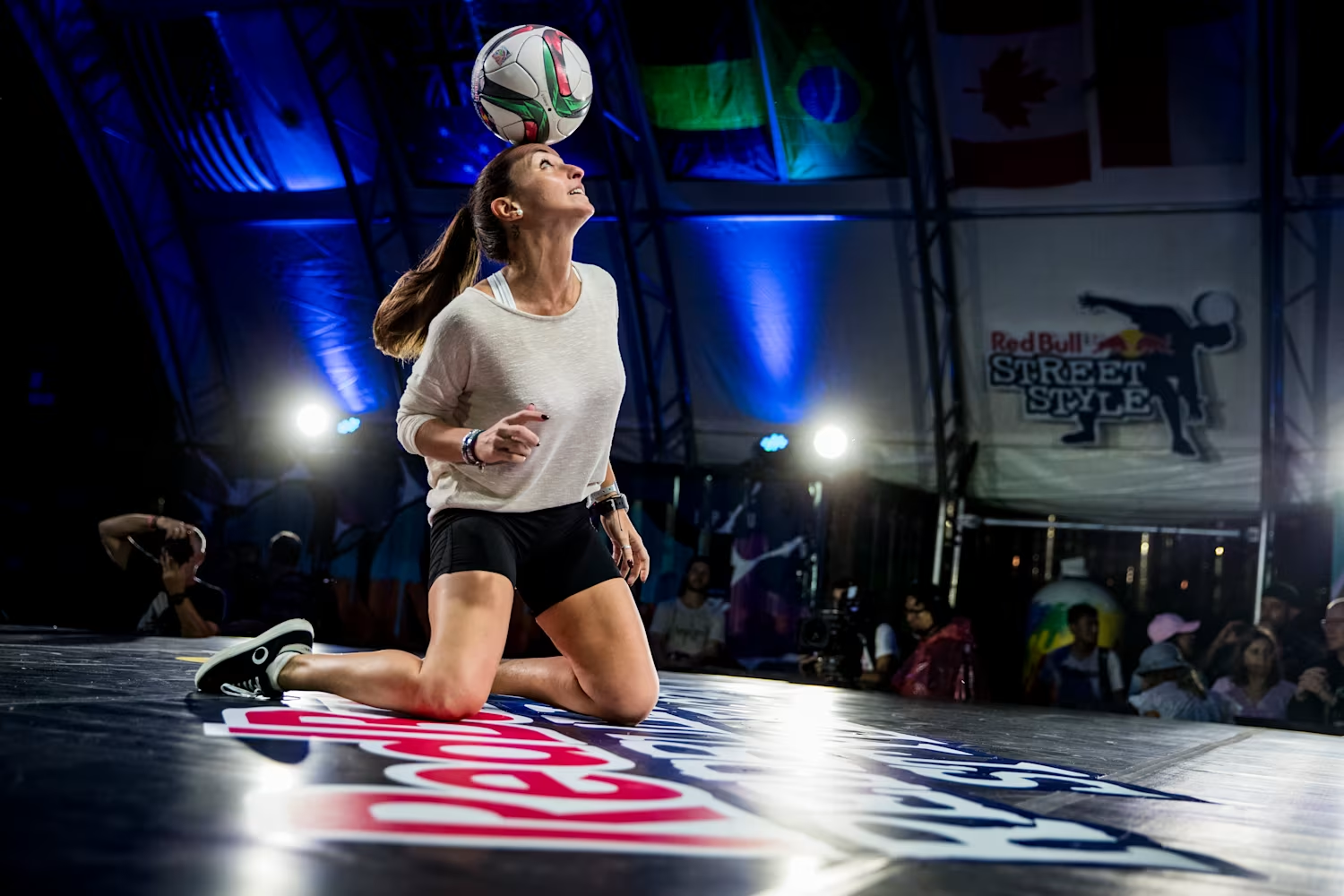
Words by Dr. Tamara MC | Published 08.08.2026Laura Biondo has set 20 world records in a sport most Americans don't know exists.
Twenty Guinness World Records. One world title. Biondo is the first woman ever to set a Guinness World Record in freestyle football, and the only Latin American — male or female — to win the world championship.
Laura Biondo is the most decorated freestyle football athlete Latin America has ever produced. In 2011, she became the first woman in the sport's history to set a Guinness World Record.
Four years later, at the Super Ball World Open in Prague, she won the world title, making her the only Latin American, male or female, to do so. No one from her region has matched the result in the decade since.
Her competition résumé runs four Latin American Championships, two European Championships, and a runner-up finish at the 2014 Red Bull Street Style World Championship. Cirque du Soleil cast her in Luzia in 2016, where she spent four years on tour as the first Venezuelan and the first female freestyler to anchor a Cirque show.
By her own count, she has set twenty Guinness World Records. Since 2019, she has run the women's development arm of the World Freestyle Football Association, the sport's governing body, headquartered in Barcelona. Last November, ten months after ankle surgery, she flew to London and reclaimed a record she had lost the year before, performing forty-eight Clippers in a minute.
Biondo was born in Venezuela. Her family moved to Weston, Florida, when she was ten, and two years later relocated to Italy, where she played in the country's top women's soccer league for clubs in Verona, including Foroni and Bardolino.
She eventually returned to South Florida and now lives in Miami, though she still represents Venezuela in international competition.
Freestyle football, the discipline Biondo practices, is the art of performing tricks with a soccer ball using any part of the body except the hands. Its modern roots are usually traced to Diego Maradona's famous pre-match warm-ups in the 1980s, but the sport's technical vocabulary was developed in the 1990s by the South Korean freestylers Mr. Woo and Kang Sung Min.
The discipline broke into mainstream audiences in the mid-2000s, when the Joga Bonito campaign cast Mr. Woo alongside Ronaldinho in commercials that aired across Europe and Latin America, and when the Dutch freestyler Soufiane Touzani's YouTube videos began showing a new generation what was possible.
The first major international competition, Red Bull Street Style, was held in São Paulo in 2008. The first open world championship, the Super Ball, followed in 2009.
I met Laura at the Loews Miami Beach Hotel, one block off Ocean Drive. She had just finished a freestyle set: sole juggles done lying on her back, clippers, around-the-worlds.
She was in head-to-toe black, white freestyle sneakers, her dark hair pulled back in a ponytail. We talked about origins, records, the World Cup coming to her city, Miami, and the case she keeps making for her discipline: that it's a sport separate from soccer.
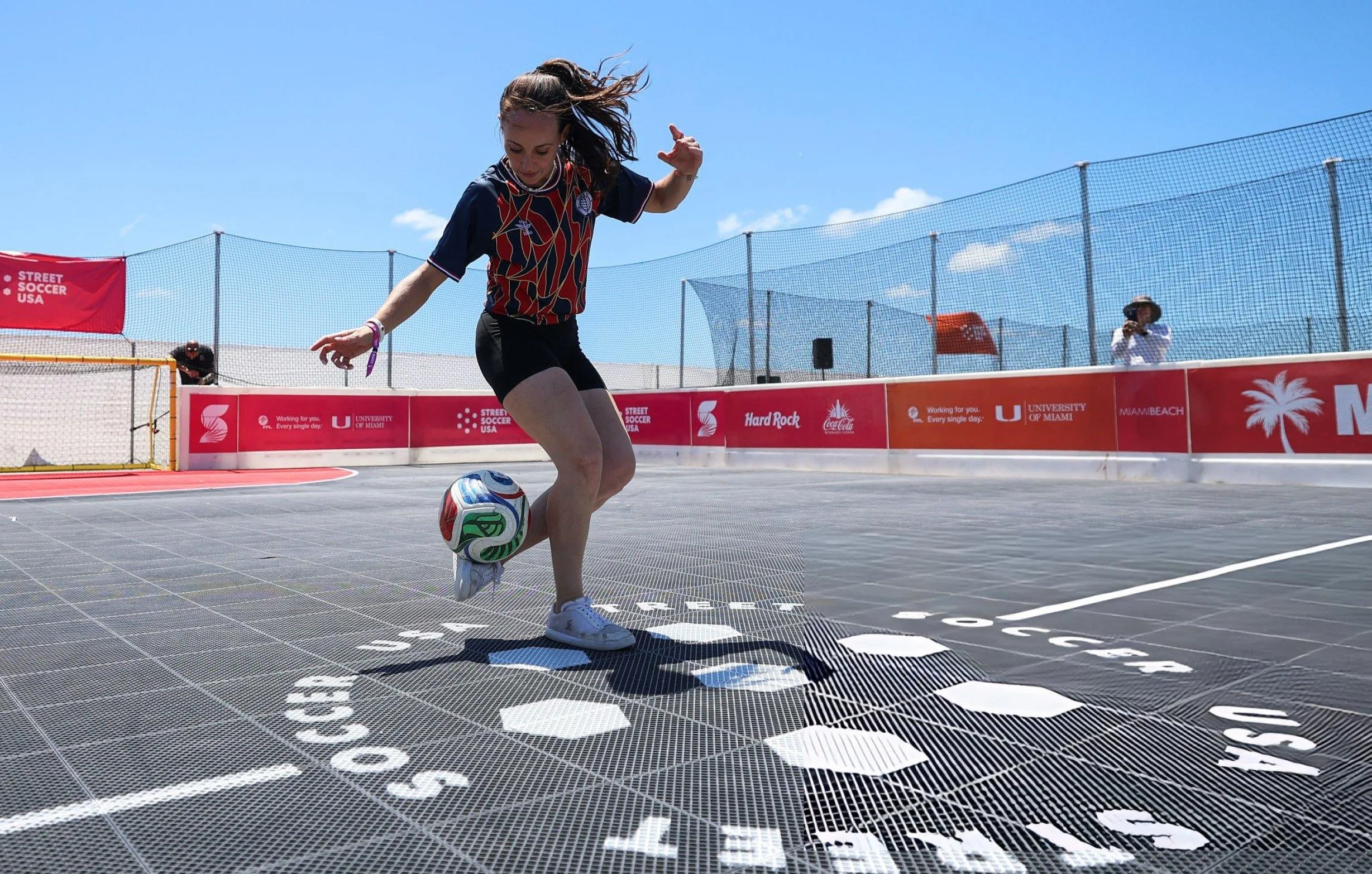
Laura Biondo in action at the Copa Del Sol street soccer tournament in Miami Beach, 2026.
Photo Credit: Getty Images
Tamara: For readers who are meeting you for the first time, who are you, and what do you do?
Laura: My name is Laura Biondo, and I'm a professional football freestyler. I don't compete for a team because this is an individual sport.
So, in competitions, it's you against another opponent, like in breakdancing or dance battles. You represent your country. I represent Venezuela. I've been doing this for nineteen years already. I'm 37 now.
Tamara: What do you wish more people knew about freestyle?
Laura: I just think people should know that this is a sport, per se. Separate from soccer or football. We share the ball and the skill of juggling, and it does help a lot in the game to have that sensitivity to the ball.
But they're two different sports. We have competitions, and they're exciting. The vibes are very underground, where you're close to the stage, so you're really close to the action. You're right up next to the athletes. So, it's entertaining.
Tamara: Take me back to Verona, 2005. You were fifteen, playing soccer in the Italian women's league, when a knee injury sidelined you. How did freestyle enter the picture?
Laura: I used to play, and I was recovering from a knee injury, and my brother would watch commercials with Ronaldinho, the famous Joga Bonito series.
He would try to learn — he was learning tricks, so I would try to imitate him. And then I always say it was God's will that I met a freestyler one day, who started teaching me tricks and then introduced me to more people in the freestyling community.
That's how I got involved. And then after school, I would go to the parking lot, and then practice, and practice, and practice, and practice.
Tamara: What does your practice look like now?
Laura: I'm roughly doing between one and one and a half hours a day. It depends — some days I can do more.
I try to work on new skills I want to learn, or new transitions, or refining the tricks I already have. And I'm thinking about competition too.
Tamara: What does a typical competition year look like for you?
Laura: Every year we have three major ones. So, we have two world championships. One is open, so anyone can register and compete. We average 200 to 250 athletes every year.
And then you have your continental, so I would compete in the Latin American championships. Each continent has a set number of slots for athletes to qualify for the world final.
In South America, we have four slots that would qualify for the world final. So those are the ones I follow.
Tamara: Do you have a main rival? Someone you're trying to beat year over year?
Laura: It's always a come and go. Because it's also subjective in a way, and it varies so much. One time you can win; one time you can lose.
It depends on who's having a good day, who makes more drops, and who's more creative that day. And the judges are always different. So, there are a lot of variables at play.
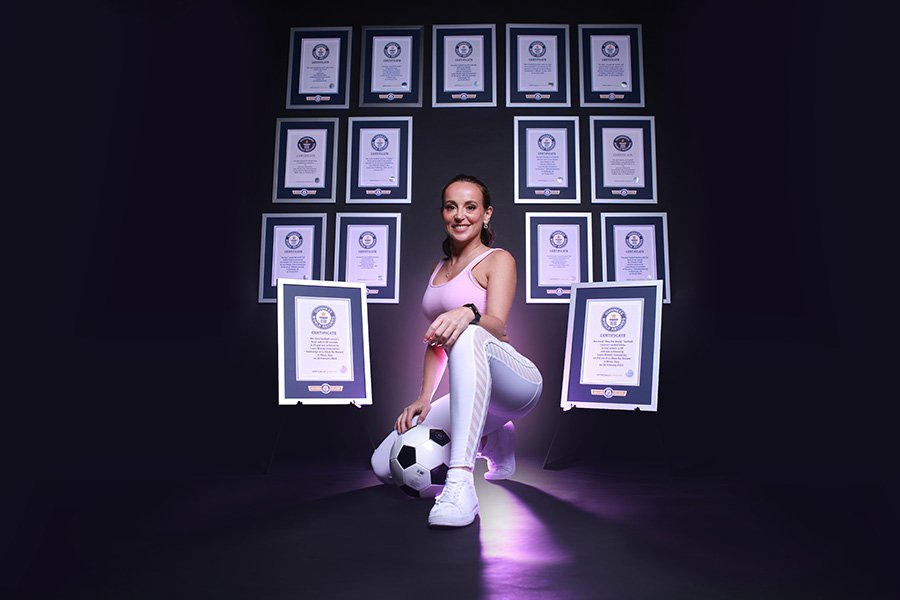
Laura Biondo holds 20 Guinness World Records.
Photo Credit: Guinness World Records
Tamara: How are the competitions structured in freestyle?
Laura: We have female and male competitions. The number of female competitors is lower than that of males, and we want to keep pushing to change that.
We want more women to get involved; to know there's a female category, to know there's equality in the sport. We have the same prizes, the same stage time, the same stage presence.
We alternate the rounds: top eight men, top eight women, women's semifinals, men's semifinals, women's final, men's final. So, it's not like they're separate days or separate world finals. It's all together, one after the other. It gives the women's side that exposure.
Tamara: You hold twenty Guinness World Records. Can you name some of them?
Laura: They're all about doing the most of a specific trick, either in a minute or in thirty seconds. I don't remember all of them, but I think these are some: the most headers in one minute.
The most Around the Worlds in a minute. The most clippers in a minute. The most Around the Moons in thirty seconds, which is another trick using the leg. The most sit-down crossovers in a minute.
The most head rolls in thirty seconds. The most football touches in a minute while running on a treadmill. The most sole juggles in a minute, lying on my back. The most shin juggles in a minute, sitting down.
Tamara: Where do you go to set these records?
Laura: My first one ever was in Italy, on a TV show dedicated to breaking Guinness records called Lo Show dei Record. After that, I stayed in contact with Guinness, and they've invited me to set records in a few different ways.
Some are on TV shows in other countries. Some are at live events Guinness organizes, where they bring in athletes to break records as a showcase. I did one at Inter Miami Stadium a couple of years ago.
And some I've done online, where you record yourself and send the video to the club. Anybody can get one. The Guinness World Records page online explains how.
Tamara: Are you still interested in setting more records? Or competing?
Laura: I'm okay, I'm happy. It's a nice achievement, and twenty is a lot. If more come, I'm happy.
But I'm also happy to help others break records, even my own. It's exciting. As for competing, I want to keep going until I'm forty. It's hard, especially with the new generations.
There are eighteen-year-old girls right now who are killing it. It's insane. But it's more about the personal challenge of pushing myself to the maximum I can do at that high level.
I'm also still working on freestyle performance and starting to develop some concepts for coaching kids. I'm getting more requests. It's fun.
Tamara: Is there a place in Miami to get coached in freestyle?
Laura: We don't really have that kind of structure yet, where there's a place you go to get coached for freestyle. It's more about reaching out to freestylers directly: "Are you open to coaching? Do you do sessions?" Miami isn't very developed as a freestyle community.
Other parts of the world have much bigger ones. In the US, there are more people around LA, maybe New York, but the majority is in Europe. There's a big presence in South America and Tokyo.
I have a lot of friends in Medellín, Colombia, which has a huge community, and they do a lot of group classes with kids. Here, it's probably me and maybe one other guy. That's it. We gather on Wednesdays at the same park.
Tamara: Why does coordination matter, beyond the sport itself?
Laura: For everyday activities, we need to coordinate sight with movement, with perception and depth, everything. It helps a lot with understanding body perception, which we sometimes don't develop very well.
And as we get older, coordination becomes even more important. People forget that. There are so many falls and things that happen as you age. So even if it's not freestyle, anything that builds coordination helps.
Incentivizing older people to take a Zumba class, or any kind of class where you listen to music and move to it. That's a big part of what we do in competition: musicality. You recognize the beats and coordinate your movements.
Of course, I might not be doing this at sixty the way I'm doing it now. But interacting with different kinds of activities, ones that aren't part of your usual day, keeps you moving.
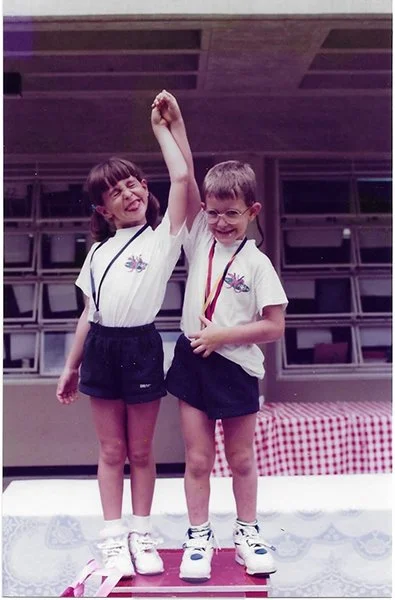
Laura Biondo at the very start of her freestyle football career.
Photo Credit: Guinness World Records
Tamara: What does the gear look like?
Laura: The shoes I'm wearing are freestyle shoes. They're very light and flexible. This is a generic freestyle brand, but before these came out, we'd use Puma Archive Lites. Those were the go-to: really light, kind of runner shoes.
Some people even freestyle in regular running shoes. I don't know how they do it. For me, they're too bulky. For the ball, any official match ball works. Some people don't like the official one and grab any ball of good quality instead.
It's up to you. It's a very low-cost sport to get into, which is great, because some sports are so hard to start.
Tamara: You're in black now. Do you usually wear black?
Laura: It depends. For performances, I usually keep it neutral, unless there's a specific brand or team shirt the client wants me in.
In competition, it's about comfort. I get sweaty and things get dirty, so I stick with something neutral. Pink is my favorite color, though, so I'll wear that. Sometimes everything is black but with pink shoes.
Tamara: You moved to Miami from Venezuela. How did that come about?
Laura: I moved here when I was ten, in 1999. My mom lives here. I've always loved it. Miami feels like home. I didn't decide, though.
It was my family. I haven't been back to Venezuela in a while. Hopefully soon, when things get better down there. I still compete for Venezuela. The freestyle community there is small.
We're not even ten people. Two girls started recently, so we're three women now. We met at a competition, and that's how I started helping them. I send them balls and shoes, share tips and training.
Tamara: How can someone get started in freestyle?
Laura: It's as simple as grabbing a ball, going to your backyard, and practicing. What I did was watch videos, slow them down, study what the person was doing with their body, and try to replicate it.
It's a lot about repetition. That's where you build persistence, patience, and consistency. You just go out there and try and try and try until you succeed. There are no shortcuts. It's really a lot of hours.
Tamara: Are there good tutorials out there for beginners?
Laura: Not really. That's something we should probably be developing. But any clip of someone juggling will do. You just put it in slow motion, and that's enough to understand how the body moves and how to touch the ball.
Tamara: Last question. Anything I didn't ask that you think is important?
Laura: No, no, no. All your questions were amazing. The fact that you had the interest and curiosity to learn how the sport works is amazing, because not everyone always asks those questions.
And it's great. Because at the end of the day, freestyle is something that is not overly complicated. You generally just need the ball, a space to practice, and creativity. Because it's really: how can I move the ball with any part of my body?
And then you just play around and figure out a new way to place the ball somewhere, hold it, tap it. So that's how we also come up with tricks. Just playing around with the ball.
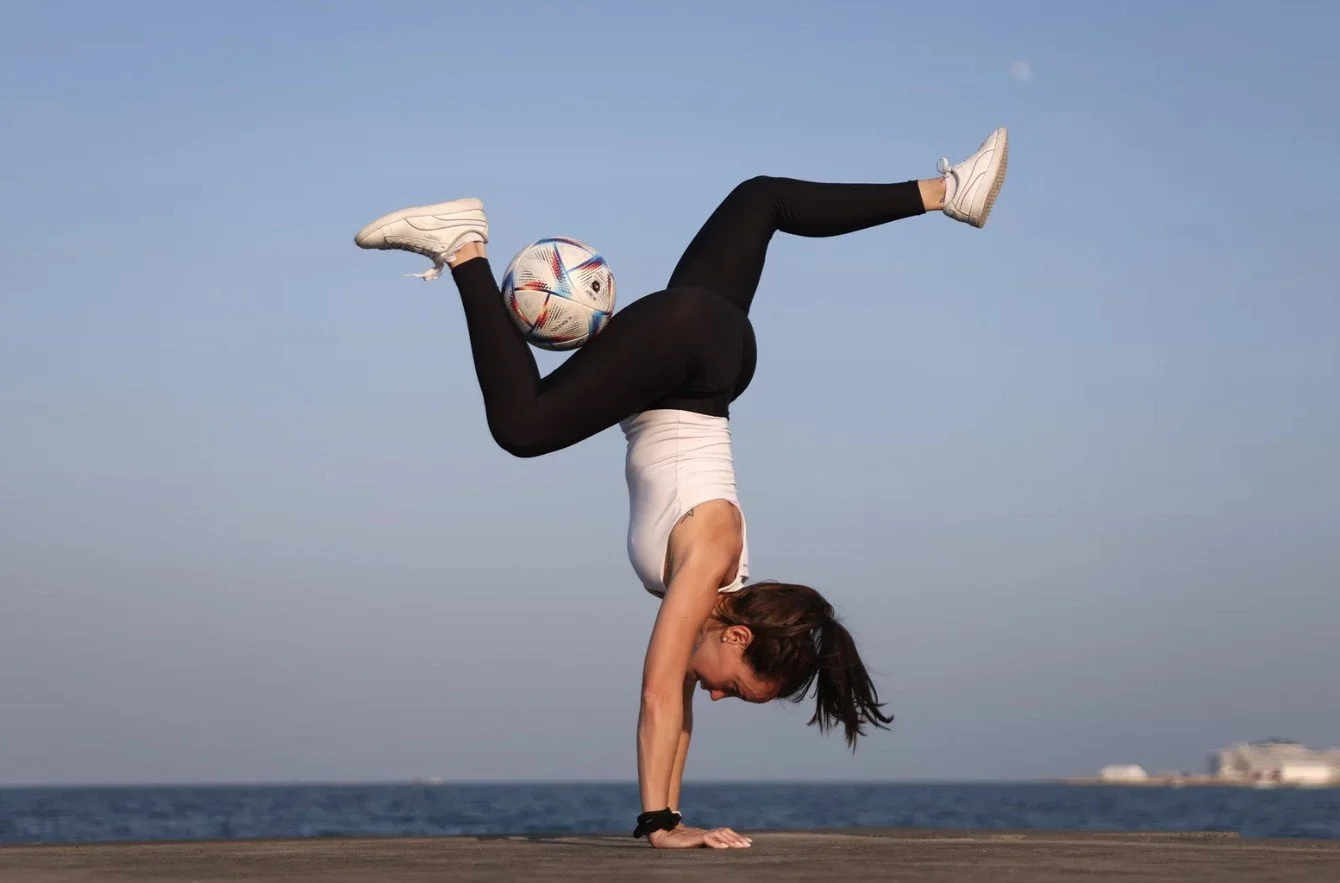
Laura Biondo'a workouts are incredible technical and intense.
Photo Credit: PS Fitness