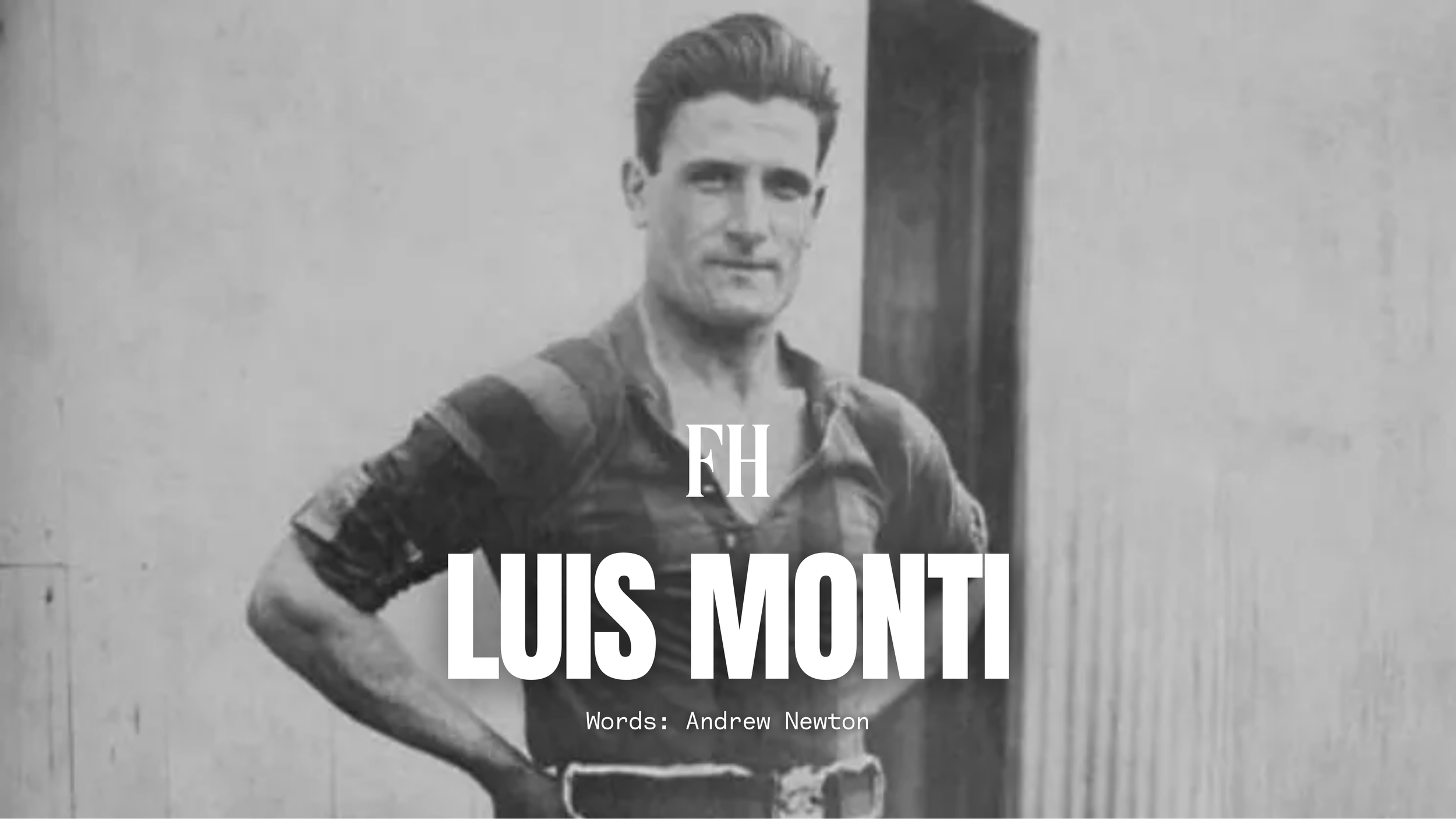
Words by Andrew Newton | Published 11.07.2026The list of footballers that have won senior caps for more than one country is longer than you’d think. Perhaps the most famous example is Alfred Di Stéfano, who played for Argentina, for Colombia in non-FIFA sanctioned games, and for Spain, having been banned from playing for Argentina due to his Colombian sojourn and taking Spanish citizenship.
Hungarian internationals László Kubala and later Ferenc Puskás both played for Spain following their defections in 1949 and 1956. Kubala had also played for Czechoslovakia between 1946 and 1947 while he was playing club football for Slovan Bratislava.
In some cases, players have won caps for two national teams because their original country ceased to exist. Zvonimir Boban, Robert Prosinečki, Davor Šuker, Siniša Mihajlović, and Dejan Stanković, for example, were all capped by Yugoslavia and then subsequently capped by the relevant successor countries following the break-up of the Yugoslav republic.
Similarly, players like Andrei Kanchelskis, Oleg Luzhny, and Kakhaber Tskhadadze won caps for the USSR and later, following the collapse of the Soviet Union, for Russia, Ukraine, and Georgia respectively.
Tskhadadze, and several other players that had played for the USSR and went on to play for the various newly independent nations, also played for the Commonwealth of Independent States, an intermediary team that bridged the gap between the USSR and the establishment of the new federations, during the 1992 European Championship.
Several Austrian international players of the 1930s, such as Karl Sesta, Willhem Hahnemann, Franz Binder, and Peter Platzer, were called up by Germany following the Anschluss.
The list of players with caps for more than one country extends far beyond just these examples. Between 2021 and 2026 alone, at least 88 players won caps for more than one country.
The reasons for changing allegiance are similarly multitudinous, although in many cases it relates to the player’s ancestry and a desire to represent the country of their forebears.
During the 20th century, FIFA allowed a player to play for any national team, as long as they held nationality of that country. Amongst the Home Nations, however, particularly in the early part of the 20th century, the rules were much stricter.
Falkirk outside-right Jock Simpson, despite living in Scotland for most of his life and having Scottish parents, was denied a call up to the Scotland team because his parents were briefly in England at the time of his birth. Place of birth was the only criteria for eligibility.He played eight times for England.
In 2004, FIFA had to tighten their rules in response to the growing trend of naturalisation of foreign players in some countries. From that point on, players had to demonstrate a “clear connection” to any country they wished to represent and to switch nationalities must not have played in a competitive fixture (i.e. can only have played in friendlies) for the first nation.
In 2021, this rule had to be updated due to the increasing trend of competitive fixtures, such as the Nations League, replacing friendlies.
Although the list of players capped by multiple countries is extensive, the list of players who have played in the World Cup Final for more than one country is, as you might expect, not quite so long. In fact, it’s really short.
It consists of Luis Monti, and no one else.
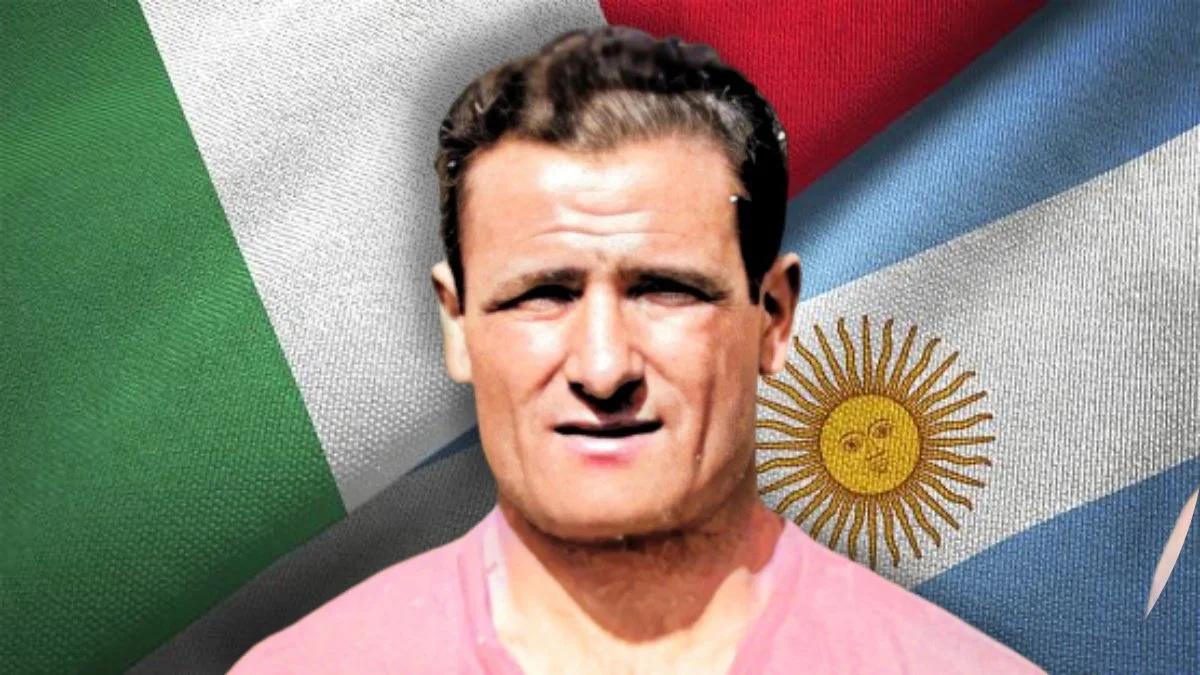
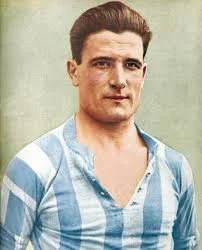
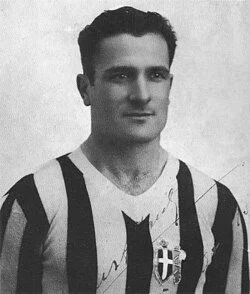
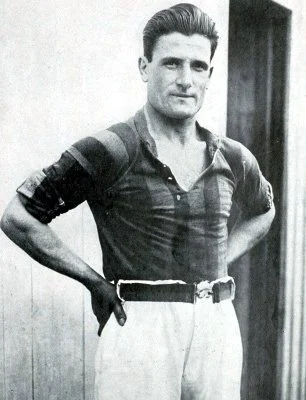
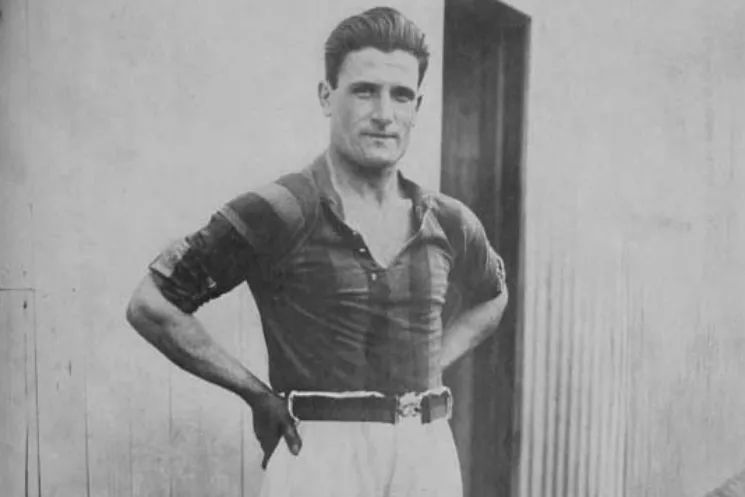
Luis Monti represented both Argentina and Italy in different World Cup finals.
Photo Credit: Storie di Calcio
Luis Felipe Monti was born on the 15th May 1901 in Buenos Aires. His first club in first-class football was Club Atlético Huracán, a multi-sports club from the Parque Patricios neighbourhood of Buenos Aires.
This club was founded in November 1908 as Nueva Pompeya, but later changed its name in honour of the Huracán hot-air balloon, brought to Argentina from France and piloted by the Argentine aviation pioneer Jorge Newbery in 1909.
In 1910, Newbery was named as ‘protector member’ of the club and he went on to be highly influential in their early history. Indeed, Newbery was a popular figure in Argentina, so much so that there are at least five streets named after him, as well as an airport, a school of technical aeronautics, a railway station, and seven football clubs.
Monti’s football career began in 1921, during the period when Argentine football was still, nominally at least, amateur. Perhaps unusually then, he only stayed for one season at Huracán, although he did win the Argentinian Primera Division in that time.
The following season, he moved on to Boca Juniors, but left after three months without making any appearances for the Xeneize. When he left, he went to another of Argentina’s Cinco Grandes, San Lorenzo de Almagro, where his brother Enrique was already playing.
Luis Monti played as a centre-half in, of course, the days when the 2-3-5 formation was still widely in use. Despite not being blessed with great height, he was a rugged and robust player, who was also good at reading the game.
He earnt the nickname Doble Ancho, meaning ‘double wide’, which could have been a reference to his physique but was mainly in recognition of his ability to cover large spaces on the pitch.
Monti was a ruthless and uncompromising player. His opponents were often more than aware that they had been in a physical encounter. Another of his nicknames was ‘the butcher’.
A joke developed in Argentina that facing Monti on the grass was more dangerous than facing heavyweight boxer Luis Ángel Firpo, a knock out artist nicknamed ‘The Wild Bull of the Pampas’, in the ring.
He certainly made an impact in English football circles when, while playing for a Buenos Aires XI against a touring Chelsea side in 1929, he booted the opposing centre-half, George Rodgers, in the testicles.
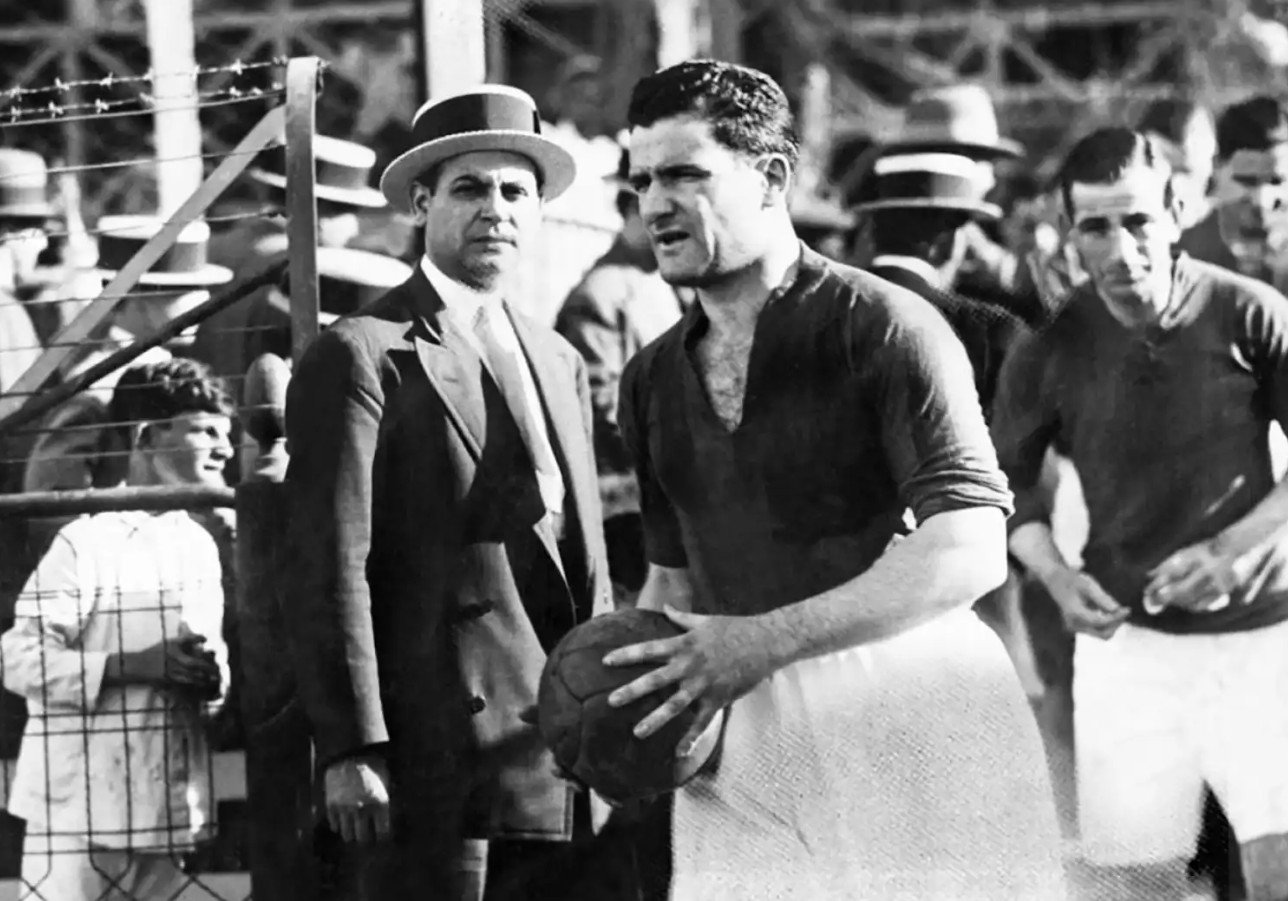
In total, Luis Monti played professional football for 4 clubs sides in his career.
Photo Credit: DIA 32
He wasn’t just an enforcer, though. Monti was a technically gifted player and could operate as a deep-lying playmaker. He was known for playing long, accurate passes out to the wing to spark attacks for his team. He was a much-loved player and a big star in Argentina.
During his time with the club, San Lorenzo won back-to-back titles in 1923 and 1924. These were the first two league titles in the club’s history. In 1925 and 1926, they finished second in the league, first behind Racing Club de Avellaneda and then Club Atlético Independiente.
They sealed a third league title in 1927, and followed this up by winning the Copa Ricardo Aldao, a usually annual, but often irregular, contest between the league champions of Argentina and Uruguay, against Rampla Juniors. The 1927 title was the last of Argentina’s amateur era.
Monti received his first call up to the Argentinian national team in 1924 and he went on to win the 1927 South American Championship and a silver medal at the 1928 Olympic Games in Amsterdam, losing in the final to Argentina’s neighbours and great rivals, Uruguay.
By this time Monti had established himself as a key player for the national team. His main rival for the centre-half position was Adolfo Zumelzú of Racing Club.
El Gráfico, the monumentally influential and often moralistic South American sports magazine, described Zumelzú as embodying the aristocratic side of Argentinian football: “noble… neat sidestep, a short passer… complete intelligence”. Whereas Monti was a “fighter… strong in bitter struggles… a battler”.
By the time the inaugural World Cup came around in 1930, Monti had established himself as first choice; Zumelzú, although part of the squad, did not appear in the 1928 Olympic campaign. Monti would be Argentina’s starting centre-half for the tournament that was hosted by their rivals on the far side of the Rio de la Plata.
Argentina’s first game at the World Cup was against France, who had played their opening game 48 hours earlier, beating Mexico 4-1. Argentina would leave something of an impression on the French, in what was the first ever meeting between the two sides.
It was a tight affair, although Argentina, the stronger of the two sides, were kept at bay by a phenomenal goalkeeping performance by Alex Thépot. Monti bullied his French opponents throughout the match and legend states that he left several broken bones in his wake.
Certainly his heavy tackle on Lucien Laurent in the first few minutes of the game left the French forward limping and ineffective for most of the contest. In the 81st minute, Monti scored from a direct free-kick to put Argentina ahead, with Thépot’s view blocked by his teammates. Inexplicably, the referee, Almeido Régo, blew for full time three minutes after Monti’s goal, and 6 minutes early, just as France were desperately seeking an equaliser.
He was eventually persuaded to restart the game to play the final few minutes, but the momentum that France had built was interrupted. Argentina were therefore able to resist them and won, as had been widely anticipated.
However, the result was jeered by the numerous Uruguayans in the crowd of 23,409 that was present in Montevideo’s Estadio Parque Central that day. The reaction was so hostile that Argentina threatened to withdraw from the competition, and only agreed to stay after the president of the republic had given his personal guarantee of safety.
Argentina’s second game of the competition was against Mexico. Monti sat this one out and was replaced by Adolfo Zumelzú. Argentina won 6-3, with Zumelzú scoring twice. Nonetheless, Monti was back for Argentina’s final group game.
They met Chile in front of 41,459 people in the Estadio Centenario. Guillermo Stábile had scored twice for Argentina and Guillermo Subiabre had pulled one back for Chile, all within the first 15 minutes.
This was how things remained until just before half-time when Luis Monti put in a heavy tackle on Chile’s right-half, Casimiro Torres. According to Belgian referee, John Langenus, in response “the Chilean grabbed hold of Monti’s head with one hand and, with the other, delivered a vicious uppercut”.
This sparked a mass brawl with all 22 players engaged in the fisticuffs and officials and police poured on to the pitch, trying to restore order. Thankfully, the second half saw no repeat of the violence and Mario Evaristo added a third goal for Argentina in the 51st minute. Argentina finished top of the group with three wins from three.
Only the winners of each of the four groups progressed to the next round. This was the semi-final round and Argentina faced the USA. The game was again played at the Centenario and the Uruguayan crowd took the side of the Americans.
Argentina continued the physical approach that they’d employed in their previous games. Within four minutes of kick off, a hefty challenge on US goalkeeper Jimmy Douglas resulted in a twisted knee.
After 15 minutes, centre-half Ralph Tracy’s leg was broken in a tackle. Monti opened the scoring in the 20th minute. Tracy managed to get to half-time carrying his injury but was unable to come out for the second half and, with no substitutions at this time, the USA had to complete the game with 10 men.
To make matters worse, Douglas suffered a second injury, hurting his shoulder 15 minutes into the second half. Argentina scored five more goals after half-time, although the US did manage to score a consolation at the very end of the game through outside-right Jim Brown of the New York Giants, following a nice passing move also involving Andy Auld of the Providence Clamdiggers and Fall River Marksmen’s Bert Patenaude.
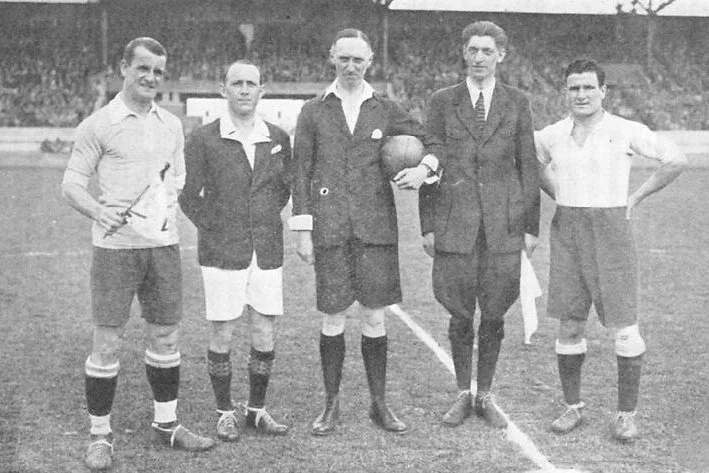
Monti before the 1928 Olympic final against Uruguay.
Photo Credit: Libertad Digital
The USA’s coach, the former St Mirren player Robert Millar, was furious with the referee for letting Argentina get away with dirty play. Claims were made that Jimmy Douglas had been deliberately targeted and there was similar anger over Tracy’s broken leg, and a ripped lip suffered by Auld.
Rumours abounded that when the US trainer, Jack Coll, entered the field to assist Auld following his injury, a bottle of chloroform was shattered, incapacitating Coll and temporarily blinding Andy Auld. The team’s general manager, Wilfred Cummings, suggested that this too had been done deliberately to disrupt his side.
Despite the USA’s complaints about their physicality, Argentina were clearly the better side and it was them that deservedly progressed to the World Cup Final. Their opponents would be the hosts, Uruguay, who had also won their own group and won 6-1 in the semi-final, against Yugoslavia.
It had been anticipated prior to the tournament that the final was likely to pit the Olympic finalists of two years previously against one another again. Argentina and Uruguay had developed a fierce football rivalry and recent meetings between the two sides had been extremely aggressive.
Their most recent meeting had occurred just two months before the World Cup in the Copa Newton, a semi-regular, nominally friendly, contest between the two countries. Despite this finishing in a 1-1 draw, Uruguay had been declared the winners under the rules of the competition.
To add spice to the Final, the rough, often violent, play that the Argentina team had employed during the competition had made them even more unpopular with the Uruguayan public than they already were.
Their hotel in Montevideo required around-the-clock police protection due to the animosity felt towards them. The hostility even extended to arguments over what kind of ball would be used in the final.
Eventually, the referee, John Langenus, had to decree that they would use the Argentinian ‘Tiento’ ball, which was smaller, lighter and made of 12 rectangular panels, in the first half; in the second half they would use the Uruguayan ‘T-Model’, which was made of 11 interlocking T-shaped strips of hand-stitched leather.
Over 15,000 Argentinians made the short crossing to Montevideo for the final, although only a small proportion made it into the stadium. Even then, their progress to the Centenario was delayed as the Uruguayan police searched them all for firearms.
The 1930 World Cup final has taken on legendary status on both sides of the Rioplatense estuary and numerous stories are told about it. Often, these stories can be contradictory, conflicting, or inconsistent, particularly with regards to events surrounding Luis Monti and his part in the match.
Word went out in the days before the final that Monti would not be playing. One of the stories, perhaps deliberately leaked, was that he was injured, having exacerbated a knock he’d picked up in the group phase during the semi-final against the USA.
It seems, however, that he’d received death threats that he took so seriously that he refused to play. Other Argentinian players had, allegedly, also received threats but none as specific as those made against Monti; some stories claim that Monti’s mother and daughters had also been threatened.
Monti’s absence created a significant problem for Argentina, not only because he was their captain and one of their best players, but because the obvious replacement, his great rival for the centre-half position, Adolfo Zumelzú, was injured.
Alberto Chividini, who had only played three times for Argentina previously, was selected to replace him. On the morning of the game, Monti decided that he would play after all, possibly as a result of an intervention by officials from his club, San Lorenzo, but it had a detrimental effect on the team’s preparation and morale.
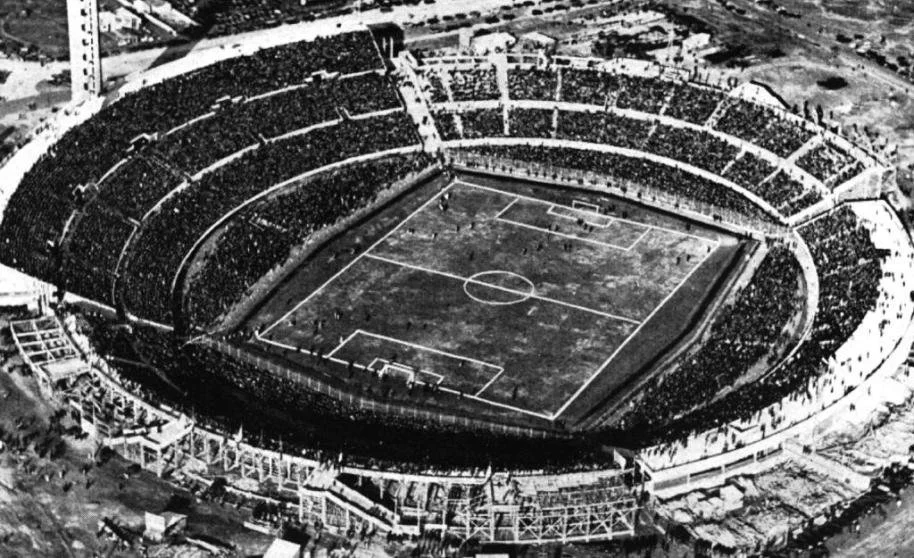
An aerial view of the Estadio Centenario ahead of the 1930 World Cup final.
Photo Credit: Wikipedia
The day of the game, Monti was so terrified that he could not lift his legs for trembling. Twelve minutes into the final, Pablo Dorado gave Uruguay the lead. Eight minutes later, Argentina winger Carlos Peucelle’s powerful shot was too much for goalkeeper Enrique Ballestrero and Argentina were level.
In the 37th minute, Guillermo Stábile, who would finish as the tournament’s top scorer, put Argentina ahead. Monti’s team led at half time.
It appears that the threats made against Monti and his family were repeated during the interval. His granddaughter, Lorena Monti, has stated that “at half-time, when Argentina were leading 2-1, they said that if Argentina didn’t lose, they would kill my grandmother and my aunt”.
Twelve minutes into the second half, Pedro Cea equalised for Uruguay. In the 68th minute, Santo Iriarte put Uruguay ahead and with a minute remaining Héctor Castro scored a fourth, securing the title of first FIFA World Champions for Uruguay.
The threats had clearly worked. Monti didn’t play well and El Gráfico described him as ‘standing, literally soulless, without being the great playmaker that in normal circumstances he would have been.’ At half time, he had been in tears. “I was very scared during that match, because they threatened to kill me and my mother”, he said later.
Argentinians, ever fond of finding a scapegoat but quite naturally, given his uncharacteristic performance, blamed Monti for their failure. He would later say, “All the Argentinians had made me feel like rubbish, a maggot, branding me a coward and blaming me exclusively for the loss against the Uruguayans”.
Even 80 years later, his own team mate, inside-right Francisco “Pancho” Varallo, was unable to forgive him “The Uruguayans beat us because they were sly” he said. “I found out later that he had received an anonymous letter saying that if we won, he and his daughters would be killed” but Varallo claimed that he would never have been cowed by their behaviour, as Monti was.
Luis Monti’s mother, one of the subjects of the death threats made ahead of the 1930 final, and his father, were from the Romagna (the south-eastern part of Emilia-Romagna) region of Italy. Between 1850 and 1950, around 3.5 million Italians immigrated to Argentina, making it one of the largest voluntary diasporas in history.
It is estimated that around 60% of Argentina’s population today have some degree of Italian ancestry, particularly in Buenos Aires, where Monti was born. Argentine culture has significant connections to Italian culture in terms of language, customs, traditions, and cuisine.
Monti was, therefore, of Italian ancestry. Italy’s fascist regime encouraged the return of Italian expatriates and colonial settlers to serve the purpose of state-building, although their settlement was strictly managed to avoid urban unrest and ideological deviation. These returnees were referred to as the rimpatriati.
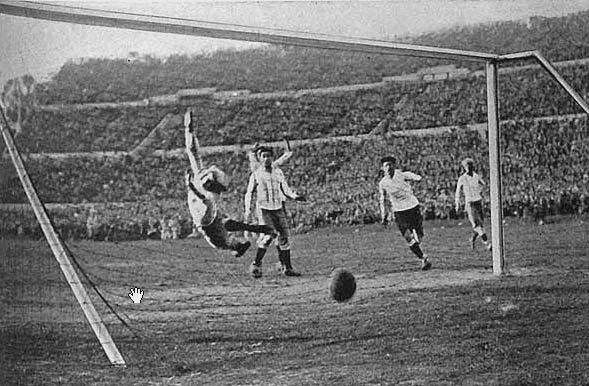
Héctor Castro scores Uruguay’s fourth goal.
Photo Credit: Wikipedia
The regime maintained a strict oversight of its diaspora, treating foreign-born Italians not just as emigrants, but as a vital resource for Mussolini’s imperial and military ambitions. Many were aggressively recruited and conscripted, either as volunteers or via mandatory military draft.
Mussolini’s personal feelings about football are disputed but he keenly understood its mass appeal and its potential for propaganda purposes. The rimpatriati were, therefore, highly visible in football.
Accomplished sportsmen of Italian ancestry were welcomed back to the ‘homeland’, particularly from Argentina and Uruguay, and these foreign-born players helped to make Italian teams globally competitive. They were utilised by the state to prove the physical superiority of the Italiano Nuevo identity.
One of the stories regarding the death threats made against Monti and his family suggests that they came from two Italian agents, sent to ‘scout’ at the behest of Mussolini.
According to this rumour, the purpose of the threats was to unsettle him in Argentina, presumably to make it easier to entice him to move to Italy. He was, apparently, told that if Argentina won the 1930 World Cup Final, he and his family would be killed but, if they lost, his future would be ‘beautiful’.
After the 1930 World Cup Monti’s career had collapsed. He was released by San Lorenzo, and decided to quit football to run a shop selling pasta. He had either decided to give football up, or was happy with his enforced retirement.
He’d won three titles with San Lorenzo and said there was nothing more he could achieve as a player. The pasta shop clearly became a passion for Monti, and it seems that he may have enjoyed testing his wares as by the time he turned 30 in May 1931, he was around 15kg over weight.
One of the most persistent stories regarding Monti in the post-1930 World Cup period is that one of the rimpatriati footballers, Raimundo Orsi, who had also been part of Argentina’s 1928 Olympic Squad and who had subsequently moved to Juventus, convinced the directors of the Bianconeri that Monti was the best defensive midfielder in the business.
Another story goes that Monti received a visit from two mysterious Italians who told him that he would soon receive an offer from an Italian club and, if he accepted, he would earn a salary of $5000 a month. Whatever the mechanism that brought him to their interest, Juventus decided to take a gamble on the out of shape Monti.
The Italian press had field day over Monti’s weight, mocking his nickname Doble Ancho and calling him ‘double wardrobe’, but he was determined to get fit. Overseen by Juve’s fitness coach, Guido Angeli, he was up at 6am each morning to run to the Palazzina di caccia of Stupinigi, the huge and elaborate 18th century hunting lodge built for the Royal House of Savoy, to the south of Turin, wearing three woollen jumpers. Then he’d work with the medicine ball, eat a big slab of beef for lunch, and repeat the process.
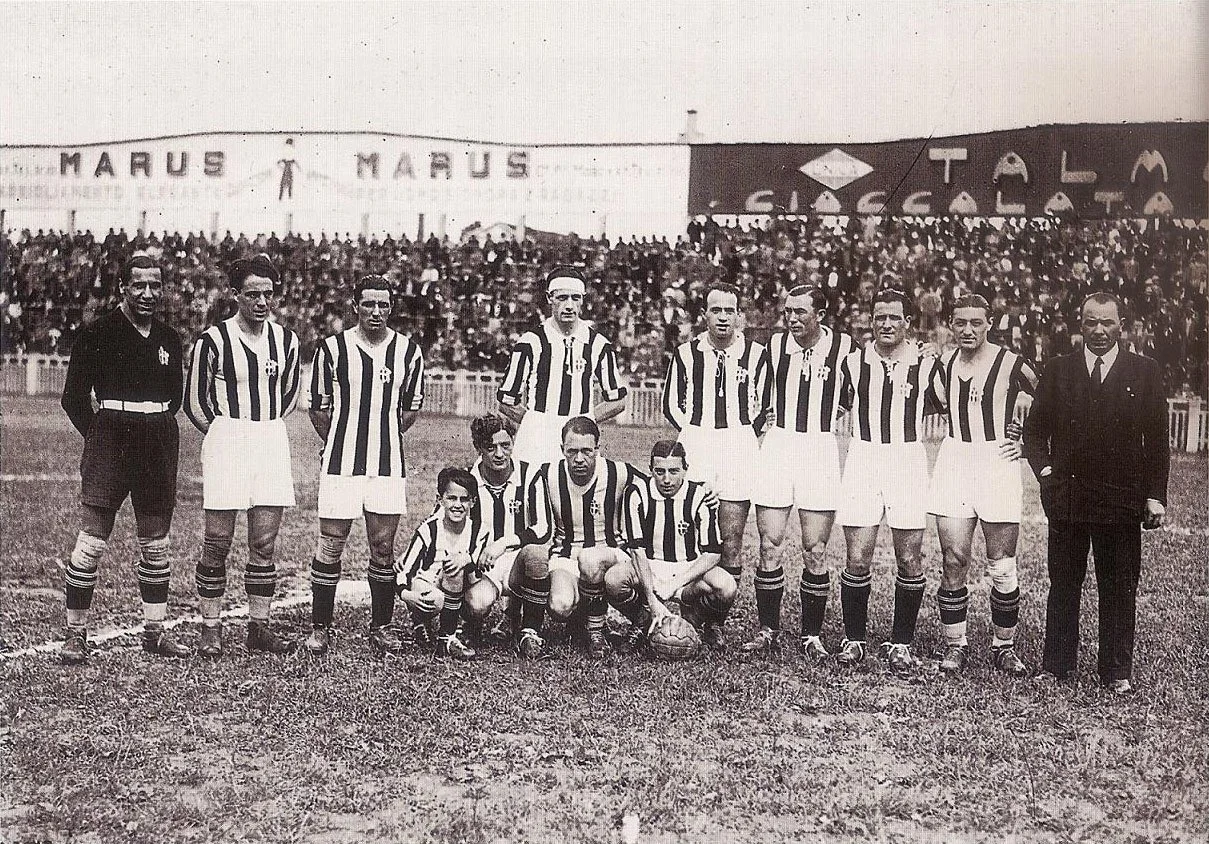
Monti (third from the right) with his Juventus team mates in 1932.
Photo Credit: Wikimedia Commons
The hard work paid off and Monti became a key part of a successful Juventus team. With him in the side, they won four consecutive Serie A titles, from 1932 to 1935. He served as the club’s captain and formed part of a fearsome defensive trio with full backs Virginio Rosetta and Umberto Caligaris.
Monti’s performances for Juventus brought him to the attention of the Italian national team’s manager, Vittorio Pozzo. Monti made his Italy debut on 27th November 1932, in a 4-2 win over Hungary.
Pozzo was not a fascist but, as national team manager, he effectively worked for the regime and is therefore considered by some historians to have been a ‘reluctant fascist by association’. He was criticised in some quarters for selecting foreigners.
However, in what might be considered to be a swipe at the fascist regime, he argued that if the rimpatriati could be subject to conscription it was absurd that they should not be eligible for the national football team. “If they can die for Italy, they can play for Italy”, he said.
Pozzo favoured a traditional 2-3-5 formation, and developed this into the metodo system, which required withdrawing two of the forwards into the midifield. This was similar to Herbert Chapman’s WM system and might be referred to as the WW as the centre-half was not moved backwards in to the back line.
Pozzo, however, lacked a centre-half of sufficient mobility and creativity to play the formation well, which is why he called Monti up to the Italian team. Pozzo used him as a centro mediano. He would drop when the opposition had possession and mark the centre-forward but would advance and become an attacking fulcrum when his side had the ball.
In order to integrate Monti into his Italy side, Pozzo had needed to smooth out relations between the former Argentina man and key forward Angelo Schiavio. Monti and Schiavio had first clashed in 1929, when the latter’s Bologna side had toured South America.
Then, in a crucial Serie A match in 1932, Monti had deliberately stamped on the forward’s knee while he lay on the ground. Monti and Schiavio despised each other. Pozzo solved the problem by forcing the pair to room together during a pre-World Cup training camp and, although they never became friends, the animosity subsided to a level that allowed them to work as effective team mates.
The success of the 1930 World Cup meant that 32 nations expressed an interest taking in part in the next edition in Italy in 1934. This meant that, unlike four years previously, a qualifying competition had to be organised to whittle the entrants down to 16.
Despite the increased interest, there were some notable absentees; Uruguay declined to participate in protest at several European Countries’ refusal to travel to South America when they were hosts.
The British Home Nations still considered themselves above the whole thing, even though FIFA had offered England and Scotland direct entry without having to go through qualifying. Despite being hosts, Italy were still required to qualify. This is the only occasion when the host nation has had to qualify for their own World Cup.
Italy’s qualification was secured with a 4-0 win over Greece, in a game that is notable for being the only time that Nereo Rocco, who would go on to become one of AC Milan’s greatest ever managers, appeared for his national team. The tournament itself did not feature a group stage and began with a knockout round of 16 teams.
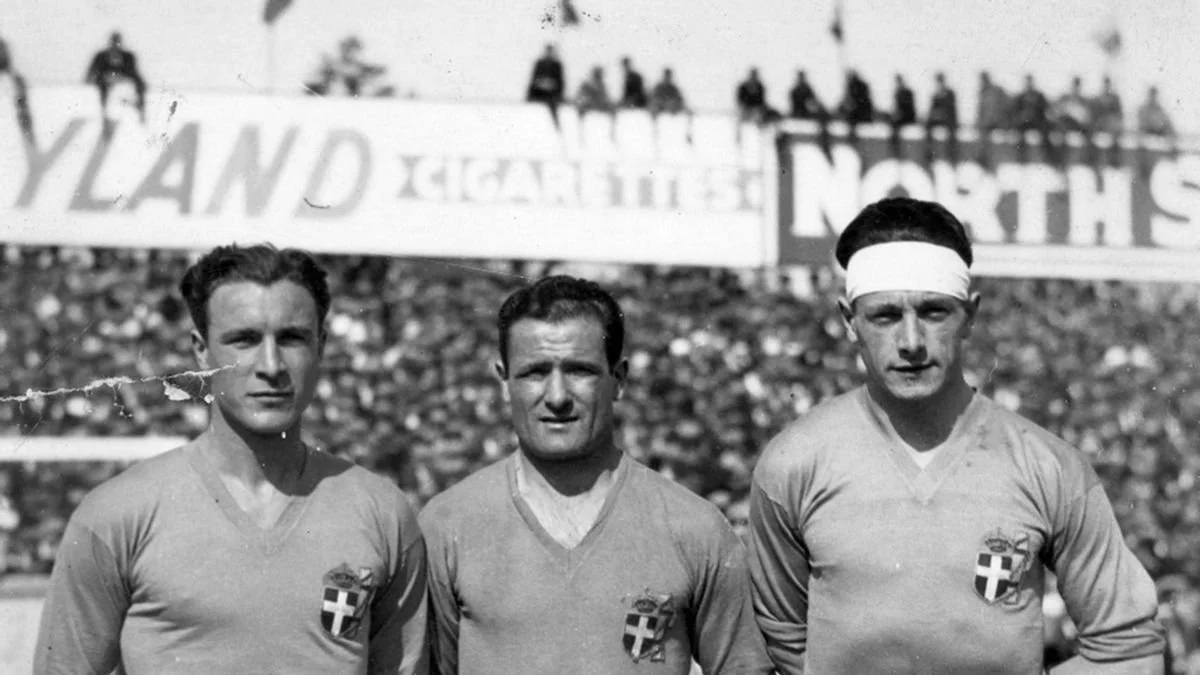
Monti (centre) in Italian colours.
Photo Credit: El Diario
Italy’s first ever match in the World Cup proper came on the 27th June in the Stadio Nazionale PNF against the United States. Italy defeated the USA 7-1, Monti’s nemesis Schiavio scoring a hattrick, his fellow rimpatriato Raimundo Orsi scoring twice, and Giovanni Ferrari and the legendary Giuseppe Meazza getting one each.
If it hadn’t been for an outstanding performance by the American goalkeeper, Julius Hjulian, the score might have been even bigger. Meanwhile, Argentina, Monti’s former team, containing none of the players that had appeared for them in the 1930 World Cup final, were eliminated by Sweden.
In the quarter finals, Italy faced Spain, who included in their side the iconic goalkeeper, Ricardo Zamora. The game was bad-tempered and violent. Zamora was particularly targeted for rough treatment.
There were some contentious refereeing decisions and it was clear that the match officials were favouring the home side. Spain were no shrinking violets though, and a challenge from a Spanish player left Fiorentina midfielder Mario Pizziolo with a broken leg.
Spain took the lead on the half hour mark but Giovanni Ferrari equalised for Italy just before half time. The score remained this way for the rest of the game, meaning that the teams were required to take part in a replay the next day.
The physicality of the previous game had taken its toll, and both sides had to make changes. Of the four changes that Italy made, Luis Monti was not one of them. Spain had to make seven changes, including in goal, where they had to replace Zamora with the uncapped Juan José Nogués.
The game was again characterised by dubious refereeing decisions and excessive physicality. Within the first five minutes, Crisant Bosch was hacked down in the penalty area but Spain were not awarded a penalty. Bosch, however, was injured and his team were forced to play the rest of the game with 10 men.
During the second half, two Spanish goals were disallowed: one for offside and one after a Spanish player had been fouled. The Swiss referee, René Mercet, was suspended in the aftermath of the tournament. The game was won in the 15th minute with a goal scored by Giuseppe Meazza following a free kick.
Italy’s progression to the semi-final meant that they would face one of the pre-tournament favourites, the Austrian Wunderteam. Led by manager Hugo Meisl, and playing a quick passing style introduced to Danubian football by influential coach Jimmy Hogan, Austria had won the 1932 Central European Cup, beating Italy 4-2.
In the build up to the 1934 World Cup, they had demolished Germany 5-0 and 6-0, Switzerland 6-0, and Hungary 8-2. To reach the semi-final, they had beaten France and Hungary.
In what might retrospectively be considered to be an incident of poetic symmetry, this draw meant that Luis Monti, a man who would become famous for winning caps for two countries, would be in direct opposition to a man whose refusal to do the same is rumoured to have led to his death.
This man was ‘The Mozart of Football’, Matthias Sindelar, ‘Der Papierene’, undisputedly one of the greatest players of the 1930s. Although his untimely demise at just 35 was officially recorded as the result of carbon monoxide poisoning, rumours persist that Sindelar was murdered due to his refusal, following the annexation of Austria in 1938, to play for the national team of Nazi Germany.
While this has never been conclusively proven, it is known that the Gestapo had a file on Sindelar and that his café was kept under surveillance.
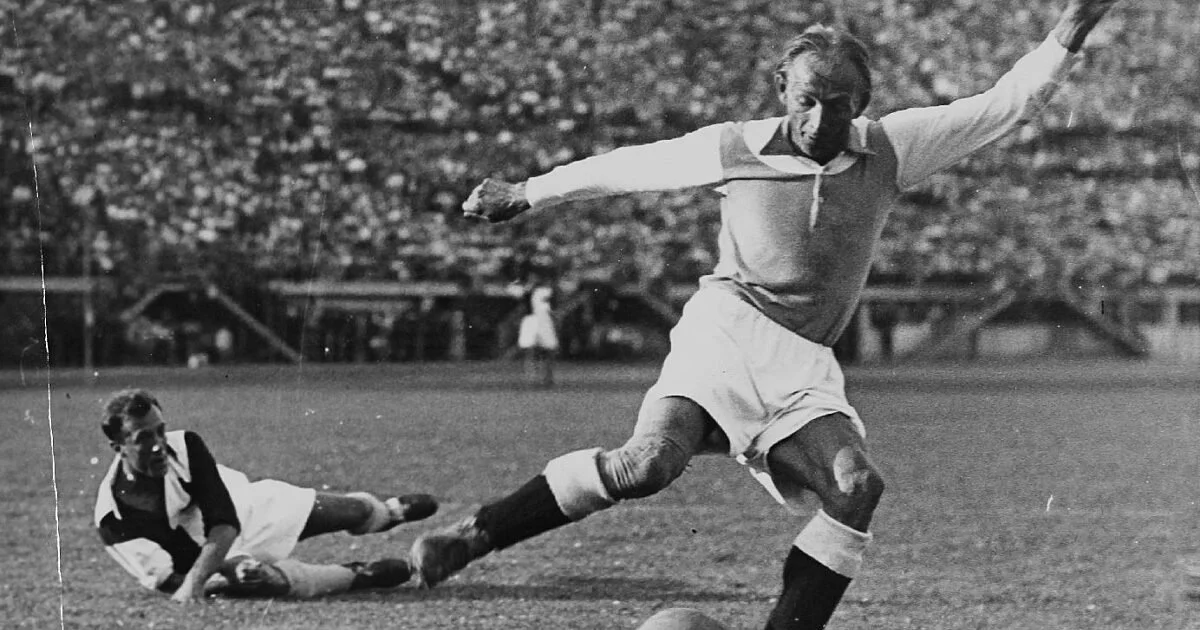
Matthias Sindelar, ‘Der Paperiene-The Paper Man’, a reference to his slight build, in action for Austria Vienna.
Photo Credit: FK Austria Wien
The semi-final was played on a rain-soaked pitch which hampered the Austrians’ passing game. Additionally, Luis Monti’s magnificent performance nullified the threat posed by Sindelar.
At least part of this performance was, as Monti was famed for, based on a robust physicality. Sindelar had been so comprehensively roughed up that he needed to attend an orthopaedic clinic after the game and Vittorio Pozzo felt moved to write a letter to him to apologise.
Italy won the game by a single, controversial goal. In the 19th minute, Austria’s goalkeeper Peter Platzer fell onto the ball near the goal line. Giuseppe Meazza ploughed into him and forced the ball from his grasp. It rolled against the post and Enrique Guaita was on hand to stab it home. And so, Italy would meet Czechoslovakia in the final.
The players were left in no doubt as to what Mussolini and the fascist regime expected of them. The propaganda value of winning the World Cup was of massive importance to Il Duce.
Monti’s granddaughter, Lorena, in an interview with the FIFA Museum, said of her grandfather:
“He told us that before the match against Czechoslovakia in 1934, a person came in to the locker room with a message from Mussolini that said there would be consequences if we didn’t win. He used to say that in 1930, in Uruguay, they wanted to hurt him if he won. In Italy, four years later, they wanted to hurt him if he lost.”
The message that Lorena Monti refers to, in fact, came in the form of a telegram from Mussolini and began “Victory or death gentlemen” and ended “Good luck tomorrow. Win. If not so, crash.” Few were in any doubt about the chilling implications of the word “crash”.
As in the semi-final against the Austrians, the final pitted Italy, with their game based on stamina and strength, against a stylish, short-passing team. The match was a tight one, and the Czechs weren’t going to make things easy for the under pressure Italians.
The first half was goalless and, indeed, it took until the 70th minute for either side to make a break through. Czech winger Antonin Puč took a corner kick which eventually came back to him and he hammered it past Giampiero Combi in the Italian goal.
The Stadio Nazionale PNF must have been like a pressure cooker for the Italian players, under the glare of the dictator. The Czechs held the lead for 10 minutes and could have extended their lead in that time. However, in the 80th minute, two of Monti’s fellow rimpatriati, Enrico Guaita and Raimundo Orsi, combined to produce an equaliser.
After 90 minutes, the teams remained tied on one goal each, so extra-time was required. In the 95th minute, the Czechs left the limping Giuseppe Meazza unmarked, his cross found Guaita who passed to Monti's foe and roommate, Schiavio, who beat defender Josef Čytřoký and shot past the goalkeeper Plánička. No further goals were scored and the match finished 2-1.
Italy had won the World Cup. Luis Monti had made history, becoming the first person to appear in two World Cup finals and the first and, so far, only person to play in World Cup finals for two different countries.
Although numerous players have now played in more than one World Cup final, Luis Monti’s place in history will never be taken, unless FIFA drastically relax their rules around eligibility. He is, and probably always will be, the only person to have ever achieved this feat.
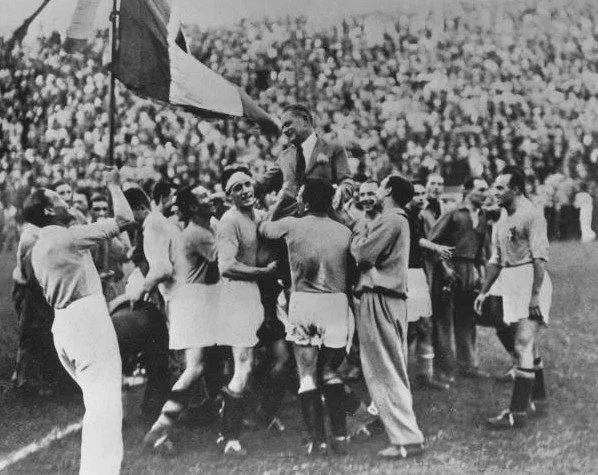
Italy are Champions of the World, 1934.
Photo Credit: Wikipedia