

Words by John Morgan | Published 04.12.2026How is it that, as a football fan, you come to have not one but two heroes?
Of all the players you’ve seen playing the game, either live or televised, of all the interviews you’ve watched, the articles and the football books you’ve read, the drama and the excitement that you’ve experienced, why do two players stand out ?
Arguably, they weren’t the best players in their era, except to me. But there was something about the two personalities, and admittedly the teams they played for, that made them special, and they remain special players.
Although only four years separated them in age, it’s not unusual that they never met one another, except in a fleeting way at a notable game in 1979, the only match they played against each another.
In some ways, they had little in common, one a professional player captaining his club in Spain’s La Liga, the other a very talented player in a largely amateur League of Ireland of the time, but they both won their respective league titles, played international football and took a principled stand on issues about which they felt strongly.
There is more to a footballer than just football for two men who grew up on the border in Ireland or in the interior of the Basque country in the 1950s.
What would they have recognised in each other?
I knew one quite well, sadly no longer with us, and maybe someday I will have the opportunity to meet the other in his Basque hometown.
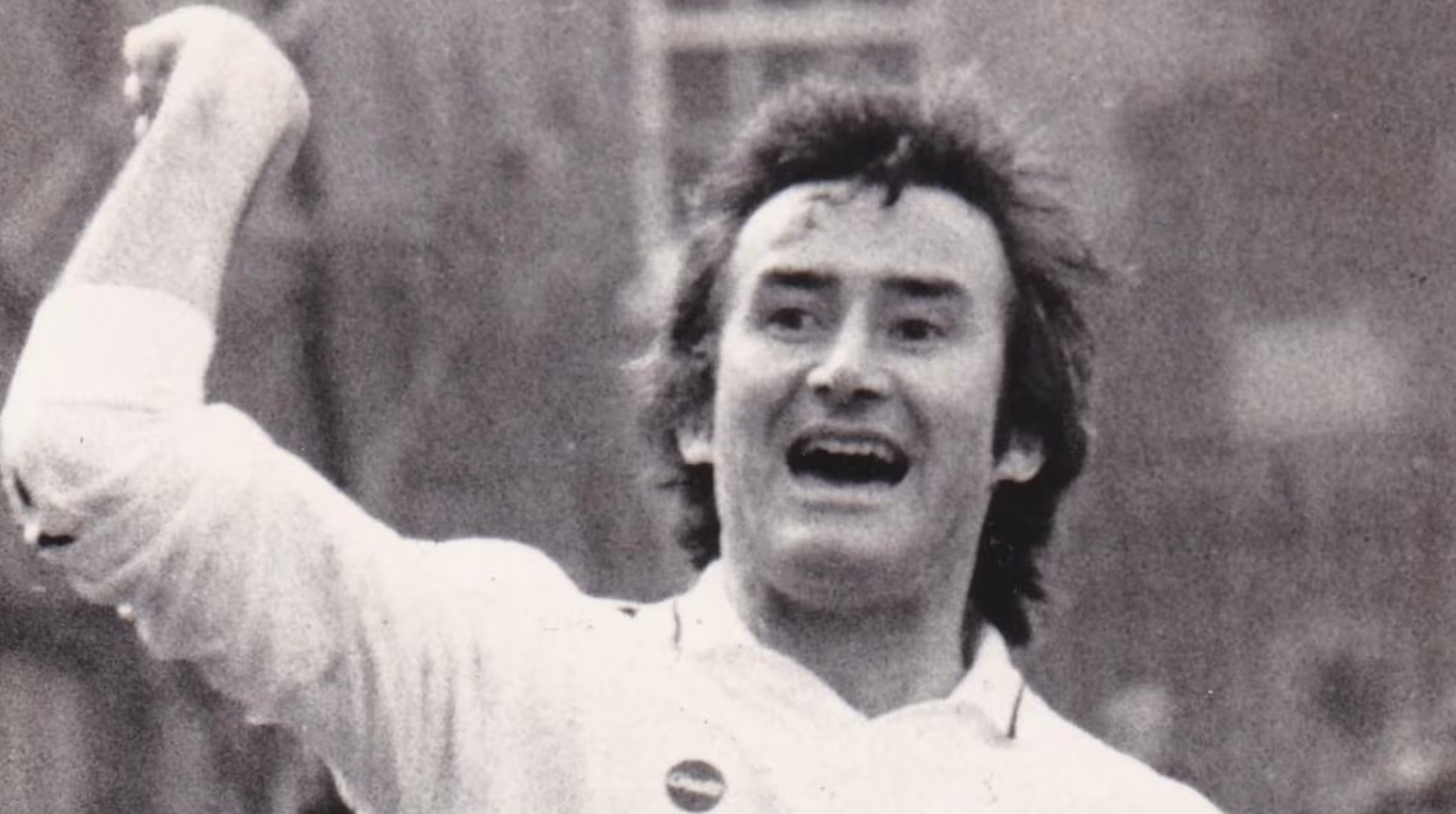
Tommy McConville is one of Dundalk's legendary players.
Photo Credit: Dundalk FC
Born in Dundalk on 19 March 1946, Tommy McConville began life in post-World War II Ireland, a relatively young nation experiencing an economic depression in the aftermath of a global conflict.
Beset by high unemployment which drove significant numbers of people to emigrate, some left to seek jobs in the rebuilding of post-war Britain.
Wartime rationing continued and severe weather in the winters of 1946/47, along with a lack of fertilisers, led to certain food shortages.
Political tensions in Northern Ireland, about four kilometres from Dundalk, would later lead to what was known as the Border Campaign by the Irish Republican Army from the mid-1950s which continued until 1962.
Political violence would break out again in 1969 and last until 1998.
Inaxio Kortabarria Abarrategi was born in Mondragón, in the Basque Country region of Gipuzkoa on 31 July, 1950.
Post-War economic problems, similar to Ireland, would also lead to very significant emigration from the Basque Country. However, one light in the economic darkness emerged from Inaxio’s hometown of Arrasate/Mondragón in 1956; the establishment of a co-operative movement, inspired by Fr. José María Arizmendiarrieta and others, to create jobs and to retain and share profits in the local area.
During the 1950s, under the Francisco Franco regime in Spain, the Basque language and expressions of Basque culture were illegal.
Political repression would eventually contribute to the emergence of the Basque paramilitary group, Euskadi Ta Askatasuna, otherwise known as ETA, in 1959, whose armed campaign continued until 2018.
It is not a surprise that both young men looked to football for diversion, and possibly an escape from the political and economic pressures of the time.
Inaxio Kortabarria played with his local team in Mondragón before joining nearby La Liga club, Real Sociedad, in 1968.
He played for its reserve side until graduating to the first team in 1971. He would go on to play for Txuri-urdin for 14 seasons, featuring in 442 matches and scoring 22 goals.
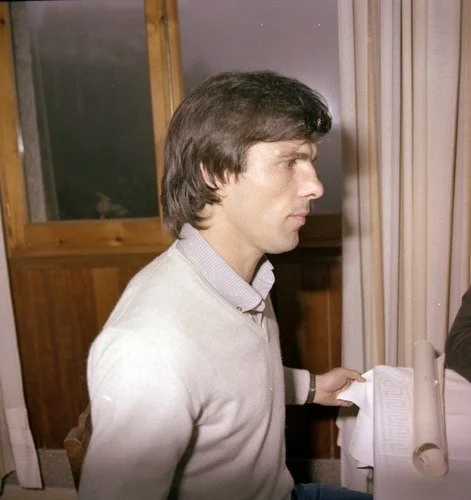
Inaxio Kortabarria in 1981.
Photo Credit: Wikimedia Commons
An iconic captain and personality at Real Sociedad, the high point of his career was undoubtedly the early 1980s.
The club won the La Liga title for the first time in the 1980/81 season. They overcame Real Madrid on head-to head goal difference, over the two matches between the clubs, with Real Sociedad winning their home fixture 3-1 while Real Madrid won 1-0 at their Bernabeu stadium.
It was an historic season for the San Sebastian club, and for Inaxio along with talented players like celebrated goalkeeper, Luis Arconada, the club captain that season, who was famously known as El Pulpo, the octopus, for his shot-stopping skills.
The champions’ leading goalscorer for the season was Jesús María Satrústegui from Pamplona, with 16 league goals. As it happened, Satrústegui had earlier scored his first international goal for Spain in a friendly against Ireland in Landsdowne Road in February, 1977.
In the 1981/82 season, Kortabarria again marshalled the defence and inspired the team to win back-to-back La Liga titles, this time with FC Barcelona finishing as runners up.
Pedro Uralde emerged as the leading goalscorer for the champions with fourteen goals, followed by Satrústegui on thirteen.
Real Sociedad completed the defence of their title with a 2-1 win in the last league game, at home against their Basque rivals, Athletic Bilbao, at the Atotxa stadium in San Sebastian.
The La Liga trophy was proudly raised to the sky, in front of ecstatic fans proudly waving their blue and white scarves, the colours of their club and their city, along with a celebration of Basque Ikurrina flags.
The 1982 Spanish Supercup, over two legs, was contested by the La Liga champions and the winners of the Spanish Cup final, Real Madrid. It was a feisty contest in which, over the two games, the referee handed out six yellow and three red cards to Alfredo Di Stefano’s Real Madrid, with Real Sociedad receiving eleven yellow cards.
Real Sociedad eventually overcame their Madrid opponents 4-1 on aggregate to win the Supercup title.
Having qualified for the 1982/83 European Cup, Real Sociedad began its campaign with a win over Vikingur of Norway in the first round.
Two more wins followed, against Glasgow Celtic in the second round and Sporting CP of Lisbon in the last eight.
Real Sociedad reached the semi-final and a tie against Hamburg. Kortabarria did not feature in either of the two semi-final games.
After a 1-1 draw in San Sebastian in front of 26,900 people, Hamburg won the second leg 2-1 to reach the final where they beat Juventus 1-0 at the Olympic stadium in Athens to lift the European Cup.
Inaxio had won his first international cap for Spain against West Germany in May 1976. His international career proved to be very short-lived, however, playing just four times, with his last match being a friendly against Hungary only ten months later, in March 1977. Kortabarria declined to play for Spain again.
Why did he take that decision? A clue may lie in a celebrated match in December 1976, often known as the ‘Ikurrina Derby’.
The Spanish dictator, Francisco Franco, who ruled over the country since the end of the Civil War in 1939, had died on 20 November 1975. Under his regime, the people of the Basque Country had been denied the right to express their identity, their culture, and their language, Euskera.
They were forbidden from giving their children a Basque name and displays of the Basque Country flag, the Ikurrina, were strictly forbidden.
By 5 December, 1976, the Ikurrina was still illegal as Real Sociedad prepared to welcome their fellow Basques, Athletic Bilbao, to the Atotxa stadium in San Sebastian.
Basque society shared a frustration at the continued repression of their historic identity. A Real Sociedad player, José Antonio ‘Josean’ de la Hoz Uranga, came up with a plan. He asked his sister, Ane Miren, to make a Basque Ikurrina which he smuggled into the home dressing room.
The players of each team, captained by Kortabarria and by José Ángel Iribar Kortajarena, all agreed to line up behind the Ikurrina as they emerged onto the pitch at the Atotxa stadium.
Supporters of both clubs, particularly older fans who remembered the dark days of the Civil War, wept only as they saw their Basque flag emerge from the shadows after nearly 40 years.
It remains an iconic moment in Basque sport. The Basque flag was legalised a mere 40 days later.
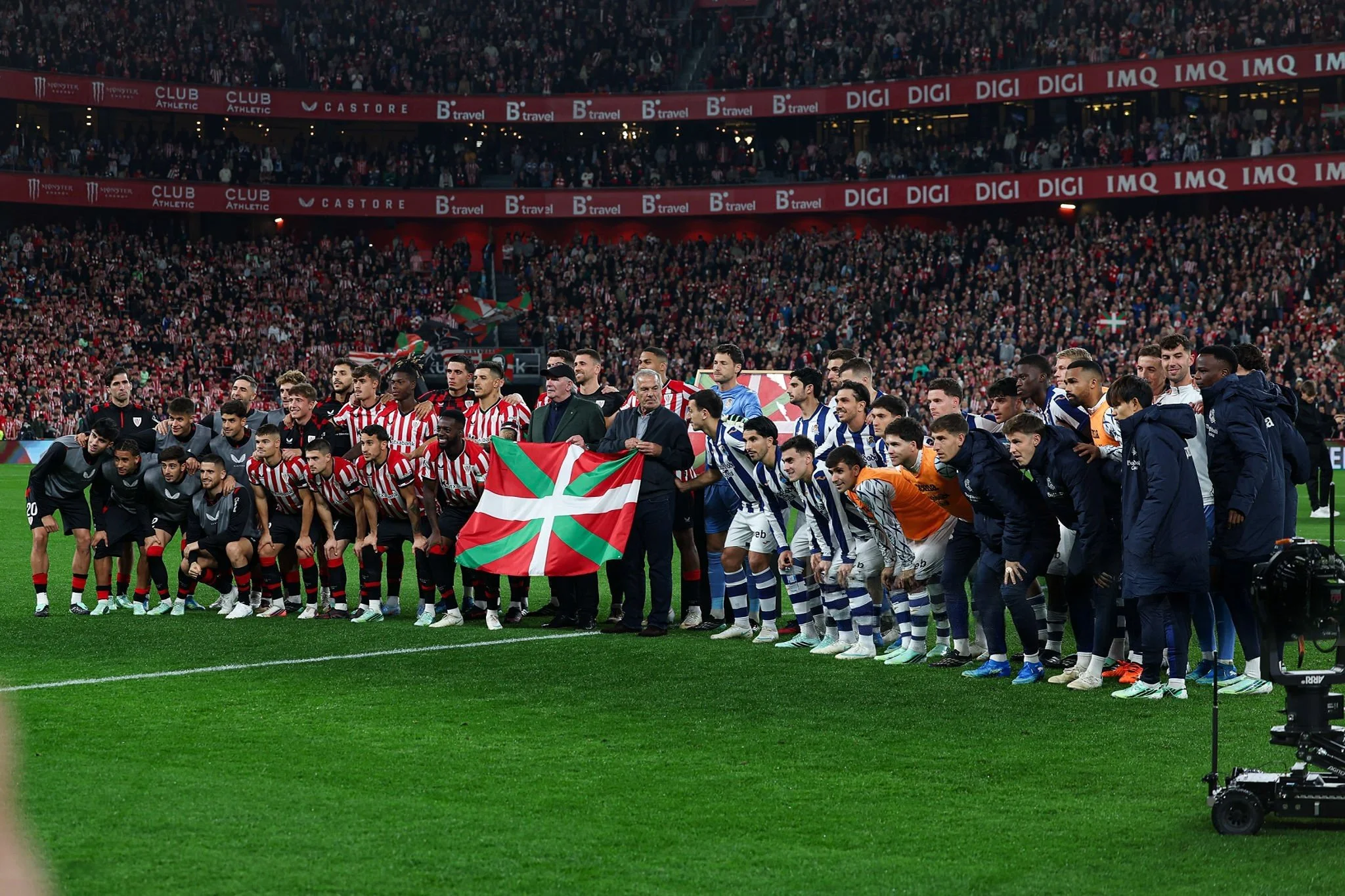
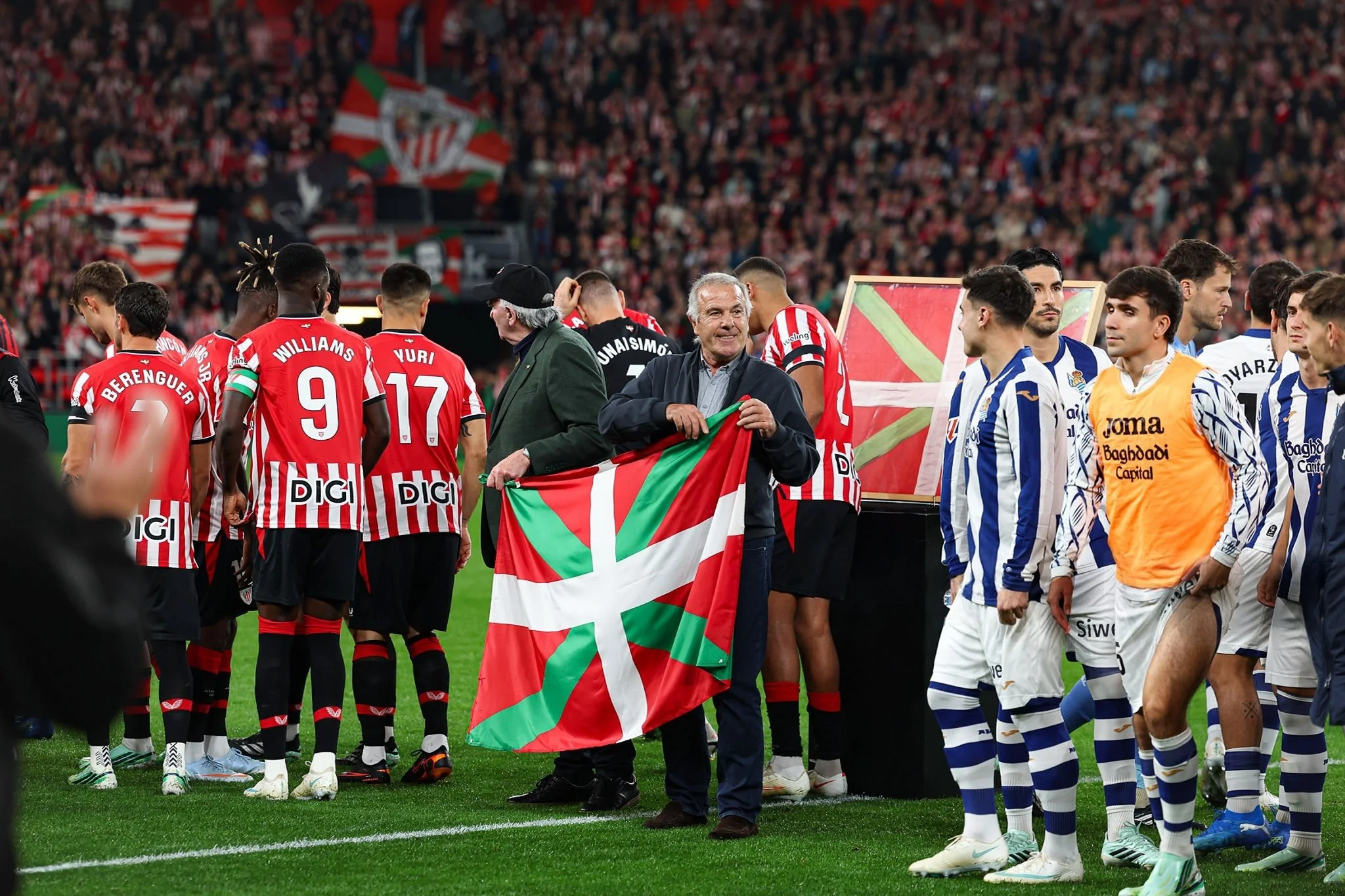
Kortabarria and Iribar recreated their iconic Ikurrina Derby walkout in November 2026.
Photo Credit: BBC News
Tommy McConville, meanwhile, began his underage football career with the Rangers Minor League team in the Dundalk area. In a short time, Dundalk FC approached Tommy, then aged 16, to join its reserve team.
After a spell playing with Bangor in Northern Ireland, managed by former Glasgow Celtic great, Charlie Tully, Tommy returned to Dundalk FC from the 1967/68 season.
He established himself as a very stylish and effective defender. However, Dundalk FC experienced financial pressures in the early 1970s, forcing the club to reluctantly sell a number of key players in 1972.
McConville was transferred to Waterford FC, under manager Shay Brennan, a member of the Manchester United team which had won the European Cup in 1968.
Tommy was a key player in the Waterford side which won the League of Ireland in 1973 and was by then in the Irish International squad.
It was during a World Cup qualifier at Lansdowne Road in Dublin when he came to the attention of Manchester United, who contacted the Waterford manager and agreed a very sizeable transfer fee at the time to sign McConville, who described the opportunity as a ‘dream come true’.
Shay Brennan was satisfied that he had secured a very lucrative transfer deal for Waterford FC but, when he notified the Club directors, they insisted they wanted a larger transfer fee. Brennan communicated the Board’s position to Manchester United. Unimpressed with the Waterford directors’ attempts to undermine what they considered to be an agreement between the clubs, they withdrew from the deal.
When McConville was told what had happened, he felt betrayed by the club, that it had sabotaged his opportunity of a professional career with one of the leading football clubs in Europe.
He refused to play for Waterford again and left to join Dublin club, Shamrock Rovers.
After two seasons, he returned to his hometown club in Dundalk. No doubt, he was still impacted by losing out on a professional career in the English First Division.
He wasn’t to know that Dundalk were about to embark on one of the most successful periods in the club’s history.
Under manager Jim McLaughlin, Dundalk won three league titles, three FAI cups and three League cups over nine seasons between 1974 and 1983.
Tommy had joined in the 1975/76 season and was a key player in the teams which delivered those honours to Dundalk, as well as big European nights against Liverpool, Tottenham Hotspur, Porto, Celtic FC, PSV Eindhoven and Hajduk Split, with Dundalk being only beaten once at home under Jim McLaughlin, in Oriel Park, by Liverpool in 1982.
Dundalk won the League and Cup double in the 1978/79 season and, in the following season, 1979/80, the Dundalk defence, marshalled by Tommy and his teammate and friend, Dermot Keely, in front of goalkeeper Richie Blackmore, had an impressive defensive record, conceding only 13 goals in 30 games, a ratio of 0.43 goals conceded per game.
In other European leagues that season, Porto of Portugal had a ratio of 0.30 and Trabzonspor of Turkey, the present home of Mo Salah, had a ratio of 0.367 goals conceded.
By way of comparison, in the previous season of 1978/79, Bob Paisley’s Liverpool side won the English first division title with a record points total of 68 and an impressive defensive record, a ratio of 0.381 goals conceded per game.
During Tommy’s career, across European games, internationals and during his time in the United States, he played with, and against, some of the stars of the game, like Pelé, Franz Beckenbauer, Maradona, Michel Platini and George Best.
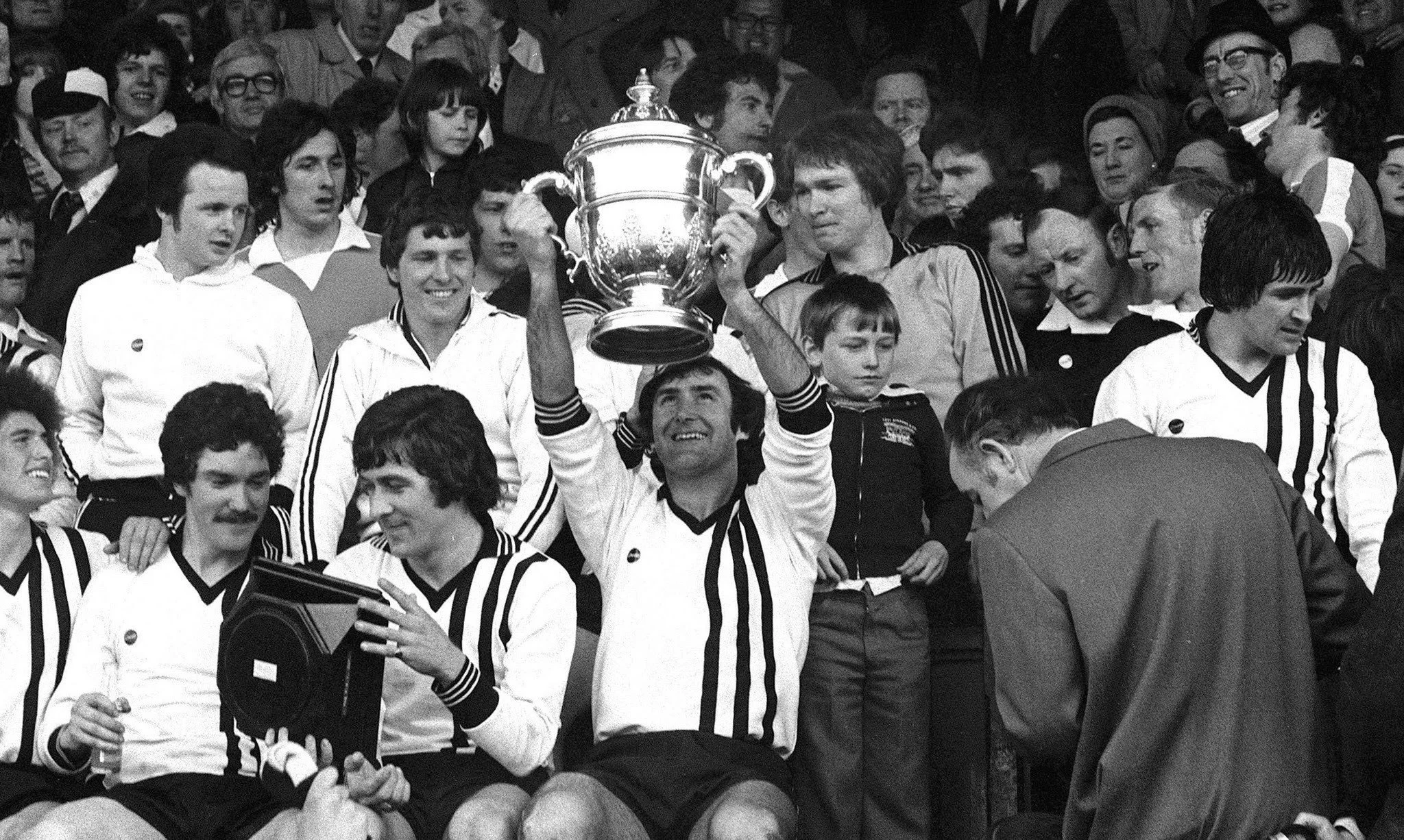
Tommy McConville lifts the FAI Cup with his teammates in 1977.
Photo Credit: Dundalk FC
It was 16 August 1979 at the original San Mames stadium when Tommy McConville and Inaxio Kortabarria faced each other for the first and only time.
The occasion was a friendly match between a Basque Country selection, Euskal Selekzioa, and a League of Ireland selection. The match was hosted during the annual festival in Bilbao, known as Aste Nagusia.
The first official game played by Euskal Selekzioa had taken place on 26 April 1937, the same day as the infamous bombing of the Basque town of Guernica during the Civil War by the German Condor battalion allied to General Franco.
For its first official game since the Civil War, the Basque Football Association reached out to play an Irish side chosen from players in the League of Ireland.
In 1979, Spain was still charting its way towards a complete realisation of democracy and tensions remained, not least in the Basque Country. It is estimated that 40,000 fans packed into the iconic stadium in Bilbao.
The match was also a fundraiser for the promotion of the Basque language but the Basque president Lehendakari, Carlos Garaikoetxea, walked out of the Presidential area in the main stand when the Spanish Government of the day prohibited the playing of the Basque national anthem, The Tree of Gernika, Gernikako Arbola.
Ultimately, the match went ahead despite a bomb scare in the stadium.
Euskal Selekzioa fielded a strong team, with players from Athletic Bilbao and Real Sociedad, such as Jose Angel Iribar, Inaxio Kortabarria, Miguel Ángel 'Periko' Alonso, father of Xabi Alonso, a World Cup winner in 2010, Jesús María Satrústegui and Luis Arconada.
The League of Ireland selection battled gamely but Euskal Selekzioa won the game 4-1, the Irish goal coming from a young Ronnie Whelan, shortly before his transfer from Home Farm to Liverpool where he would go on to win multiple League titles with the Merseyside club.
More important than the result was the deepening of the sporting links between the Basque Country and Ireland and the memories of the game which remained with the players long afterwards.
Pat Nolan, the Limerick United defender, said of the match: 'You can have all the caps, you can have all the medals, but if you don’t have the memories then you’ve got nothing.’
The occasion and the memories of it would have been no less profound for Inaxio Kortabarria and Tommy McConville.
Both selected for their qualities as cultured defenders at club level, Kortabarria was a one-club man, playing for Real Sociedad for 14 seasons, featuring in 442 matches and scoring 22 goals.
While McConville played for other teams, the truth is that, at heart, there was only club for him, his beloved hometown club of Dundalk FC, where he wore the famous white jersey in 580 first team games, scoring 26 goals.
Both players were products of their communities and their generation. They were formed by similar upbringings and cultures. They treasured their identities which, in turn, inspired them to achieve at national and international level.
Guided by their values, they stood up for their beliefs and were willing to pay a price for them. Both iconic personalities and forever remembered by the fans of their beloved clubs.
To Tommy and to Inaxio, thank you for the memories.
Míle buíochas. Eskerrik asko zuei.
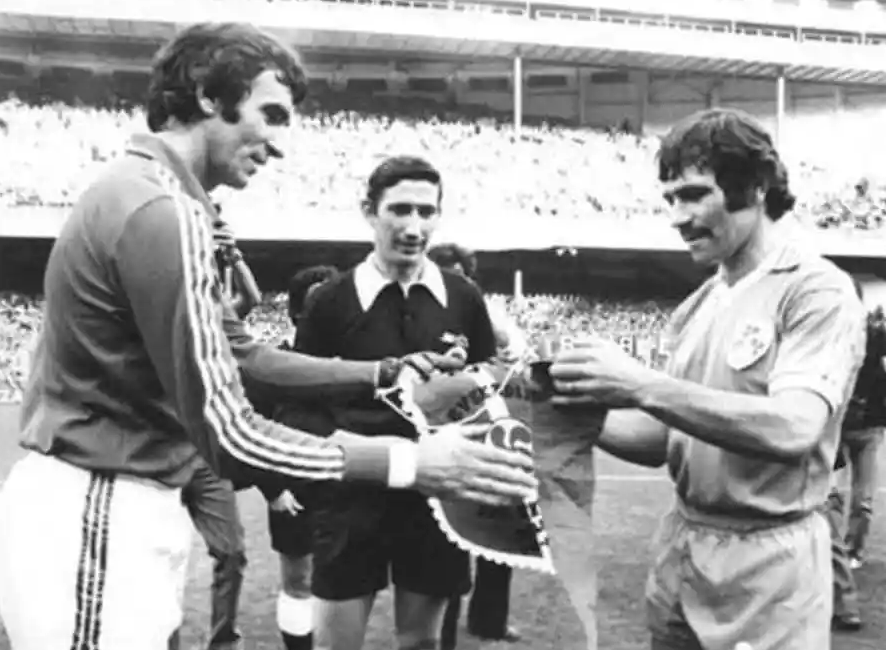
Captains exchange pennants before the match between Basque Country and Ireland select sides, 1979.
Photo Credit: About Basque Country