

Words by Jonee | Published 23.09.2026Football doesn’t really matter. Well, perhaps. I don’t agree with it but then again, I’m also a believer that honey is horrible and some people love it, so what do I know?
Living in Manchester, and regularly attending games both at Old Trafford and the Etihad, I’m faced with the feeling that none of these games, no matter how exciting they are, actually matter much to me.
Now, that is obviously connected to the simple fact that I’m not a supporter of either of these teams, so the emotional tie to them is just not there, which reflects in the way that I watch these games, but, and it is a massive but, at most of the games I attend in Manchester, I have friends with me, die-hard supporters of either Red or Blue side of town, which obviously adds a bit of spice, interest, to these games.
After all, what kind of friend would I be if I didn’t want my friends to be happy?
On Sunday, and for the whatever consecutive year running, I went to the Manchester Derby, this time at Old Trafford. As per usual, I was meeting friends there, so I knew exactly what was expected.
As I was making my way through Victoria Station and then walking past the National Football Museum (go visit it! It’s well worth your time!), I kept thinking about what it truly means to be a neutral fan at any football game, let alone a massive rivalry like the one that I was about to attend.
I honestly feel that you’re never really neutral with anything, let alone when it comes to football and its passions, stories and history.
Obviously, I had to stop at Michaels for a lovely Spanish latte (again, more than worth it), which gave me extra time to think about all sorts of things, including the incoming Clássico in Portugal, between my FC Porto and our bitter rival SL Benfica.
I do love to walk around town before a big game, to feel the energy, to see the fans with their shirts, scarves, and football paraphernalia, all out in public for everyone to see. I have to say, I love when I see different generations going to a match together, it really brings warmth to my soul.
Football, if anything, is a family affair.
Walking past the Manchester City Hall and now the newly instated Number 10 of the North (obviously there is a pub next to both), I lose track of my thoughts while noticing the still-there scaffolding surrounding the Hall building, but I digress, so back to what I was saying.
I like to think about football, both in a tactical way, although less these days, and in a social way, because this game of ours has itself so ingrained in our culture, in our day-to-day life, that it is almost impossible to escape it.
My mates are texting me, begging me to not bring anything blue to the game, which makes me laugh, because I was indeed wearing something blue, my FC Porto shirt. I know it confuses them and my blue friends, but a man’s allegiances don’t simply disappear when facing a different scenario.
Take a very busy tram to Old Trafford (the cricket ground) and then make my way to Old Trafford, the football hallowed ground. Thousands and thousands of people, including groups of friends split by the two colours, but united in the shared love for the game.
I finally meet my friends, who once more decided they wanted to ask why I am wearing my Porto shirt, like that is even a question. We then go for a proper football pre-game scran, that can only be described as very greasy, very tasty and with a large portion of chips.
We start rattling out ideas on how the game will go, which players can unlock the score, who has more on the line, the forever-in-question future of any current Man United manager, how Player A is clearly better than Player B on the other team, how the lady in the pink top is absolutely stunning and out of the league of Mark (we will call him that for the sake of his anonymity).
All sorts of topics are discussed in a pre-game gathering, especially if there is time for a few pints (Guinness for me, obviously).
As a neutral supporter at this game, it is for me to indulge in provocation of my mates. After all, they’re the ones with everything on the line, not really but you know what I mean, which I happily engage in.
Once game time approaches us, it becomes clear in everyone’s faces that the time to horse around is over, it’s time to focus, to think about important things concerning that game.
In my case, I just finished my meal and went to grab a chocolate bar. Can’t be facing games without a nice chocolate!
Time to go in.
Now, this is Old Trafford, one doesn’t just go in. You embrace the opportunity to enter this special place and I do, I really do.
Growing up about 1700 miles away from Manchester, this ground was already one of the must-go stadiums for me, and although I’ve attended dozens and dozens of games here, every time I come, I feel emotional.
I feel a weird type of happiness, because it’s not rooted in love, but it is deeply emotional.
Old Trafford is one of my sweet ladies and deserves to be treated with respect and admiration, also because it is the spiritual home of Eric Cantona and that alone would be enough to have me hooked!
A bit of confusion going in, always expected, there’s a lot of us here, but once you get past the gates and whatever stairs you have to climb up, you find yourself facing this absolute monster of a football cathedral, with its insane size, scale and numbers of supporters.
Now, I’m not a man who loves the colour red for obvious reasons, but like in Anfield, I’m perfectly ok with the colour choices at Old Trafford.
Some people are singing, there is a kid crying because of whatever reason, two ladies checking their messages, a fella drawing some random thing on his phone, and I look to the side and my mates are incredibly nervous.
It is a Manchester Derby after all and a derby always carries extra weight and special meaning, and the two Manchester teams are giants in their own right, which makes this a match between colossi.
Funny enough, both are going through a transition period, so you never know what to expect.
So, I let them be to deal with their nerves, while I catch up on some news, take pictures and observe all sorts of things, both in the stands but also on the ground.
There is always a player or two that, during their warm-ups, just look more ready than the others, and Haaland was looking relaxed, a lot of smiles and staring confidently at the opposing supporters.
I smelt problems for United supporters, which would later confirm itself.
It is game time.
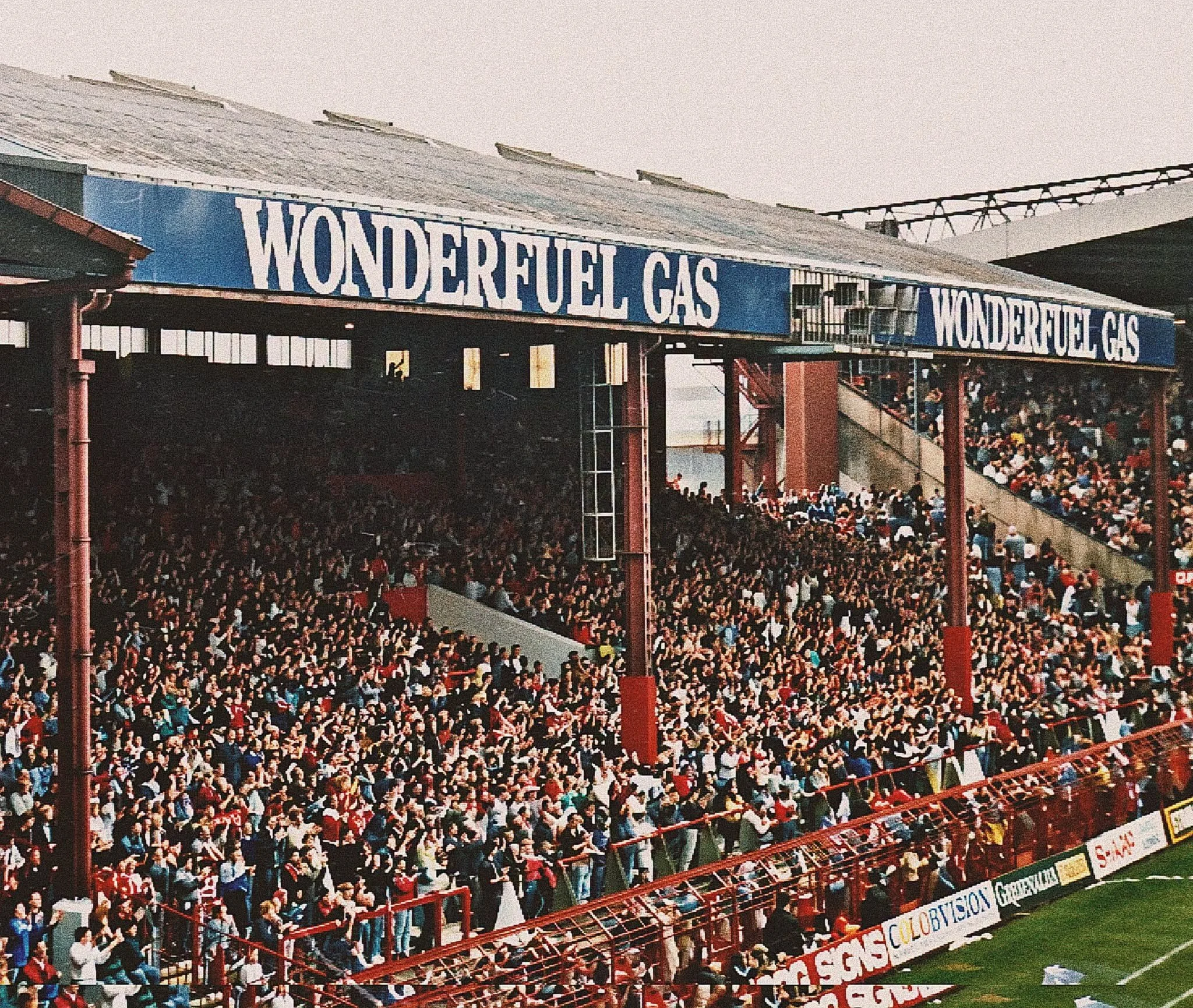
Old Trafford during the 1980s.
Photo Credit: Terraces
Ball goes up and down, one way and the other, a few shots, a few nervous moments on the pitch, which in turn spread through the supporters.
Then that Foden idiotic moment happens and with it, a red card.
The home fans were elated! Surely this meant they could go on top of the game and establish their dominance. I look at the City supporters and many were nervous, while some kept that defiant look that only a sports fan is capable of recognising.
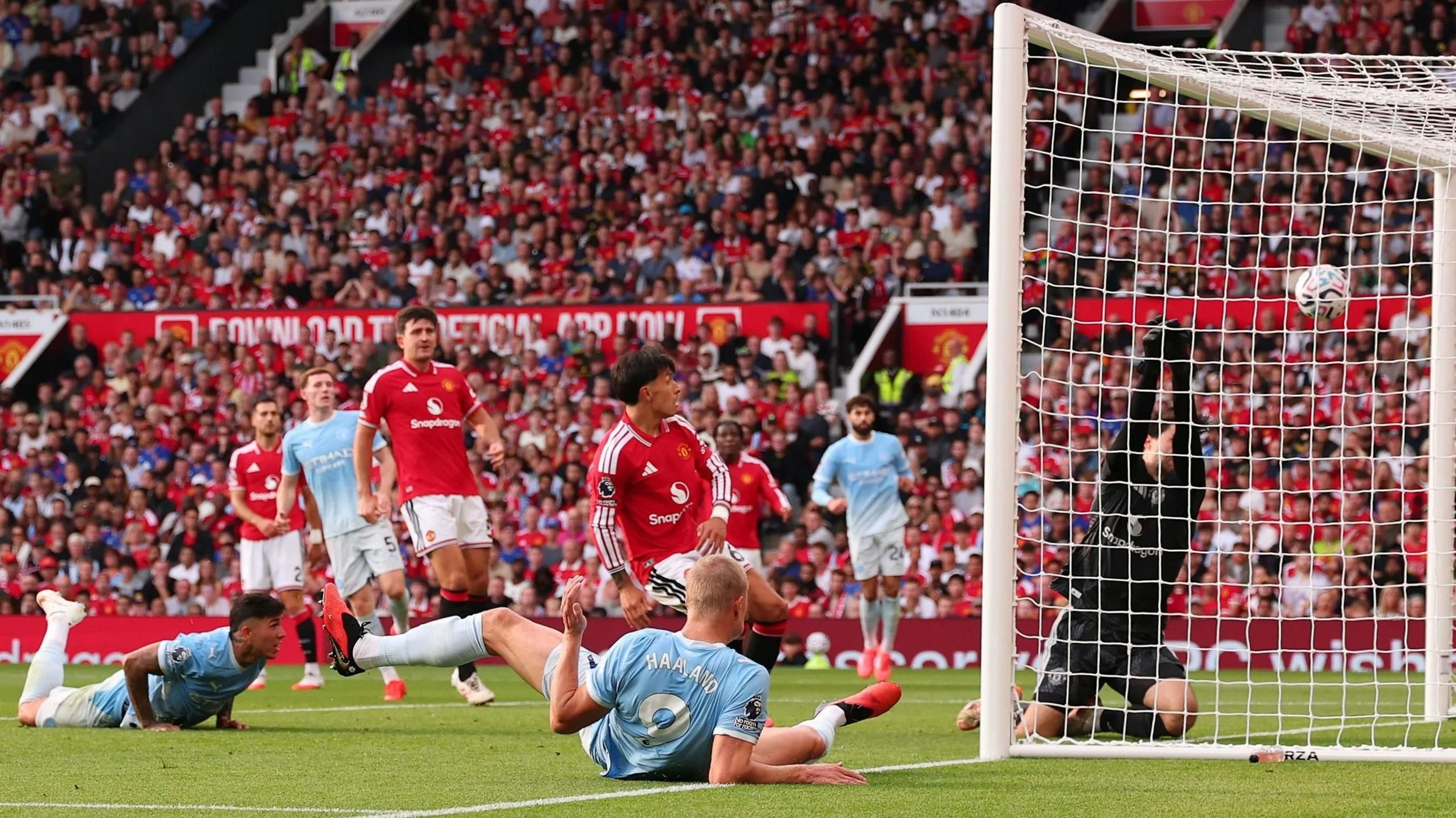
The ball continues to be played, well at moments, poorly in others. Towards the final 30 minutes, a ball is crossed and Haaland does what Haaland does, he scores (he was offside…).
All of a sudden, it’s the home supporters who are nervous and angry, while City supporters are singing and reminding their rivals that they are the team to beat nowadays in Manchester.
Game is over.
The away side wins, although in a derby, no one is really the away team, because I bet a lot of those supporters on the Blue end are locals and neighbours to Old Trafford.
My mates are sad, pissed off, and although I’m not feeling those emotions, I realise I’m sad as well, but in a different way.
I’m sad because people I care about are sad because of their team and even if I can’t relate to their team, I sure relate to them, both as a friend and a football fan.
And perhaps that is where the idea of neutrality starts to fall apart.
Football lives in a bubble in many aspects, and seems to operate at a level that no self-respecting business would operate at, but that side of football is not ours, it’s not what makes us love this.
After a game, I like to scamper off, to think about what I just saw, both on and off the pitch, so I say bye to my mates and make my way into town, this time walking all the way, because I want to make a stop to grab a certain item of food (greedy bastard, I know), which gives me plenty of time to consider many things, amongst them, the way that friendship affects football and football affects friendship.
It would be extremely easy to just dismiss whatever happened at the game yesterday, after all, it was not my team.
But those teams will have impacted every interaction that I will have around Manchester this week, both with Man United and City supporters, which in turn, will affect my personal existence.
That is the power of football, the way it affects and infects everything around it, regardless of which club you support.
My friends deserve my love and they deserve to experience happiness, but sometimes, I have to just think about my neutrality and let them be. Will be hard enough to get a smile from person X or Y when I go grab my coffee, if they are a Man United supporter.
The good thing about football is that, for the better part, whatever the result of the previous weekend, has a shelf-life that ends when the next game begins, so wins and losses are always ephemeral, well, most of them anyway.
Funny enough, I had to return to Old Trafford this morning, so it was really interesting to see how different it looks when empty, without singing supporters. The stadium doesn’t keep a record of happy and or sad moments, it merely gives a stage to the game.
But it does record the memories, and that’s all that football is in a way, memories of trips with friends and family, tears next to fellow supporters, laughs and yes, the occasional aggressive remark towards a rival player or fan.
A stadium is the storage room of our memories as football fans.
Old Trafford is not my home, but it stores many memories that are mine as well, from goals to players, plays and near misses, to sadness and great joy (that Mourinho run by the sideline in 2004).
And maybe that is why football does matter, even when the football itself doesn’t matter to you.
The result of a game between two teams that I don’t support should, logically, have very little impact on me. I should be able to walk away, forget the score, have my food, go home and carry on with my life.
But football is not particularly interested in logic. It has this strange ability to attach itself to everything around it, to friendships, family, cities, memories, conversations.
Manchester lives split in half, between Red and Blue, both sets of supporters having things to be proud about, from domestic to European successes, great players and amazing managers, and I live in the space between the two of them.
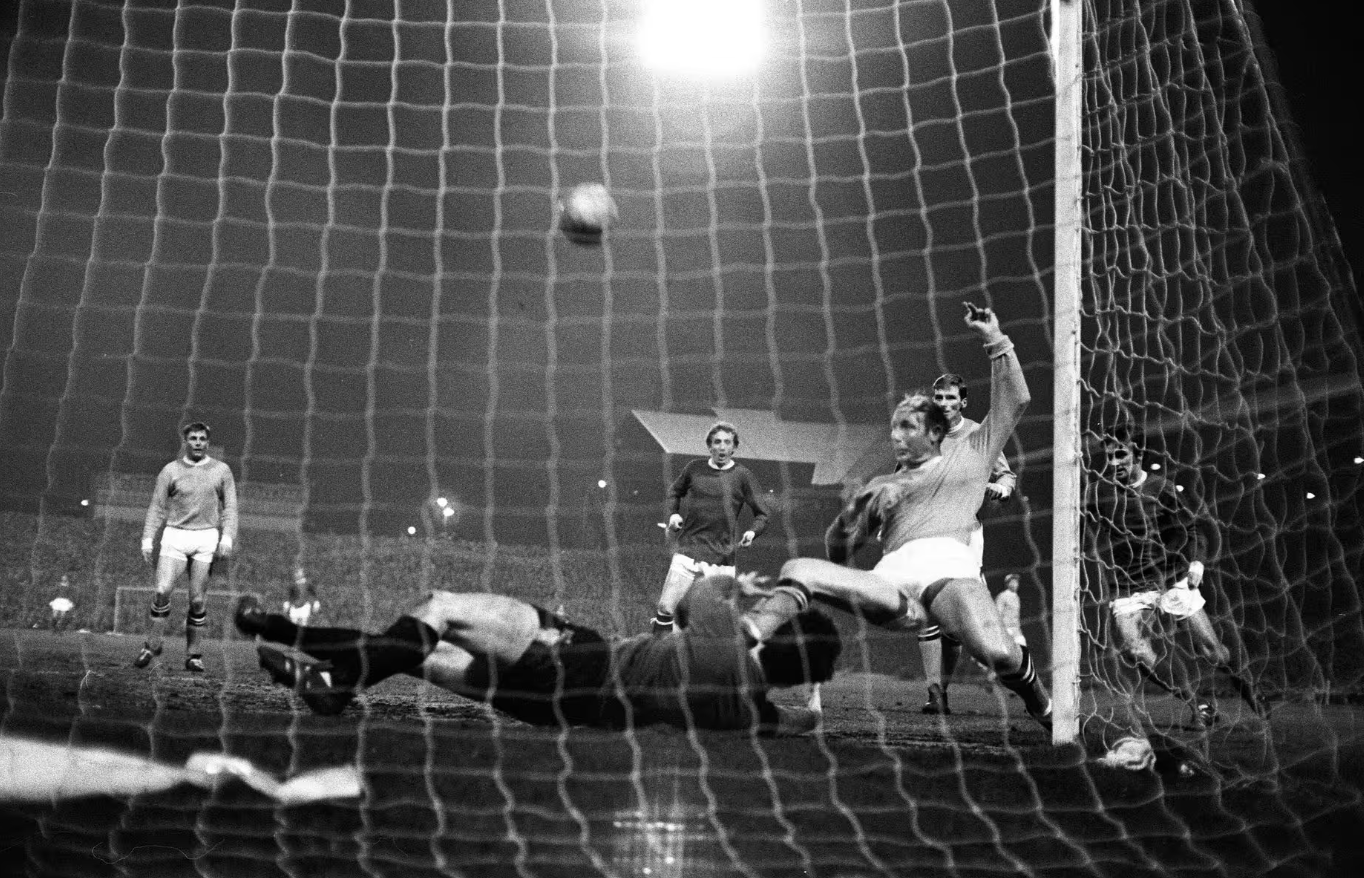
A league match at Old Trafford between United and City, Wednesday 27th March 1968.
Photo Credit: Manchester Evening News
Sometimes hoping my City friends win, other times hoping the same for my United mates, always with the simple realisation that both groups of friends will never be happy at the same time, which is funny to me.
Perhaps that is my version of football neutrality. Not caring who wins, but caring very much about who is happy, who is sad, who I am standing next to, who I am sharing a pint with, who I am walking back into town with after the final whistle.
Football doesn’t really matter. Well, perhaps it does.
I do enjoy the neutrality of my trips to these Derby games, because I can just relax and enjoy the game for what it is, without the added pressure or emotional side of it.
I can watch a player make a great pass and appreciate it without immediately thinking about what it means for my team. I can watch a goal and look around me to see how everyone reacts, rather than immediately jumping out of my seat.
I can take in the noise, the tension, the anger, the celebrations, all without having to experience it through the lens of my own club.
There is something liberating about that.
Football supporters will probably hate me for saying this, but sometimes I think being a neutral allows you to actually see more of the game.
You notice the little things, the way a player moves when he doesn’t have the ball, the reaction of a manager, the mood of a stand changing after one tackle or one misplaced pass.
You see the game as a whole rather than through the very narrow tunnel of your own emotions. Of course, this only works because I know that at the end of the day, I can walk away from it.
My friends cannot. That is the biggest difference between us.
For them, that result will stay with them for a while. It will be discussed, analysed, complained about, probably blamed on someone who should never play for the club again, and then brought up again when the next game comes around.
For me, it is something I experienced with them. It is a memory of a particular afternoon, a particular game, a particular walk into Old Trafford and a particular group of people around me.
That doesn’t make their experience less important to me. If anything, it makes it more interesting.
Walking around Manchester, you can easily see the influence of these clubs. Pubs and small businesses showcase with pride whatever colours they love, sometimes in very subtle ways, sometimes not so subtly.
A pub is red, another one is blue, a flag hangs from a window, a scarf is placed somewhere where everyone can see it. You walk through town on a matchday and you know immediately that something is happening.
Football is everywhere.
It is in the conversations, in the shops, in the pubs, in the trams, in the people walking around town with shirts and scarves, in the little comments you hear from strangers. You don’t need to ask who is playing. You can feel it.
I get asked about my Porto shirt all the time, but it’s almost always in a good-humoured way. After all, I’ve been going to the games for a long time, and what started out as a weird thing for them to see, now it’s more of a funny aspect of my friendship.
“Why are you wearing that?” Because I support Porto.
“But today?” Yes, today as well.
I find the question funny because, in their minds, they are trying to understand how I can walk into Old Trafford wearing blue, while sitting with United supporters, or walk into the Etihad wearing a Porto shirt and expect no one to say anything.
But a man’s allegiances don’t simply disappear when facing a different scenario.
I am not a City supporter because I am in Manchester. I am not a United supporter because I am at Old Trafford. And I am certainly not going to pretend to be one just because I want to blend in.
The Porto shirt is almost a reminder of that. It says, quite simply, that I have my own football story, my own memories, my own people and my own reasons for caring about this ridiculous game. And yet, somehow, it also makes me part of their experience.
Because when they ask me about the shirt, we are talking about football. When they take the piss out of me for wearing it, we are talking about football. When I wind them up about their team, we are talking about football.
When they are miserable after a defeat and I try to make them laugh, we are still talking about football. The game becomes the language.
I go to these games because I love football, both watching it and experiencing the energy around it.
I love the “work” of going to a football match. The energy, the feeling that everything is busy, that everything is intense, that there is something happening everywhere you look.
There is something about the journey to a football game that I love. Getting on a packed tram.
Walking amongst thousands of people. Looking for food. Finding the right pub. Meeting friends. Talking absolute nonsense about football for hours. Looking at the teams warming up. Trying to work out what the manager is thinking. Hearing the first songs from the stands. Finding your seat. Looking around and realising just how many people have made the same journey for the same reason.
It is almost always a great experience, even as a neutral like I am in these games.
And maybe that is because the match itself is only one part of going to football.
The game is obviously the centre of it, but it is surrounded by all these other things that are just as important.
The people you meet, the food you eat, the walk you take, the conversations you have, the jokes, the arguments, the pints, the photographs, the things that go wrong and become funny stories later.
You won’t remember every pass or tackle, many games will fade in your memory, but almost never, do you forget the people with whom you shared these moments with.
That is the human part of football.
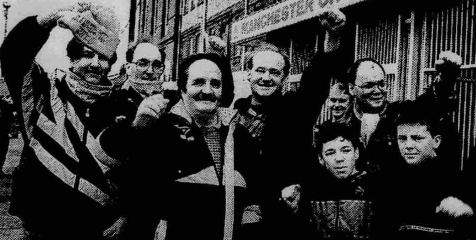
Supporters gather for the Manchester Derby at Maine Road, 1990s.
Photo Credit: Manchester Evening News
Football doesn’t matter in terms of life and death matters, but it absolutely matters in a human way, in an emotional way. It matters because humans are emotional creatures and we need things to care about.
We need reasons to gather. We need things to celebrate and things to complain about. We need rituals, traditions and memories.
Football provides all of that in ridiculous quantities.
It gives people a reason to travel across a city, or across a country, or across a continent. It gives people a reason to meet friends they might otherwise not see.
It gives fathers and daughters, mothers and sons, brothers and sisters, grandparents and grandchildren a reason to spend a Saturday together.
And sometimes it gives a group of friends who should probably know better a reason to spend several hours eating greasy food, drinking Guinness and arguing about whether Player A is better than Player B.
I’m perfectly happy with that. Maybe that is also why I don’t really mind being a neutral.
I don’t need my team to be playing for me to enjoy football. I don’t need to have something personally at stake to understand why a moment matters to somebody else. In fact, there is something quite beautiful about being able to witness somebody else’s passion without needing to own it.
I can see my friend celebrating and be happy that he is happy.
I can see him devastated and feel sorry that he is devastated.
I can laugh when he is being ridiculous.
I can wind him up when the opportunity presents itself. And then, eventually, we move on.
That last part is important.
Because football can feel like the most important thing in the world for ninety minutes, but then the game ends. The players go home. The supporters leave the stadium. The lights eventually go out. The pitch becomes just grass again. And tomorrow morning, the city carries on.
People go to work. People go for coffee. They get on the tram or walk their dogs. People will still complain about the weather.
The world does not actually change because United beat City, or City beat United.
But, for those ninety minutes, thousands of people experienced something together. That is not nothing.
Perhaps that is the contradiction I keep coming back to when I think about football. It is both completely meaningless and incredibly meaningful at the same time.
It doesn’t matter. But it matters.
It can be completely ridiculous, while also being deeply serious. It can be a business worth billion, while also being a father holding his son’s hand as they walk towards a stadium.
It can be an argument between strangers in a pub, while also being two old friends meeting every other Saturday because they have done it for thirty years.
It can make someone miserable on a Sunday afternoon and give them a memory they will carry for the rest of their life. It can be so many different things to so many different people.
I go because I want to experience all the things that happen around the game.
I want to be there for all of it. And then I want to walk back into Manchester, preferably with something else to eat, and think about what I’ve just experienced.
Maybe that is my version of neutrality. Not being indifferent. Not being completely detached.
Just understanding that football belongs to everyone differently.
For my friends, yesterday was about Manchester United and Manchester City.
For me, it was about Old Trafford, a Derby, my friends, the city, the atmosphere, the memories and the strange privilege of being able to experience something that means so much to people I care about, without having to carry the weight of the result myself.
And next weekend, they will all move on to the next game.
Someone will win and someone will lose. There will be complaints about the referee.
Ridiculous goals will be scored, with someone becoming and instant hero, while others will be vilified.
My friends will send me messages. I will probably wind them up. Then we will do it all again.
Because football doesn’t really matter.
But perhaps that is exactly why it matters so much.
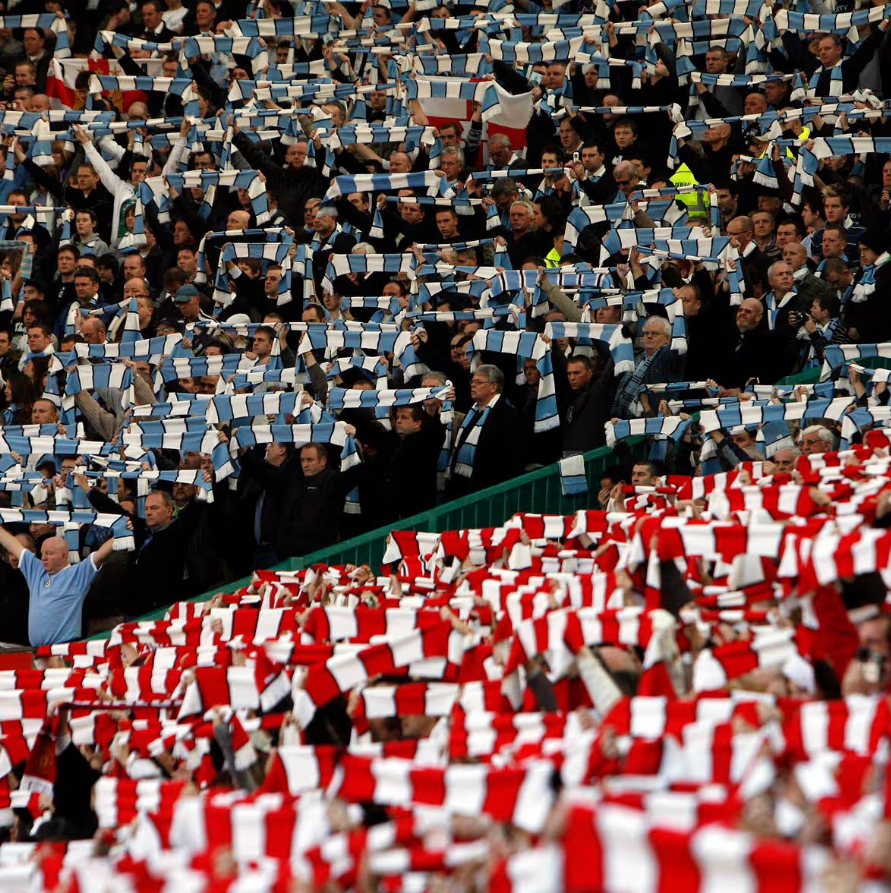
Supporters of both Manchester clubs remember the Munich Air Disaster together during the derby in 2008.
Photo Credit: The Guardian