

Words by Andrew Newton | Published 09.12.2026Anyone that has regularly read Football Heritage articles or listened to Football Heritage podcasts over the last couple of years will know that the United States of America has a rich, deep, and historic Association Football culture.
Nevertheless, there remains a distinct difference between the overall sporting culture of the USA and that of much of the rest of the world.
Over the summer of 2026, these cultures clashed when the FIFA World Cup was held in the USA (and Mexico and Canada). The nature of this clash, of course, mainly relates to the importance that Association Football holds.
Social media, that great ocean of reasoned debate, balanced opinions, and factual accuracy, was teeming with ‘discussions’ about the relative merits of different codes of football.
This inevitably led to the question (which I have addressed previously for Football Heritage) “why is American Football called football when it is played predominantly with the hands?”
One explanation that was repeatedly given was “football was the name given to games played on foot to distinguish them from games played on horseback”. Such was the confidence with which this explanation was given, it merited further investigation.
Games referred to as ‘football’ seem to first appear in the British Isles during the medieval period. So does this mean that there were ball games played on horseback in medieval Britain? Were the Knights of Yore playing games like polo?
Polo developed from a game played by the nomadic peoples of central Asia from about the 6th century BC. This original game is considered to have been similar to the Afghan game of Buzkashi, or goat pulling.
This is a traditional game in which horse-mounted players attempt to place a goat or calf carcass in a pre-designated location. Similar games, with slightly differing names, are played in Kyrgyzstan, Uzbekistan, and Kazakhstan.
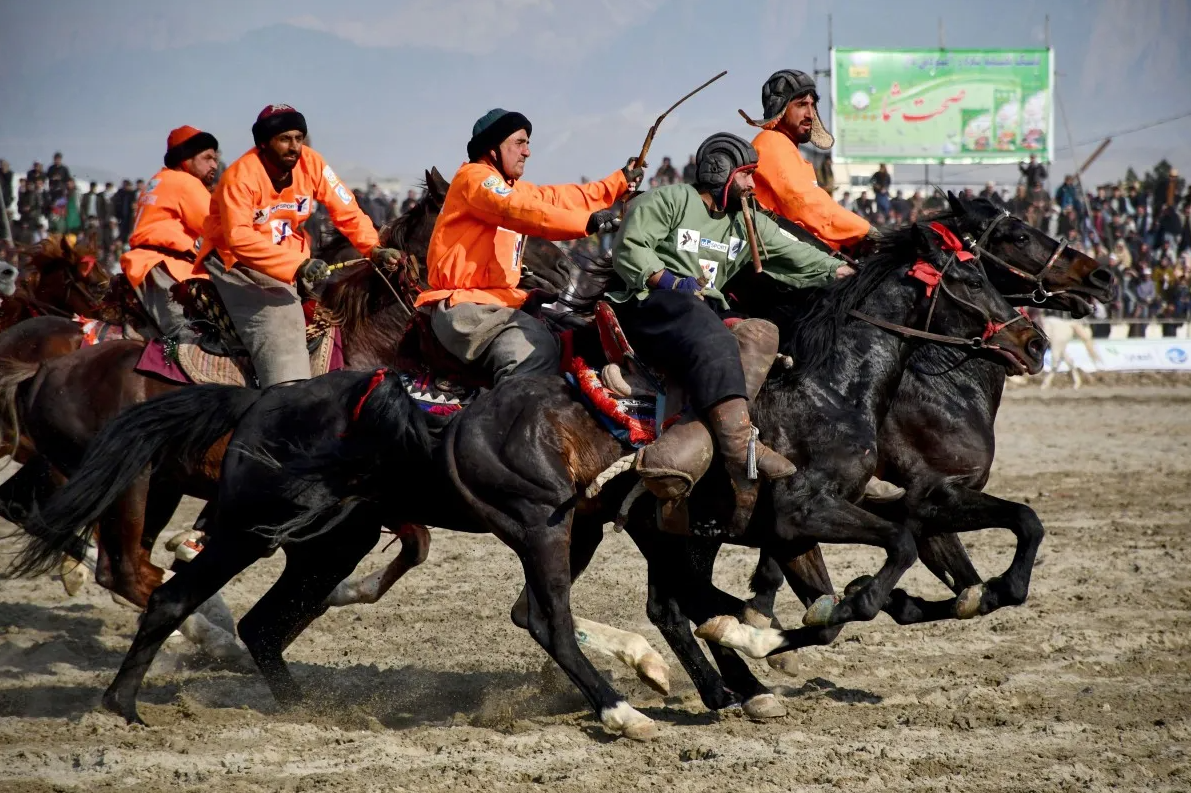
Modern Buzkashi. Action from the Afghan Buzkashi League.
Photo Credit: Al Jazeera
The game became formalised, and swapped the dead animal for a ball, in Persia during the Parthian and Sassanian Empires.
It became a regal pursuit embraced by the Persian nobility and elite cavalry units, becoming a symbol of prestige and martial excellence.
From there it spread westward to the Byzantine Empire, eastward to the courts of Tibet, China, and Japan, and south into the Indian sub-continent where it became a favourite of the Mughal rulers.
While Europeans might have witnessed the game, particularly through its popularity in the Byzantine Empire, it does not appear to have become established further west.
Polo sticks were featured as one of the suits on the Mamluk predecessor to modern-day playing cards. However, these were transformed into the clubs that appear on a deck of ‘Latin’ cards due to the lack of familiarity with polo in Europe at the time.
Polo did not come to Britain until the 1860s. Tea planters and British military personnel had learnt the game in India, observing games played in the state of Manipur, where it was very popular.
The first European polo club was established in Silchar in Assam in 1859 and the game then spread from there to Calcutta and then to Britain.
The game of Pato (or juego del pato) is popular in Argentina. This is a game played on horseback in which teams of four attempt to get a ball with six leather handles through a vertically positioned ring at the top of an 8ft pole.
It has similarities to polo, basketball, and rugby. Pato is the Spanish word for duck. In its early forms, the game was played not with a ball, but with a live duck inside a woven basket.
The game has been banned several times due to the violence involved, and not just to the duck. However, this was not a game descended from a medieval European ancestor; its genesis appears to have been in competitions between gauchos from neighbouring ranches during the 17th century.
Instead, horseback sports and games in medieval Britain appear to have been limited to those with martial associations.
They mainly consisted of things like jousting, the quintain (striking a rotating wooden target with a pivoting arm that could strike the rider on the back), the mélée (a large-scale, mock battle), and horseback archery.
Hunting would also have been carried out on horseback and we can assume that people probably raced each other while riding horses. None of these activities involved balls.
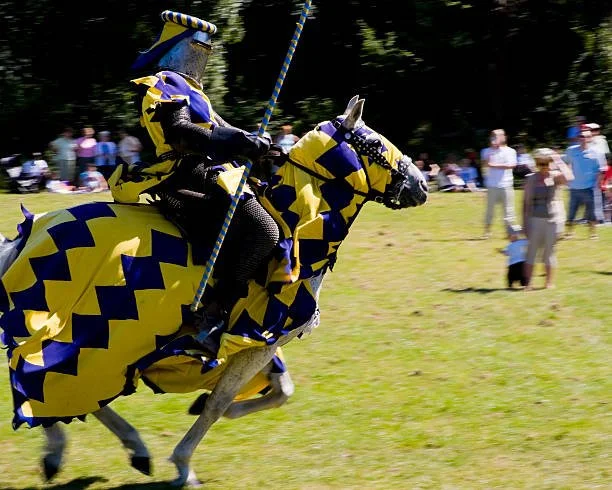
A modern interpretation of medieval jousting.
Photo Credit: iStock
The one possible exception to this is the Cornish game of ‘hurling to the countrie’, which is mentioned in an account from 1602 and appears to be a variant of the Cornish hurling game, sometimes known as ‘hurling to goals’, which is still played.
This version of the game was played with ‘goals’ positioned in neighbouring villages or homesteads, sometimes three of four miles apart, and involved carrying a small silver ball ‘by force or sleight’ to one of these locations. It appears that some participants in this game could be mounted.
So it seems that there were no horseback ball games that were widely played in medieval Britain. However, many iterations of this theory do not specifically refer to ball games.
The distinction is simply that the nobility and upper classes took part in pastimes (such as jousting or hunting) in which they were mounted upon horses, whereas ordinary people played games on foot.
This would, therefore, make any ball game ‘football’. The problem with this is that there were many ball games played on foot that were not referred to as ‘football’.
First though, it’s important to note that several of the early documentary references that are assumed to relate to football don’t actually use the word football.
William Fitz Stephen, in his Descriptio Nobilissimae Ciutatis Londinae of 1174, often considered to be the first recorded description of football, only refers to “the famous game of ball”.
Ball, not football.
Similarly, references to events at Ulgham, Northumberland in 1280, Oxford in 1303, and Shouldham, Norfolk in 1321, refer only to “ball”. The need to specify that this game wasn’t played on horseback appears to have been unnecessary on these occasions.
The earliest reference to “football” comes from 1314, when Nicholas de Farndone, Lord Mayor of the City of London, issued a decree on behalf of Edward II, banning it.
Around the same time, medieval sources appear to be referring to a ball game that involved another portion of the human anatomy.
In 1365, a statute (dated 12th June that year) forbade the men of London “under the pain of imprisonment to meddle in the hurling of stones, handball, football… or other vain games of no value”.
Instead, they were expected to practice archery. In 1388, a similar statement was made when it was stated that “servants and labourers shall… leave all playing at ball whether handball or football, as well as other games called coins, dice, stone-putting and other importune games”.
The game of handball referred to in this statute is a different animal to the European game, a bit like five-a-side football, that was not widely known in Britain until the 2012 Olympics.
The game referred to in these early sources is considered to have originated from early forms of the French game jeu de paume.
It was generally played against the walls of the north ends of churches or the walls of bell towers. This led to damage to the expensively glazed windows of these buildings.
Many of the earliest references to handball (or hand-tennis, as it was sometimes known) are directives by clergy trying to prevent the game being played, in order to avoid damage to their churches.
Such documents appear from 1287, when the Synod of Exeter banned handball.
In 1591, Elizabeth I witnessed a game of handball played by the servants of the Marquess of Hertford. “…they played five to five with hand-ball at bord and cord as they tearme it, to the great liking of her highness” John Nichols, the 18th century author and antiquary, recorded in his The Progresses and Public Processions of Queen Elizabeth (Vol. II).
About the time that Elizabeth Tudor witnessed this game, however, it was becoming known as Fives in England, and different variations of Fives were eventually codified at several of the major public schools.
However, related games such as Gaelic Handball, or liathróid láimhe, and Welsh Handball, or pél-law, preserve the anatomical name.
Handball was evidently still being played in certain parts of England in the 19th century; when the Ashington Recreation Ground, a venue established by the area’s collieries for local people to use, opened in 1886 a handball wall was included amongst its numerous facilities.
Other medieval games that were played on foot were often bat and ball games. Stoolball is considered to be similar to cricket and rounders or baseball.
It was traditionally played by milkmaids who used their milking stools as a wicket. There are some suggestions that it originated as a courtship ritual, rather than as a competitive game.
In Kent, a game called bat and trap was popular. This involved a mechanism that shot a small ball into the air in front of a batsman who had to hit it between two white posts, positioned about 21 yards away.
Fielders stood behind the posts and attempted to catch the ball. This game originated in the 14th century.
A similar game, known as Knurr and Spell was played in Lancashire, Yorkshire, Cumbria, and the North East until well in to the 20th century.
This used the same kind of spring-loaded mechanism as bat and trap, but the aim was to hit the small wood or ceramic ball as far as possible.
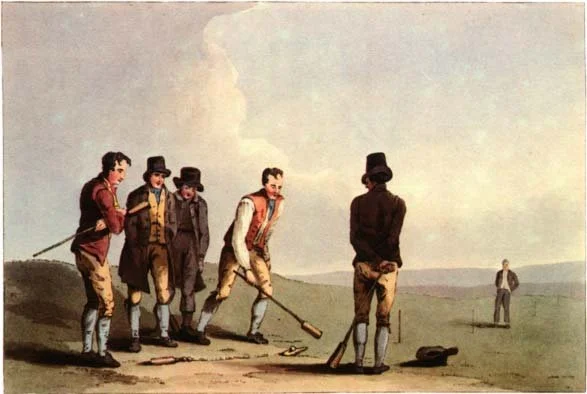
Yorkshiremen playing knurr and spell around 1814.
Photo Credit: Wikimedia Commons
All of these games, as well as games such as (Irish) hurling and shinty, which were played in the medieval period, involved balls and were played on foot, yet they were not referred to as football.
In their 2015 book, Association Football: a Study in Figurational Sociology, Graham Curry and Eric Dunning suggest that references to ‘football’ in early documentary sources are describing a type of ball rather than a type of game.
For example, the 1314 prohibition of football in London referred to a ‘tumult arising from great footballs’ not to ‘playing football’.
Similarly, a prohibition on this kind of activity in Manchester from 1608, refers to playing ‘with the ffote-bale’ rather than to ‘playing ffote-bale’.
They assert that the type of ball to which this name was given, as far as they have been able to ascertain, was an inflated animal bladder usually, but not always, encased in leather.
Curry and Dunning go further, postulating that certain traditional games which are regularly identified as early forms of football, such as cnappan, played in Wales, bottle-kicking from Leicestershire, the related Cornish games of ‘hurling to the countrie’ and ‘hurling to goals’, and East Anglia’s camp-ball, were given these names because they were played with different types of implement.
The cnappan, for example, was a sort of wooden disc, and the bottle used in bottle-kicking is a wooden keg. In both of the Cornish versions of hurling, and in camp-ball, the ball used was small and hard.
The larger, inflated balls described by Curry and Dunning would have lent themselves better to kicking than the small, hard balls used in camp-ball and Cornish hurling.
The idea that the term ‘football’ originated as the name for a ball that could be struck with the foot seems compelling. Indeed, all modern forms of football utilise such a ball.
Perhaps the most interesting thing about the ‘game played on foot’ theory is the question that it is intended to answer: “why is a game that is played mostly with the hands called football?”
This question would not have been asked 150 years ago. It might not have been asked 50 years ago.
People generally accepted that some forms of football included the use of the hands. Until well into the 20th century, the media in Britain referred to both rugby and soccer as football.
More recently, however, in the UK and in many other countries, football, or linguistic variations of that name, has come to mean only Association Football. Only a handful of places still use ‘Football’ to refer to other games.
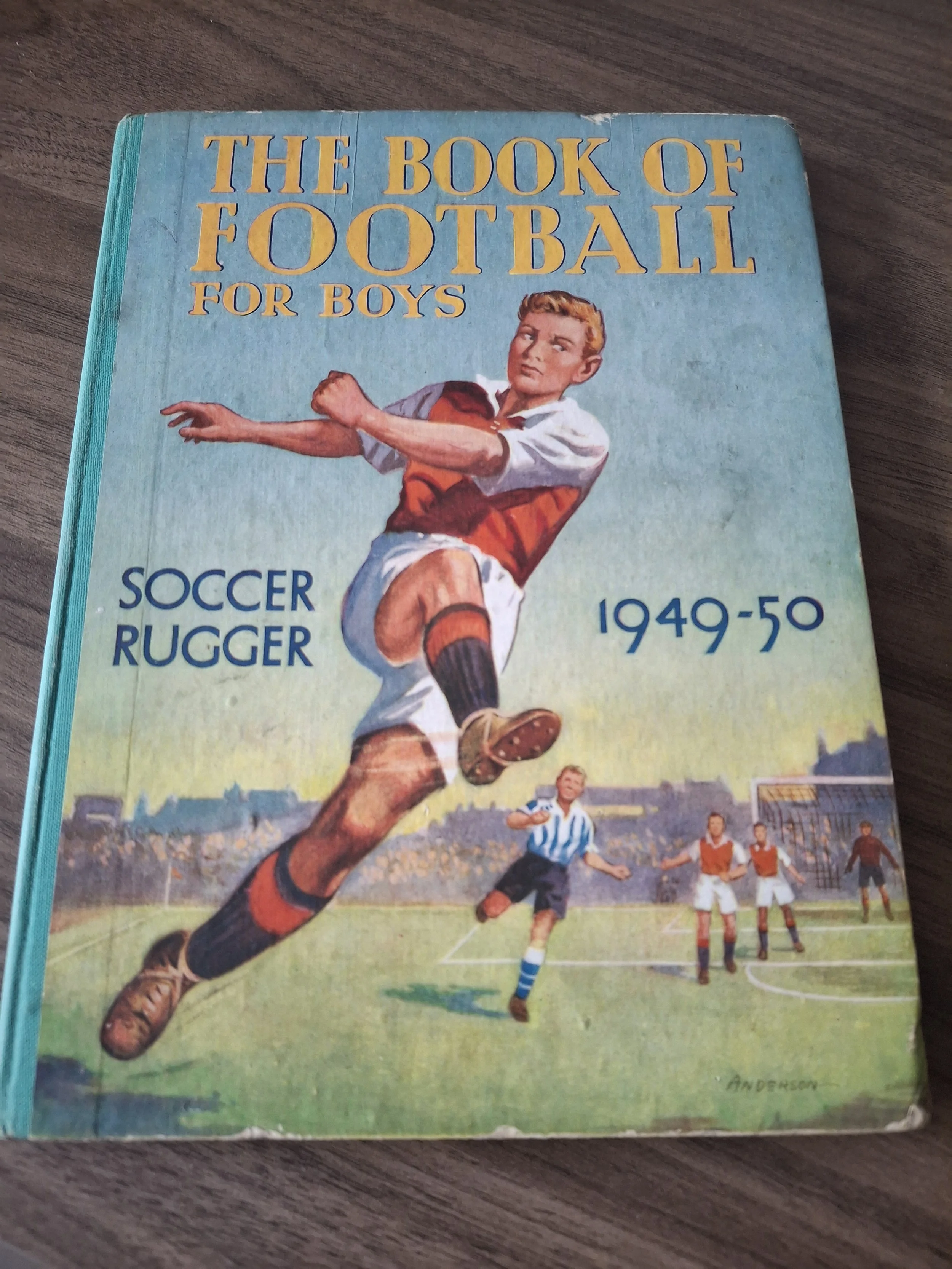
A football book from 1949, containing sections on two different forms of football.
Photo Credit: Andrew Newton
It is the almost worldwide ubiquity of Association Football that has led to the assumption that football is a game that is played exclusively with the feet. Compared to all of the other modern codes of football, soccer is, in fact, unusual.
In the original version of the rules, outfield players were allowed to handle the ball under specific circumstances. Evolution of the game, and changes to the rules, the most recent of which was the introduction of the backpass rule in 1992, have reduced handling to minimal levels and limited it to just one player within one specific area of the pitch.
At the opposite end of the evolutionary scale is American Football (and Canadian Football). These games, which themselves evolved from Rugby Football, a game which still retains extensive use of the feet, have evolved to minimise kicking and have limited use of the feet to one particular player during specific phases of the game.
All of the other extant versions of football involve the use of both hands and feet to varying extents. The Victorian originators of the game did not consider that football could not involve use of the hands. Writing in 1887, Montague Shearman, a member of Wanderers FC and one of the first serious historians of football, noted that “there is no trace in the original form [of football] to suggest that nothing but kicking was allowed”.
The precise origins of the term “football” still remain open to speculation, but the assumption that football can only be played with the feet, is clearly a modern misconception.
The theory that “football was the name given to games played on foot to distinguish them from games played on horseback” is also of recent origin. A quick Google search suggests that it first appeared as a pop-history theory online in the 2010s.
This does not necessarily mean that it is an idea entirely without merit. Most academic authors, historians and sociologists that tackle the subject, treat the ‘game played on foot’ explanation as a plausible theory but stop short of accepting it as a definitive origin for the term ‘football’.
Where this explanation is problematic, however, is that it is used, accepted, and propagated as a definitive answer to a question that is based on a flawed understanding of the history and development of football, in all of its various forms.
The seductive thing about this explanation is that it appears to confirm classist stereotypes that football was a violent, chaotic, badly organised melee played in the mud and dirt by the uncouth, uneducated peasantry.
Meanwhile, the expensively dressed, mannered, cultured, horse riding aristocracy looked down, literally and figuratively, upon this rabble from their elevated positions.
This is a flawed view. The existence of complex games like camp-ball, bat and trap, and handball suggests that there were equally well-organised versions of football.
There is also evidence that, while the aristocracy may not have taken part, clergy, merchants, and artisans, not just the labouring classes, played football.
By the time we get to the post-medieval period, there is clear evidence for significant organisation, including formalised training and clear playing positions, in some forms of football and that Royal households were taking an active interest in football.
History in general, and the history of football more specifically, is far too complex to reduce it to convenient, simplified explanations.
While we remain unsure of the etymology of the term ‘football’, its origins appear to be more complicated, and far more interesting, than the rather glib “oh, it’s called that because it was a game played on foot, not horseback”.