

Words by Jonee | Published 26.04.2026To write about Pep Guardiola in the context of English football is to confront a contradiction that feels almost built into the modern game itself. He exists in the shadow of Sir Alex Ferguson, a figure whose legacy at Manchester United is so vast, so deeply embedded in the mythology of the Premier League, that it resists comparison. Ferguson’s greatness was constructed over time until it became something close to permanence.
Guardiola, by contrast, operates in a different age, one defined by acceleration, scrutiny, and structural volatility. He has not been in England long enough, nor is it likely that any manager ever will be again, to replicate that scale of endurance. And yet, to measure him purely against Ferguson is to misunderstand what he represents. If Ferguson defined dominance, Guardiola has redefined possibility.
He will, almost certainly, never be universally accepted as the greatest manager the Premier League has seen. But there is a persuasive argument that he is its most genial—its most intellectually restless, its most creatively driven, its most determined to bend the game towards an ideal.
Guardiola is not simply concerned with winning; he is concerned with how winning is achieved, with the patterns that produce it, with the aesthetic and conceptual framework that underpins it. In that sense, he stands apart. Where many managers adapt themselves to the league, Guardiola has, to a significant extent, forced the league to adapt to him.
When Guardiola arrived at Manchester City in 2016, he did so with a reputation already established across Europe, but also with a set of ideas that had yet to be fully tested in the specific conditions of English football. The Premier League, with its relentless tempo, its physical demands, and its cultural resistance to excessive control, presented a challenge that was as much philosophical as it was tactical.
Guardiola did not approach this challenge cautiously. From the outset, he sought to impose his vision, to reshape the team in accordance with principles that prioritised positional play, spatial awareness, and technical precision.
The early difficulties he encountered were instructive. His first season was marked by inconsistency, defensive fragility, and moments where his team appeared vulnerable to the very chaos he sought to eliminate. There were matches in which City dominated possession yet conceded soft goals, instances where the balance between control and risk seemed elusive.
Critics questioned whether Guardiola’s methods, so effective in other contexts, could truly thrive in England. The narrative began to form that the Premier League might resist his influence, that it might expose the limitations of a philosophy built on control in a league defined by unpredictability.
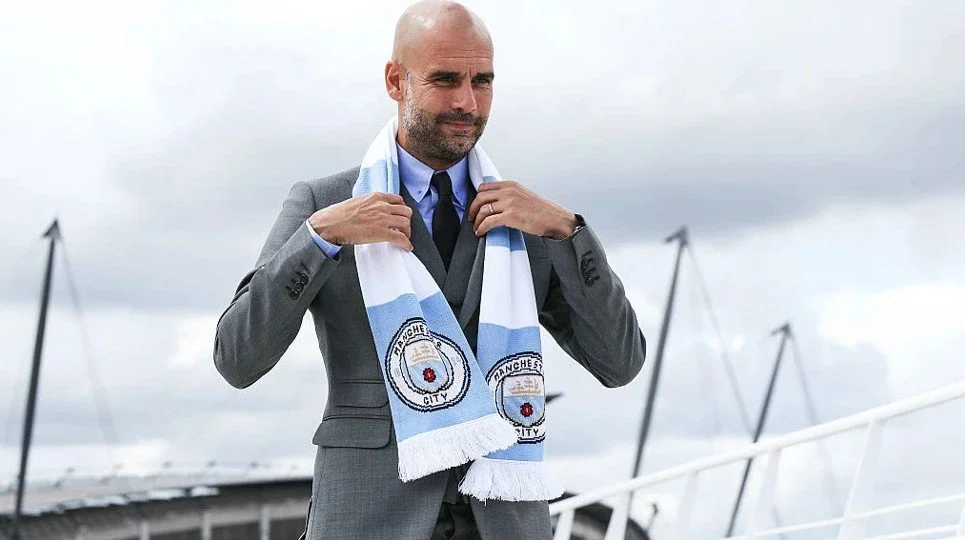
Pep Guardiola was unveiled as Manchester City boss in 2016.
Photo Credit: Manchester City
What followed was not a retreat, but an escalation. Guardiola did not dilute his ideas; he intensified them, refining the mechanisms through which they were applied. Recruitment became not just a supporting factor, but a central pillar of his project. Players were identified and acquired not simply for their talent, but for their compatibility with a highly specific system.
The arrival of a goalkeeper capable of initiating attacks, of defenders comfortable in possession, of midfielders capable of operating within tight spatial constraints—all of this contributed to a transformation that was both rapid and profound. By the 2017–18 season, Manchester City had become something altogether different. They were dominant in a manner that felt almost systemic. The accumulation of one hundred points was, in itself, a remarkable achievement, but it was the manner of their play that truly distinguished them.
Matches were controlled with an authority that reduced opposition teams to reactive roles. The ball became a tool of domination, a means of dictating tempo, territory, and rhythm. This was not simply winning; it was the imposition of a footballing ideology on a league that had long prided itself on resisting such impositions. It is, of course, impossible to discuss Guardiola’s work without addressing the role of financial investment.
Manchester City’s resources have enabled the acquisition of players at a level that few clubs can match, creating a squad of exceptional depth and quality. This has led to persistent criticism, to the argument that Guardiola’s success is inseparable from the financial power that underpins it. There is validity in acknowledging that resources matter, that they provide advantages in terms of recruitment, rotation, and resilience over the course of a season.
However, to reduce Guardiola’s achievements to financial backing is to overlook the complexity of what he has built. The history of football is replete with examples of clubs that have spent heavily without achieving coherence or sustained success. Money can buy talent, but it cannot guarantee understanding. Guardiola’s contribution lies in his ability to create a system in which that talent is maximised, in which each player functions as part of a larger, interconnected whole.
His teams do not simply rely on individual brilliance; they rely on collective intelligence, on a shared understanding of space, movement, and timing. One of the most striking aspects of Guardiola’s tenure at Manchester City is his capacity for reinvention. He has not built a single dominant team, but several, each distinct from the last.
The early iteration, defined by relentless pressing and fluid attacking movement, gave way to later versions that emphasised control, positional discipline, and defensive solidity. This evolution has not been linear; it has been iterative, shaped by the changing dynamics of the league, the ageing of players, and the emergence of new challenges.
The arrival of Erling Haaland marked a particularly significant moment in this process. For much of his managerial career, Guardiola had favoured systems that de-emphasised the traditional centre-forward, instead relying on fluidity and interchangeability in attack. Haaland’s presence, with his physicality and goal-scoring instinct, appeared at odds with this approach.
Yet rather than disrupting the system, his inclusion has expanded it. City have become capable of playing in multiple ways, of combining intricate build-up with direct, decisive attacking play. This adaptability has added a new dimension to Guardiola’s teams, making them even more difficult to contain.
In the current phase of his tenure, there is a noticeable shift in emphasis. While the underlying principles of positional play and ball retention remain, there has been an increased reliance on individual talent to resolve matches. Players such as Cherki have taken on greater responsibility in decisive moments, producing moments of creativity that transcend the system.
This is not a sign of decline, but of evolution. Guardiola has recognised that control, while essential, is not always sufficient. There are moments in football that require improvisation, that demand a departure from structure.
This willingness to adapt extends beyond tactics into Guardiola’s relationship with the environment in which he operates. His connection to Manchester is not superficial; it reflects a genuine engagement with the city’s culture and identity. His admiration for Oasis, and his friendship with Noel Gallagher, are emblematic of a broader integration.
Guardiola has embraced the idea that a football club is not an isolated entity, but part of a larger cultural ecosystem. In doing so, he has positioned himself not merely as a manager, but as a participant in the life of the city.
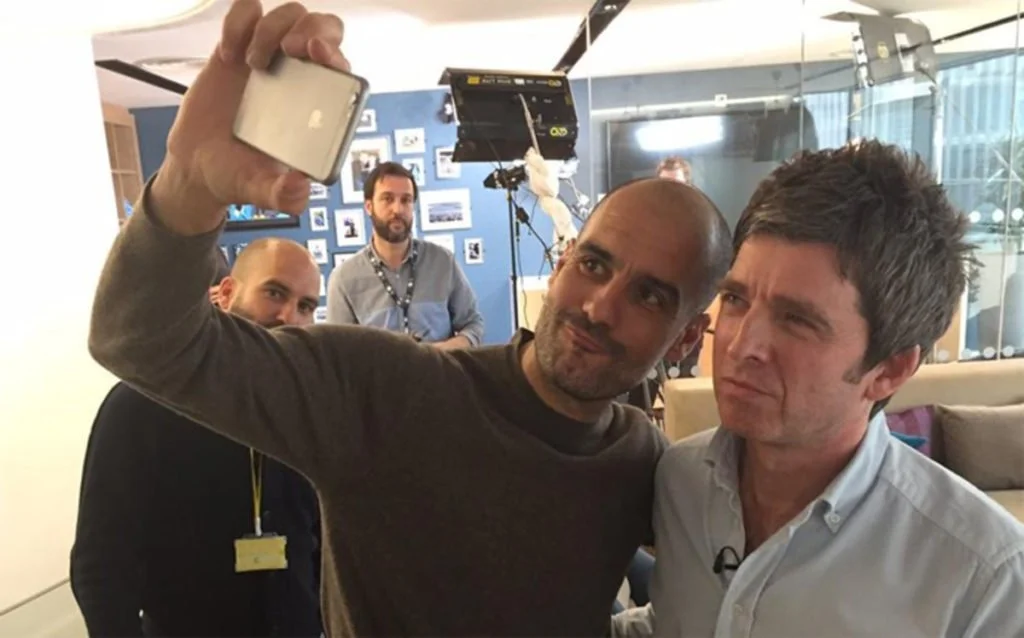
Pep takes a selfie with his friend, Noel Gallagher.
Photo Credit: BBC News
The rivalries that have defined Guardiola’s time in England have further shaped his legacy. His battles with Jürgen Klopp and Liverpool FC have produced some of the most compelling football the Premier League has seen. These encounters have been characterised by intensity, quality, and a sense of mutual escalation, with each team pushing the other to new heights.
Klopp’s emphasis on pressing and transition has provided a counterpoint to Guardiola’s control, creating a dynamic that has enriched the league. The emergence of Mikel Arteta at Arsenal FC adds another layer to this narrative. Arteta, having worked under Guardiola, has adapted and reinterpreted many of his ideas, creating a team that reflects his influence while asserting its own identity.
Their rivalry is, in many ways, an extension of Guardiola’s impact, a demonstration of how his philosophy has permeated the league. At the same time, the Manchester derby remains a fixture of unique significance. Matches against Manchester United are shaped by history, by the legacy of Ferguson, and by the shifting balance of power within the city.
For Guardiola, these games are not merely about points; they are about narrative, about the ongoing redefinition of dominance within Manchester.
Importantly, Pep does not compromise his philosophy to accommodate individuals. At the heart of Guardiola’s work is an obsession with possession, but this is often misunderstood. Possession, for Guardiola, is not an end in itself, but a means of control.
By retaining the ball, his teams dictate the tempo of the game, limit the opportunities for opponents, and create conditions in which their own strengths can be maximised. This requires not only technical skill, but a collective understanding of space and movement. It is a demanding approach, one that requires constant concentration and discipline.
In recent years, Guardiola has also become more vocal about issues beyond football, expressing his views on political and humanitarian matters, including his stance on Palestine. This aspect of his public persona adds another layer to his identity, positioning him as a figure who engages with the world beyond the sport.
It reflects a belief that football does not exist in isolation, that it is connected to broader social and political contexts. Ultimately, Guardiola’s legacy in the Premier League will be defined not only by the trophies he has won, but by the influence he has exerted. He has changed the way football is played, the way it is understood, and the way it is discussed.
He has demonstrated that success can be achieved through a commitment to a clear and coherent philosophy, that a team can dominate not only through physical superiority or individual brilliance, but through collective intelligence and tactical sophistication.
He may never surpass Sir Alex Ferguson in the traditional hierarchy of greatness, but his impact operates on a different level. He has not simply competed within the Premier League; he has reshaped it, leaving an imprint that will endure long after his departure. In doing so, he has ensured that his legacy is not merely one of success, but of transformation, of a reimagining of what football in England can be.
That reimagining becomes even clearer when one considers how Guardiola has, over time, altered the expectations placed not only on his own players, but on the league as a whole.
Before his arrival, possession-based football in England was often treated as a stylistic preference rather than a competitive necessity. Teams could succeed through directness, through physical dominance, through moments of individual inspiration untethered from a broader structure.
Guardiola challenged that assumption by demonstrating that control—sustained, methodical, and almost suffocating control—could be the most reliable path to victory. In doing so, he forced opponents to evolve.
It was no longer enough to be organised or resilient; teams had to develop mechanisms for surviving without the ball, for pressing intelligently, for recognising and disrupting patterns that were designed with extraordinary precision.
This shift has had a ripple effect across the Premier League. Managers who might once have been content to adopt reactive approaches have been compelled to engage with more complex tactical frameworks. The influence of Guardiola’s ideas can be seen, in varying forms, across multiple clubs, from those competing at the top end of the table to those fighting relegation.
Even teams that seek to counter his methods do so with an awareness shaped by his presence. In this sense, Guardiola’s impact extends beyond results; it resides in the very fabric of the competition, in the way matches are prepared, analysed, and contested.
And yet, for all the systemic influence he has exerted, there remains an enduring tension within Guardiola’s work, particularly in recent seasons. His earlier teams at Manchester City were often described as machines—precise, relentless, almost mechanical in their execution of a clearly defined plan.
Every movement appeared rehearsed; every passing sequence calibrated to achieve a specific objective. There was beauty in this precision, but also a sense that individuality was subsumed within the collective. In contrast, the more recent iterations of his team have allowed for greater variance, for moments in which structure gives way to instinct.
This is where the increasing reliance on individual talent becomes significant. Players like Kevin De Bruyne in the recent past or Cherki nowadays, whose vision and execution can unlock even the most organised defences, have become central not just to the system, but to its moments of deviation.
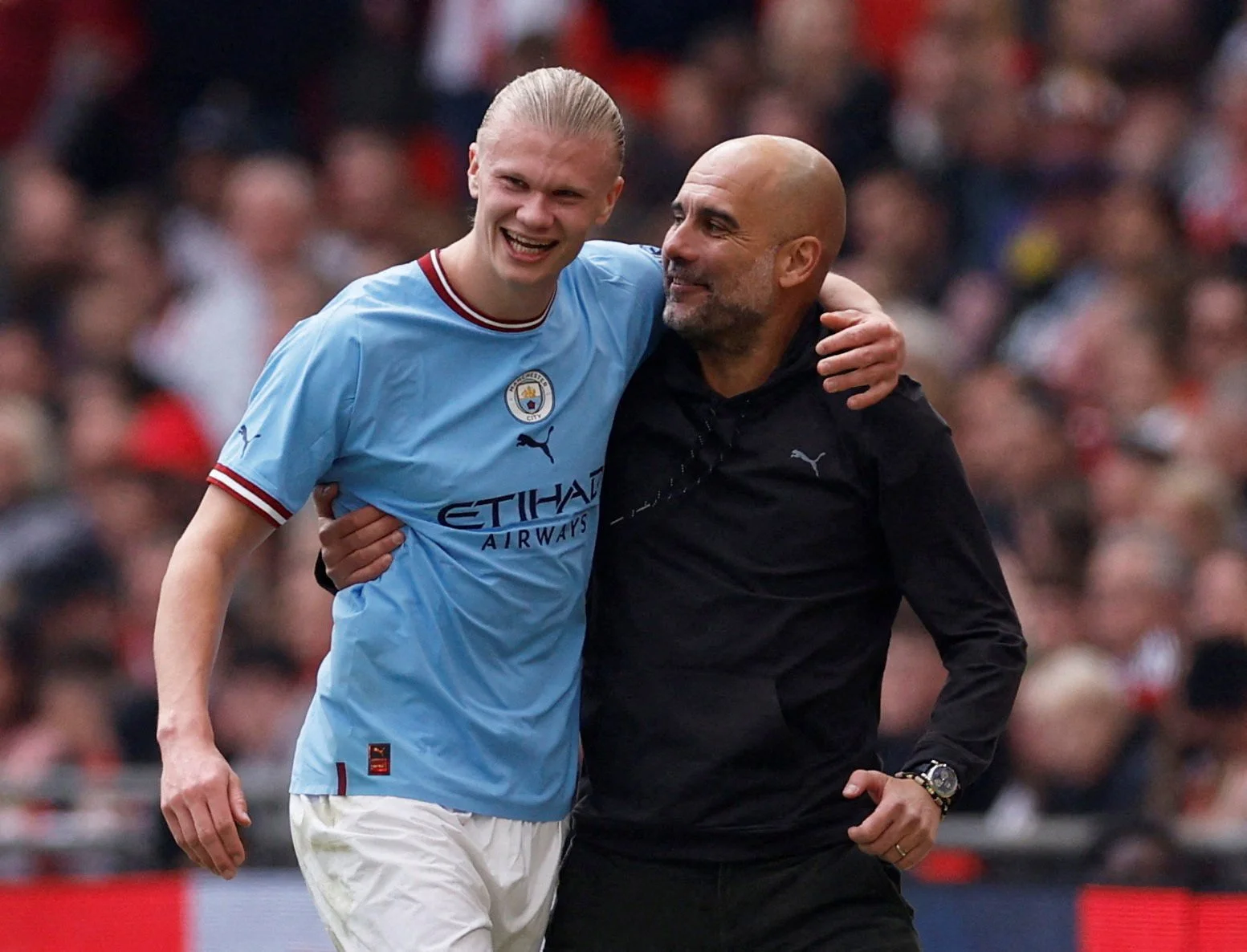
Erling Haaland has allowed Guardiola to further improve his tactical philosophy.
Photo Credit: Reuters
Similarly, the presence of players such as Erling Haaland or Doku introduces a form of directness that sits alongside, rather than within, Guardiola’s traditional patterns. These players do not replace the system; they punctuate it, providing solutions when the system alone is insufficient.
What is particularly revealing about this evolution is that it does not represent a departure from Guardiola’s philosophy, but rather an expansion of it. He has come to recognise that absolute control is, in many ways, an illusion. Football, by its nature, contains elements of unpredictability that cannot be entirely eliminated.
The challenge, then, is not to remove these elements, but to manage them—to create a framework within which spontaneity can occur without undermining the overall structure. In this respect, Guardiola’s recent work can be seen as a synthesis of his earlier ideals with a more pragmatic understanding of the game’s inherent variability.
This adaptability is also evident in the way Guardiola has managed the psychological demands of sustained success. Dominance, while desirable, brings with it its own challenges. Maintaining motivation, avoiding complacency, and continually setting new targets for a team that has already achieved so much requires a level of managerial acumen that goes beyond tactics.
Guardiola has had to find ways to refresh his squad, to introduce new ideas, and to prevent the stagnation that can afflict even the most successful sides. This has often involved difficult decisions, including the departure of players who have been integral to previous successes.
In this context, Guardiola’s willingness to allow certain players to leave, or to accept that they no longer fit within his evolving system, can be seen as both a strength and a weakness. On one hand, it reflects a commitment to progress, to the idea that no individual is more important than the collective.
On the other, it raises questions about whether such an approach sacrifices continuity and emotional connection in favour of perpetual reinvention. This tension is intrinsic to Guardiola’s methodology. He prioritises the integrity of the system above all else, even when that means making decisions that may appear ruthless.
The dual nature of his influence on players becomes particularly apparent when examining those who have struggled under his management. For every success story—every player who has been elevated to new heights—there are others whose careers have faltered within the same environment.
These are not necessarily players lacking in talent; rather, they are individuals who, for various reasons, have been unable to internalise the demands of Guardiola’s system. The level of cognitive engagement required, the need to constantly interpret and react to spatial dynamics, can be overwhelming. In such cases, the system does not adapt to the player; the player is expected to adapt to the system, and failure to do so often results in marginalisation.
This aspect of Guardiola’s management style has contributed to a perception of rigidity, of an unwillingness to compromise. Yet this perception coexists with the evidence of his adaptability at a broader level. The distinction lies in the scale at which adaptation occurs.
Guardiola is willing to evolve his system over time, to incorporate new elements and respond to external pressures, but he is less inclined to make concessions at the level of individual players. The system, once established, retains its internal logic, and it is this logic that players must embrace if they are to succeed within it.
All of these elements—tactical innovation, adaptability, cultural integration, rivalry, player development, and public engagement—combine to create a portrait of Guardiola that is both complex and, in many ways, unique within the Premier League era.
He is not simply a manager who wins, though he does that with remarkable consistency. He is a figure who challenges assumptions, who redefines expectations, and who continually seeks to push the boundaries of what football can be.
In the end, the question of whether Guardiola can be considered the greatest manager in Premier League history may be less important than the recognition of what he has contributed. Greatness, in this context, is not a single dimension, but a spectrum.
Ferguson’s greatness was rooted in longevity, in the ability to sustain success across changing circumstances. Guardiola’s greatness lies in transformation, in his capacity to reshape the game according to a vision that is both deeply personal and broadly influential.
If Ferguson built an empire, Guardiola has redesigned the architecture of the league itself. And in doing so, he has ensured that his impact will be felt long after the final match of his tenure, in the ideas that persist, in the players he has shaped, and in the countless ways in which the Premier League now bears the imprint of his genius.
That uncertainty hanging over the coming summer adds a different kind of weight to the legacy of Pep Guardiola, because for the first time since his arrival at Manchester City, there is a genuine possibility that his story in the Premier League is approaching its final chapter.
Officially out of contract, and with no definitive public commitment to a renewal, the situation is no longer framed around routine extension negotiations or predictable continuation. Instead, it has become a broader question about exhaustion, ambition, and what comes after a project that has already stretched across nearly a decade of constant reinvention, pressure, and expectation.
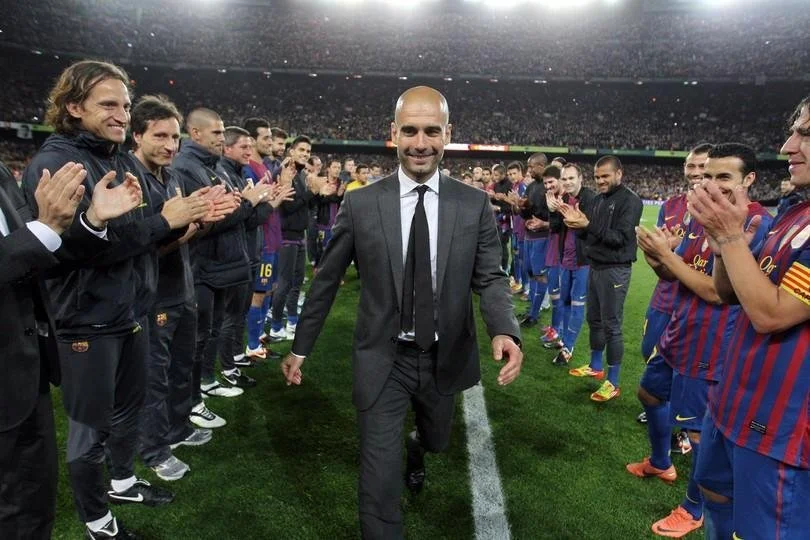
Guardiola was given a guard of honour at Barcelona.
Photo Credit: FC Barcelona
For a manager like Guardiola, whose entire career has been defined by intensity of thought and emotional investment in the work itself, the idea of simply continuing by default feels almost incompatible with his nature. He has never been someone who operates on autopilot. Every phase of his managerial life—from FC Barcelona to Bayern Munich and now Manchester City—has been marked by deliberate choice, by the decision to commit fully to a project, extract everything from it, and then, once the internal challenge begins to feel solved or diminished, consider whether the next step lies elsewhere entirely.
That is what makes this moment different: there is no obvious next step already mapped out in public, no guaranteed continuation, and no certainty that the cycle will simply reset again.
At Manchester City, the question is not only whether he will stay, but what “staying” would even mean at this stage. The team he has built has already reached levels of dominance that border on historical abnormality within the Premier League context. Multiple titles, domestic cup success, European triumph in the UEFA Champions League, and sustained control over English football have all been achieved within a system that he himself has repeatedly reshaped.
In practical terms, there is very little left to prove within the confines of the club. That in itself creates a psychological tension: when the competitive frontier has been pushed so far, what remains to motivate the same intensity of daily work?
This is where the possibility of departure becomes more than just contractual speculation. There is a growing sense that Guardiola’s relationship with football is not infinite in the conventional managerial sense. He has always operated with a kind of emotional and intellectual saturation point in mind—an awareness that projects are lived fully, not indefinitely extended.
The Premier League, with its relentless schedule, media scrutiny, and competitive escalation, demands a specific type of endurance. Even for someone as method-driven and detail-obsessed as Guardiola, there is an inevitable human cost to sustaining that level of engagement year after year.
The idea that he might step away, even temporarily, is therefore not as implausible as it might first appear. Football has never been the only axis of Guardiola’s identity. His interest in culture, in politics, in broader social questions, has become more visible in recent years, whether through his public statements or his willingness to engage with issues far beyond the touchline.
His comments on global conflicts, including his stance on Palestine, reflect a manager increasingly aware of his position as a public figure whose influence extends beyond sport. That awareness does not necessarily indicate a desire to leave football entirely, but it does suggest a mind that is not confined by it.
If he were to walk away from the Premier League this summer, it would mark the end of an era in which English football was structurally shaped by one dominant intellectual force. The league would not just lose a successful manager; it would lose a reference point.
So much of what teams now do tactically—how they press, how they build from the back, how they interpret positional structure—has been filtered through the lens of Guardiola’s influence. His absence would not erase that influence, but it would mark the end of its most active phase within England.
At Manchester City itself, the implications would be equally profound. The club has been built around a long-term alignment with his ideas, from recruitment strategy to training methodology to tactical identity. Even players who arrived without prior connection to his philosophy have been shaped by it over time.
A departure would therefore raise questions not just about who replaces him, but about what remains of the system once its architect steps away. Unlike some managerial exits, this would not be a simple transition from one style to another. It would be the end of a highly specific footballing language embedded into every layer of the club. And yet, there is also the possibility that he stays.
That he signs another extension, perhaps shorter, perhaps conditional, and continues to refine a system that has not yet reached a natural conclusion. Guardiola has, after all, shown throughout his career that he is not afraid to revisit assumptions or prolong a project if he feels there is still something unresolved within it.
The recent evolution of Manchester City—less rigid in structure, more open to moments of individual expression—could be interpreted as evidence that he still sees new problems to solve, new versions of the team to construct. In that reading, the story is not ending, but entering another phase of experimentation.
This ambiguity is what makes the current moment so significant. It is not a dramatic farewell, nor a confirmed continuation, but a suspended state in which both possibilities feel equally real. That in itself is rare in modern elite football, where managerial cycles are often abrupt, reactive, and externally imposed. Guardiola’s situation is different because it is self-determined. If he leaves, it will be because he chooses to leave; if he stays, it will be because he still sees value in continuing the process.
There is also a broader question of personal evolution. Guardiola has already experienced the cycle of intensity, success, exhaustion, and renewal multiple times across different countries. The Premier League represents the longest continuous stretch of that cycle in his career.
It is reasonable to consider whether, at this stage, he might feel the need for a different form of life altogether—one that is less defined by weekly competitive pressure, media cycles, and the constant demand for tactical adjustment. That does not necessarily mean retirement in the permanent sense, but it could mean withdrawal, reflection, and a period outside the structural demands of elite management. If that were to happen, it would not diminish what he has achieved in England. If anything, it would sharpen the sense of scale.
His work would stand as a completed body of influence within the Premier League: a period in which one manager reshaped the tactical direction of an entire competition while simultaneously sustaining domestic and European success. The fact that it might end not in decline, but in voluntary departure, would reinforce the sense that Guardiola has always treated football as something to be fully inhabited, not indefinitely occupied.
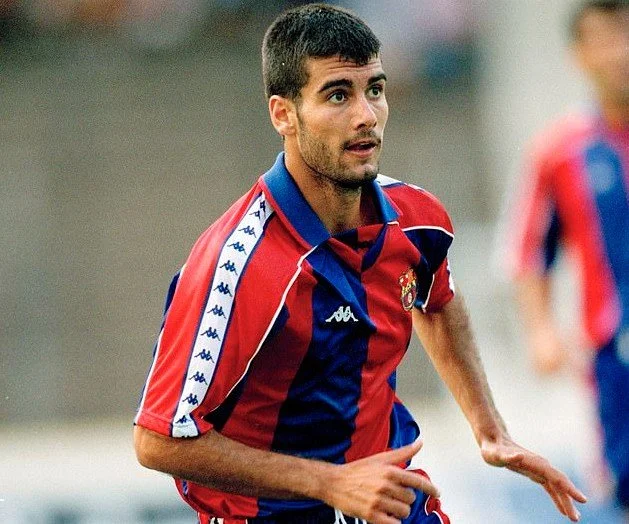
A young Pep Guardiola during his playing career.
Photo Credit: FC Barcelona
Whatever decision is made this summer, it will not simply affect Manchester City’s future. It will mark a turning point in the modern history of English football itself. Because Guardiola’s presence has not been an external addition to the Premier League story—it has been one of its central structuring forces. If he stays, that influence continues to evolve.
If he leaves, the league enters a new phase in which it must define itself without the constant reference point of his ideas shaping the competitive environment. And that, ultimately, is what makes this moment so significant. Not the uncertainty of one manager’s contract, but the possibility that an entire era of tactical and cultural influence may be approaching its natural conclusion—not because it has failed, but because it has been fully expressed.
In the end, perhaps the most remarkable strand running through the entire modern story of the Premier League is not just what Pep Guardiola has done at Manchester City, or what Sir Alex Ferguson achieved at Manchester United, but the sheer coincidence—and inevitability—that both revolutions happened in the same city.
Manchester, divided by colour and rivalry yet bound by geography and shared identity, became the unlikely epicentre of two of the most influential managerial reigns English football has ever seen. Ferguson shaped the Premier League’s early identity, defining its competitive psychology and its standard of sustained dominance; Guardiola, arriving decades later, redefined its tactical imagination and technical ceiling.
One built the idea of control over time, the other refined control over space, and together they have framed the league’s evolution across generations. That both legacies unfolded within the same city, separated by little more than a few miles and a bridge of rivalry, gives English football a symmetry that feels almost unreal—two neighbours, two philosophies, and two managers who, in very different ways, ended up reshaping the very language of the game itself.