

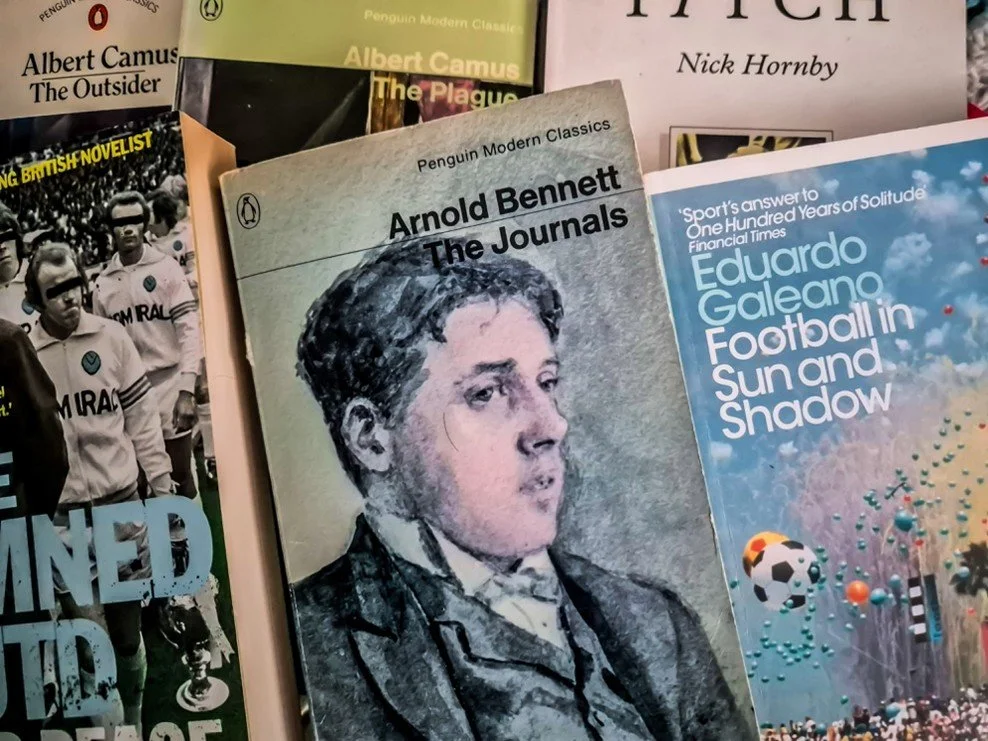
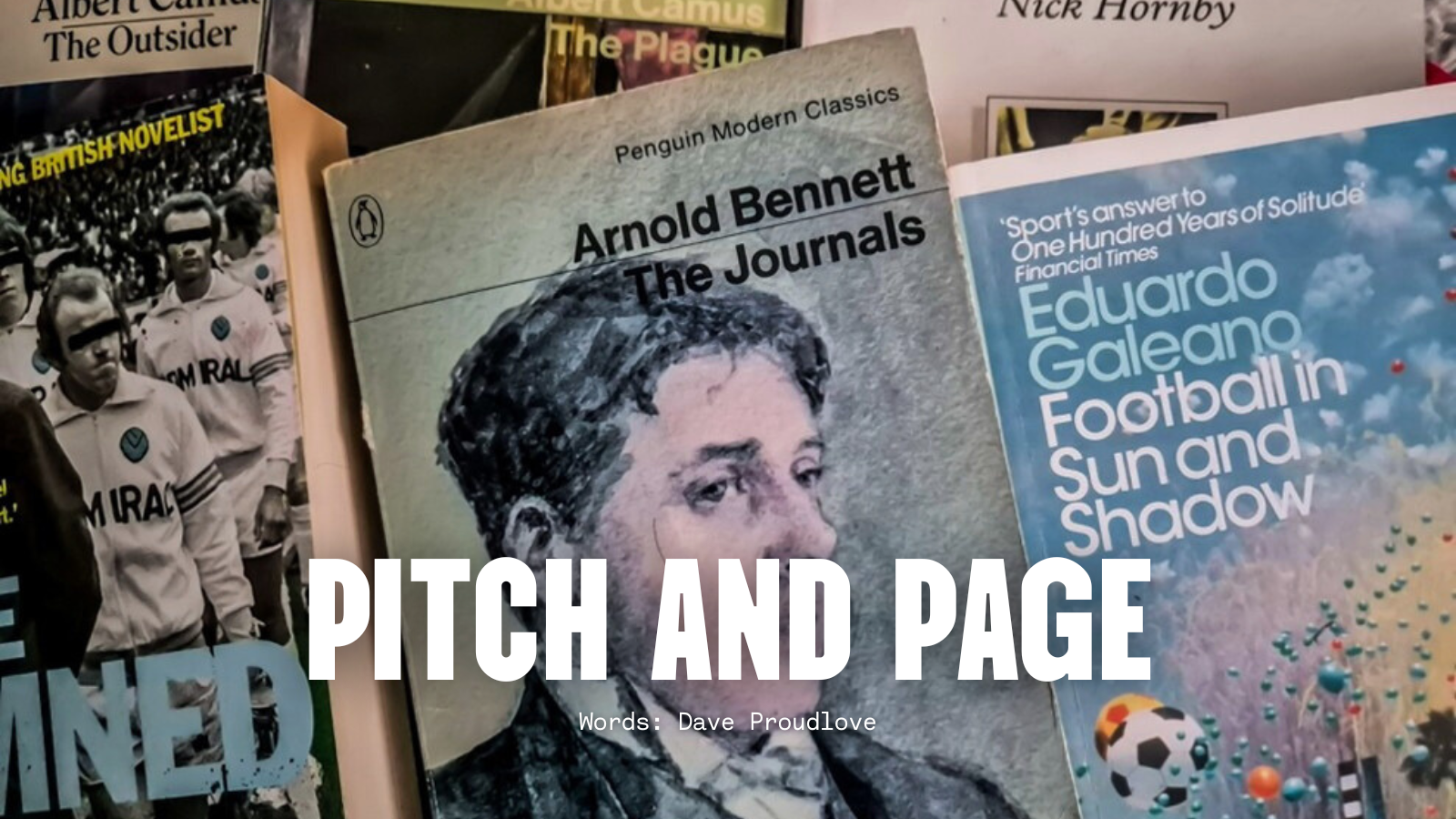
Words by Dave Proudlove | Published 27.02.2026I fell in love with both football and books at an early age, but it’s so long ago now I can’t recall which came first, though given the regularity with which I can be seen with a ball in old photographs, the answer is probably the former. But I did learn quickly that both were languages of sorts before I learned that either of them could be mastered. The pitch was my first library: green, uneven, and full of footnotes in mud and chalk.
And though my understanding of the page came later, and in a less raucous manner, it certainly carried the same weight and promise – that the world, when looked at closely enough and through a different lens, might briefly make sense.
To some, football and literature can perhaps be framed as opposites. One is physical, immediate, and communal; the other is a more solitary experience, reflective, and slow. But anyone who has truly loved either knows this is a fallacy. Football is full of narrative; it has metaphor, rhythm, repetition, and sometimes silence. And literature, at its best, has a pulse, a sweat, and a sense of jeopardy. They are not rival arts. They are dialects of a similar human need: to tell stories about ourselves under pressure.
Albert Camus understood this instinctively. Before he developed into a philosopher of absurdity, before he wrote The Stranger, The Plague, or The Fall, he was a goalkeeper. Camus famously wrote:
“All that I know most surely about morality and obligations, I owe to football”.
It is one of the most quoted lines in the literature of the game, partly because it is so disarming. We anticipate ethics from books, not from the mud and chaos of the penalty area. Yet Camus’s footballing years – despite his tender age – make perfect sense when read alongside his philosophy: the goalkeeper, isolated yet responsible, waiting for catastrophe, learns that effort does not guarantee justice – this is Camus rehearsing the absurd long before he depicted it.
To be a goalkeeper is to learn about time: 90 minutes can and will stretch and contract. Long periods of nothingness are punctured by moments that can define you, and literature can capture this feeling. The long chapters of waiting, the sudden sentence or phrasing that changes everything. Camus’s Meursault, staring into the sun before pulling the trigger, is not so far from a keeper squinting into floodlights as a striker bears down on them. Both are trapped in moments that refuse to explain themselves but can define everything.
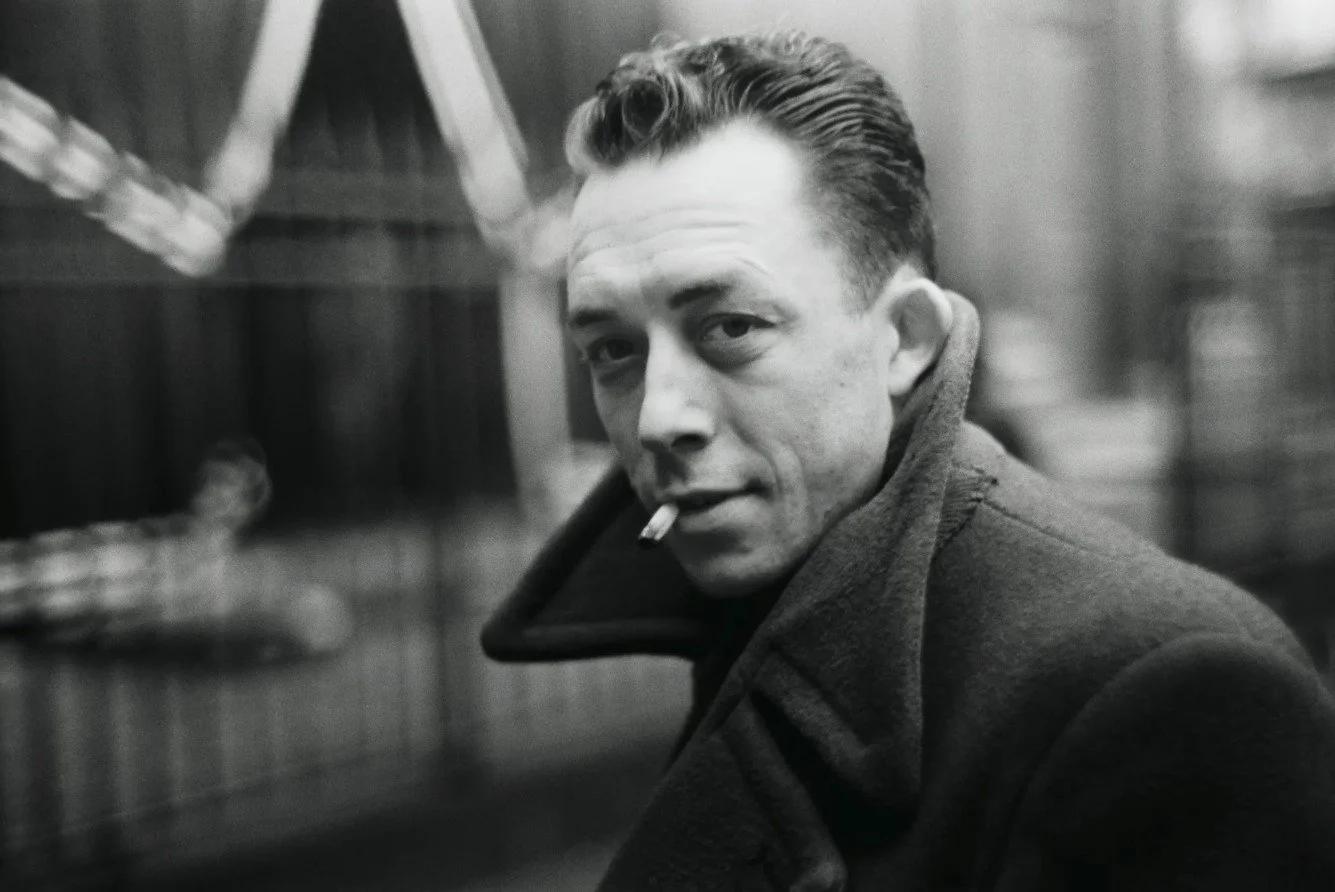
Albert Camus.
Photo Credit: Henri Cartier-Bresson/Magnum
Eduardo Galeano, by contrast, embraced football not as an absurd condition but as a secular religion. In Football in Sun and Shadow, he writes with the voice of a poet disguised as a journalist. He says:
“The game is played by the feet, but is decided by the head”.
He sounds almost like a Latin American Johan Cruyff. Galeano understood football as memory: every match is haunted by earlier matches; every goal echoes older goals. For him, watching football was an act of collective remembrance – of neighbourhoods, dictatorships, lost freedoms, and fleeting joys and celebration.
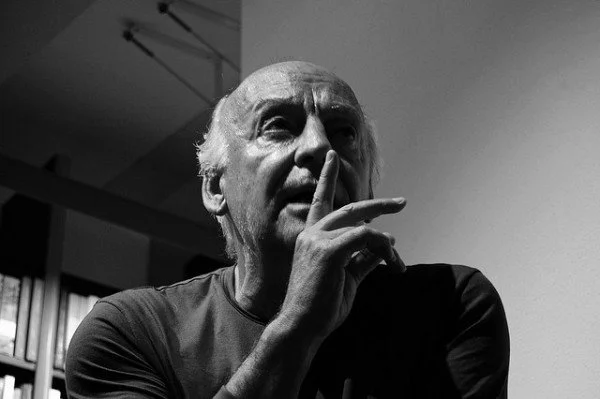
Eduardo Galeano.
Photo Credit: Guernica Mag
Galeano’s writing feels like a series of short stories smuggled into match reports. He writes about the beauty of the dribble the way others write about a line of verse. A good goal, in his telling, is not just an event but a moral gesture, a small rebellion against order, efficiency, and power. It is no coincidence that he mourned the modern game’s obsession with results and systems. To drain football of beauty is, for Galeano, to drain language of poetry. Legacy versus modernisation.
Of course, England is considered to be the home of football as we know it, and one of the most important cities in the history of English football is Stoke-on-Trent, or the Potteries as it is popularly known. And when it comes to literature and Stoke-on-Trent, you don’t need to look beyond the bard of the Potteries Arnold Bennett, and his famous Five Towns novels.
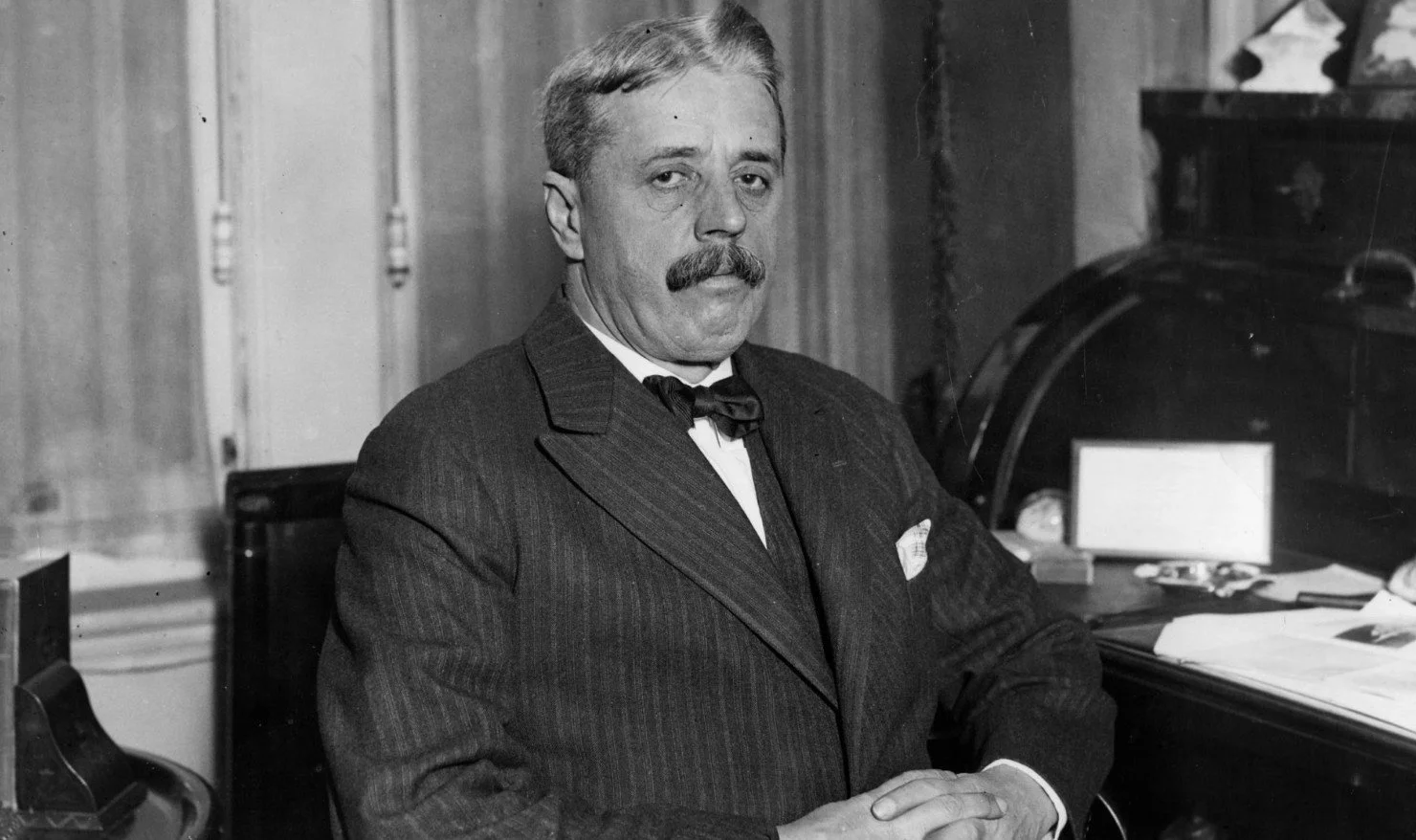
Arnold Bennett, the Poet of the Potteries.
Photo Credit: The Times
Bennett’s great subject was ordinary life across the Potteries; the routines, ambitions, and disappointments unfolding throughout the industrial towns of Stoke-on-Trent and their gritty reality. Though football only occasionally appeared in his work, its spirit was everywhere, most notably in The Card where he talked about the fortunes of Port Vale and Stoke, thinly disguised as Bursley and Knype:
“…the Knype Club was struggling along fairly well, the Bursley had come to the end of its resources. The great football public had practically deserted it. The explanation, of course, was that Bursley had been losing too many matches".
Bennett’s realism reminds us that football is not just the 90 minutes, but everything around it – the walk to the ground, the pub afterwards, the arguments rehashed on Monday mornings. Football lives in the margins as much as in the headlines, and as such, belongs to the same literary tradition as the novel of social observation: a way of understanding how communities imagine themselves.
Bennett wrote about people shaped by their environments, and by habits repeated until they become destiny. That is football’s world, too: Saturday afternoons, inherited loyalties, and the quiet heroism of showing up again and again. Bennett recognised this and the passion for football in the Potteries, noting in his journals that:
“Grown men no longer play at marbles, as they used to when I went to school. Of the more ancient diversions, pigeon-flying alone remains a very harmless hobby. Football alone reigns supreme and has no serious rival. The Potteries was one of the first centres of football, and in the history of the Association game, the name Stoke-on-Trent is glorious. Football has the characteristics of force and violence and spectacular bigness which could not fail to attract a race as the potters. Cricket is much practiced, and golf waxes yearly, but there is nothing like football in North Staffordshire.”
This is one of the great fires of the Potteries that has never been extinguished.
In the modern era, football’s reputation took a nosedive – particularly in England – but in literary circles it continued to be embraced. In some cases, this fuelled the game’s post-1980s resurgence.
Nick Hornby arrived at football from another direction entirely: not through philosophy or politics, but through obsession. Fever Pitch is not a book about Arsenal so much as a book about the way football colonises and envelops a life. Hornby writes as a fan who understands that supporting a club is an act of narrative self-harm:
“…the natural state of a football fan is bitter disappointment, no matter what the score”.
Yet the fan returns, year after year, to a story that keeps disappointing them, because the alternative – walking away – would leave a hole too large to contemplate and explain.

Nick Hornby.
Photo Credit: The Talk
What Hornby captures better than most is football’s remarkable power to reorder time. Seasons replace years. Matches become emotional benchmarks: before that goal, after that defeat, when we reached Wembley. And he writes with genuine and relatable comic precision about the way football infiltrates relationships, moods, even memory itself. Reading Fever Pitch, you recognise the truth you rarely admit out loud: football is not entertainment. It is infrastructure. It shapes who you are and who you’re allowed to be.
A decade or so later, David Peace took this idea and stripped it of joy and comfort:
“You are afraid, afraid of your dreams, your dreams which were once your friends, your best friends, are now your enemies, your worst enemies”.
In The Damned United – through the eyes of a righteous but paranoid Brian Clough during his doomed spell at Elland Road – the game becomes claustrophobic, obsessive, almost violent in its repetition. Peace writes about football the way Samuel Beckett wrote about waiting: as something you are trapped inside. His prose circles itself, repeats phrases, and collapses into rhythm. Reading Peace feels like listening to a crowd chant that won’t let you go home.
Brian Clough, in Peace’s hands, is more than a hero or a villain; he is a voice, brittle, insecure, and manic, desperate to impose order on chaos and perceived skulduggery. Football at Clough’s Leeds wasn’t a release but a pressure cooker. The pitch is a place where masculinity fractures, where ambition eats itself, but Peace understands something crucial: that football’s myths are sustained not by glory but by anxiety. The fear of failure is louder than the memory of success.

David Peace.
Photo Credit: The Guardian
What unites all these writers – and others, including me – is not simply that they wrote about football, but that they recognised it as a serious imaginative space. Football, like literature, is a way of asking questions that never quite get answered. Why do we care? Why does it hurt? Why does beauty feel so brief?
The stadium and the book share another secret: both depend on attention. To really watch a match is to read it; to notice patterns, pauses, and foreshadowing. And to really read a novel is to feel its tempo in its body. The best commentators always sound like novelists; the best novelists understand pacing the way a midfielder understands space.
There is also loss. Both football fans and readers are both collectors of ghosts. You remember players as you remember characters: not as they were, but as you first encountered them. The game you watched with your father. The novel you read when you were alone. Football, like literature, teaches you that time only moves in one direction, and that nostalgia is a form of grief.
And so I return to Camus’s goalkeeper again – standing alone, responsible, waiting. It feels like a metaphor not just for football or philosophy, but for the art of writing itself. You prepare. You train. You master the angles. And then something comes at you faster than you expected, and you react. Sometimes you save it. Sometimes it beats you, and the crowd roars anyway.
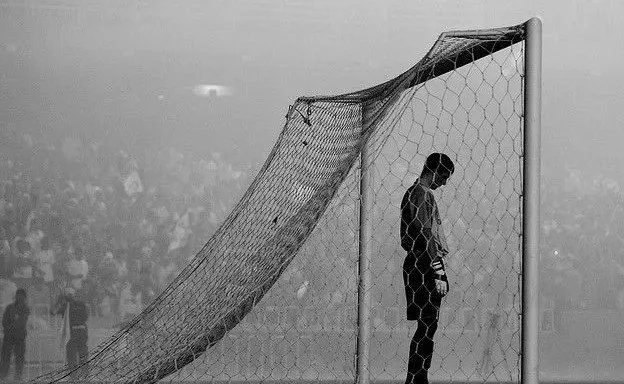
The goalkeeper stands alone.
Photo Credit: Mirrorpix
In an age of algorithms, AI, highlights packages, and the right now of social media gossip and meltdowns, football and literature remain stubbornly inefficient. You cannot skip to the end of a match without losing its meaning. You cannot skim a novel, or ask for an AI summary and claim its truth. They demand time, patience, and vulnerability. They ask you to feel things that you simply cannot monetise. That is why the relationship between pitch and page endures. They are not hobbies. They are practices. Ways of paying attention. Ways of belonging to something bigger than yourself, even as it breaks your heart with casual regularity.
The pitch and page are life.
When the final whistle blows, when the last page is turned, you are left with the same quiet aftermath: the sense that something mattered, even if you cannot quite explain why. You talk about it. You argue about it. You return next week, next season, and to the next book. Because somewhere between the grass and the paper, between the roar and the words, we recognise ourselves – running, reading, waiting, hoping.