

Words by Miguel Sanchez | Published 13.05.2026On 8 November 1931, Racing Club de Madrid, who had been touring Perú, Cuba, México and New York, played in front of the Manhattan skyline against the Spanish-American League Stars, a team made up of players from the Spanish-American league.
Racing went in 1-0 down before half-time, and looked for an equaliser throughout the second half, but it never came.
Actually, it didn't matter, as Racing had already ceased to exist.
It was ruined, in debt to its players and to the Federation, which had expelled it in September for non-payment of affiliation fees. That tour had been a desperate gamble to try to fill the club's battered coffers, carried out without the Federación's permission, which led to its definitive death.
Due to being an inland city, football did not reach Madrid through the docks, as it did in cities such as Huelva, Seville or Bilbao. It was through the Institución Libre de Enseñanza, founded in 1876, which aspired to the regeneration of the educational world and which, adopting the motto ‘mens sana in corpore sano’, introduced sports like football into its educational programme.
At ILE, physical education was essential, as it transmitted values such as discipline and obedience. It was precisely a group of ILE students who founded, in 1897, the first football club in Madrid, simply called Sociedad de Football. Later, the rest would follow.
But ILE and its football were not the only symptom of the eruption of sport in Madrid. In fact, before football came the gymnastics, which, as well as educating the character of young people, guaranteed health - that, at a time of recurrent epidemics, was no minor thing. This spirit grew very quickly, and by 1887 the Sociedad Gimnástica Española had been created, which began with gymnastics and later incorporated fencing, shooting and, in 1907, football.
This team, made up of players from other clubs, such as Moncloa FC or Hispania FC, soon became one of the great protagonists of local and national football: in 1909, Gimnástica was one of the driving forces behind the Federación Española de Fútbol, while in 1910, 1911, 1912 and 1914 they won the Campeonato Regional Centro (in which teams from Madrid competed), which allowed it to take part in the Copa del Rey. In 1912, they reached the final, losing 0-2 against FC Barcelona.
At that time, Gimnástica's fame reached all corners of Spain. Thus, Real Club Fortuna de Vigo (one of the clubs that, in 1923, would eventually form Real Club Celta de Vigo) invited the Madrid club to the inauguration of their new stadium in July 1914.
Gimnástica accepted, but, as it was summer, it was difficult to field their best eleven. Most of their players were students, and many had already started their holidays, while others were punished for poor grades.
Therefore, Gimnástica had to rely on players from two other little-known teams, Cardenal Cisneros FC and Regional FC. The expedition set off for Vigo, thinking of the seafood and casino nights that awaited them, but the reality was quite different, as a typhus epidemic had broken out in Vigo, causing almost 1,000 deaths.
Having hardly eaten or drank, Gimnástica played two games against the Vigo side and returned to Madrid as fast as they could, which in those days meant a 24-hour train journey. A long enough journey for the guests from Regional FC and Cardenal Cisneros FC to realise that their football skills were actually similar to those of the Gimnástica players.
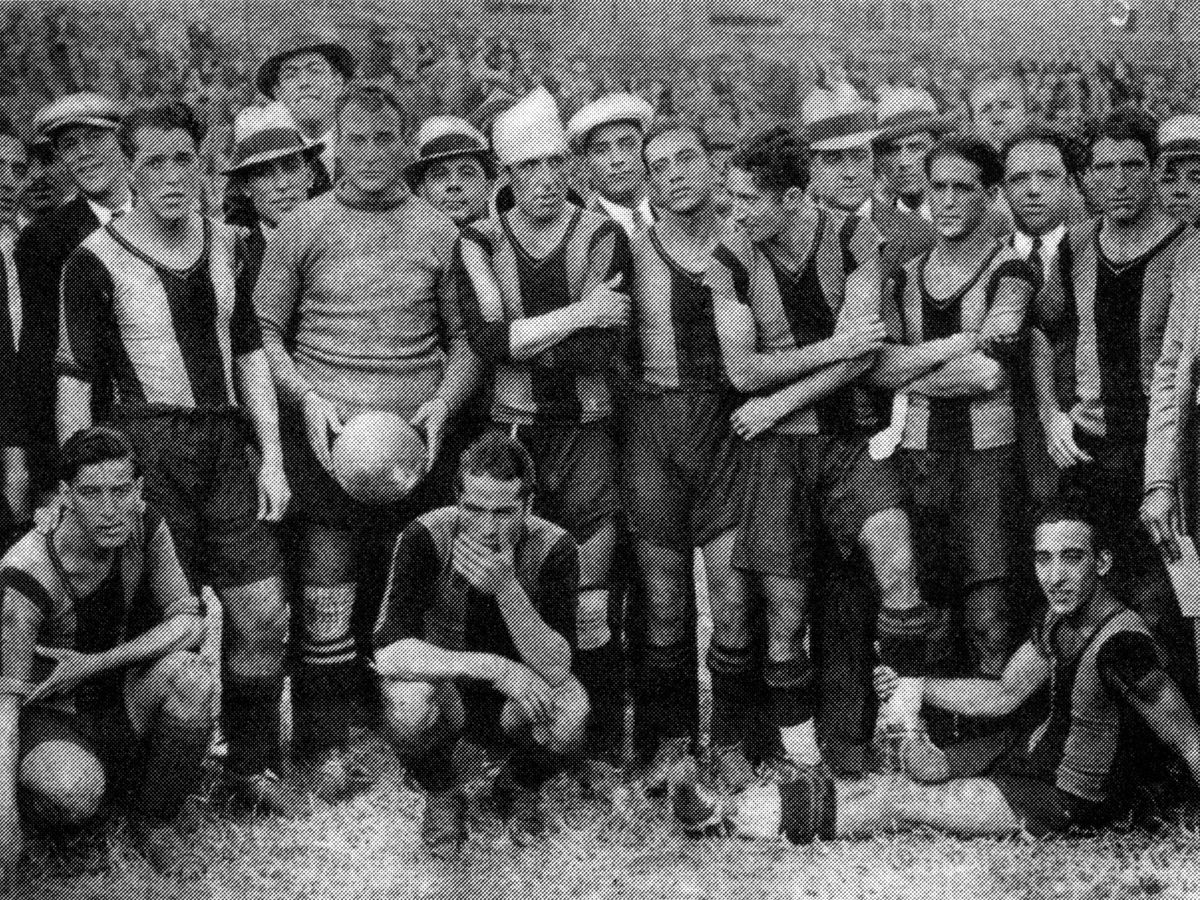
Racing de Madrid squad photo.
Photo Credit: Racing de Madrid
Bearing this idea in mind, they eventually founded a new football club, which came into being on 13 September 1914. The project leader was Ramón Teja who, perhaps because he was from Cantabria, decided to call the club Racing Club de Madrid, after Racing Santander, which had been founded the previous year.
Although they had no ground to play on, they formed a squad with players left over from the rest of the teams, almost all from the Chamberí neighbourhood, cradle of ‘madrileñismo’, and registered with the Federación Centro to participate in the Campeonato Regional Centro for the 1914/15 season.
Their debut came in December of that year, against Madrid FC (later ‘Real’), and the result was as expected - a 0-2 defeat. What no one expected was that this would be Racing's only defeat, and against all odds, they were eventually crowned champions with their own style based on pushing, shoving and tripping opponents. Their matches were marked by violence, and police intervention was necessary from time to time.
Despite their triumph in the Campeonato Regional, Racing, in a foretaste of the constant ups and downs that would mark their entire career, could not participate in the Copa del Rey, because they did not meet the longevity requirement demanded by the Federación.
They tried again the following year, but the regional title eluded them on the last matchday and went to Madrid FC, a disappointment that contrasted with the happiness of finding a site on which Racing's own players built the club's first stadium, which was ready for the 1916/17 season.
But, by then, the good spirits had dissipated. Antonio de Miguel and Ricardo Álvarez, two of Racing's best players, were recruited by Madrid FC, and without them, victories became an echo of the past. At least, until Alejandro Miró Trepat arrived to take over the presidency at the end of 1917.
Miró, a construction entrepreneur, generously financed the building of a new stadium equipped with grass (the first in Madrid), stands and a tram stop next to it, which was inaugurated in September 1918. He brought back Ricardo Álvarez and recruited players from outside - Racing was back to being a competitive team. And so it proved during the 1919 Campeonato Regional, where they won the title again with such scandalous scorelines as a 6-0 thrashing of Madrid FC.
It was then that they began to plan an ambitious idea: to tour America during the summer. An idea that they quickly had to abandon, as suspicions soon arose that Miró was secretly paying his players, a still forbidden practice in Spain. Indeed, Miró, a native of Catalonia, where many clubs paid their players without hesitation, employed the players in one of his companies, but those would then just dedicate themselves to playing.
Although at that time it was very difficult to find a totally amateur player, complaints from Madrid FC ended up with racinguistas Ricardo Álvarez, Feliciano Rey and Félix Tejedor being banned for two years.
Racing, once more deprived of their stars, again suffered on the pitch, and by the time professionalism arrived in 1926, it was too late. Miró had left the club years before, so the club had no money to pay its players, and Athletic Club had established itself as a close rival of ‘los blancos’.
Even then, Racing fought for its survival, hired a new manager, Paco Bru, with whom the Spanish national team had obtained the silver medal at the 1920 Olympics, and managed to qualify for the Copa del Rey in 1929 for the first time in ten years. A success that, like so many other times, would quickly fade away for two reasons.
On the one hand, Madrid was growing and required every plot of land in its path. Madrid FC and Athletic Club, who since 1913 had played in two stadiums only 100 metres apart in the centric O'Donnell street, had to move in 1923 - ones to Chamartín and others to the Metropolitano.
In Racing's case, relentless urbanism forced them to abandon their stadium in 1929. The search for a new ground took racinguistas to Vallecas, which at that time was not part of the city of Madrid and, despite lacking any financial backing, they were determined to build a better stadium than that of the madridistas and colchoneros.
The result was a monumental stadium, inaugurated in January 1930 with two stands for more than 16,000 spectators, changing rooms with showers, an infirmary, a press room with telephone and even a hotel with rooms for the players.
In return, Racing invested 1,000,000 pesetas, almost twice what Chamartín had cost, seriously compromising its budget balance. The solution, in principle, was simple: sell out the box office, and recover the investment and the lost splendour. But that stadium was not only far from Chamberí, where the majority of racinguistas fans were concentrated, but also, as if to say, far from civilisation.
The nearest metro stop was almost a kilometre away – an unpaved kilometre, surrounded by suburbs, that on winter would become a muddy via crucis for all those who wanted to attend the games.
Then, after several years of discussions and failed attempts, the Liga was created at the end of 1928, to begin in February 1929.
With Primera División reserved for teams that had reached a Copa final, Racing were placed in Segunda División. It did not start badly, but, as the games went by, scores became more and more painful, and they finished in last position, relegated to a Tercera División in which almost no team, including Racing, wanted to be.
To be in a Tercera División meant certain ruin.
Thus, during the 1929/30 season, Racing barely contested the Campeonato Regional and the Copa, with little success. Evidently, that was not enough to recoup the investment in the stadium, so they agreed to compete in the Third Division during the following season (1930/31), dragging financial deficits week after week.
And it wasn't just the stadium's remoteness. To take advantage of the sunlight, matches were scheduled early, at lunchtime, and fans, if they had to choose, preferred to go to Primera or Segunda matches, not to those of a Tercera team which, to make matters worse, was renowned for their violence, making them unpopular.
In short, the meagre revenues not only did not improve Racing's fragile financial position, but worsened it.
Such was the desperate situation that the club revived the old idea from 1919: an American tour. Peru, Cuba and Mexico were appealing scenarios in which Racing could perhaps find the fortune that had eluded them in Spain. Of course, it was a risky project, both logistically and financially, so the Federación Centro denied the club the necessary permission to leave the country.
But Racing, sticking to its guns, did not give up. They recruited players from other clubs, such as Franz Platko, FC Barcelona's legendary goalkeeper between 1923 and 1930, who were not registered with Racing and could therefore give the appearance of undertaking the trip on an individual basis.
Understandably, nobody believed that.
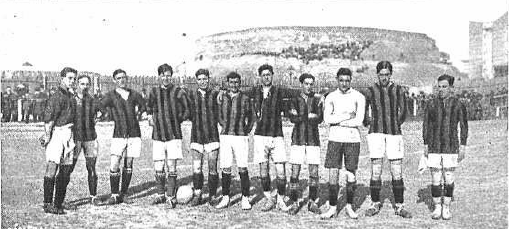
Racing Club de Madrid squad in the 1920s.
Photo Credit: García Archive
The mastermind behind the project was the coach, Paco Bru, who had a strong grasp of knowledge of football in the Americas. Years earlier, in 1926, while coach of RCD Español, he had organised the first American tour for a Spanish team, visiting Argentina, Uruguay, Peru, Chile and Cuba, where he stayed for two years and served as national coach, before taking charge of Racing Madrid. Then, in 1930, he received permission from the club to coach the Peru national team during the 1930 World Cup in Uruguay.
At the time, Peru was going through a deep crisis after the Great Depression and a climate of political turmoil that led to a coup d'état in August 1930 by Commander Luis Miguel Sánchez Cerro.
Although Sánchez Cerro enacted social measures, he failed to reverse the situation and was forced to leave power in March 1931, going into exile in Paris. His successors fared no better, and the provisional government finally called for elections in October.
Sánchez Cerro, at the head of his Unión Revolucionaria created in exile, wanted to contest the elections, but authorities prevented him from entering the country. Coincidentally, Bru, who was leaving for Peru before the rest of the team to finalise tour details, met Sánchez Cerro at Barcelona, where the two talked like two old friends.
Sánchez Cerro headed for Paris, from where he would prepare his entry into Peru, while Bru went on to Santander, where he embarked for South America. But before arriving, on a stopover in Vigo, he met another old acquaintance: Lieutenant Commander Ricardo Guzmán Marquina, who had chaired the Federación de Perú during Sánchez Cerro's time.
They sailed together across the Atlantic to Colón, Panama, where Sánchez Cerro also arrived shortly afterwards. The three went to lunch and, sitting at that table, Sánchez Cerro asked Bru to deliver three letters upon his arrival in Peru.
One was addressed to Escuela de Cadetes de Chorrillos’ director, another to the Lima police chief, and the last one to Escuela de Hidroaviación de Ancón’s director. In those letters, Sánchez Cerro gave instructions to carry out a military uprising if the government prevented his entry into the country.
Bru accepted, hid the letters among some socks and handed them over while Sánchez Cerro issued an ultimatum demanding his entry into Peru. Eventually, the government ignored the ultimatum, the mutiny triumphed, thanks to Bru, and Sánchez Cerro entered Peru on 4 July. But that is another story.
The rest of the team, which left Santander on 23 June, arrived in Peru seven days after the commander. Their luxurious trip was not free of bad news, as one of their players, Félix Pérez, contracted a tuberculosis that forced him to stay in bed for the entire trip.
Still, they were eager to play games and start collecting some money. The opportunity was not long in coming, and Racing made their debut on the 12th against Atlético Chalaco, last season’s national champions. Racing were looking good after a 2-1 lead at half-time, but in the second half they suffered travel fatigue and ended up losing 3-2.
The next match came a week later. They faced Alianza de Lima, a fierce opponent comprising a great generation of Peruvian players on their way to claiming the 1931, 1932 and 1933 titles. Bru was aware of Alianza's superiority, but as the success of the tour depended on looking good in those matches, he opted to innovate. Instead of using zonal marking, as was customary at the time, he ordered his players to mark their opponents individually, thus blocking their dynamic, combinative play.
The plan worked half-heartedly, as Racing ‘only’ lost 1-0, but the 12,000 fans who expected a big win for Alianza, outraged, waited for the Peruvian players to leave the stadium and chased them through the streets of Lima. They felt Alianza had deliberately played badly to force a draw and play a rematch to fill their pockets.
In these circumstances, Alianza refused to play Racing again, who had to find another opponent before ending their Peruvian tour – Frigorífico Nacional de El Callao. That match resulted in Racing's first victory of the trip, 2-1, albeit at the expense of several injuries and very little revenue, as it was played on 28 July, the same day as the country's independence celebrations.
Two days later, Racing, in the absence of Félix Pérez, who had to stay for several weeks in Peru before returning to Spain at his own expense, sailed for Havana, where new adventures awaited. At the time, Cuba was ruled by Gerardo Machado, who had come to power in 1925 with broad popular support and a promise not to stand for re-election.
However, his constitutional reforms to perpetuate himself in power, the imprisonment of workers‘ and students’ leaders and his control of the press, combined with the devastating consequences of the ‘29 crisis, buried his political popularity. All this provoked a general discontent in the country, the consequences of which were felt right from Racing's first match on Cuban soil.
It was on 9 August, against Juventud Asturiana: Racing played well and deserved to win, yet the tropical heat affected them, and they were held to a 1-1 draw. But that result did not worry players as much as the fact that the stadium's stands were almost empty, once again undermining their revenue. The stadium was located on the outskirts of the city, and it was practically impossible to get there because of a tram strike.
At the same time, former president Mario García Menocal, together with Colonel Carlos Mendieta, led an anti-Machado insurrection that, despite being quickly defeated, was followed in several parts of the country and led the government to declare a two-week state of war.
For two weeks, Racing were unable to play matches while the hotel bill grew steadily. They managed to return to the field of play on the 23rd against Real Iberia. Unfortunately for Racing, Rafael Morera got injured at the very beginning and they ended up losing 0-3.
Afterwards, Racing were due to play against Centro Gallego, league champions that year, but the latter refused. After much discussion and complaints between the clubs, the Asociación Cubana de Fútbol intervened and decided that Racing should play again against Real Iberia, this time beating them 3-2. The problem was that the last two matches were played at the La Tropical stadium, located in an area where insecurity was so high that safe conduct was needed - again, this resulted in poor gate receipts.
Despite some players’ pessimism, Racing continued their tour, convinced that their next destination, Mexico, would bring them fortune. They were booked for seven matches there, but first they had to get from Veracruz, where they arrived by boat, to the capital. So far, the tour had yielded little profit, and telegrams sent to Madrid asking for money went unanswered, so Bru had no choice but to sell the box-office rights to five of the seven matches for $3,500, enough for the trip and a month's accommodation.
His debut on Mexican soil came against Club America on 7 September, and it could not have been more encouraging: after going in 3-4 down at half-time, Racing rallied to win 5-4 and impressed the crowd. Two days later, they faced Asturias and, although they drew 2-2, they again made a good impression.
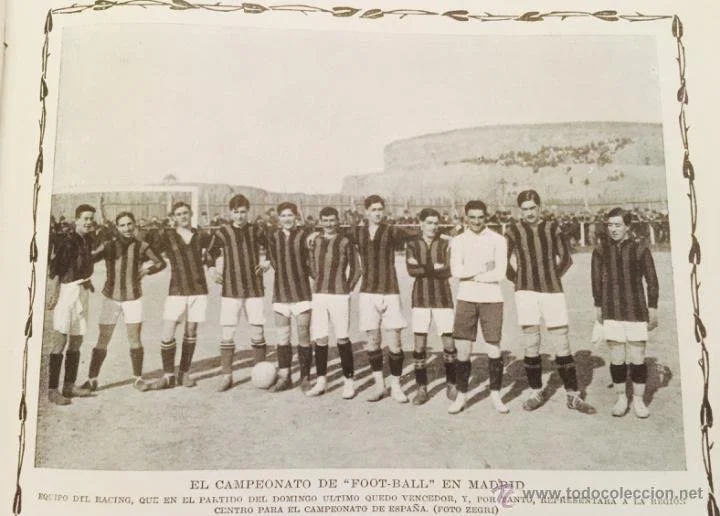
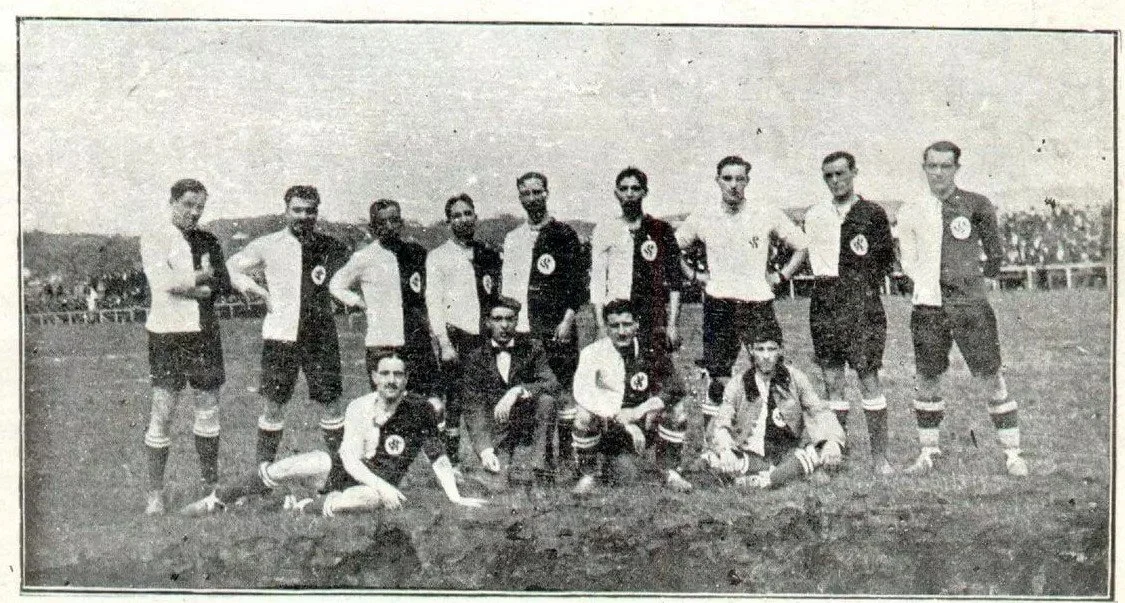
Racing Club de Madrid squad from 1915.
Photo Credit: Todocoleccion
Optimism spread among the players. Moreover, from the third match onwards, Racing would field a football star: Gaspar Rubio. Rubio, a former Real Madrid player, accumulated in a few years as many goals as fines for his poor attitude, until the club declared him transferable in 1930.
Furious with this decision, Rubio fled to Cuba and then Mexico. Real Madrid protested to FIFA, which banned him from playing, although that did not stop Racing from recruiting him for their tour. Rubio scored three goals in Racing's 4-2 win over Atlante and went on to score again in their 1-1 draw against Club América and in their 3-1 win over Necaxa.
Racing were at their best and there were two more games to come with all the revenues going into their coffers. But, once again, luck forgot them: two hurricanes crossed the Gulf of Mexico, meaning that very few people attended Racing’s 2-2 draw against Real España and their 3-0 defeat in the rematch against Atlante.
Before the last game, Bru already knew that Racing had to keep playing matches if they wanted to succeed in raising some money. He also knew that Atlante played very violent football so, to avoid injuries, he ordered his players to clear the ball into the stands whenever they could - that way, they would not get kicked.
Fans, however, saw this tactic as a provocation, and soon invaded the pitch to chase racinguistas, who were not only injured, but also arrested for disorderly conduct. And the next day, while Bru was wrapping up the Mexican tour, a crowd of Mexican fans approached the hotel where the team was staying to beat up the players.
By the time Bru returned, they had been taken to the police station, where they were fined 11,000 pesos. Ultimately, thanks to the efforts of the hotel owner, who was himself a lawyer, the fine was reduced to 10 pesos per player.
Despite this, new matches had to be found, and they accepted the proposal of a promoter who promised them four matches in New York. He also convinced Rubio to take part in the tour for $2,000, as the box office depended on him being on the pitch.
Racing headed for New York by train, arriving on 10 October. Their first opponents were New York XI, a team made up of local players, who beat Racing 3-1 amid an unfortunate performance by goalkeeper Platko.
This caused the public's interest to drop. After that match, the New York Giants arrived, with Bert Patenaude and Bart McGhee among others, crushing Racing with a 2-6 thrashing. Finally, in their third match, they got their first victory on American soil: 2-1 against the Zionist Hakoah All Stars. Once again, though, the rain, which forced an early end to the match, resulted in a reduced box office.
To celebrate, some players went for dinner at Little Spain, the small Spanish colony on 14th Street, common spectators at their games. They were accompanied by Juan López, who described himself as a contragánster, at a time when alcohol production was reserved for mafiosi and gangsters.
Bad luck, which had so often accompanied Racing during that tour, struck again that night, as they crossed paths with a group of gangsters who had scores to settle with that ’counter-gangster’.
As if in a movie, they stole a car and made their escape, snaking through the city and leaving behind sounds of gunshots. After that experience, there was still one last game to play, against New York Prague, which Racing beat 3-0 in the best game of this series.
It was a good way to bid farewell to a tour that, by any standards, had been a disaster. But there were more surprises to come, as the promoter, claiming the games had been a ruin, said he could not pay them.
Racing were now trapped in New York City. Rubio paid his own way back to Mexico, while some players sent telegrams to their families desperately asking for money to make their way back to Spain. The only thing left for the rest was to keep hoping that Bru would arrange some matches to pay for the boat fare.
So they kept playing every team they could: New York German Hungarian, Newark Portuguese, 1st German FC, Hakoah All Stars again and, finally, Spanish-American League Stars. Racing played in New York or New Jersey, on wastelands as empty as their stomachs, looking for a win that would bring them some money. None of that was forthcoming.
Racing, victims of their own trap, hardly raised enough to afford the next night, and continuing to play was, at the same time, the only hope of being able to return home and the most painful way of prolonging their agony. An agony that had gone on for far too long.
Finally, the Federación Centro came to the rescue and sent Racing the 12,000 pesetas that the return tickets were to cost. All this even though Racing had travelled without permission, had been expelled from the Federación for not paying its dues and had accumulated a 50,000 pesetas-debt.
To make matters worse, the money came from the Federación's member clubs, many of whom needed financial aid and demanded to consider their contribution as a loan to be repaid by Racing.
But Racing no longer existed. In 1932, a group of Racing members, led by Fernando de Bernardos, tried to revive the club and applied for reinstatement in the Federación. However, the Federación made it a condition that someone should be responsible for the debts contracted by the club, and no response was found.
Thus, amidst silence, Racing Club de Madrid, the club that had given so much to talk about during its brief existence, ceased to exist. The one that was born on a train, in the midst of a typhus epidemic, and died on a ship, in the wreckage of a shipwreck, after provoking an uprising in Peru, meeting an insurrection in Cuba, getting to know the prisons of Mexico and escaping from a group of gangsters in New York.
They say you can’t write these things.