

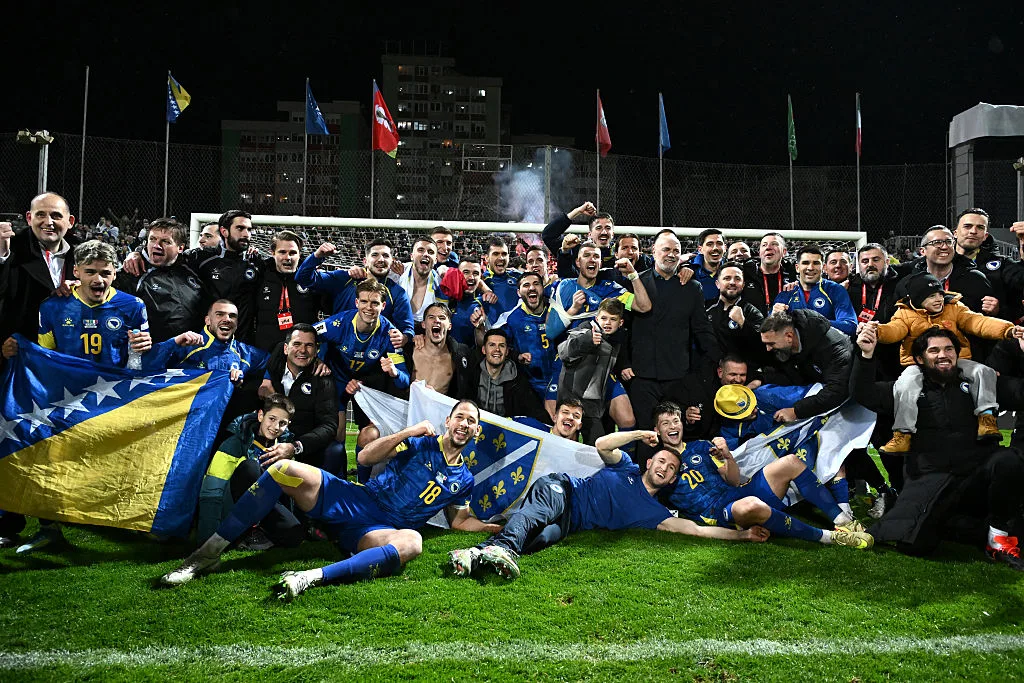
Words by Mark Orton | Published 04.07.2026On a dramatic night at the Stadion Bilino Polje in Zenica on 31 March, Bosnia & Herzegovina (BiH) qualified for the 2026 FIFA World Cup in North America, just the second tournament appearance in the country’s relatively short history, after having appeared at the 2014 competition in Brazil.
While for many, the story of the shoot-out victory was Italian goalkeeper Gianluigi Donnarumma’s meltdown after his penalty crib-sheet was taken by a local ballboy, the story of the journey is strongly linked to the bloody war that marked Bosnia’s birth as an independent nation between 1992-1995.
Key to the success of the Zmajevi (‘the Dragons’) has been a large number of young members of the Bosnian diaspora, who completed their football education in more established leagues around Europe and as far away as the USA, who chose to play for Bosnia and Herzegovina rather than the countries of their births.
Of the squad that went to Brazil a dozen years ago, more than three-quarters of the squad were born in BiH (although seven of those later migrated across Europe with their families due to the war). By contrast, two-thirds of the 26 players in coach Sergej Barbarez’s squad to go to the United States and Canada, two-thirds were born and raised outside the country.
From 1945 Bosnia & Herzegovina was one of the six republics that made up the socialist Republic of Yugoslavia under the iron grip of Marshal Josip Broz Tito. It was a multi-ethnic state combining Serbs, Croats, Macedonians, Slovenes, Montenegrins and Bosniaks as well as ethnic Albanians and Hungarians as well as different religious groupings of Muslims, and Catholic and Orthodox Christians.
With the exception of Slovenia, none of the republics was ethnically homogenous, but simmering tensions were kept in check by an overarching policy of ‘Brotherhood and Unity’ that united this federation of disparate republics into a singular Yugoslav state.
However, when Tito died in 1980, the bond that held the country together was broken and nationalist ethnic and religious fissures began to break open by the end of the decade beginning in the autonomous province of Kosovo.
As Yugoslavia started to break apart in the early 1990s, with Slovenia and Croatia seceding, the Muslim majority led by Alija Izetbegović also pushed to leave the republic fearing a Serb dominated Yugoslavia and declared independence for Bosnia & Herzegovina in 1992.
However, the significant Serb and Croat minorities countered this by declaring their own ethnic microstates of the Republika Srpska and Bosna Herceg as the war erupted with each trying to carve territory from the nascent nation, perpetrating ethnic cleansing and atrocities on the Muslim Bosniak population.
Over the next three years the fighting continued until the tide turned when Croat forces went from fighting the majority Bosniaks to joining forces to fight the Serbs. The war came to a negotiated end with the Dayton Accords of 21 November 1995 which saw Bosnia become a federal state in which the Serbs had considerable autonomy in the Republika Srpska.
During the three years of the war hundreds of thousands fled the country as it lost a quarter of its population, with refugees going to countries across Europe and beyond: principally Germany, Austria, Switzerland, Sweden and the USA, giving rise to a million-strong Bosnian diaspora worldwide.
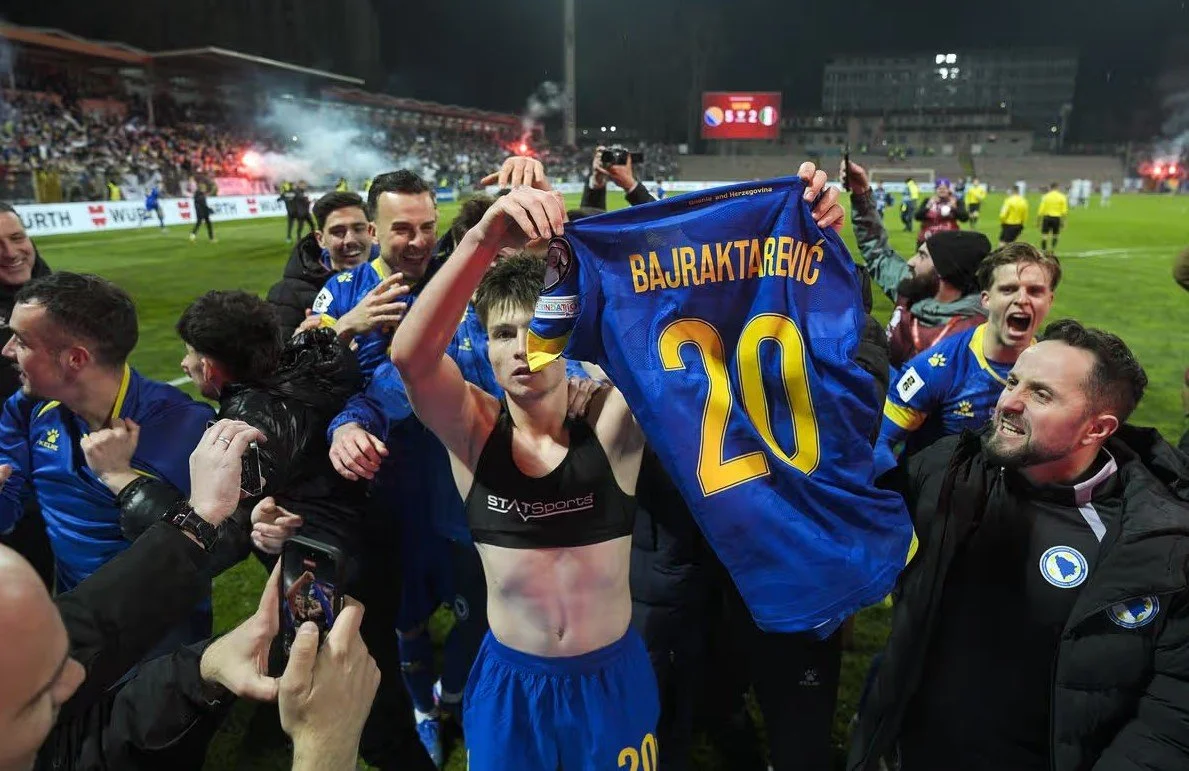
Bosnia and Herzegovina international Esmir Bajraktarević was born and raised in the United States as a member of the diaspora.
Photo Credit: Wikimedia Commons
One of the last functioning symbols of a unified Yugoslav state was the Yugoslavia team that shone at the 1990 FIFA World Cup in Italy, going out only at the quarter-final stage on penalties to Argentina.
Led by Bosnian coach Ivica Osim, the squad had several players from the republic including luminaries such as Safet Sušić and Faruk Hadžibegić.
After declaring independence from Yugoslavia in 1992, foreign-based Bosnian players led by Sochaux’s Hadžibegić and Mesa Bazdarević created a national team in exile to raise the international profile of the new state, playing Belgian and German club sides in the early months of the following year.
Granted provisional membership by FIFA in November 1995 after the agreement of the Dayton Accords, Bosnia played their first international against Albania in Tirana on 30 November, a game that resulted in a 2–0 defeat.
The following year the Bosnians attained full FIFA membership and made their competitive bow in the qualifiers for the 1998 World Cup.
However, progress was undermined by ethnic tensions, with many Bosnian Serbs and Croats such as Neven Subotić and Vedran Ćorluka preferring to represent the national teams of their kinsmen.
As Subotić explained, ‘I didn’t turn down Bosnia and the USA (where he lived as a teenager) as much decide for Bosnia. I’ve a Serb background and blood. I didn’t look at the strength of the national teams I could play for. This was a decision of the heart.’
Meanwhile, Ćorluka was born in the Bosnian settlement of Derventa near Madran before he was forced to flee with his family to Zagreb. Ćorluka later built a monument to the fallen defenders of Madran.
Indeed, Ćorluka was one of eight members of the Croatia squad that reached the 2018 World Cup Final with a Bosnian-Croat background, whilst the team’s coach Zlatko Dalić was born in the Bosnian town of Livno.
Attempts to get around the issue by having a tripartite presidency for the Bosnian Football Association involving each of the three ethnic groupings came to nought as it became mired in claims of corruption that landed some officials in jail and player rebellions.
Such were the problems that FIFA threatened to expel BiH unless they introduced a unified leadership, something that happened under the chairman of a FIFA and UEFA appointed normalisation committee, Ivica Osim, who oversaw the election to the presidency of Elvedin Begić. As the Bosnians cleaned up their administrative act, things started going right on the pitch under coach Safet Sušić.
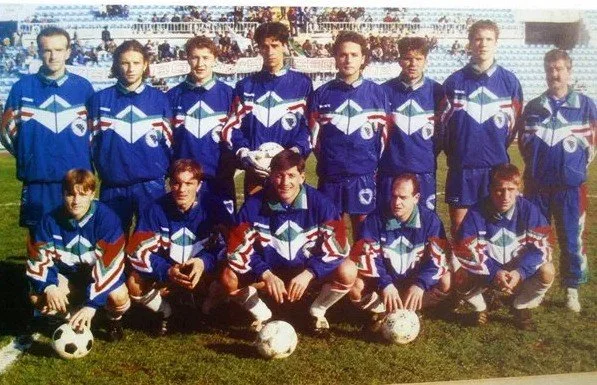
Bosnia and Herzegovina played their first international match in 1995 against Albania.
Photo Credit: Sarajevo Times
Bosnia & Herzegovina first qualified for the World Cup in 2014. According to the team’s goalkeeper, Asmir Begović in a 2025 interview with World Soccer:
‘It was a historic occasion on so many levels. We had a special group of players who had been displaced all over the globe. Some didn’t even speak Bosnian. Being on such a stage was beyond football, considering what our nation had endured because of war. We had the likes of [Sead] Kolašinać, [Muhamed] Besić, [Miralem] Pjanić and Edin Džeko and we were confident of going up against anyone.’
For Džeko the conflict was a lived experience. Born in Sarajevo in 1986, he was six-years-old when the war broke out and lived a key part of his childhood during the Yugoslav siege of the city, that killed 11,000. As he told The Mail in 2011:
‘Our home was destroyed, so we had to move in with my grandparents … It was constant stress and worry, in case someone we knew had been killed. I was only young, and I cried often, through fear. Every day you could hear the guns firing and we lost family friends and even some relatives.’
The former Manchester City striker known as Djamant ‘Diamond’, sought relief from the terror by playing football in the street with his friends. The one day that his mother stopped him, a shell exploded on the exact spot where he usually played.
He went on to use his platform to highlight the plight of refugees, becoming Bosnia’s first UNICEF ambassador in 2009.
Others were impacted by the war by being forced into exile during their formative years and enduring huge upheaval. Ermin Bičakčić was called-up for Bosnia in the qualifiers, fled to Germany with his family when he just three-years-old.
Despite playing for Germany at youth level, Bičakčić returned to his homeland to play senior international football.
Leading BiH to the World Cup was coach Sergej Barbarez. Born in the divided city of Mostar, his personal story highlights both the complex issues that have affected Bosnia’s past but also provide hope for the future.
A former striker with the national team, Barbarez spent most of his playing career in the German Bundesliga after being sent to stay with his uncle in Germany as the events that led to war began in late 1992.
His multiethnic background – his father is a Bosnian-Serb, his mother came from a Bosnian Croat and Bosniak marriage, although he himself professes to be an atheist – complicated his international career due to kidnap and death threats against his mother.
Barbarez only agreed to play for his homeland once her safety was guaranteed, winning the first of his 47 caps against Argentina in 1998 before retiring from the national team in 2006.
He returned to take charge of the national team as coach in the middle of 2024 and his first competitive challenge in the UEFA Nations League was a chastening experience as BiH went down 7–0 to Germany, but with the increasing addition of young, hungry foreign-born players, there was hope of on upturn in fortunes in a World Cup qualifying group that contained Romania, Cyprus, San Marino and Austria.
An opening 1–0 win over Romania in Bucharest set the tone for the campaign in which the Dragons finished second behind Austria, gaining a place in the play-offs, where they showed great grit and resilience to get past Wales and Italy on penalties to seal their place in the finals.
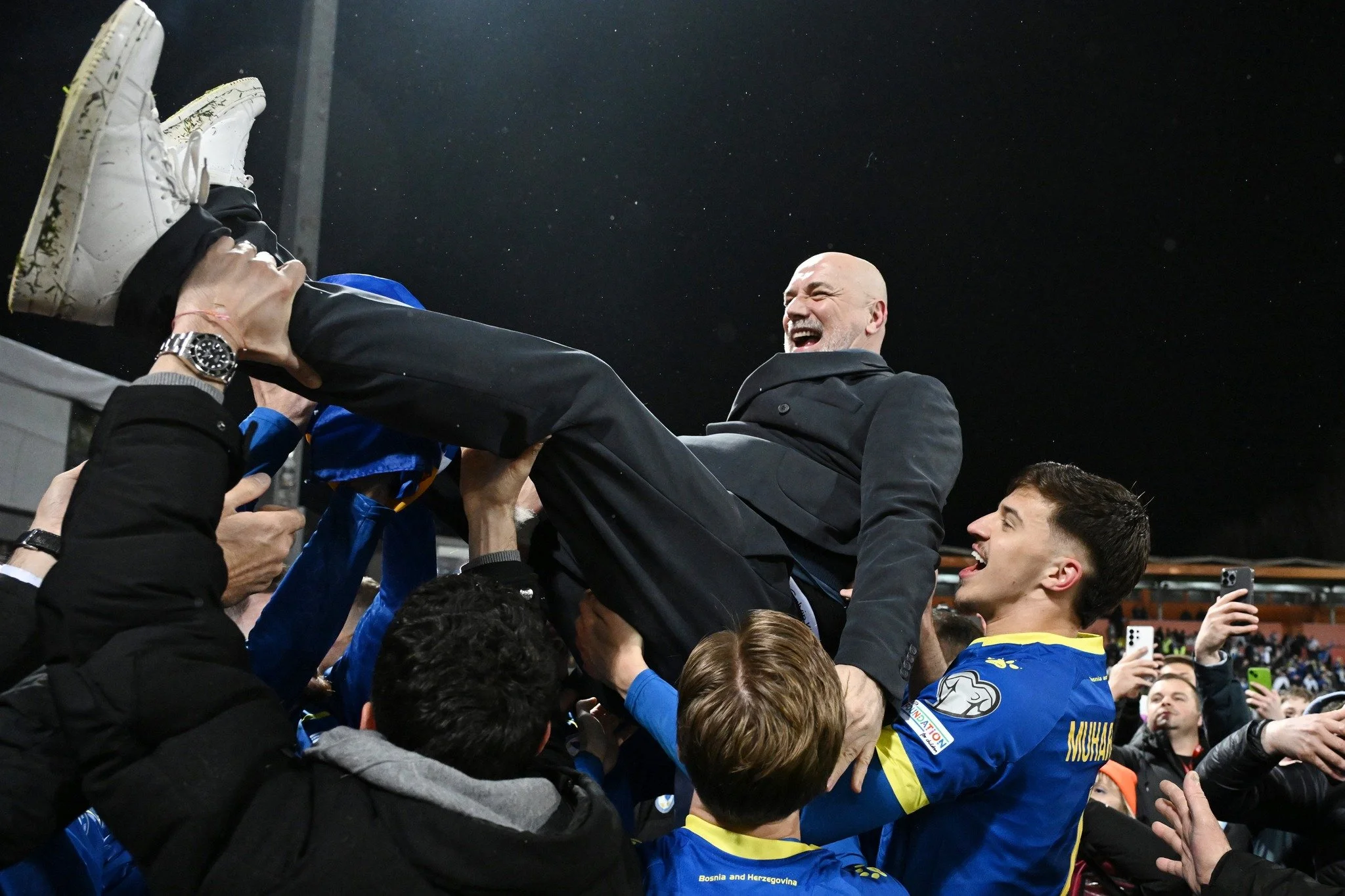
Sergej Barbarez is celebrated by his players upon sealing qualification for the 2026 World Cup.
Photo Credit: Getty
With the player pool in Bosnia being so limited, it was only natural that authorities sought recruits from the Bosnian diaspora to strengthen their national team.
FIFA’s liberalisation of the eligibility rules in 2020 that allowed players aged below 21 to switch their international allegiance so long as they have made no more than three senior international appearances so long as they were not at a major tournament, has made this process easier, especially where players have previously played at junior levels for their country of birth.
Seeking to emulate the success achieved by Croatia in reaching the 2018 World Cup Final with players born outside its territorial border, Bosnia & Herzegovina have really upped their game in terms of identifying and attracting potential foreign-born national team players, firstly under national team director Zvezdan Misimović and then his successor, and current director Emir Spahić – both members of the diaspora themselves – who spent countless hours talking to and cajoling potential players and their families with their vision for the Bosnian national team.
They have been hugely successful, with 17 of Barbarez’s 26-man squad for the finals being born outside Bosnia: four in Germany, three in Austria, three in Sweden, two in Serbia and one each in Slovenia, Denmark, Croatia, Switzerland and the USA. Meanwhile six of the nine standby players for the tournament were also born abroad.
Of the German-born contingent, it is the teenage forward sensation Kerim Alajbegović of Red Bull Salzburg who is creating most excitement and is on the radar of some of Europe’s biggest clubs. The scorer of the winning penalty in the play-off semi-final against Wales in Cardiff, made his debut in the qualifier against Austria in a qualifier for Euro 24 and despite being born in Cologne and coming through the youth ranks of Bayer Leverkusen, never hid his desire to play for the land of his parents who he says ‘have not forgotten their origins’.
He is joined by 2014 World Cup veteran, former Arsenal player Sead Kolašinać who hails from Karlsruhe, former German youth international Dženis Burnić and VfB Stuttgart striker Ermedin Demirović.
Burnić was a product of the Borussia Dortmund Academy and played for Germany at the 2015 U-17 World Cup before choosing to represent the country of his parents, claiming after his Bosnia debut, ‘BiH is a country I love and I am proud to be part of this story.’
From neighbouring Austria come Benfica right-back Amar Dedić whose parents are from Gračanica, back-up goalkeeper Osman Kadžikič and attacking midfielder Ermin Mahmić of Slovan Liberec who changed his sporting nationality shortly before the tournament having been a mainstay in the Austrian U-21 side.
Spahić broke the news on the Football Association of Bosnia’s social media account with the simple tag-line: ‘Welcome Son of Bosnia!’.
The announcement caused much consternation of the Austrian press with Heute reporting, ‘a painful defeat for Austria’ with Mahmić described as ‘one of the most exciting young talents in the Austrian youth system.’ Although born in Ljubljana, Slovenia, 23-year-old defender Tarik Muharemović also received his football schooling in Austria where he broke through at Wolfsberger before moving on to Italy where he now stars for Sassuolo.
Sweden, which attracted over 100,000 Bosnian refugees during the war largely due to its humanitarian policy from 1993 that enabled easy integration into Swedish society, including the right to work and a pathway to citizenship, has also contributed three members of the Swedish-Bosnian diaspora to the of the BiH squad in the shape of Dennis Hadžikadunić, Benjamin Tahirović and Armin Gigović. First to arrive was Hadžikadunić, who debuted against the Netherlands in the UEFA Nations League in 2020.
Born in Spånga to parents from Sarajevo, Brøndby midfielder Tahirović was recruited as a 19-year-old in 2023 by Hadžibegić and Musimović who spoke to the player and his family and sold them the idea of being part of a generational change in the Bosnian national team.
A year later they were followed by young midfielder, Gigović who had been captain of Sweden’s U-21 team and even capped at senior level in a friendly for the Swedes.
The Swedish Federation were so peeved at losing the promising youngster that they prevaricated over completing the paperwork that would allow him to play for BiH.
There was also much wailing and gnashing of teeth in the Swedish media over the loss of such talent, who they claimed should instead be forming the backbone of the Sweden national team, with some sections suggesting that Tahirović’s parents should have been deported.
Other diaspora players include Danish-born Amir Hadžiahmetović, fresh from helping Hull City gain promotion to the English Premier League, PSV Eindhoven winger Esmir Bajraktarević from Wisconsin who earned one cap for the USA as a teenager in 2024 before switching and scoring the winning penalty for Bosnia that took them back to his country of birth for the finals, and Ivan Bašić from Croatia.
For 31-year-old striker Haris Tabaković, 18 June will be an emotional day when Bosnia face Switzerland, the country where he was born and who he represented at youth level.
Of the remaining nine members of the squad born within BiH, they are almost evenly split between five Bosnian-Croats and four Bosniaks.
Bosnian fans will however, lament that one local-born talent, Internazionale’s Petar Sučić will likely be at the World Cup, but in the chequerboard shirt of Croatia instead.
Despite playing 24 games at age level for Bosnia, Sučić switched his allegiance to Croatia in March 2024.
Explaining his decision on the Croatian Football Association (HNS) website, the youngster said:
‘The decision was not easy and I would like to thank everyone in the Bosnian-Herzegovan federation and the national teams for their understanding. However as a Croat, my greatest desire is to represent Croatia, which is my homeland.’
Meanwhile, the Bosnian press have picked up on the absence of Sweden U-19 international Kenan Basuladžic and Serbian-born teenager Mirza Catović despite neither having expressed a desire to play for Bosnia.
As an exasperated Barbarez said at the press conference announcing his World Cup squad, ‘I don’t even know what we are doing here, we are asking about players who are not even citizens of the country!’
There have been allegations in the Serbian press that the team that reached the World Cup was not truly representative as it has too few Serbs: just the Serbian-born pair of Samed Laždar and Jovo Lukić.
It was a suggestion refuted on TV by Football Association of Bosnia and Herzegovina president, Vico Zeljhović, himself a Bosnian-Serb and nephew of the former President of the Republika Srpska, Milorad Dodik, saying, ‘This is football and we don’t mix politics and sports. The best players with the highest quality should play,’ before pointing out that coach Barbarez and members of his coaching staff, Ninoslav Milenković and Sinisa Mrkobrada originated from the Bosnian-Serb community.
On the issue of Bosnian-Serb players rejecting the call to the national team, former director Misimović – also of Bosnian-Serb origin – said:
‘Everyone has to look at themselves. An invitation to the national team also increases market value. I see no reason why someone wouldn’t play for Bosnia & Herzegovina. However, everyone should decide if they feel that way. I think it’s counterproductive if they don’t go [to the national team].
A case in point is Baždar, the young forward on loan in the Polish League from Real Zaragoza, who after making his debut for the country of his birth, Serbia, in March 2024, switched to their Balkan neighbours just months later after being approached by the Bosnian Federation.
Explaining his decision, the striker told Radio Sarajevo:
‘My roots are from Bosnia and Herzegovina on one side of the family … Make no mistake, I think the best of Serbia, I was born and raised there, grew up as a player at Partizan [Belgrade] and I am grateful for the invitation to the national team where I was well received … I am a professional and the decision to accept the invitation of the Football Association of Bosnia and Herzegovina was motivated by that.’
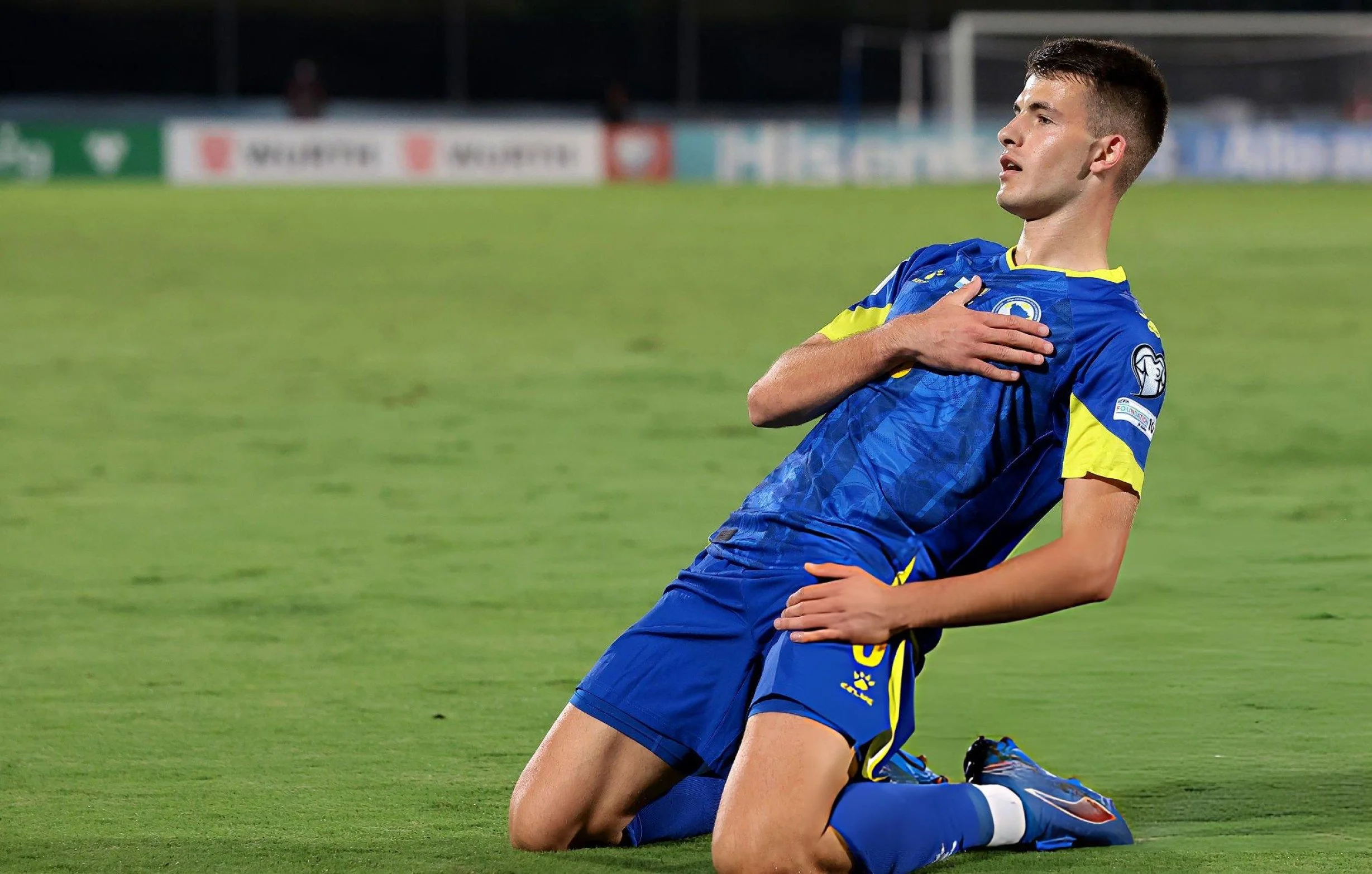
Samed Baždar made his first appearance for Bosnia and Herzegovina in 2024.
Photo Credit: Getty
There is another aspect of the diaspora that has worked for the Bosnian national team over the years: the support from local BiH communities that has turned away fixtures into the atmosphere of a home game, with 20,000 supporting the Dragons in Vienna in the qualifying match against Austria in November 2025.
The team will not be short of support either as they start to acclimatise to their North American odyssey either.
In their final friendly before the tournament, BiH will face Panama on 6 June in the Energizer Stadium in St Louis, a city with an estimated Bosnian population of 70,000, the biggest outside Europe.
The entire 22,000 capacity is expected to filled with Bosnian fans. As one fan told Klix, ‘We are a people who have been through a lot, and that is why we are especially proud. We have many people who were displaced, refugees and immigrants, and today we feel represented through the team, especially here in St Louis.
One interested observer at Bosnia’s opening match with Canada in Toronto on 12 June will be 2014 World Cup goalkeeper, Asmir Begović who grew up in Canada and represented the Canucks at the 2007 U-20 World Cup.
Although, as he said in a 2014 interview with World Soccer, ‘I played for Canada in youth teams, but the moment I received a call-up from Bosnia-Herzegovina I knew what I would do. And it is similar with the other guys. It’s not you that decides, you just follow your heart.’
Similarly, at their second game against Switzerland six days later in Los Angeles. As well as Tabaković, Dubai United striker Haris Seferović will be someone with a foot in both camps.
Born in Switzerland, Seferović was approached by the Bosnian authorities to join their national team in 2013 before opting to stick with the country of his birth with whom he earned 95 caps.
Seferović told Swiss media outlet CH Media that he was, ‘Swiss on paper, Bosnian in the soul.’ Talking of the team’s qualification.
The player, whose parents are from Sanski Most said, ‘Not all the wounds from the war in the Balkans have healed yet, so it is really nice to see the entire country once again has a real reason to celebrate.
Bosnia conclude their group stage against Qatar on 24 June in Seattle with high hopes both within the country and amongst the Bosnian diaspora around the world that Barbarez’ side of wise old heads and young tyros can create history by reaching the knockout stage of a major tournament for the first time and creating more moments of national joy.