

Words and Photos by Tomasz Kosiński | Published 13.11.2026South Tyrol is a mountainous region home to the vast Dolomites, where German precision meets Italian style. The towns have dual names (BolzaBolzano/Bozen, Bressanone/Brixen), and the people speak several languages.
The cuisine combines strudel, dumplings and wine with pasta and olive oil. The region hosts traditional celebrations, such as ‘törggelen’ - autumn wine and chestnut tastings - the Christmas market in Bolzano, and the Marmot Festival, which has its roots in Ladin culture.
FC Südtirol is a football club from the autonomous province of South Tyrol in northern Italy. Formed in 1995 from the amateur team SV Milland, it represents all three linguistic communities in the region: German, Italian, and Ladin.
It is the only German-speaking professional club in Italy and the first team from the region to advance to Serie B. The club's success has sparked interest in European media, with Spain's El País describing FCS as a "little Bayern Munich," praising its management and infrastructure and highlighting the stadium's ability to integrate three languages.
Since then, the history of FCS has been not only a sporting rise from the seventh division to Serie B, but also a story of reconciling the identities of multiple groups in a region where language, history, and symbolism are paramount.
In 1915, Italy entered World War I on the side of the Entente in exchange for the promise of South Tyrol, among other things. The region was annexed to Italy under the Treaty of St. Germain in 1919.
Until then, it had remained part of the Habsburg Monarchy for over five centuries. During the Fascist period, Mussolini pursued a policy of Italianization, including banning German names and the language, dissolving German associations, and introducing the exclusive use of Italian in workplaces and public administration.
Construction began on the provincial capital, Bozen, intended to become a new, Italian Bolzano, with thousands of Italian workers settling in the city.
Between 1926 and 1928, the Victory Monument (Italian: Monumento alla Vittoria, German: Siegesdenkmal) was built. The structure is located in Piazza della Vittoria, in the part of the city designed by Marcello Piacentini, Benito Mussolini's favorite architect.
The arch was built to commemorate Italy's occupation of South Tyrol, which had been seized from Austria. After the outbreak of World War II in 1939, the German and Italian governments reached an agreement: German-speaking residents had to choose between emigrating to the Third Reich or remaining and losing their language and culture.
After World War II, the Treaty of Paris (1946) confirmed the region's affiliation with Italy, guaranteeing "full equality of rights" and protecting the cultural and economic development of German-speaking residents.
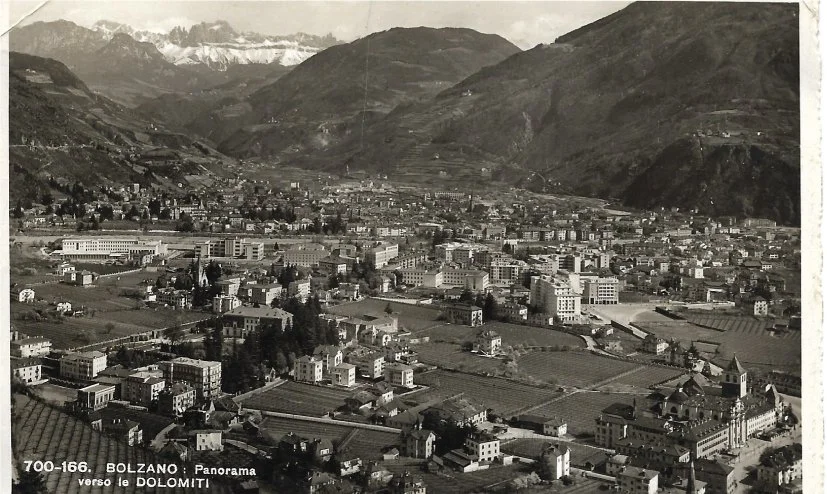
Bolzano during the 1940s.
Photo Credit: Wikimedia Commons
In 1948, the first autonomous status was adopted, which increased tensions in the region, leading to bombings in the 1950s and 1960s.
The Italian government and Austria, acting as a welfare state, negotiated a package of laws (1969) and a new autonomous status (1972), which transferred most of the region's powers to the provincial level.
The system was intended to ensure ethnic balance through proportional distribution of positions in administration, the judiciary, and education, as well as through the requirement to declare affiliation with a linguistic group.
The region is inhabited by three main linguistic groups. The largest German-speaking community (approximately 69% of the population according to the 2011 census) descends from settlers, including Bavarians, who arrived in the Middle Ages.
The South Tyrolean dialect differs from Standard German and is widely spoken in everyday life. The Italian-speaking group (approximately 26% of the population) Its rapid growth occurred in the 1920s and 1930s, when Mussolini encouraged southern Italians to settle in Bolzano.
As a result, the provincial capital today has an Italian-speaking majority. The third group is the Ladin minority, comprising approximately 4% of the population and using Ladin - the oldest language in the Dolomites - in everyday life.
The language arose from a fusion of military Latin and Celtic culture and survives only in a few mountain valleys. The Ladin are the smallest group, but their language enjoys equal rights - taught in schools, used in government, and in the media.
South Tyrol combines elements of Italian and German culture. The history of Italianization and wartime traumas still influences the attitudes of its inhabitants; at the same time, the region is one of the richest in Italy.
SV Milland, founded in 1974 in Bressanone/Brixen, played in the lower leagues for two decades. In 1995, entrepreneurs who had failed to take over AC Bolzano purchased SV Milland and transformed it into FC Südtirol-Alto Adige.
The new club was intended to represent the entire province, not just a single city; it adopted the red and white colors of the province's coat of arms and the city of Bolzano, and the bilingual name "Südtirol-Alto Adige." Leopold Goller created a joint-stock company - 90% of the shares are held by 32 shareholders (local entrepreneurs) and 10% by the youth sports association.
This ownership model allows for the reinvestment of profits in infrastructure and youth programs. After several years of success in the amateur leagues, FCS earned promotion to Serie C2 in 2000, at which point the club moved from Bressanone to Bolzano to play at the larger Stadio Druso.
The goal was to attract fans from across the province, even though Bolzano's population is mostly Italian-speaking. The club gradually shortened its name: from the bilingual FC Südtirol-Alto Adige to FC Südtirol; in 2016, the logo retained only the German name and added "Bolzano-Bozen."
In the 2021/22 season, the team led by coach Ivan Javorcic conceded only 9 goals in 38 matches, scored 90 points and won its Serie C group, which gave a historic promotion to Serie B.
In the debut season of 2022/23, FCS reached the semi-finals of the Serie A play-offs, where they lost to Bari, and the Druso stadium was regularly full.
According to general director Dietmar Pfeifer, attendance exceeds 4,000 people per match, and the club has 32 shareholders and approximately 300 sponsors, while profits are reinvested in youth training.
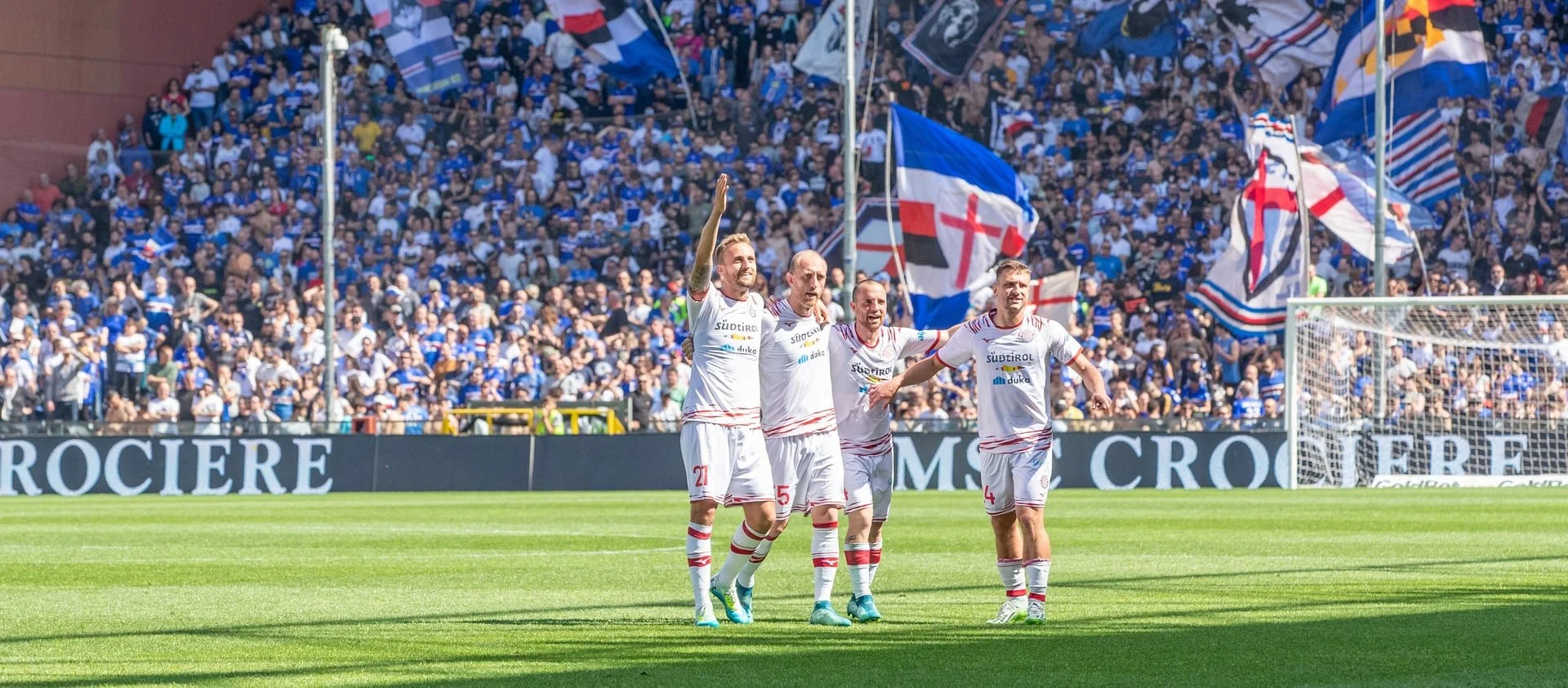
FC Südtirol celebrate after scoring the eventual winner against Sampdoria.
Photo Credit: FC Suedtirol
In South Tyrol, ice hockey and winter sports have traditionally attracted more attention than football. Due to the lack of clubs in Serie A, many residents support the Italian giants or Bayern Munich, which is due to cultural ties with Bavaria.
From the outset, the FCS's declared goal was to build unity between the language groups. The club's website emphasized that the FCS aims to be "a model of integration for the three language groups," and the stadium is intended to be a meeting place for German, Italian, and Ladin fans.
In 2022, coach Ivan Javorčić appealed that to compete with stronger clubs, "we must be united, combining both souls—the Italian- and German-speaking—of our beautiful territory."
Director Pfeifer, meanwhile, stated that the FCS combines "Italian temperament with German quality" and is a model of integration. The first FCS football fan groups were formed in 2000, and attendance in the initial seasons reached around a thousand people.
Currently, two distinct groups occupy opposite stands stand out in the stands. In November 2023, a clash even broke out between them during a match against Cittadela.
Many small ultras groups (Eagles Supporters, Ultras Centurie, Centurie Biancorosse, Forever Alto, Fedelissimi, The Rulers) have merged and disbanded.
Around 2020, they merged into Gradinata Nord Bolzano (named after the northern section of the Canazza stand).
The group, which originates primarily from the Italian-speaking community, uses the name "Alto Adige" in its chants - its manifesto emphasizes that the name "Südtirol" does not represent Italian-speaking fans.
Gradinata Nord is characterized by right-wing views, and local politicians from the right-wing Fratelli d'Italia party have used its demands to criticize the club's management, claiming that the name "Südtirol" alienates Italian fans. In 2022, Gradinata Nord called for the club to reinstate its bilingual name, a move supported by some politicians.
In 2023, a new fan group, Curva Südt, was formed and occupies the south stand. It is affiliated with the German-speaking section of the fans, but also supports them in Italian and Ladin, promoting cooperation between all ethnic groups.
Besides the ultras, there are numerous official fan clubs. These include Unterland/Bassa Atesina (founded in 1995), Fanclub Dolomites from Marebbe, Fanclub Merano, and a club in the German town of Dinslaken.
Their members attend home matches, while - due to the distance - usually only a few dozen people travel to away matches.
FC Südtirol’s rivalries are not confined to football. Venezia are regarded as one of their enemies, while locally there is also hostility towards the supporters of HC Bolzano/Bozen, the city’s historically dominant ice hockey club.
Significantly, the two rival fan scenes are themselves connected, with Venezia supporters maintaining friendly ties with HCB ultras and even using the slogan “A Bolzano solo HCB” (“In Bolzano, only HCB”).
During matches, elements of German and Italian culture are evident: the pitch announcer leads games in the style of German stadiums, but fans discuss tactics in Italian, bratwurst and Bavarian beer are served during halftime, and the Bocciodromo bar boasts an Italian atmosphere.
The club's logo and name have been a source of contention for years. The original emblem (1995) featured the German "Südtirol" and the Italian "Alto Adige," along with a checkerboard pattern in red and white.
In 2016, the club unveiled a new logo: the "Alto Adige" was removed, replaced with a darker shade of red, and the inscription „Bolzano - Bozen” was added.
Officially, this was explained as a desire to emphasize the connection with the provincial capital; however, some Italian fans viewed it as a blow that alienated the Italian community.
Despite objections, some media outlets continue to use the name "Alto Adige," and Gradinata Nord fans use "Alto" instead of "Südtirol" on banners and merchandise. This conflict is fueled by right-wing politicians who demand a return to the bilingual name.
FCS management has consistently declared neutrality and distanced itself from ethnic disputes. Dietmar Pfeifer emphasized that the club represents "the entire province," and that the supervisory board includes representatives of all linguistic communities.
Eurac Research also noted that FCS tries to ease tensions by organizing multilingual activities and leaving the choice of the language of the songs to the fans.
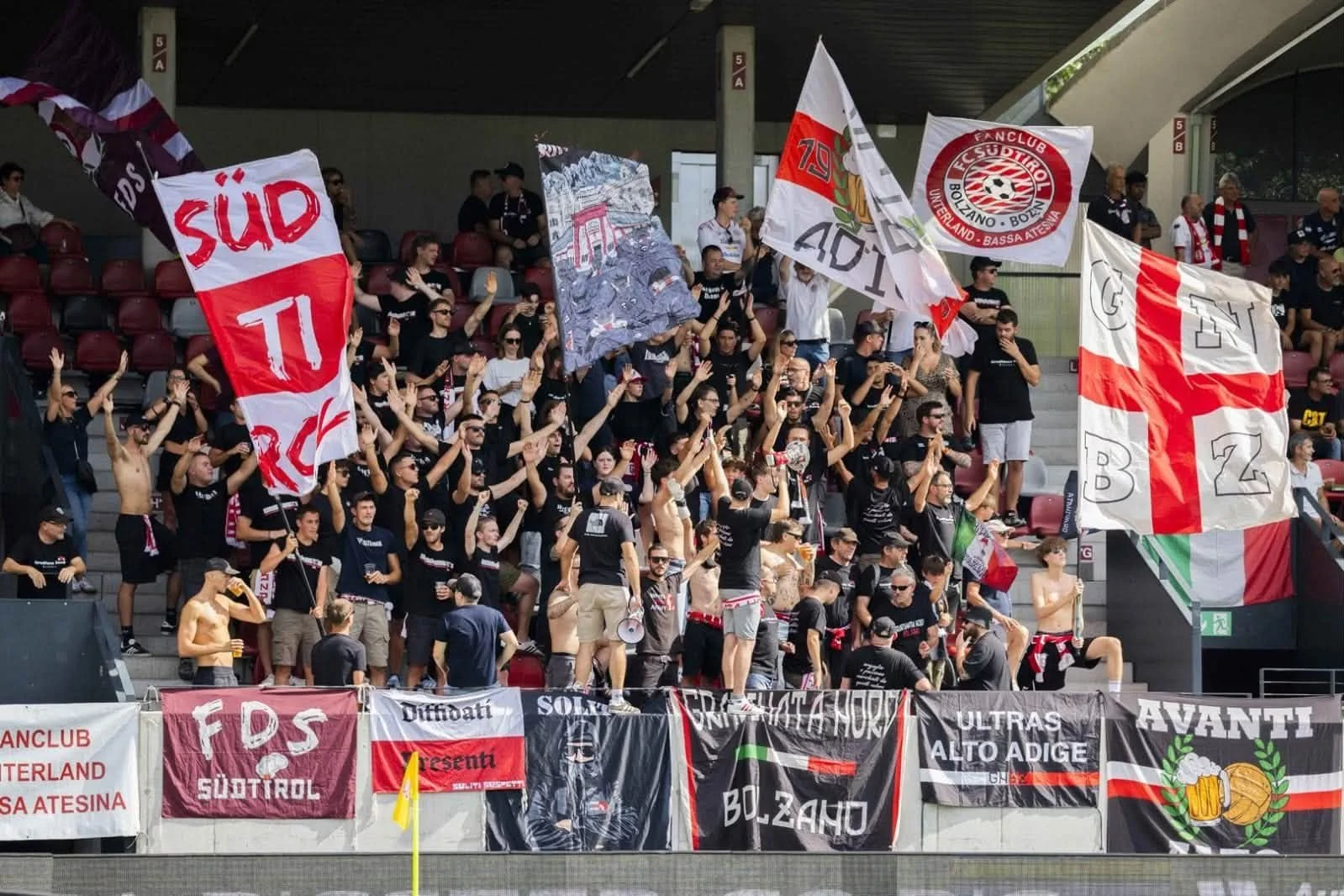
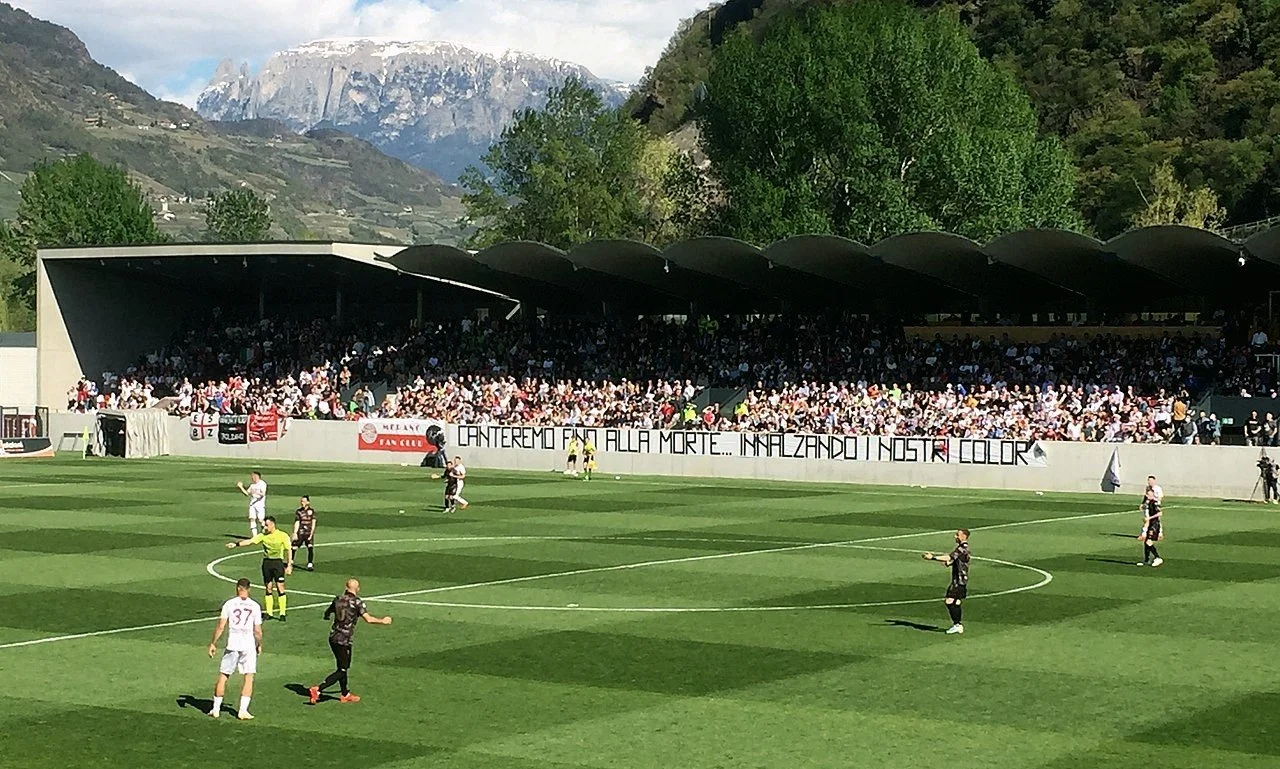
Gradinata Nord at Stadio Druso in Bolzano.
Photo Credit: Gradinata Nord
In recent years, rumors have regularly appeared in the media that global energy drink company Red Bull - owner of clubs in Austria, Germany, the United States, and Brazil, among others - is considering entering the Italian market by investing in FC Südtirol.
Although FCS consistently emphasizes its independence, this speculation has sparked debate about the club's future.
In early April 2026, the Italian daily Tuttosport reported that Red Bull representatives visited the FCS training center.
According to Gianluca Scaduto, after previous failures in Torino and Genoa, the company had turned its attention to Bolzano; talks were expected to include an inspection of the infrastructure and a modern training center.
Local media outlet Ilovepalermocalcio confirmed that "contact had taken place," and a Red Bull delegation visited the FCS Center and expressed interest in cooperation for the first time.
The Alto Adige and Südtirol News portals reported that the company was considering including Südtirol in its global network of clubs in order to develop young talents and build a project with the prospect of promotion to Serie A.
Analyses indicate several reasons why FCS could be an attractive partner. The club has a stable organizational structure, well-developed training facilities, no debt, and consistently focuses on youth training.
Commentators believe it is the ideal club for Red Bull's strategy, based on scouting and building player value, followed by sales - especially since Bolzano is located near the Austrian border and in a German-speaking region, which would facilitate integration with clubs in Salzburg and Leipzig.
For Red Bull, entering the Italian league could also strengthen its brand recognition in a country renowned for its passion for football.
However, speculation is met with skepticism. Practical problems are highlighted: the Stadio Druso seats less than 5,500 spectators, which limits the investor's ambitions and would require expansion or the construction of a new facility.
Furthermore, rebranding and introducing the name "Red Bull Südtirol" could be met with opposition from some fans.
Although the club has changed its name and moved between cities several times, completely subordinating its corporate identity would be perceived as a loss of regional character and perhaps a boycott of the club, as has already happened in the history of Red Bull.
The history of FC Südtirol is closely linked to the identity of South Tyrol - a region with a complex history, where German, Italian, and Ladin traditions intersect.
The club was founded as an integrative and symbolic project - intended to represent the entire province and build bridges between communities. Sporting success (promotion to Serie B) instilled pride in the local community, but also intensified discussions about symbolism, name, and language.
The multilingual nature of the stadium and the diversity of the fan base reflect the everyday reality of the region, where identity issues are still very much alive.
While Gradinata Nord Bolzano manifests Italian identity and calls for a return to a bilingual name, Curva Südt (FDS Südtirol) promotes multiculturalism and united support.
The conflict over the club's name, symbols, and languages is not only a fan dispute but also an echo of the historical dispute over who owns South Tyrol.
Despite these tensions, FCS remains a model of professionalism and wise management in the world of Italian football - the club develops its infrastructure, invests in youth training, and strives to transcend divisions.
For many in the region, regardless of language, FCS has become a shared source of pride, and every goal scored in the red and white colors at the Druso stadium confirms that football can unite people even in a region with a complex history and identity.
The question remains whether Red Bull's potential interest and eventual takeover of the club will undermine what has been built over years of grassroots work.
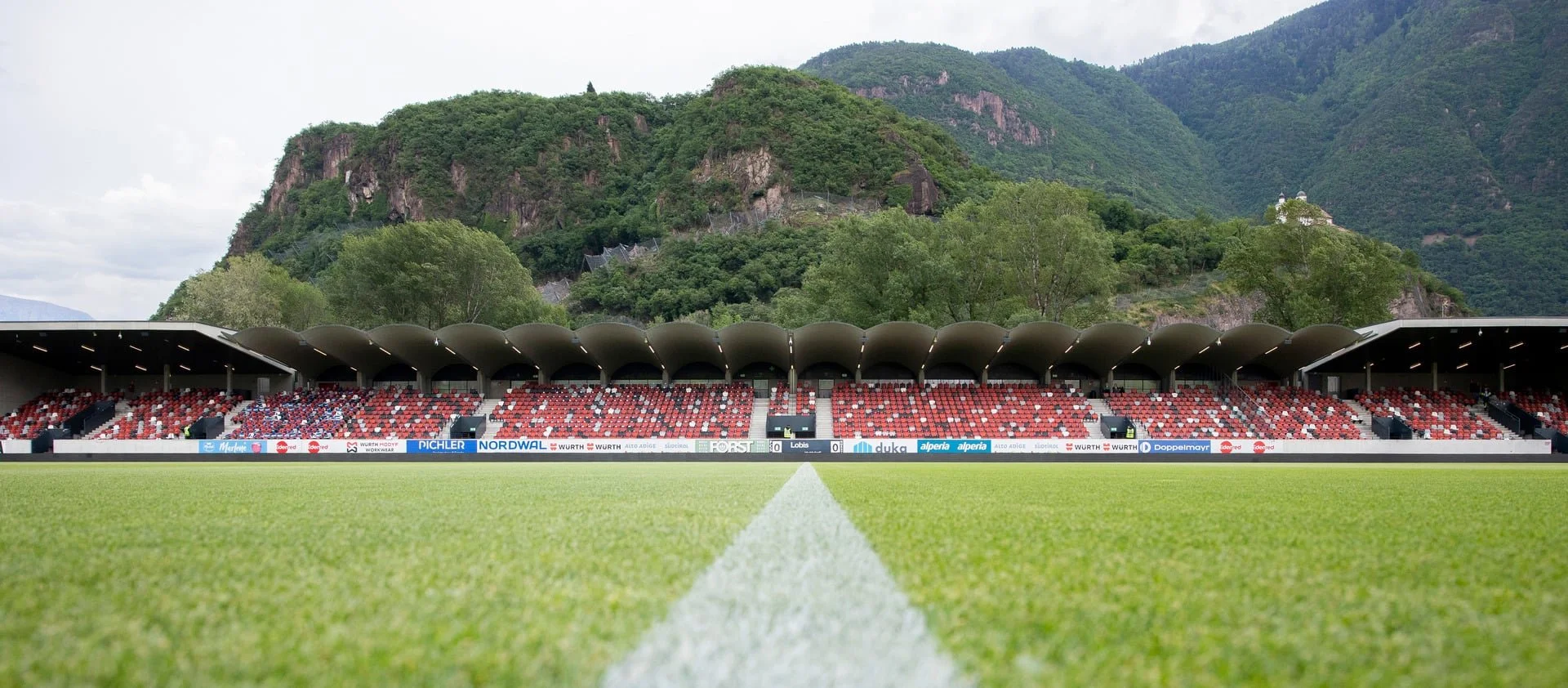
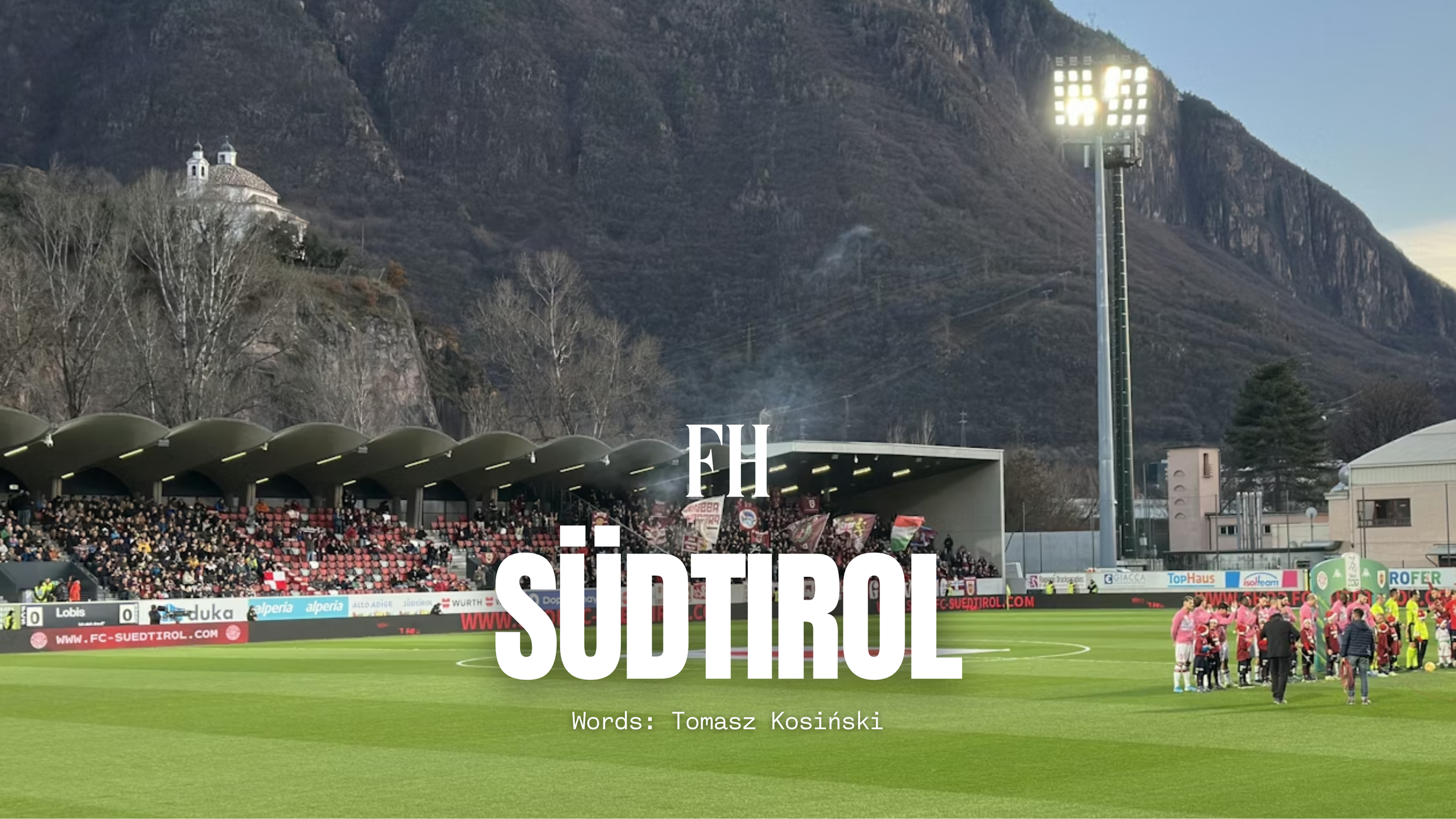
Stadio Druso, home of FC Südtirol and one of the most stunning stadiums in Europe.
Photo Credit: FC Südtirol