

Words by Max Lee | Published 24.10.2026The 29th of May 2019 marked the 48th Europa League final - a much-anticipated fixture between Chelsea and Arsenal in the first all-English final since 1972 and the only final to be contested by city rivals.
Both sides finished first on sixteen points in their respective groups yet participated in tumultuous knockout stages, with Arsenal having to recover from first-leg deficits against both BATE Borisov and Stade Rennais and Chelsea having to squeeze past Eintracht Frankfurt on penalties.
Chelsea were looking to finish a turbulent season on a high after losing the League Cup three months earlier to Manchester City but securing Champions League qualification by two points on the final day.
Arsenal, under the tutelage of the heavily criticised Unai Emery, were in pursuit of a first European trophy which would also grant them Champions League qualification for 2019/20, a feat they failed in domestically after missing out on top four by a single point.
The two English giants travelled to Baku to take part in the competition’s first Azerbaijan-based final. My dad, a lifelong Chelsea fan, followed them there and back in a day to watch his team win their sixth major European honour and second Europa League title after dismantling the Gunners 4-1 courtesy of goals from ex-Arsenal striker Olivier Giroud and Pedro, followed by an Eden Hazard brace in what would be his final game in blue.
Since I started going to games around the age of five, I always liked to come back from each fixture with something physical to show for it, whether that be a programme, fanzine, pin or scarf.
Unfortunately, I couldn’t travel to Baku that evening in May - it was deep in exam season, so I was cheering from my living room.
My dad, who was a career pilot before his retirement in 2022, often attended far-off away days, both domestic and European, due to extended blocks of time off.
For the games that I couldn’t join, he’d always bring something back for me as a memento. His trip to Baku was just as fruitful, returning with both a programme and a scarf for me to add to my collection.
Though that was not all he returned with. Presented on the kitchen table when I woke in the morning was a football shirt-shaped keyring.
The keyring read ‘Tofiq Bahramov, 1966’ on one side and ‘Baku’ on the other.
I asked my dad, as he was making his morning coffee, what the keyring meant.
He responded that he had been handed it after exiting Heydar Aliyev Airport and, amongst all the travelling and celebrations, hadn’t the time to look into it.
Instead of focusing on the schoolwork ahead of me that day, my attention turned to Tofiq Bahramov and his story.
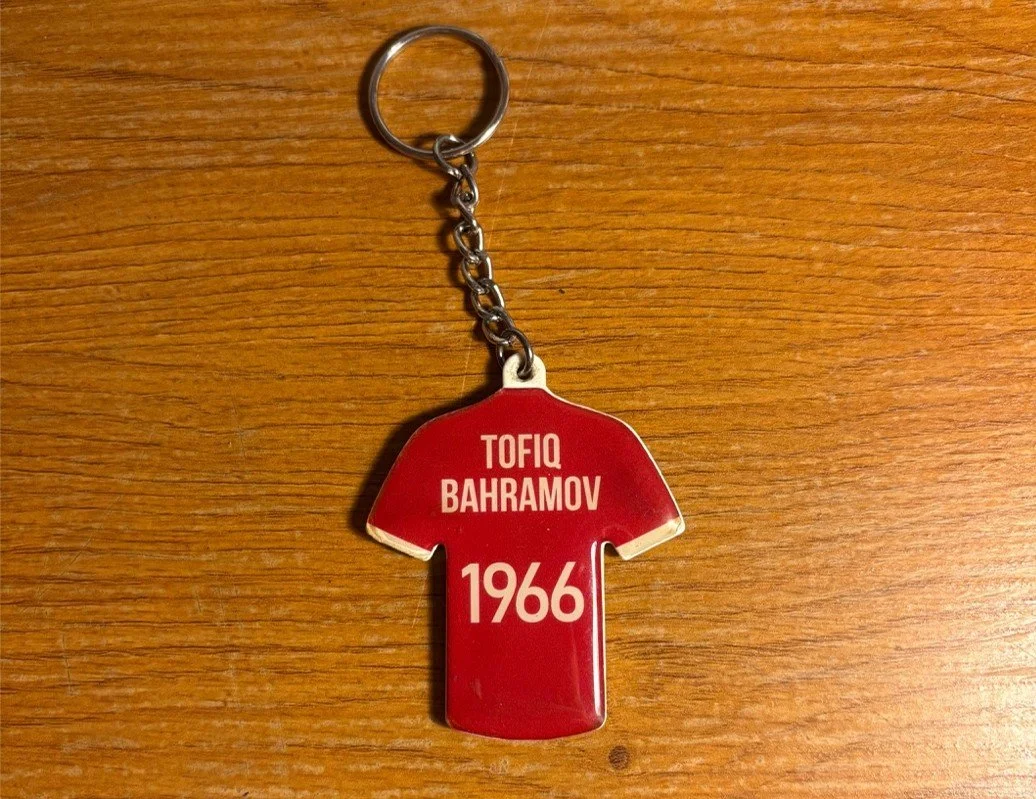
The Baku keyring.
Photo: Max Lee
Bahramov was born in Shusha, Azerbaijan, in 1925 when the country was still part of the Soviet Union. He began his journey in football as a player, appearing for clubs such as Dinamo Baku and Neftchi, before a leg injury in the 1950s forced him into an early retirement
His passion for the game is well documented, with his son, Bahram, reminiscing how his father “ripped his boots once when he got carried away”, so it shouldn’t be a shock he wasn’t in a rush to hang up his boots.
But his fall into officiating wasn’t planned; instead, it was the unpunctuality of a referee for a Baku Cup game contested by Dinamo Baku and Iashechi’s youth sides in 1951 that forced Bahramov to step into the vacant role for the day.
Six months later, he would be refereeing in the Azerbaijani First Division.
Over the coming decade, Bahramov would work the line for countless games across the USSR, including prominent derby matches and cup finals, before being elected onto the FIFA panel of referees in1964.
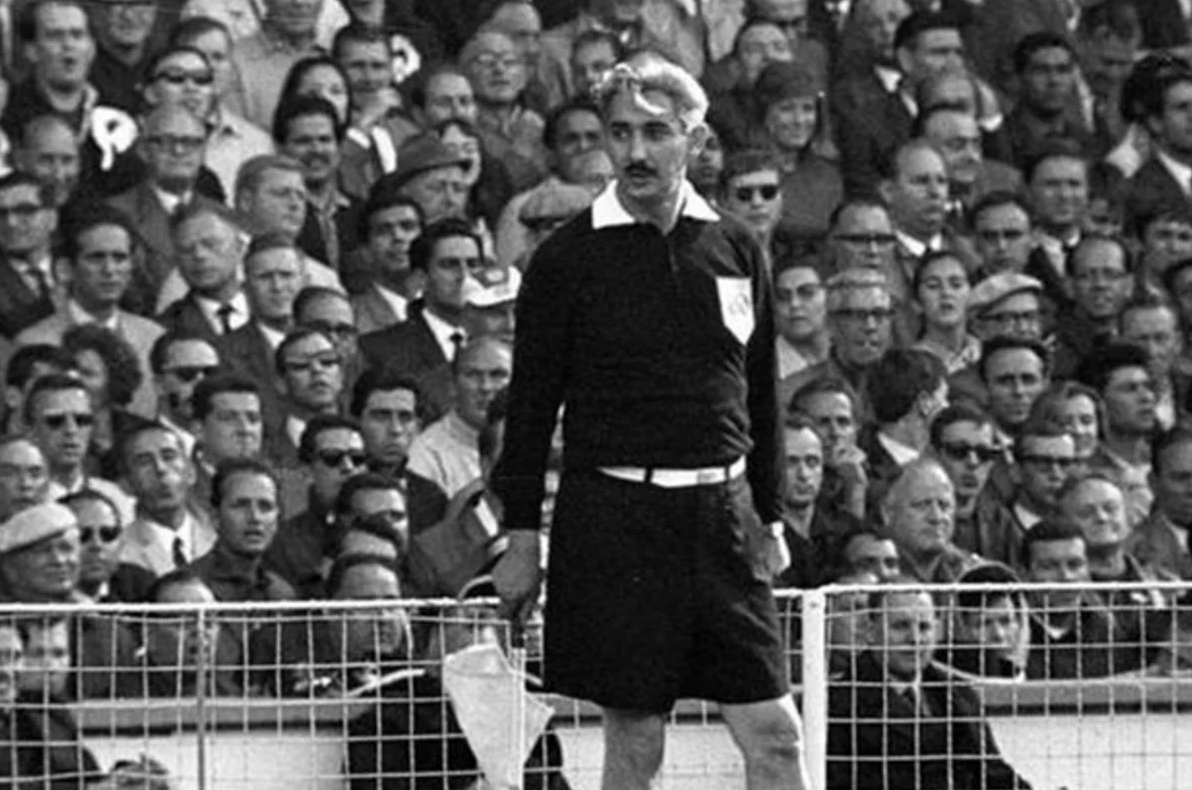
He made his World Cup debut as a linesman in a 0-0 group stage game between England and Uruguay on the 11th of July 1966.
Bahramov would go on to referee Spain vs Sweden and run the line during Argentina vs Switzerland before being chosen as one of the linesmen for England vs West Germany, a game that would define his legacy.
The function of a linesman generally means one isn’t thrust into the limelight, and such was the case for Bahramov in the allocated ninety. However, due to a last-gasp Wolfgang Weber equaliser the teams couldn’t be seperated after the ninety. They emerged once more for an added thirty minutes in hopes of a winner being crowned.
In the 102nd minute, a ball crossed into the box from England’s number seven, Alan Ball, found the feet of Geoff Hurst, who smashed it against the inside of the bar, causing it to ricochet, seemingly just outside the line and back into the 18-yard box.
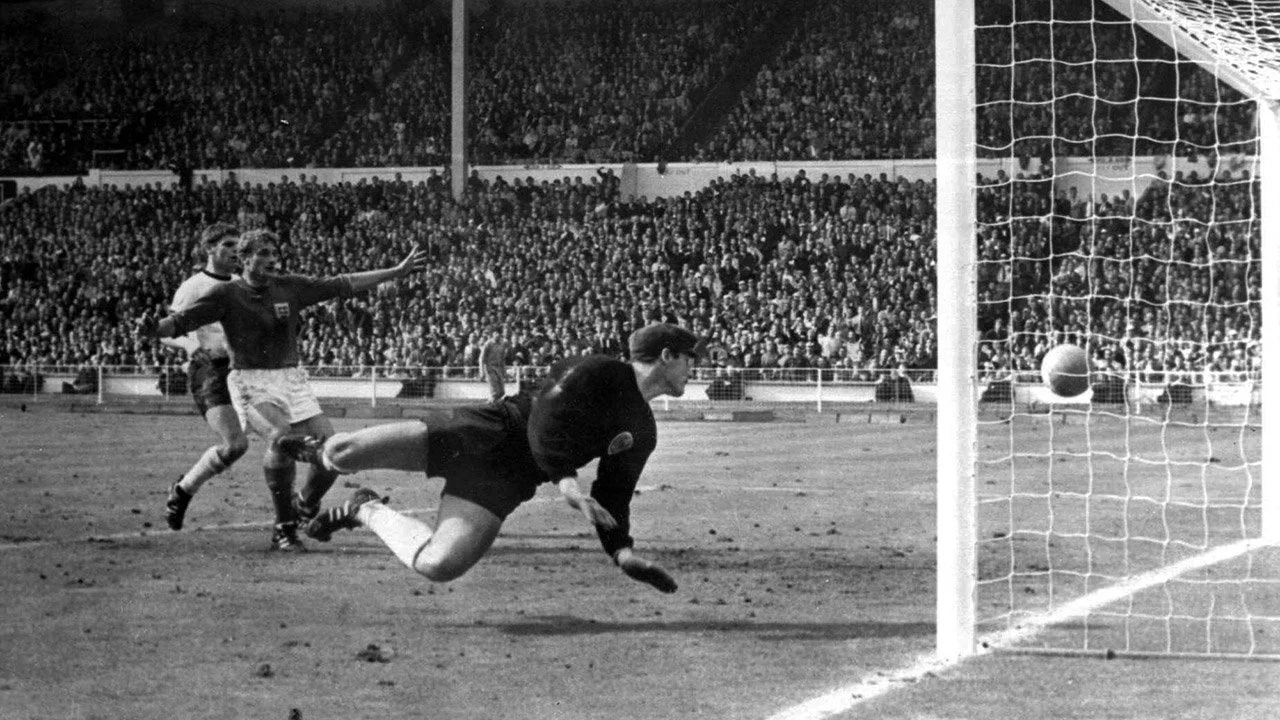
Tilkowski watches Hurst’s shot ricochet off the bar.
Photo: AP Photos
The England players paused hopefully, waiting for the goal to be awarded, but referee Gottfried Dienst seemed unmoved.
That was until he went over to check with his linesman, Tofiq Bahramov, who gave him a nod and a point to the centre circle, signalling that in his eyes the ball had crossed the line.
Pandemonium ensued. The English players erupted in celebration while their opposition ran to both Dienst and Bahramov to protest the decision.
Yet the goal stood and England headed into half time of extra time a goal up. A fourth goal would be scored by England in the 121st minute by Geoff Hurst to complete his hat-trick, securing a first, and currently only, World Cup for England and cueing the famous Kenneth Wolstenholme commentary, “They think it’s all over, it is now!”.
Even though England went on to win by a two-goal margin, Hurst’s 2nd goal and Bahramov’s decision to award it are often credited as the catalyst for the win.
The Azerbaijani official was met with both criticism and commendation. German news outlets contested the decision and introduced the colloquial term “Wembley-Tor”, which is said to mean when a shot hits the crossbar before hitting the ground and spinning back into play.
The English media, however, praised who they called the ‘Russian Linesman’ for his part in their team’s victory.
A decision like that in the modern game, be it right or wrong, may have cost Bahramov his FIFA referee ranking. However, unlike today, in the 1960s the bestowment of a FIFA referee ranking was for life, meaning Bahramov went on to participate in the following World Cup in 1970 as well as the 1968 and 1972 European Championships.
Aside from international football, Bahramov became an icon in the USSR for his domestic involvement, officiating somewhere in the region of 146 USSR First Division matches from 1958 until his retirement in 1975.
His stature grew so big that in 1971 he was requested by legendary Soviet goalkeeper Lev Yashin to referee his testimonial in Moscow and the following year refereed the first leg of the the maiden UEFA Cup final between Wolverhampton Wanderers and Tottenham Hotspur, the only all-English final until Baku 2019.
Following his retirement, Bahramov returned to Neftchi as a second coach and head of football, then served as general secretary of his country’s football federation, where he became nationally revered for his development of the sport across the different levels in the country.
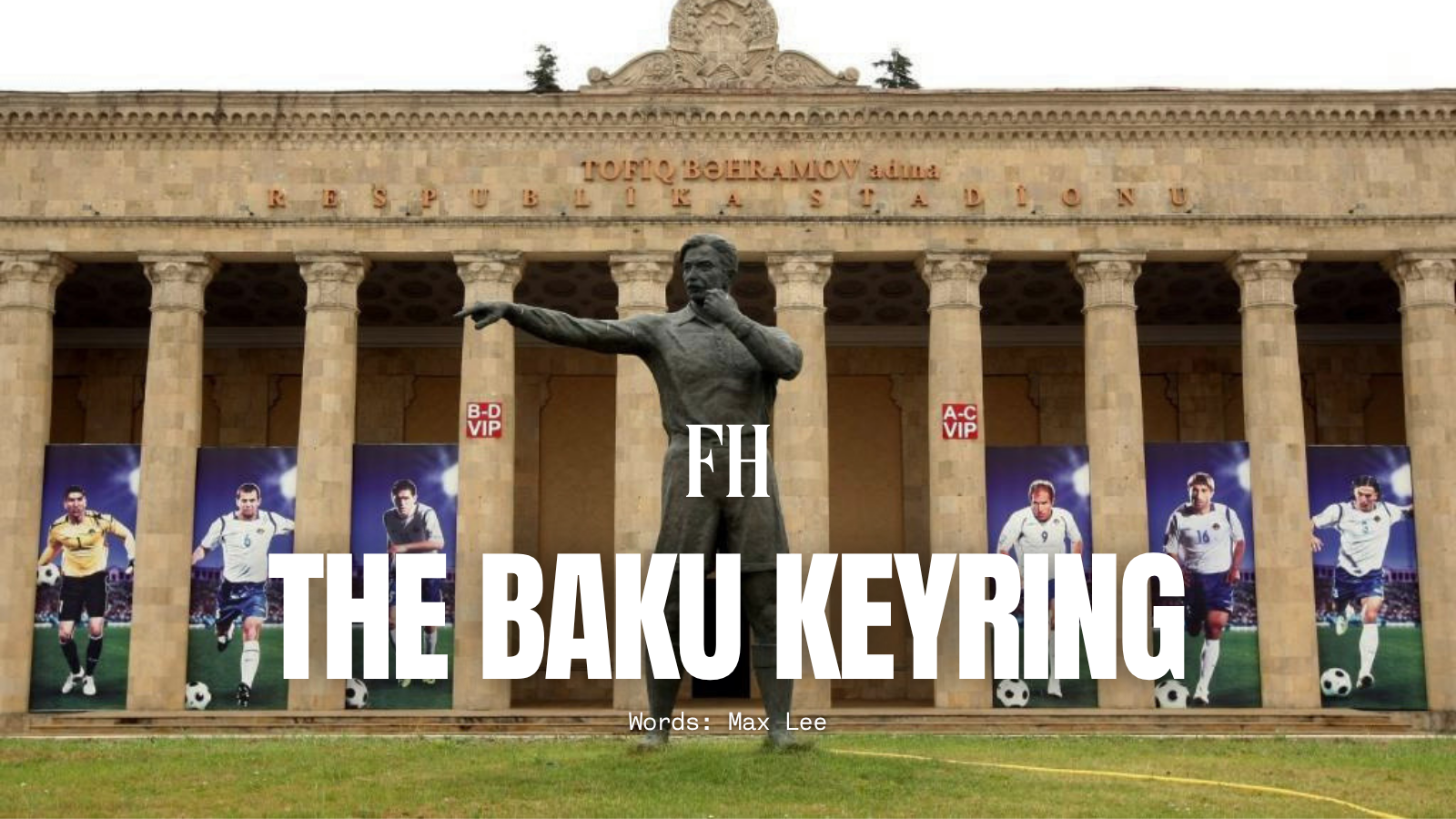
Shortly after his death in 1993 and two years following Azeri independence, Azerbaijan’s national stadium, situated in Baku, was renamed from the Tofiq Bahramov Stadium in his honour.
Eleven years later, a statue created by Azerbaijani sculptor Mammadnijat Salakhov depicting Bahramov legitimising Hurst’s second goal of the 1966 final was erected outside the stadium.
In 2011, to celebrate the 100th anniversary of Azerbaijani football, the scorer and goalkeeper who played a part in the infamous goal, Geoff Hurst and Hans Tilkowski, visited and paid their respects to said statue.
England and Azerbaijan met in 2006 for a World Cup Qualifier at the Tofiq Bahramov Stadium. Prior to kick-off, a ceremony was held with FIFA president Sepp Blatter attending in addition to Michel Platini and Geoff Hurst.
English fans were seen to be sporting ‘Bahramov 66’ jerseys in his honour, the same jerseys the aforementioned keyring was modelled on.
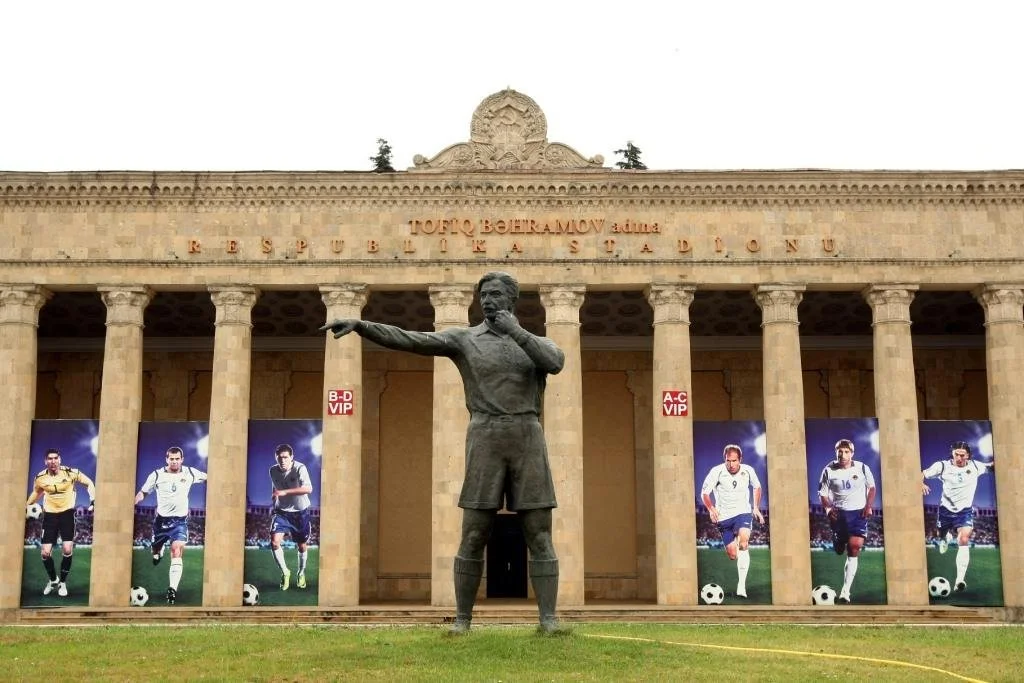
Bahramov’s statue during the 2015 European Games in Baku.
Photo: Getty Images
The word legacy is used quite sparingly in the modern game, often in retrospect, and it’s a shame that despite a lengthy career at the top level, Bahramov’s story remains largely unknown, if not diminished to just the ‘Russian Linesman’.
His actions in ’66 are sporadically remembered, but his name frequently remains absent.
He is undoubtedly a prominent figure in English football history and the sporting pride of a country where football is the most popular sport.
Whether his decision in 1966 was correct or incorrect, in a time when the official’s word was final, he made the decisive call which led to England winning their only major international tournament to date.
But that one moment is just a small part of Bahramov’s football story. He was an integral part of his country’s football development after retiring from officiating, and in an age where teams from Azerbaijan feature on the biggest European stages, it’s important to remember those who paved the way for football in the country.
The keyring handed to my dad in 2019 represents so much more than a piece of merchandise; it represents a physical element of his legacy, designed to help carry his story across the world.
I still carry Bahramov’s keyring on my keys and have done so for a while. Each time someone asks about the meaning behind it, I’m excited by the fact that I get to tell his story, thus keeping not just his legacy but his name alive.
In a football landscape which gives the spotlight to the stars of the day and the short-term cycle in which these stars are given a platform, it’s important that we remember the stories of those throughout football history who are often forgotten.
Thank you, Tofiq Bahramov, for being a part of football history and a part of my life.