

Words by Jonee | Published 21.11.2026On 30 November 1872, St Andrew’s Day, a crowd of about 4,000 gathered at Hamilton Crescent, the West of Scotland Cricket Club’s ground in Partick, to watch Scotland play England.
The match finished goalless. The players wore caps and knickerbockers. The pitch was marked with flags. There was no crossbar and no penalty area.
Five earlier games between sides calling themselves England and Scotland, beginning at the Oval on 5 March 1870, are not counted as official internationals, because no Scottish association had picked the team.
The Partick match is the one FIFA recognises as the first. Within forty years the same code was being played, argued over and loved from Montevideo to Calcutta, from Bilbao to Shanghai.
The people who carried it were not, for the most part, official envoys. They were railway engineers, copper miners, schoolteachers, ships’ crews, clerks in import houses, soldiers killing time in cantonments, and the sons of those men sent home to be educated and then returned with a ball in the trunk.
Association football is Britain’s most successful export, and also its least planned. The game left these islands in the luggage of a diaspora already on the move for other reasons: coal and copper, rails and meat, cotton and capital, garrisons and missions.
Where Britons settled in numbers, football appeared. Where they settled only briefly, it often stayed. The story is not a simple tale of imperial gift. It is a story of informal empire, of a Scottish passing game travelling at least as far as English dribbling, of local pupils who learnt the rules and then beat the teachers, and of a sport that became someone else’s long before Britain noticed it had lost the title deeds.
Folk football had existed for centuries in Britain, and ball games of one kind or another had existed almost everywhere else. What the nineteenth century produced was something different: a written code that strangers could share.
Cambridge students tried more than once to reconcile their school rules. A set dated 1848 is often cited, but no text from that year survives; the earliest surviving Cambridge code is from the 1850s. Sheffield Football Club, founded on 24 October 1857, wrote its own laws in 1858.
The decisive step came in London in the autumn of 1863, when representatives of a handful of clubs met at the Freemasons’ Tavern on 26 October and founded the Football Association.
The thirteen laws were not agreed that afternoon. Ebenezer Morley, the first secretary, drafted them, and they were settled at later meetings that year. In December the FA rejected running with the ball in hand and hacking, the deliberate kicking of an opponent’s shins.
The clubs that wanted those things walked away and, in time, became rugby. What remained was association football, soon nicknamed soccer, a word that has never quite died abroad even as it has fallen out of favour at home.
The point of the laws was practical. They let teams from different schools and different towns play one another without a preliminary argument.
That same practicality made the game exportable. A rule book fitted in a coat pocket. A leather ball could be deflated and passed through customs. A pitch needed only grass, or packed earth, and four flags.
Morley could not have designed a better commodity for a maritime trading nation if he had tried.
The domestic game then professionalised and popularised itself at speed. The FA Cup was first contested in 1871–72, the final falling on 16 March 1872. Scotland, and especially Queen’s Park, developed a short-passing game — “combination” — that contrasted with the English habit of individual dribbling.
On 20 July 1885 the FA voted to accept professionalism, on condition that paid players were registered. None of this was done with foreign spectators in mind.
It produced, almost by accident, a finished product: rules, competitions, a style worth copying, and a large number of men who already knew how to play and who were about to leave the country for work.
The carriers of our game fall into a few recurring types, and the types explain the map.
Railwaymen are the most important. British capital and British contractors built lines across Argentina, Uruguay, Brazil, India, southern Africa and parts of China. A railway camp needed recreation.
Cricket came first, because it was the game of the established British clubs; football followed, because it needed less time and less equipment, and because the younger men preferred it.
The Central Uruguay Railway Cricket Club, founded in Montevideo on 28 December 1891, is the famous case. Its football section grew until, on 13 December 1913, a club meeting approved the transfer of competitive football to a body called CURCC Peñarol.
Peñarol treats that vote as a change of name and counts 1891 as its foundation. Other historians, and its rival Nacional, treat 1913 as a split.
CURCC itself was not dissolved until 22 January 1915. The legal continuity is a cherished Uruguayan argument. The footballing descent is not in doubt.
Miners are the second type. The Rio Tinto Company brought a British colony to Huelva, in Andalusia, from 1873 to work the copper mines.
Kick-abouts among the employees became a sports club. On 18 December 1889 a group whose initiator was the Scottish company doctor, William Alexander Mackay, founded Huelva Recreation Club, with Charles Adam as first president.
Recreativo de Huelva claims, with good reason, to be the oldest football club in Spain. British miners turn up in the same role in Mexico and, later, in the nitrate and copper camps of Chile and the goldfields of South Africa.
Teachers are the third, and in some countries the decisive, type. A British school in a foreign city was a small piece of Britain with a games afternoon.
Alexander Watson Hutton, a Glaswegian graduate of Edinburgh, landed in Buenos Aires in February 1882. About two years later he opened the Buenos Aires English High School and made football part of the timetable.
He imported balls. In 1893 he established the Argentine Association Football League, after a short-lived competition in 1891 had already shown the demand. It was the first durable league outside the British Isles.
English High School Athletic Club was formed on 3 October 1898 and renamed Alumni in 1901. Playing as Alumni, his former pupils won the championship in 1900, 1901, 1902, 1903, 1905, 1906, 1907, 1909, 1910 and 1911: ten titles in twelve seasons.
The side stopped after 1911, forfeited its 1912 fixtures, and was formally dissolved on 24 April 1913. By then the league no longer needed a school team to survive.
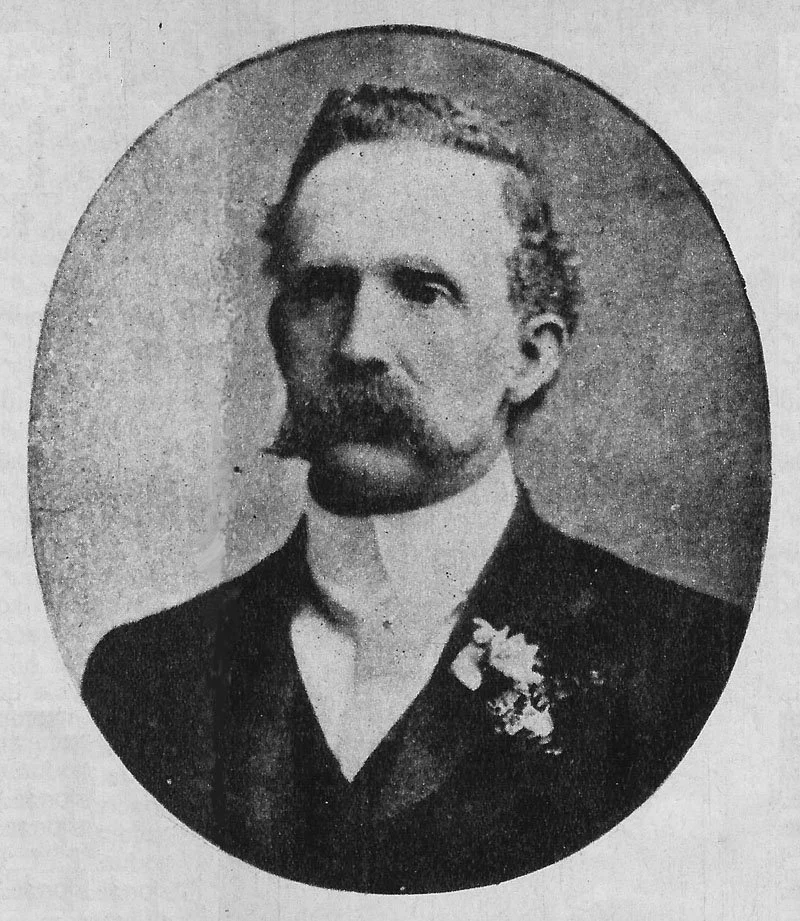
Alexander Watson Hutton - the Father of Argentine Football.
Photo Credit: Wikimedia Commons
In Rosario, Isaac Newell, an Englishman who had come out as a teenager to work on the Central Argentine Railway, founded the Colegio Comercial Anglicano Argentino in 1884.
On 3 November 1903 alumni of the school, among them his son Claudio, created the club that still bears the family name, Club Atlético Newell’s Old Boys, with Víctor Heitz as first president. The phrase “old boys” meant former pupils, as it did at home.
Sailors and merchants are the fourth type. Port cities were the natural classrooms. Valparaíso, Bilbao, Genoa, Shanghai, Singapore, Cape Town: a ship in harbour for a fortnight was enough for a scratch match against the local British club, and a scratch match was enough to start an argument about rules that only a proper club could settle.
Athletic Club of Bilbao grew, around the turn of the century, from British workers, Basque students returned from England, and local enthusiasts.
Early teams mixed Basque names with names such as Evans, Langford and Davies. The red-and-white shirts are traditionally said to have been taken from Sunderland.
Genoa Cricket and Football Club was founded by English residents on 7 September 1893 and won the first Italian championship in 1898.
The English spelling of AC Milan is not an affectation. On 16 December 1899, at the Hotel du Nord, Herbert Kilpin, a textile worker from Nottingham, gathered the meeting that founded the Milan Cricket and Football Club.
Alfred Edwards, an English businessman, became the first president. Kilpin is later said to have chosen red and black because red was the devil and black the fear of opponents.
Soldiers, missionaries and administrators are the fifth type, and they dominate the formal empire rather than the informal one.
In India the game moved from garrison to maidan. The Durand Cup, begun in 1888 by Mortimer Durand as recreation for British troops, is among the oldest surviving tournaments in the world. Mission schools and a few individual officials pushed it beyond the cantonment.
Cecil Tyndale-Biscoe used it in Kashmir as a deliberate prod against caste restrictions on physical exercise. The colonial government had no sports policy. The spread was the work of people on the spot.
None of these men thought of themselves as missionaries of a sport. They wanted a game on Saturday. The mission was a side effect of settlement.
The richest chapter is South American, and it is rich precisely because most of the continent was not painted red on the map.
Argentina, Uruguay and Chile belonged to what historians have called Britain’s informal empire: independent states tied to London by loans, railways, meat-packing plants, insurance and the habit of sending sons to British schools
Football tracked those ties more closely than it tracked colonial flags.
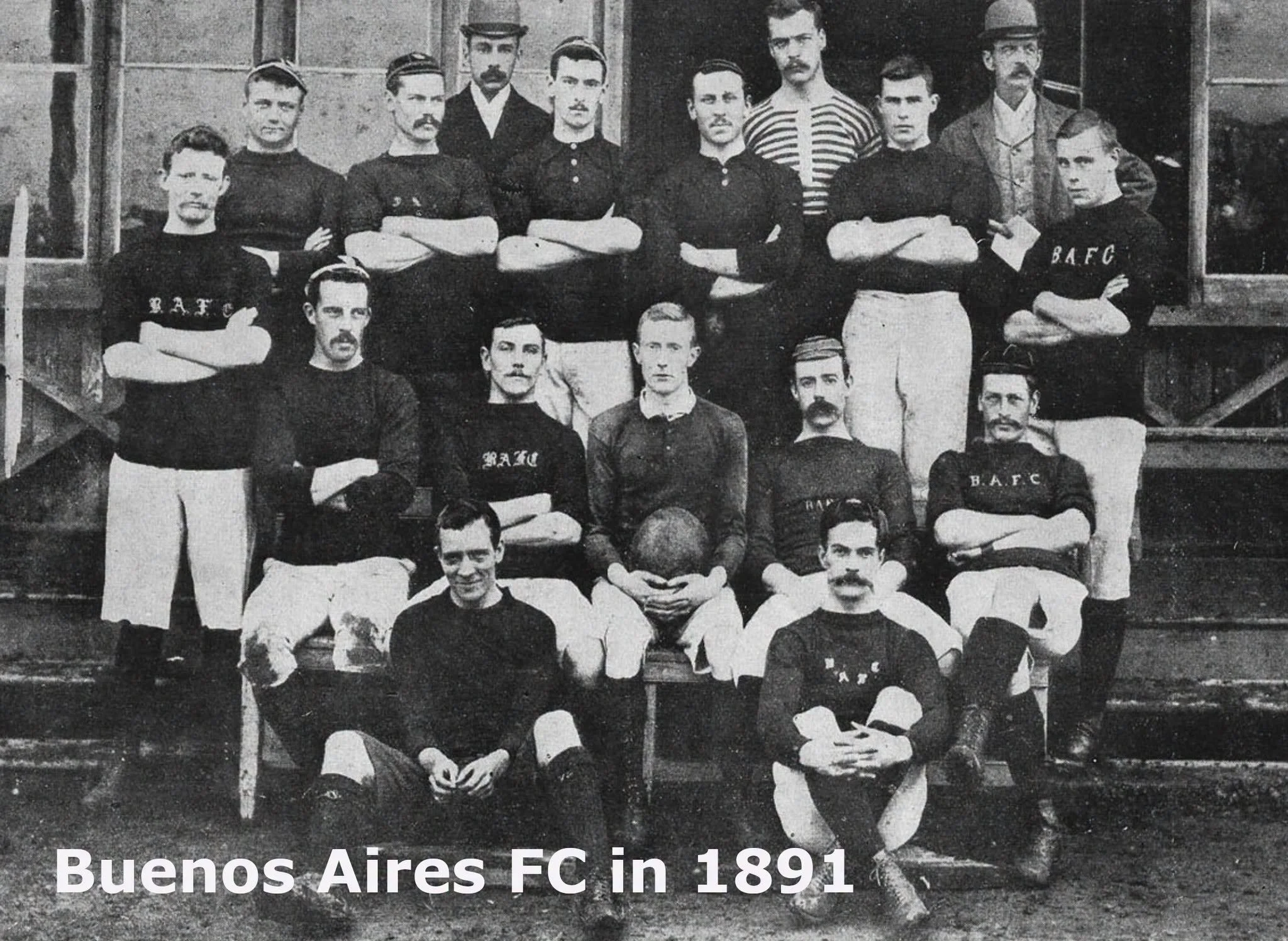
Buenos Aires Football Club was founded on 9 May 1867, in a house on Temple Street, now Viamonte, and is usually counted as the first football club in South America.
The founders were Thomas Hogg and his brother James, both from Skelton in Yorkshire, together with Thomas Jackson, Thomas Barlow Smith and the secretary, Walter Heald. They were young Englishmen in the British commercial colony.
On 20 June 1867 Hogg’s side beat Heald’s 4–0 at the Buenos Aires Cricket Club ground, the teams distinguished by red caps and white. They adopted the FA laws with slight local modifications that were never written down.
The code was not yet stable, and the club later drifted. It had faded by about 1881. Early “football” abroad was often a mixture, and the association game returned in strength only with the schools.
Watson Hutton’s league, the cricket clubs of the British suburbs, and the railway sides at Rosario and Quilmes built a competition that was, into the first years of the twentieth century, still largely an expatriate affair.
It did not stay that way. Argentine-born players moved into the teams. Alumni’s dissolution in 1913, as the British community thinned and the amateur club lost money and players, marked the end of the schoolboy phase, not of the sport. The pupils had taken the classroom.
Uruguay’s path was similar and, in footballing terms, even more consequential. British railway workers founded the Central Uruguay Railway Cricket Club. Albion, founded on 1 June 1893, wore its English name as a badge of origin.
William Leslie Poole, a Scottish teacher, is credited in Uruguayan accounts with establishing the game in Montevideo’s English schools. John Harley is on firmer ground. Born in Glasgow on 5 March 1886, he was a railway engineer in Springburn, moved to Argentine railways in 1906, and joined the Central Uruguay Railway in 1909.
Spotted while playing for Ferro Carril Oeste, he played for CURCC and then Peñarol from 1909 to 1920, captained the side for a decade, and was capped by Uruguay.
He is credited with teaching the short-passing game that Scottish clubs had refined. Uruguay’s Olympic gold medals in 1924 and 1928, and the World Cup of 1930, were won by a small country whose football had been learnt, in part, from men who laid track.
Nacional, founded on 14 May 1899 by Uruguayan students, was an early declaration that the game need not remain a British club’s property. The rivalry with Peñarol is the afterlife of that argument.
Brazil’s story has a patron saint and a complication. Charles Miller was born in São Paulo on 24 November 1874 to John Miller, a Scottish railway engineer from Fairlie in Ayrshire, and Carlota Fox, a Brazilian woman of English descent.
Aged ten he was sent, as expatriate sons often were, to Banister Court School in Southampton. He played for St Mary’s, the club that became Southampton, and crossed paths with the amateur Corinthians.
In 1894 he returned with two footballs and a copy of the Hampshire rules. He organised São Paulo Athletic Club, which won the first three seasons of the Liga Paulista from 1902, and later served as an early president of Sport Club Corinthians Paulista.
The story that his father met him at Santos and asked what was in the trunk is repeated in almost every account, and has no primary source. The trunk’s contents are not in dispute.
Miller was not alone. Thomas Donohoe, another Scot, was organising games in Rio de Janeiro in the mid-1890s. Oscar Cox, son of George Emmanuel Cox of the English cricket colony in Niterói, had learnt the game while studying in Switzerland.
On 21 July 1902 he gathered twenty young men and founded Fluminense. He was the club’s first president and a player. The claim that early teams travelled in dinner jackets is later colour, not a recorded rule.
The British phase was real and short. By the 1910s Brazilian football belonged to Brazilians, including, soon enough, to players the British clubs would not have admitted. When the London Corinthians toured in 1910 they impressed a group of railway workers in São Paulo so deeply that the workers named a new club after them.
Sport Club Corinthians Paulista was founded on 1 September 1910. It is the compliment paid by the pupil who intends to keep the gift.
Chile followed the port. British sailors and residents were playing in Valparaíso in the 1880s. David N. Scott, an English journalist, is credited in secondary histories with helping to found Valparaíso Football Club in 1892, and the Chilean association followed in 1895.
Everton de Viña del Mar, still in the Chilean top flight, was founded in Valparaíso on 24 June 1909 by Anglo-Chileans led by David Newton Foxley Chapman, whose parents had emigrated from Liverpool in 1859.
The name honoured Everton’s tour of the River Plate that year, made with Tottenham after the 1908–09 season. Two of the founders, Frank Boundy and Malcolm Frazer, later died on the Somme. Liverpool of Montevideo took its name from the city of the railway and shipping clerks, not from the club.
The map of South American club names — Everton, Liverpool, Newell’s, Rangers of Talca, the various Alumni and Athletic sides — is a gazetteer of the diaspora.
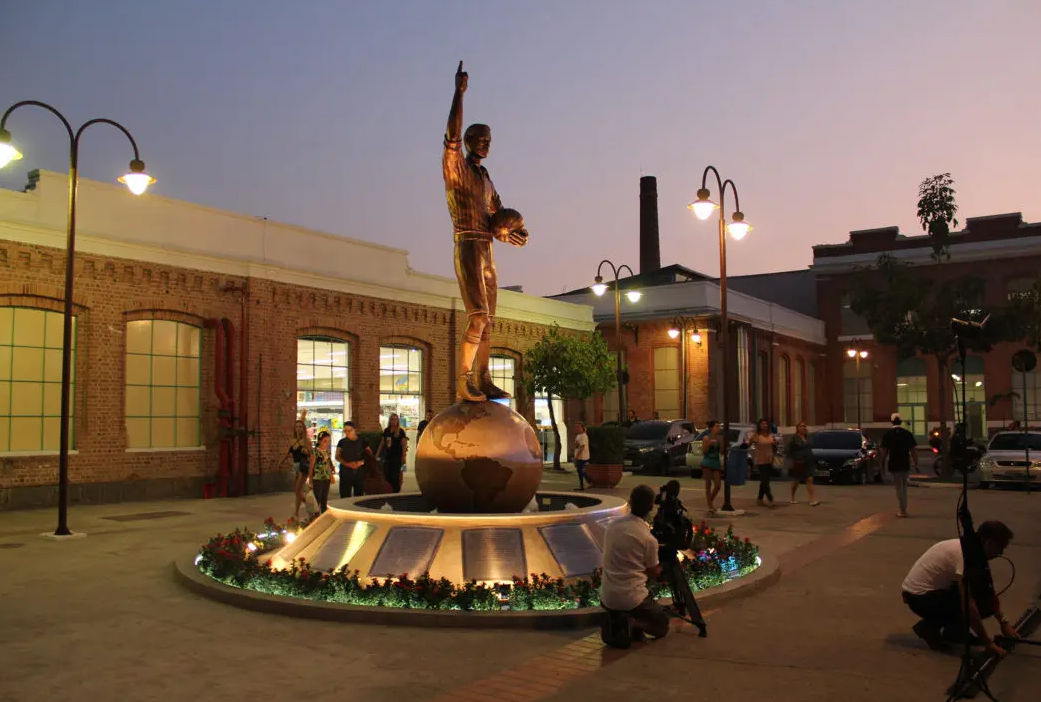
Thomas Donohoe is remembered through statues in Brazil.
Photo Credit: Clecio Regis
British touring sides confirmed what the residents had started. Southampton in 1904 were the first British club to tour South America. Nottingham Forest followed in 1905.
A Forest match against Alumni in Buenos Aires was reported to have drawn about 10,000, a figure from contemporary accounts rather than a turnstile count. Exeter, Everton, Tottenham, Chelsea and others followed until the late 1920s. They were received as masters. Within a generation the reception had changed.
On the continent the vectors were education and trade more often than settlement. Switzerland is the clearest school story. English pupils in Swiss schools and Swiss alumni of English universities founded early clubs in Geneva, St Gallen and Zurich from the late 1860s.
Lausanne Cricket and Football Club dates from 1860, but that was a cricket and multi-sport institution. Its association football came later. Denmark’s Københavns Boldklub, early sides in the Netherlands and Belgium, and clubs in Sweden followed the same pattern: a Briton abroad, or a local back from Britain, and a ball.
Spain splits in two. In the south, Huelva and the mines. In the north, Bilbao and the commercial link with Britain, reinforced by Basque students who had boarded in England.
Madrid and Barcelona acquired the game through anglophile elites and resident Britons rather than through a single British founder. Barcelona’s Swiss and English connections in the 1890s are part of the club’s origin story.
oan Gamper, a Swiss, is the name usually placed first, which is a reminder that Britain supplied the code and others sometimes supplied the organiser.
Germany had Dresden English Football Club, founded by English residents on 18 October 1873. Some later German club histories say 1874.
The club played a mixed game: association and rugby were not yet cleanly separated, and an English cricket club had already existed in Dresden since 1861. The association game spread, then met a political hesitation.
Gymnastics, not British ball games, was the approved physical culture in some nationalist circles. The hesitation lost. By the early twentieth century football was a mass game in German cities.
In Italy, Genoa and Milan were followed by clubs in Turin and elsewhere, often with a British coach, a British kit and an Italian argument about both. In France and Belgium, channel ports and student exchanges did the work.
In Russia, British residents in St Petersburg organised matches in the 1890s. The All-Russian Football Union was established there in January 1912 and affiliated to FIFA the same year.
Central Europe took the Scottish style almost as a fashion. Scottish football histories regularly cite Rangers’ tour of Vienna in 1904 as the moment the short-passing game impressed Austrian spectators who had been watching a more individual English version.
Scottish coaches later worked in Prague, Budapest and Vienna. The coffee-house game of the 1920s and 1930s, all triangles and wall passes, had a Glasgow accent, whether or not one tour can be made to carry the whole credit.
Britain’s own associations watched this with indifference that curdled into snobbery. FIFA was founded in Paris on 21 May 1904 by France, Belgium, Denmark, the Netherlands, Spain, Sweden and Switzerland.
Germany adhered the same day by telegram. The home nations were absent. They joined, left, rejoined and left again. The attitude was that the game was theirs and the rest of the world was practising.
It was a costly piece of provincialism. The football tournaments at the 1908 and 1912 Olympics were still organised by the Football Association, and both were won by Great Britain. That was the last moment at which the teachers could assume the result.
Inside the empire the social meaning of the game was sharper, because the people who brought it also ruled.
In India, the earliest extant newspaper report of a match among Britons in Bengal is from 1854. Calcutta Football Club was formed in 1872, initially with a strong rugby habit, and turned its attention to association football later.
The opening to Indian players came through the army, which found football the easiest game to share between British regiments and sepoys, and through schools.
Nagendra Prasad Sarbadhikari, later called the father of Indian football, is said to have begun by kicking a ball back to a soldier who had shouted at him to do so. The consequence is documented. Indian clubs multiplied.
On 29 July 1911, at the Calcutta FC ground, Mohun Bagan beat the East Yorkshire Regiment 2–1 in the IFA Shield final. Jackson scored first for the regiment. Shibdas Bhaduri and Abhilash Ghosh replied.
The Amrita Bazar Patrika treated the result as an answer to the charge that Bengalis were physically unfit for the modern world. It was the first all-Indian win in that competition, not the first time an Indian side had beaten a British team in any match.
A sporting upset had still become a political sentence. Barefoot Indian sides at the 1948 London Olympics, where India lost 2–1 to France, were the late coda: the empire’s game, played without the empire’s boots.
Africa’s early football map follows mines, ports and missions. Sailors and soldiers played in Cape Town and Durban. Mission schools in West and southern Africa put the game on the timetable beside scripture.
In the Gold Coast and Nigeria, as in India, the pupils were not content to remain pupils. Tours by British clubs, beginning with the Corinthians before 1914 and continuing for decades, staged the encounter in public.
After independence, matches against British sides became one of the available ways to beat the former ruler at the ruler’s game. The relationship never simplified. British clubs toured apartheid South Africa.
Rebel tours followed official isolation. Money, in the lean years of English football, took sides to places their governments would rather they had avoided. The game’s African life is not a British invention in any exclusive sense.
French, Portuguese and Belgian colonial sport mattered just as much in their zones. The British zones still carry the institutional trace: associations, cups, and the timing of the Saturday game.
East and South-East Asia repeat the port pattern at lower intensity. Traders, engineers and teachers founded clubs in Shanghai, Hong Kong, Singapore and Rangoon.
Scottish popular histories credit a marine engineer, John Prentice, with organising matches in China in the late 1870s. A British naval instructor is part of the usual origin story of organised football in Japan, introduced at the naval academy and in the treaty ports.
The Japanese game then developed on its own timetable, through schools, and did not become a mass spectator sport until much later. The foothold on the China coast was real and thin.
Unlike in South America, football in much of Asia remained for a long time a game of colleges, ports and expatriate clubs, and only later a game of the street.
Australasia and North America took the code and then, in different ways, declined it. Australian rules and rugby filled the sporting calendar that association football might have taken.
The association game survived in migrant pockets and returned as a mass sport only with post-war immigration. In the United States and Canada, British and Scottish migrants founded clubs, but baseball, and then American football, occupied the ground. The United States team that finished third at the 1930 World Cup included several Scottish-born players. It was a last flicker of the diaspora game in a country that had chosen other codes.
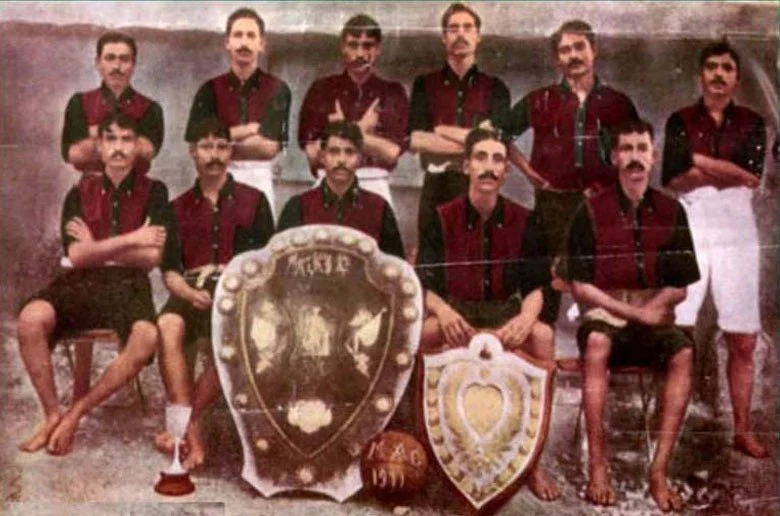
The legendary bare-footed Mohun Bagan XI who defeated the East Yorkshire Regiment in India.
Photo Credit: The Bridge
Rules travel more easily than styles, but styles travelled too, and the style that travelled furthest was Scottish.
The combination game worked out by Queen’s Park and the early international sides — short passes, movement off the ball, the team as the unit — was easier to teach than individual dribbling, and it suited groups of men who had learnt the game together in a workplace or a school.
Scottish coaches and Scottish players turn up in the origin stories of Belgium, France, Sweden, Austria, Argentina, Uruguay and Brazil with a frequency that English codification alone does not explain. England wrote the laws.
Scotland, through its disproportionate share of the engineering and teaching diaspora, exported a way of playing.
There is a domestic prologue. From the 1870s, Lancashire clubs quietly recruited Scots. Preston North End’s unbeaten League and Cup side of 1888–89, the Football League’s first season, was built on that recruitment and on the passing game those players brought.
The same craft then kept going, to the railways of the Plate and the mills of Gothenburg. The passing game was, all the same, a portable craft, like fitting a boiler.
British tours after 1900 reinforced the lesson and then undermined the teachers. The Corinthians, amateurs drawn from the public schools and universities, toured South America, Europe and South Africa playing a fast, attacking game and refusing, on principle, to foul.
They were admired and copied. Corinthians Paulista is only the most famous copy. Professional Football League clubs on close-season tours did the same work for a fee. George Allison later called them ambassadors in soccer kit.
The ambassadors were not always diplomatic, and the hosts were taking notes.
The decisive fact about football’s spread is how quickly it ceased to be British. In Argentina the league was an expatriate competition in the 1890s and a national one by the First World War.
In Uruguay the railway club’s relationship with its own football section broke, or changed name, in 1913, and the argument has never been settled. In Brazil the expatriate phase lasted about a decade.
In India the IFA Shield final of 1911 was the moment the crowd’s loyalty, in that city and that competition, changed sides.
In Spain, Italy and Austria the British names on the team sheets thinned through the 1900s as local players took the places.
The reasons are built into the way the game had arrived. It had not been restricted by a colour bar in the informal empire, because the informal empire was a commercial community, not a settler colony with a political theory of exclusion.
It had been restricted in parts of the formal empire, and the restriction made the first victories sweeter and the adoption faster.
It was cheap. It fitted the new industrial week. It rewarded practice more than physique, which mattered in places where the British had claimed a monopoly on sporting manhood.
And it offered, ready-made, the things a modern city wanted from a sport: a club, a Saturday, a rival, a newspaper report.
By the time Uruguay won the first World Cup, in Montevideo in 1930, the centre of gravity had already shifted.
England did not enter. The home nations’ absence from the early World Cups was of a piece with the absence from FIFA’s founding: a belief that a game exported by railway clerks was still, in some proprietary sense, a British domestic product.
The World Cup itself was partly Jules Rimet’s answer to that belief. The answer was accepted everywhere except, for a while, in the country that had written the rules.
The traces are still visible, which is why the story is easy to sentimentalise and worth telling plainly.
They are in names: AC Milan, not Milano; Athletic, not Atlético, in Bilbao; Newell’s Old Boys; Everton de Viña del Mar; Liverpool in Montevideo; the Corinthians of São Paulo; Recreativo.
They are in a badge that still carries a St George’s cross, and in shirts that tradition, if not a document, traces to Sunderland. They are in the idea of the club as a members’ association with a committee, a ground and a grievance, an idea exported intact and then adapted. They are in the word “football” itself, which most of the world uses in preference to the American distinction.
They are also in the absences. Britain did not found FIFA, did not host the early World Cups, and did not keep the pedagogical lead.
Scottish coaches gave way to Hungarian, then to Brazilian, then to Dutch. The short-passing game that left Glasgow came back, decades later, as something learnt again from Barcelona.
The diaspora’s gift was not a permanent advantage. It was a start.
That is the right scale for the claim. Association football was codified in London and refined in Glasgow and Lancashire.
It was carried abroad by a migrant population whose main business was railways, mines, trade, teaching and soldiering, at the historical moment when British capital and British ships reached further than British flags. In South America it became a popular passion within a generation and a world-beating culture within two.
In Europe it fused with local traditions and produced the clubs that still dominate the commercial game. In the formal empire it was both a colonial pastime and one of the available tools for answering colonialism back.
The men who packed the balls did not intend a world sport. They intended a match. The match turned out to be enough.
It’s indeed remarkable and in a deeply simple way, almost romantic that football found its own wings and continue to spread and evolve after being brought to distant shores by all sorts of individuals.
It’s common place to say that life always finds a way, but I do feel that in this case, we can say – football always find a way.
This is not intended as a history exercise but instead a remembrance of the few that made our game truly a worldwide passion.
In the same way that we put the kit of our club in our bags before a trip abroad, these fellas were taking a ball, a small booklet with some rules, perhaps not even that, when they took on the adventure of working abroad. Kudos to them.
From a football lover, thank you!