


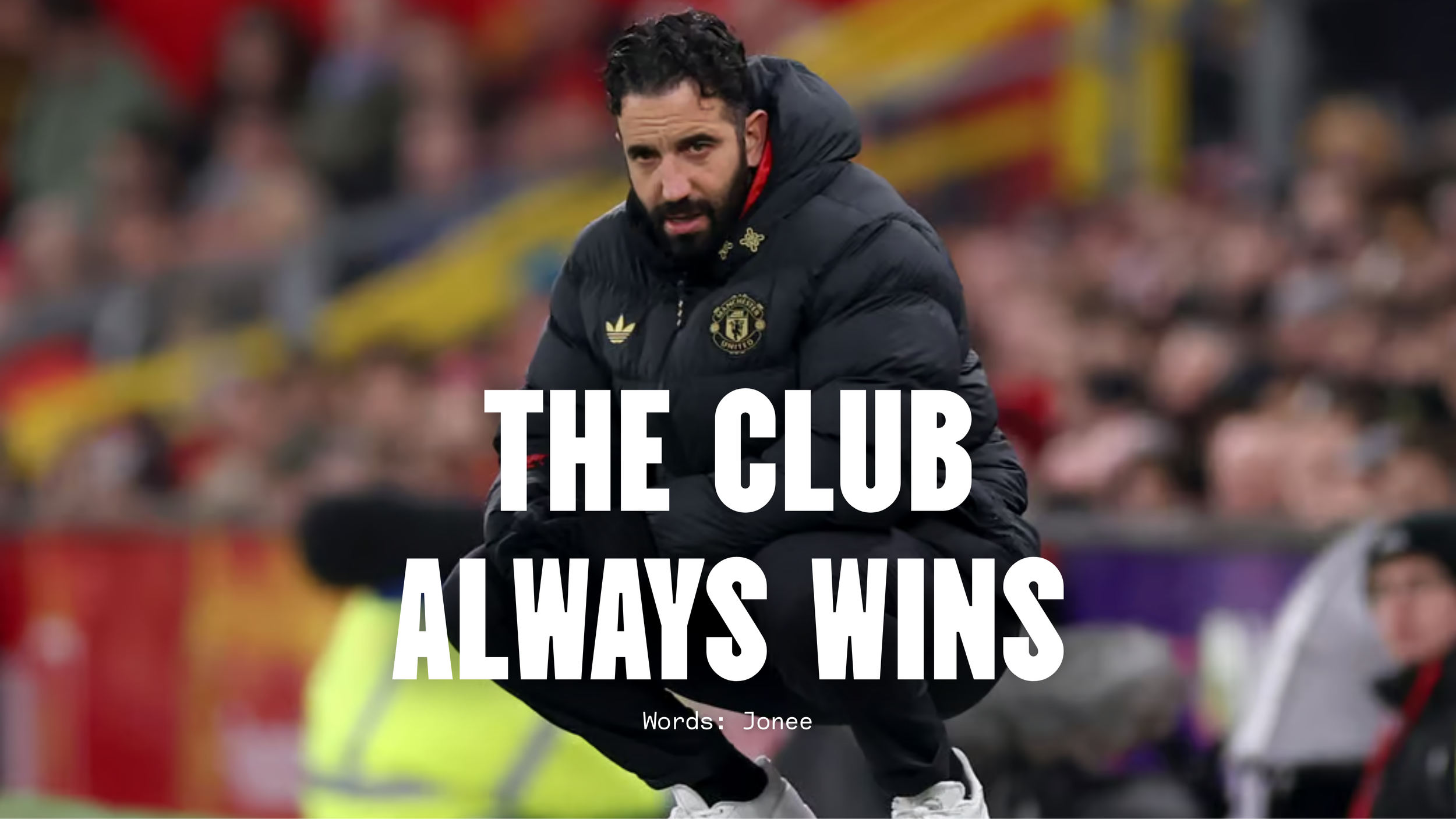
Words by Jonee | Published 25.03.2026In football, success is often measured in results, points, and trophies. But beneath the numbers lies a far more nuanced reality: a football club is not just a team, but a living organism. It is history, memory, expectation, and emotion all entwined. Every club carries with it decades of victories and defeats, chants and rituals, heartbreak and triumph.
For a manager, understanding this organism is as crucial as understanding tactics, formations, or player statistics. Without that comprehension, even the most brilliant coach can stumble, regardless of pedigree or ambition.
In recent years, we have seen striking examples of managers whose failures illustrate this principle with painful clarity. Ruben Amorim at Manchester United, Martin Anselmi at FC Porto, and Wilfried Nancy at Celtic, each arrived at clubs with strong reputations — yet each struggled because they failed, in different ways, to reconcile their personal vision with the culture, history, and expectations of the institution they were tasked with leading.
Amorim, known for his innovative approaches and tactical flexibility, entered Manchester United with a clear philosophy: possession-based football, high pressing, and a modern, data-driven approach. On paper, his ideas seemed perfectly aligned with the global trend in elite football. In reality, they collided with the weight of history. At a club of Manchester United’s stature, players, fans, and media alike expect not only results but a certain feel — a blend of tradition, identity, and emotional intelligence that cannot be reduced to x’s and o’s. By attempting to remodel the team too quickly, Amorim failed to connect with the existing culture, leaving supporters frustrated and players uncertain. Tactical brilliance cannot compensate for an emotional disconnect, and at a club like United, that gap becomes glaringly apparent almost immediately.
Similarly, Martin Anselmi’s tenure at FC Porto reflected a similar misalignment, albeit in a different cultural context. Anselmi arrived with a philosophy honed in Mexico, emphasizing structured build-up, positional discipline, and meticulous attention to metrics. While these ideas are intellectually compelling, Porto is a club where passion, intuition, and adaptability have always been as important as structure. Success is measured not only by silverware but by the narrative arc of the season — the way the team reacts to adversity, the pride it shows against rivals, and the seamless integration of local identity into every decision. By approaching Porto as a technical project rather than a living, breathing organism, Anselmi struggled to earn the trust of players and fans, and tactical execution alone was insufficient to mask the disconnection.
Wilfried Nancy at Celtic offers a third lens through which we can understand this phenomenon. Celtic is a club imbued with deep cultural and historical resonance, where every match is saturated with expectation, symbolism, and meaning. Nancy arrived with a clear vision and high-level strategic plans but failed to absorb the emotional and historical context that informs every decision at the club. The supporters’ reaction — passionate, unforgiving, and deeply invested — is a reflection of the club’s DNA, and failing to account for that DNA can turn tactical or managerial competence into irrelevance. No matter how sophisticated the systems or how elegant the formations, if the manager cannot read the heartbeat of the club, the results will almost inevitably suffer.
Across these three cases, a pattern emerges: managerial failure often stems not from a lack of technical ability, but from a lack of cultural connection. Clubs are ecosystems shaped by centuries of accumulated identity. Players are transient, managers come and go, but the club’s expectations, rituals, and relationships persist. Success is rarely about simply imposing one’s ideas; it is about listening, observing, and harmonizing those ideas with the environment. It is about understanding the balance between history and innovation, authority and empathy, structure and passion.
This insight may seem obvious in hindsight, but football continues to demonstrate it repeatedly. Tactical genius, advanced analytics, and cutting-edge methodology are all valuable, but without emotional intelligence and cultural understanding, they are often insufficient. Managers who attempt to transplant their vision without first cultivating a deep relationship with the club risk alienating players, frustrating fans, and ultimately undermining the very project they intended to advance.
At the end of the day, no individual is bigger than the club.
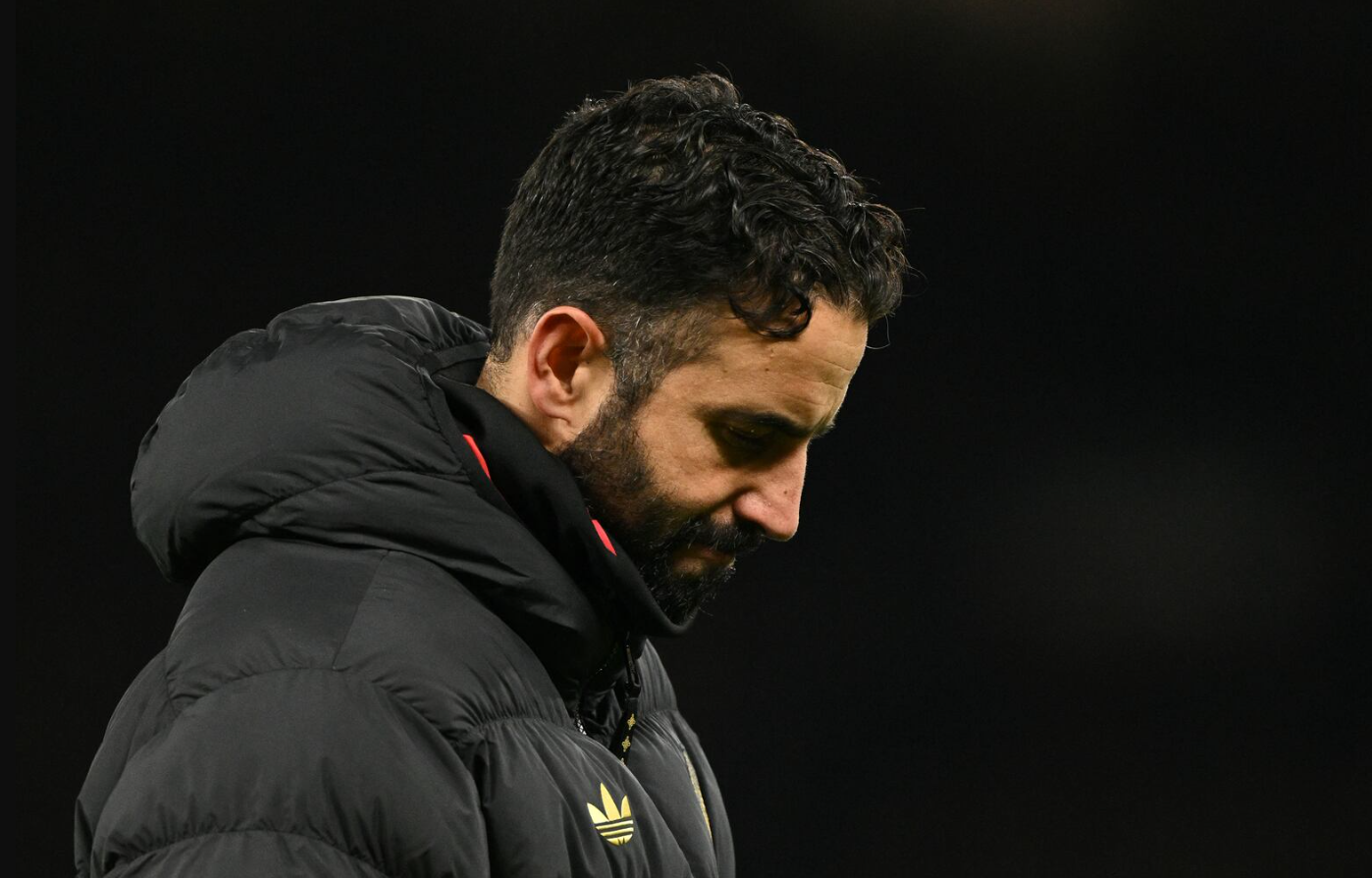
Ruben Amorim often cut a frustrated and dejected figure during his time at Manchester United.
Photo Credit: The Irish Times
What binds Amorim, Anselmi, and Nancy is not incompetence — on the contrary, each has demonstrated quality in other contexts — but a common misreading of the club as a vehicle for personal philosophy above an institution. And for managers, the greatest challenge is often not tactics or transfers, but learning to navigate that living history with respect, sensitivity, and insight.
Understanding a football club is as important as understanding football itself. The living organism of a club cannot be reduced to spreadsheets or formations, and the manager who disregards that reality will ultimately find that the game is far more complex than any plan can capture.
When Manchester United appointed Rúben Amorim in November 2024, it was a signal of intention: the club was embracing a new era. After the dismissal of Erik ten Hag amid poor results, United turned to the Portuguese tactician off the back of his domestic success with Sporting CP. At Sporting, Amorim was celebrated for his intelligent use of possession football, flexibility in formation, and ability to integrate youth with experienced players. His arrival at Old Trafford, however, soon revealed the limits of applying a proven system to a club with a distinct identity and expectation structure.
Manchester United is one of the most decorated clubs in world football. Sir Alex Ferguson, who retired in 2013 after an era defined by resilience and emotional connection to the club’s DNA, set a bar for managerial success that has proved almost impossible to replicate. In appointing Amorim, United were hoping for structural progress, but in practice they found an uneasy mismatch between the club’s visceral culture and the tactical transformation Amorim aimed to implement.
In the 2024‑25 season, United languished in mid‑table, briefly flirting with relegation danger before escaping it — a finish that was still well below the club’s historic standards. They reached the Europa League final, only to lose narrowly, and endured embarrassing exits in domestic cup competitions. Off the pitch, Amorim’s reported clashes with recruitment staff and his comments about his role illuminated a deeper tension between his vision and United’s established corporate hierarchy.
The inability to reconcile these dimensions — the tactical philosophy with the emotional expectations of fans and the operational realities of the club — culminated in his dismissal in January 2026, after just 14 months in charge. All the analytics and clever tactical shifts in the world could not reconcile Manchester United’s immediate demand for emotional connection, traditional prestige, and security with the longer‑term, patient project Amorim seemed to envision.
What his tenure highlighted was not an inherent flaw in his coaching philosophy, but rather an underestimation of what it takes to manage Manchester United: not just skilfully constructed systems, but an alignment with identity — a recognition that for the supporters, the club is more than a footballing entity, and that this identity should be reflected on the field and in the dugout.
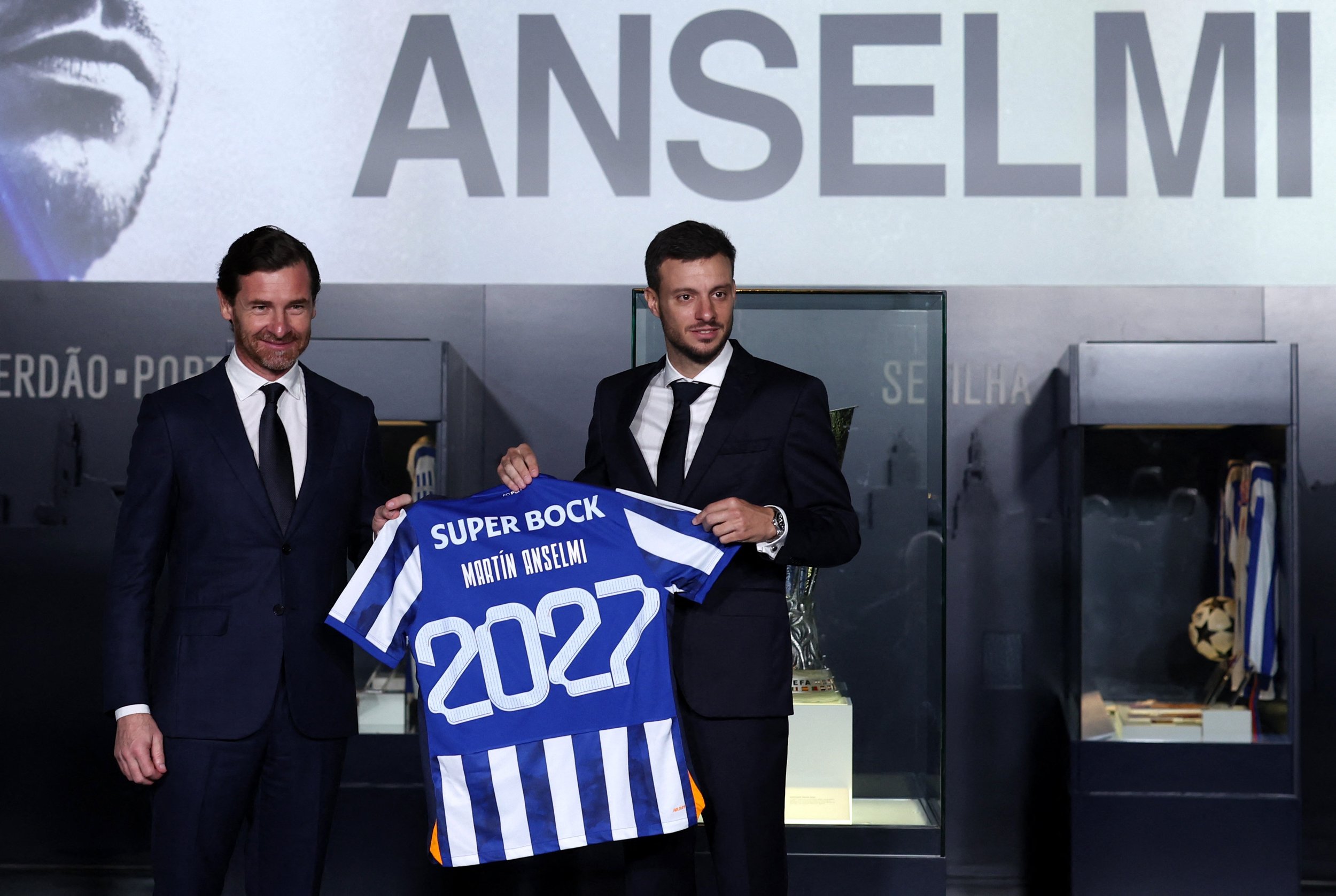
Though he signed a two-year deal at Porto, Anselmi lasted just over 5 months.
Photo Credit: Reuters
If United’s failure was a mismatch between tradition and tactics, the brief tenure of Martín Anselmi at FC Porto in 2025 represented a different kind of disconnect — one between disciplined methodology and deep cultural rhythms. Porto is one of Portugal’s “Big Three,” alongside Sporting and Benfica, but its identity differs significantly from both. Porto’s supporters pride themselves on resilience, adaptability, and a fierce competitive instinct — values rooted in the club’s historical rise outside the power centres of Portuguese football.
Anselmi arrived at Porto with credentials earned in South America and Mexico. On paper, his philosophy was coherent and professional. In practice, however, it struggled to cohere with a club culture that values response to adversity and tactical flexibility more than rigid patterns of play. Porto fans expect their team to react instinctively to the emotional demand of each match — something that cannot be fully captured in a playbook.
His tenure, which lasted only from January to July 2025, saw Porto underperform in major competitions and produce results that were inconsistent with the club’s standards. The lack of identity cohesion between his tactical structure and the supporters’ expectations contributed to an underwhelming atmosphere around the team, and Porto’s leadership ultimately decided to part ways with him after a disappointing Club World Cup campaign.
It is notable that Porto keeps a long memory for the managers it selects. In previous eras, coaches who embedded themselves into the club’s emotional rhythm — adapting not just tactics but tone — tended to last longer and achieve greater success. Anselmi’s departure was a reflection of a deeper misalignment: the team’s emotional tempo and supporters’ expectations did not find resonance in his disciplined, calculated approach.

Wilfried Nancy is Celtic's shortest serving manager, lasting 33 days in charge.
Photo Credit: The Irish Mirror
Across the North Sea, another short‑lived managerial experiment underlined how crucial cultural fit is when leading a historically passionate club. Wilfried Nancy was appointed manager of Celtic FC in early December 2025, signing a two‑and‑a‑half‑year contract, only to be sacked on 5 January 2026 after a disastrous start that included consecutive league defeats and a loss in the Scottish League Cup final against St. Mirren.
Celtic’s identity is deeply rooted in identity, heritage and religion — not just in terms of supporter energy but in a deep sense of collective purpose that defines how success and failure are understood. Expectations are intense, and every match carries the emotional weight of rivalry, history, and local pride. To lead Celtic is not merely to manage a squad, but to channel that energy into performance. A manager can have tactical acumen, but if they fail to grasp the emotional heartbeat of the club, their ideas can feel sterile outside the training ground. Winning and losing with Celtic is much more than just a full-time result.
Nancy’s brief tenure was marked by calamitous results and a visibly frustrated fanbase. His inability to generate a sense of connection — to feel the emotional cadence of Celtic Park and its supporters — contributed to a rapid loss of trust. Unlike clubs where patience is part of the culture, Celtic’s environment demands emotional intelligence, bold leadership, and a sense that the manager understands what the club feels like, not just how it plays.
What unites these three managerial spells is not simply failure. It is a pattern of misunderstanding football clubs as systems to be managed rather than living organisms to be understood. Tactics, data, and modern methods are all essential components of elite coaching, but they sit alongside — not above — the emotional and historical ecosystem of a club. When these dimensions collide without synthesis, even the most intelligent manager can struggle.
For fans, the lesson is clear: football is not a neutral enterprise governed solely by logic and efficiency. Managers who succeed are those who respect not just the tactical needs of their teams, but also how the club feels to the people who live and breathe it.
In a world increasingly enamoured with data, pattern recognition, and optimized performance models, it can be easy to forget that football is, at its core, a human, deined by narratives, stories and emotion that numbers alone cannot capture
In theory, Amorim, Anselmi, and Nancy don’t have much in common, apart from a love for tactical systems that have, in practice, been found wanting over thousands of games. That alone might be reason enough for clubs to approach them with caution. But above all, they misunderstood the true nature of the clubs they were managing. At certain clubs, winning is the sole purpose of the institution and its supporters. Winning to live and living to win are mental states that some of us are unwilling to let go of, especially when it comes to our clubs.
All three managers had success in previous roles. But it is one thing to win where success is unexpected not fully demanded; it is quite another to arrive at a club where winning is expected at all times, regardless of circumstances. That relentless drive shapes the mindset of everyone within the club, and these managers failed to grasp it: the unyielding hunger for the next victory. I have no doubt that these managers will find success in future opportunities, but at clubs where winning is as natural as grass being green, I have my doubts.
At Manchester United, Amorim at times seemed almost too cautious, and at other times stubborn — always one step behind the club’s true culture. Yes, Manchester United has struggled in recent years, but the drive remains. Even if it feels constrained at times, the hunger for the next big story never disappears — and it shouldn’t. A club like Manchester United deserves leaders who embody success, individuals willing to do almost anything to win. Amorim was never that.
Wilfried Nancy at Celtic similarly misunderstood the club’s demands. At Celtic, winning is expected from day one. Losing is never taken lightly, because sheer domestic dominance is a fundamental part of the club’s identity. If you finished second in a two-horse race, you’re finishing last. At the time of writing, Celtic are languishing in third. Nancy came from a background where the stakes were never this high, where expectations were lower, and that inevitably shaped his approach. Celtic is not in the Scottish Premiership merely to participate. Nancy was never capable of embracing this ethos. His downfall was inevitable.
Finally, Anselmi at FC Porto provides a similar lesson. Charismatic, eloquent, and almost poetic in his presentation, he arrived with a track record of potential and sustained success elsewhere. Very early, though, it became apparent that he didn’t fully understand his environment — the players, the supporters, or the weight of Porto’s expectations. FC Porto, like Manchester United and Celtic, is built around one purpose: to win. Everything else is secondary. If you support a club like Porto, you are compelled to prioritize victory above all else.
Anselmi treated his tenure as a laboratory experiment, testing ideas and systems while seemingly ignoring the fundamental truth: at clubs like Porto, experimentation is only tolerated when it leads to results. Lack of awareness is almost as damaging as lack of ability in football management. A manager’s success is not measured solely by tactics, halftime speeches, or innovative formations, but by their understanding of the environment and the club they lead. When a manager at a historically elite club accepts defeat too casually, something is fundamentally wrong. No one wins all the time, but some managers demand to win all the time — and that is the critical difference.
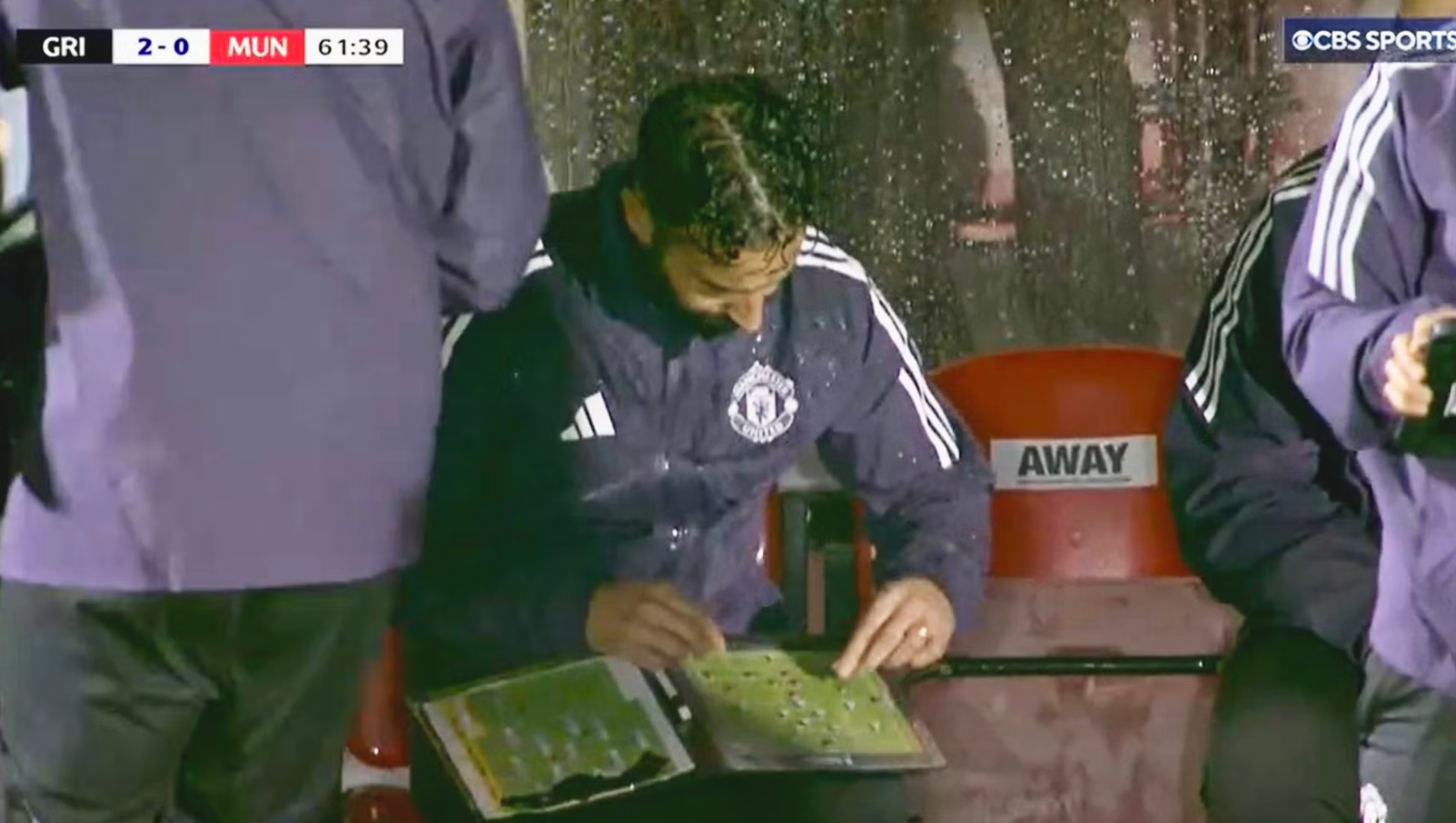
Amorim, Anselmi and Nancy became infamous for their use of tactics boards in the dugout.
Photo Credit: The Independent
What makes these failures so compelling is that they are never solely about incompetence. Amorim, Anselmi, and Nancy are intelligent, ambitious, innovative men. Each has proven they can win elsewhere. The tragedy lies in the collision between intellect and intuition, between ambition and understanding. They arrived with vision, and yet, vision without empathy is hollow. They sought to shape their clubs, when what was truly required was to feel them — to internalize the heartbeat of the institution and move in harmony with it.
At the heart of it, managing a club like Manchester United, Celtic, or Porto is an act of translation. You must read the unspoken rules embedded in decades of expectation, decode the emotional syntax of the supporters, and anticipate the invisible currents flowing through the locker room. There is no manual, no tactical blueprint that can capture that. Winning is not just a result — it is an attitude, a shared consciousness, a culture that has been carefully nurtured over decades. Misreading that culture is not a minor error; it is fatal.
This is why failure often appears so sudden. One week, the team looks competent, the press hopeful, the fans tentative but patient. The next week, a loss or two, a mismatch of expectations, a misread locker room, and suddenly the cracks are exposed. Fans sense when a manager is out of sync — it is instinctive, almost spiritual. They forgive tactical missteps, they tolerate the occasional experiment, but they cannot forgive a disconnection from the essence of their club. That is why Amorim felt too cautious, why Nancy never embraced Celtic’s relentless ethos, why Anselmi’s lab-like experimentation could never compensate for a lack of cultural understanding.
In football, as in life, brilliance alone is insufficient. Knowledge and technique must intersect with understanding, empathy, and timing. A brilliant manager who misreads a club’s soul may fail faster and more publicly than one who is merely competent but deeply attuned. Success is not about clever ideas in isolation; it is about aligning those ideas with the human, emotional, and historical fabric of the club. And when that alignment is absent, brilliance becomes brittle.
Ultimately, the stories of Amorim, Nancy, and Anselmi remind us of something that every supporter already knows instinctively: football is more than a game. It is an inheritance. It is a shared memory, a communal heartbeat, a responsibility as much as a profession. To lead a club is to step into that current, to feel it, to respond to it, and, only then, to shape it. Ignore it, and no amount of innovation, strategy, or ambition will be enough.
The lesson is simple yet profound: a football club is alive, and to survive and thrive, a manager must first recognize that life — its rhythms, its desires, its history, its unrelenting hunger to win — exists independent of them. A manager may bring ideas, tactics, and personality, but the club will accept only what resonates with its own soul. Those who fail to see that are destined to leave, no matter how clever, no matter how innovative, no matter how brilliant they may seem on paper.

Wilfried Nancy struggled to implement his confusing tactical philosophy at Celtic.
Photo Credit: The Celtic Star
In the end, the stories of Rúben Amorim, Wilfried Nancy, and Martín Anselmi are not merely accounts of managerial failure; they are reminders of the profound truth at the heart of football: a club is never just a team, never just a set of players or a collection of tactics. It is a living, breathing entity, forged over decades of joy and heartbreak, victories and humiliations, legends and heartbreakers. It is an organism whose pulse beats through the supporters’ chants, whose memory is etched in every crest, every stadium, every worn jersey, every photograph of a final won or lost. And a manager who seeks to impose their own vision upon it, without first listening to its rhythm, is not leading — they are intruding.
Amorim arrived at Manchester United with ambition and brilliance, but brilliance alone cannot substitute for empathy with history, for understanding the invisible currents that run through Old Trafford, from the dressing room to the Stretford End. Nancy stepped into Celtic’s cauldron with plans and philosophy, but Celtic is a club that demands instinctive alignment with its unrelenting pursuit of dominance; anything less is interpreted as a lack of will. Anselmi’s tenure at Porto, for all its polish and potential, demonstrated that even elegance and intelligence can be fatal if divorced from the club’s obsessive, almost spiritual, imperative to win. In all three cases, it was not the absence of skill or innovation that doomed them — it was a misreading of the invisible, unquantifiable, yet undeniable heartbeat of their clubs.
To manage a club like this is to understand that football is more than sport; it is a civilization of emotion, ritual, and expectation. The manager is not simply a tactician, but a translator, a conductor, a custodian of legacy. They are entrusted with something far bigger than themselves: the hopes of generations, the collective pride of millions, the relentless demand for victory that persists even when the team is wounded, even when it struggles, even when it seems impossible. Success cannot be imposed; it must be earned, in harmony with the organism of the club itself.
And therein lies the cruel beauty of football. A manager may arrive with brilliance, intellect, charisma, and ideas that could revolutionize the game. They may have conquered challenges elsewhere, dazzled spectators, and accumulated accolades. Yet if they fail to honor the soul of the club, the soul that existed long before them and will endure long after them, brilliance alone is insufficient. The club, ever vigilant, ever alive, will assert itself. It will tolerate mistakes, it will forgive missteps, but it will never surrender its identity. The organism always survives, even if the caretaker does not.
For the supporters, there is a strange mixture of pain and awe in witnessing this. We cheer, we chant, we live and breathe through every decision, every formation, every pass. And when a manager fails to grasp the essence of our club, we feel it immediately — a subtle misalignment that can never be hidden by results alone. We recognize instinctively that football is about more than winning; it is about understanding, about connection, about reverence for something bigger than any individual. And when that connection is broken, failure becomes inevitable.
Amorim, Nancy, and Anselmi are cautionary tales, yes — but they are also testimonies to the unforgiving majesty of the game. They remind us that clubs are alive, unpredictable, and demanding, and that the manager who disregards their invisible laws does so at their peril. There is no shortcut, no formula, no amount of tactical brilliance that can replace the intuition and empathy required to lead a club whose identity is larger than any one person.
Ultimately, football teaches a lesson that extends far beyond the pitch: brilliance, skill, and intelligence are meaningless if divorced from the world in which they are applied. To succeed is to understand, to feel, to immerse oneself completely in the organism one serves. To fail is to forget this truth — and to be humbled by it.
And for us, the supporters, the witnesses, the inheritors of this living, breathing legacy, it is a lesson we feel as keenly as any goal or defeat: clubs are more than games. They are histories. They are passions. They are organisms that demand respect, understanding, and devotion. And the managers who forget that will not survive — not in the headlines, not in the locker rooms, and certainly not in the memory of those who live and breathe their club.
Because football, in the end, is larger than anyone who tries to control it. And the organism always wins.