

Words by Tommy Potter | Published 22.02.2026Argentina is one of the most superstitious nations on earth, and as a country that feels football so passionately, the game often becomes the main focal point for these superstitions. In Argentina, this is known as Cábala. Cábala is a phrase taken from the term kabbalah, a form of Jewish mysticism, and is a strange mix of paganism, astrology and superstition. Cábala is taken very seriously in Argentina, with a variety of rituals performed in the hope of influencing the outcomes of matches.
Rituals range from the benign (stepping onto the pitch with the same foot every tim), the funny (touching the left, which involves men touching their left testicle, and women touching their left breast, to bring good luck), to the more grotesque (in 2019, a Racing fan was pictured celebrating their title victory holding his grandfather’s skull - apparently he removes the skull from a burial chamber every time Racing play). Above all, though, one of the most fascinating and enduring Cábala’s in Argentinian football has to be the curse of Racing Club, a curse that spanned 35 years and involved 7 dead black cats and an exorcism.
Racing Club de Avellaneda were formed in the City of Avellaneda, part of Greater Buenos Aires, on March 25th 1903. Whereas other Argentine clubs at the time were formed by predominantly European immigrants, Racing was the first club to be founded by criollos - native Argentines of European ancestry.
Racing won promotion to the top flight in 1910, and kick started their golden era: between 1913 and 1919, Racing won 7 titles in a row, 5 of which were won without losing a game. This period of success led to Racing acquiring the nickname La Academia (the academy), for the way in which they espoused the creole style of play, thus giving their opponents a lesson in how football should be played.
That early success, along with the size of their support and membership, would see Racing come to be considered as one of Los Cinco Grandes next to River Plate, Boca Juniors, San Lorenzo, and their Avellaneda neighbours, Independiente. Los Cincos Grandes as a term was first coined in 1937 after the 5 aforementioned clubs were granted greater voting strength than the other teams in the league. The move was dressed as a proportionally fair one, but ultimately it was simply to appease the leagues’ biggest money makers.
After the very successful 1910’s and early 20’s, Racing hit a barren streak in the 1930’s before steadily winning trophies again in the 40’s,50’s and 60’s. Their crowning glories, however, came in 1967: Racing finally won the Copa Libertadores, a tournament that had then become the pinnacle of club football on the continent. After two 0-0 draws, home and away, against Nacional of Uruguay, Racing finally prevailed 2-1 in the neutral surroundings of Santiago, Chile. With their bitter rival Independiente having won the ‘64 and 65’ tournaments, Racing now had bragging rights of their own.
They also had the chance to go one better than their rivals.
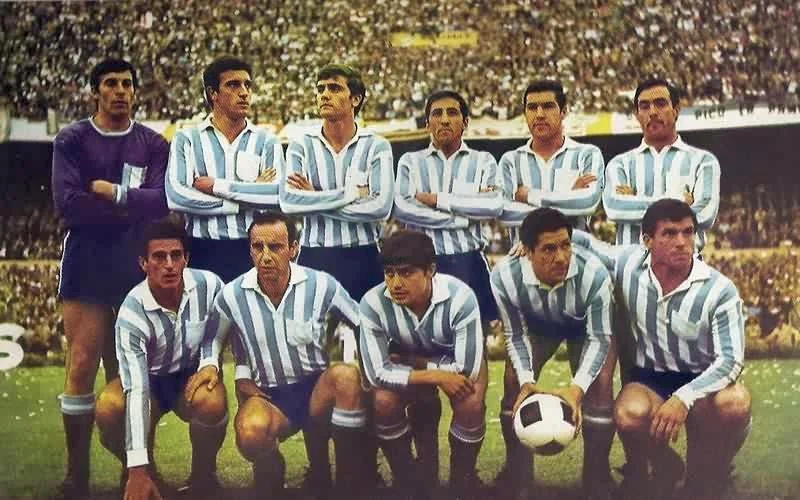
Racing Club's 1967 team.
Photo Credit: Wikimedia Commons
Winning the Copa Libertadores meant that Racing would then compete against the European Champions, Celtic, in the Intercontinental Cup; the games would go down in infamy for the sheer violence and skullduggery that marred each match. Like the Copa Libertadores, the Intercontinental Cup would take 3 gruelling games to complete.
The first leg at Hampden in Glasgow saw Celtic run out 1-0 winners, but the tone had been set as Racing players used all the ‘dark arts’ at their disposal to get under the skins of the Celtic players; spitting, hair pulling, diving, and persistent fouling were all part of Racing’s game plan.
At Racing’s Estadio Presidente Perón (nicknamed El Cilindro due to its shape), the hostility in the 115,000 strong crowd boiled over before a ball had even been kicked in the 2nd leg, as Ronnie Simpson, the Celtic ‘keeper, was hit with a missile from the crowd and had to be replaced. It set the tone for what was to come on the pitch, with violence, aggression, and cynicism once again the order of the day. This time Racing emerged victorious, fighting back from a goal down to win 2-1. With the tie poised at 2-2, a replay on neutral ground was forced.
After enduring the 180 minutes of Racing savagery, many in the Celtic hierarchy were against playing the decider. Robert Kelly, the Celtic chairman, made it clear that he would rather the players return to Glasgow. However, the team and management decided to play the game that would become known as the ‘Battle of Montevideo’.
It didn’t take long for those amongst the Celtic contingent who voiced their opposition to the game to be vindicated. If onlookers thought they’d seen the worst of football in the first two legs, they were sorely mistaken. The levels of brutality plummeted to new depths; Celtic received four red cards (although, apparently, Bertie Auld ignored his marching orders and continued to play), while Racing received two of their own.
Amongst the fouls (51 given; countless unnoticed) and fighting, a winner was found: in the 55th minute, young Racing forward Juan Carlos Cárdenas picked up the ball just inside the Celtic half. As he advanced further, the bobbling ball sat up perfectly for him to lash in a magnificent 25-yard howitzer into the top left hand corner of Celtic’s goal. It’s an incredible strike; a brief moment of light in a dark and dirty game.
Finally, after 270 minutes of football, across 2 continents and 3 countries, Racing were crowned Intercontinental Champions, and in doing so, became de facto World Club Champions. Not only were they ‘world champions’, but they were the first club from Argentina to achieve the feat, and for a country whose self-perception and national pride is so often felt through their football teams, this was a massive moment.
Not everyone in Argentina was celebrating Racing’s victory, though.
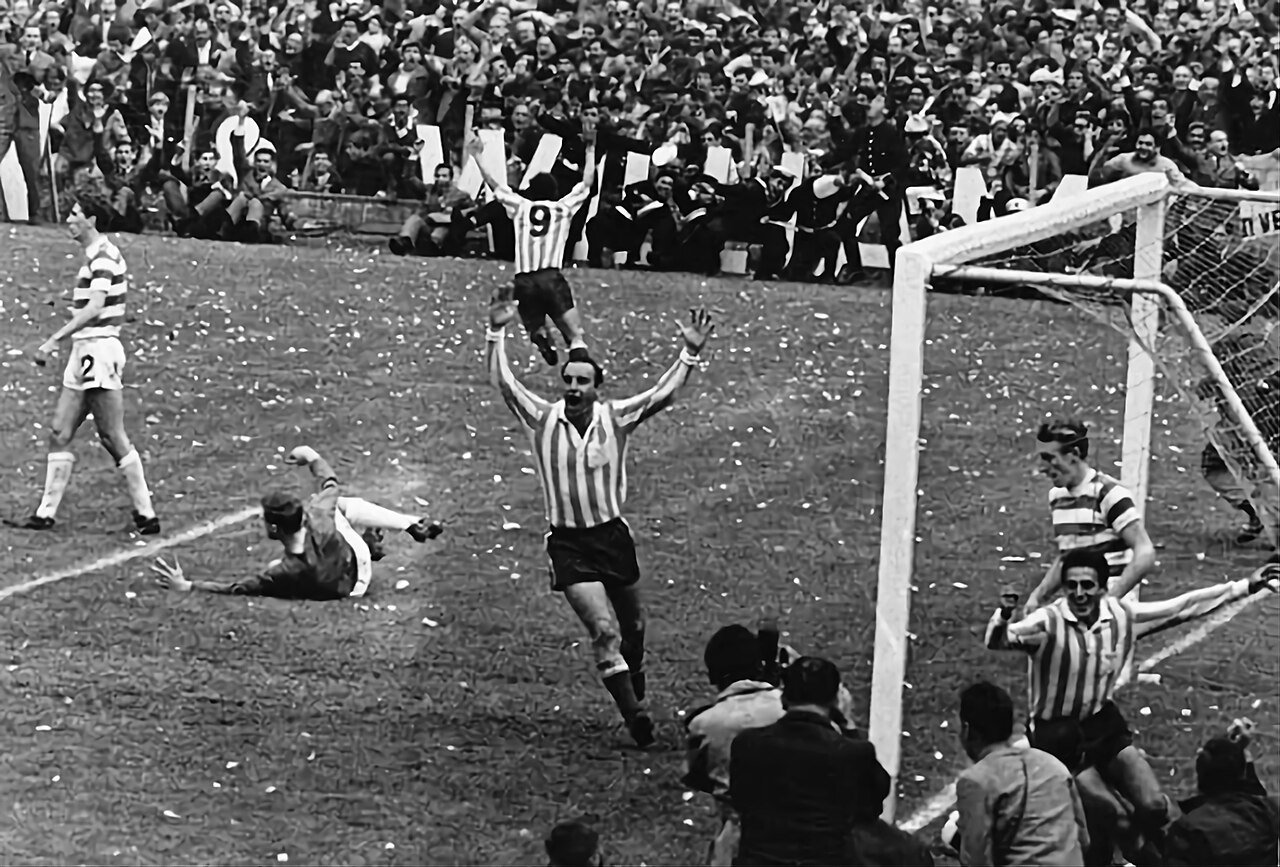
Carlos Cárdenas celebrates after scoring v Celtic.
Photo Credit: Wikimedia Commons
A short 300 metres away from Racing’s El Cilindro is the home of another of the Los Cincos Grandes - Club Atlético Independiente.
Formed in Buenos Aires in 1905, Independiente quickly moved south to Avellaneda in 1907. That same year their reserve team met their counterparts at Racing, and although the initial meetings seemed to be competitive, if relatively friendly, it didn’t take long for this to change. In fact, the change in dynamics can be traced to one game in particular.
In 1915, Independiente hosted their neighbours in a match that they won 2-1. However, the result was subsequently overturned, with Racing being handed the victory instead. The 2 points that Racing accrued from their awarded victory was enough to land them the title. It's fair to say that from then on things became more acrimonious between the Avellaneda Grandes.
By 1967, the transition from close neighbours to fierce, and often violent, rivals had long been completed. What made things worse for Independiente was that Racing had succeeded where they had failed. Despite winning the Copa Libertadores in ‘64 and ‘65, Independiente couldn’t take that final step to becoming Intercontinental Champions, losing to Inter Milan in both years. Unable to stomach the Racing celebrations, a group of Independiente fans hatched a supernatural plan to halt their rival’s successes.
The exact details around what happened next are, as expected when it comes to Cábala, quite hard to pin down. It’s a story that has no doubt grown arms and legs as it has been told over the years. Despite the obvious embellishments, it’s a fascinating tale that offers a compelling insight into how influential Cábala can be within Argentinian society, especially when football is involved.
As Racing fans celebrated their gruelling victory over Celtic, it’s said that Independiente supporters, at the suggestion of a local witch, broke into El Cilindro carrying 7 dead black cats (black cats are often symbolic of bad luck), and proceeded to bury 6 of them under one of the goals, before burying the 7th in a secret location, allegedly at the behest of the Independiente-supporting nightwatchman, who had assisted their entry to the ground.
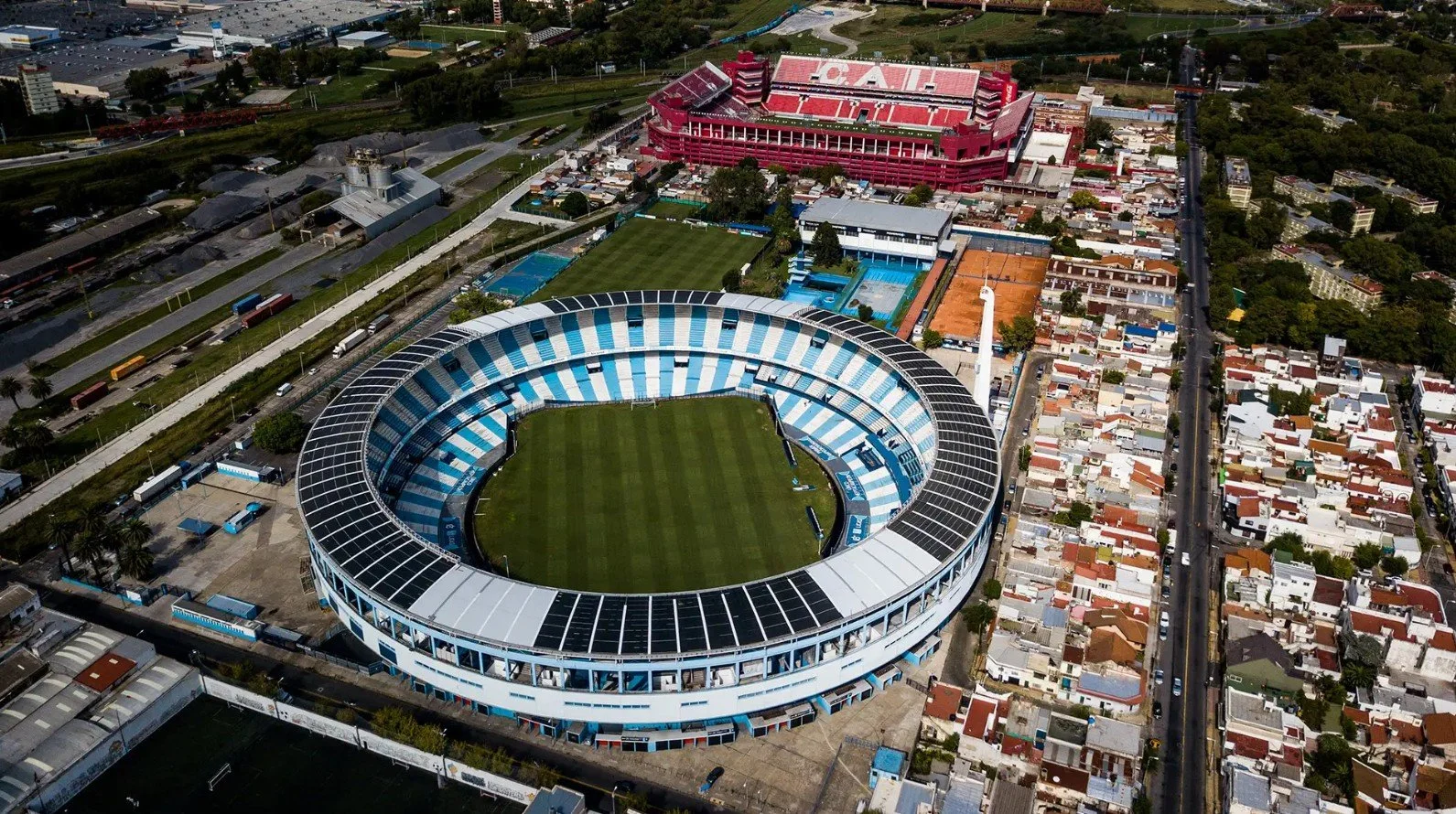
The location of Racing Club and Independiente's stadiums make them one of the closest derbies in world football.
Photo Credit: Goal.com
Of course, Racing and their supporters took little notice of the supposed curse, chalking it up as a desperate attempt by their rivals to tarnish their joy; that was until Independiente beat Racing 4-0 on the last day of the season to claim the title. Once scoffed at, talk of the curse began to gain momentum.
The 70’s saw Racing enter a decade of pain: still trophyless since their Intercontinental Cup glory, Racing sacked 4 managers alone in 197. In 1975 they succumbed to a humiliating defeat at the hands of Rosario Central, and a year later they finished 2nd bottom of the league, only avoiding relegation by the skin of the their teeth.
Enough was enough, and in 1980 the newly appointed manager, Toto Lorenzo, decided to tackle the curse once and for all. He ordered the pitch to be dug up in the hope of finding the 7 buried cats. Only 6 were found. In an attempt to counteract the curse inflicted by the dead cats, Lorenzo insisted that dead toads (apparently dead toads have ritualistic powers of healing) be buried in the cat's now vacant graves.
It’s safe to say they didn’t have the desired effect: in 1983, Racing followed San Lorenzo in becoming the 2nd of the Grandes to be relegated from Argentina’s top flight. Not only were they relegated, they were so at the hands of their old rival, Independiente; and if being relegated in your rivals’ back yard wasn’t bad enough, Independiente’s 2-0 victory saw them lift the title. Bleak, bleak times for La Academia.
The fact that the Argentinian league is structured to protect the money-making Grandes was clearly no match for the curse (I wonder what San Lorenzo's excuse was), and it would take two long, laborious seasons before Racing would be sitting at Argentina's top table again.
1997 marked the 30th anniversary of Racing’s Intercontinental Cup, and in those 30 years not one title had been won by the club; in contrast, the years preceding 1967 saw Racing crowned champions 15 times. The fact that there were now 2 championships every year made the lack of success for a club of Racing’s size almost inconceivable.
Things could not continue like this. The club and fans (who were still turning up in impressive numbers) were desperate. Desperate times call for desperate measures, and with this in mind, the club turned to one of the most influential and powerful organisations in Argentina: the Catholic Church.
On the 4th of February 1998, an estimated 100,000 Racing fans gathered outside the Santa Inglesia Cathedral in Avellaneda. From there, Father Horatio Della Barca led the 100,000 strong crowd, torches and all, on a procession to El Cilindro. Upon arrival at the stadium, Father Della Barca proceeded to say mass, before sprinkling holy water on both of the ‘cursed’ goalmouths. Of course, many in Argentina saw this as the club performing an exorcism, but Club President, Daniel Lalin, was quick to quash such talk, insisting that it was simply an act of faith:
“This is not an exorcism but an act of faith. The same faith displayed by the fans who stoically go to the stadium every Sunday. We are uniting Roman Catholicism with Racingism.”
Whether an exorcism, or act of faith, Racing would soon find out if it worked.
It didn’t.
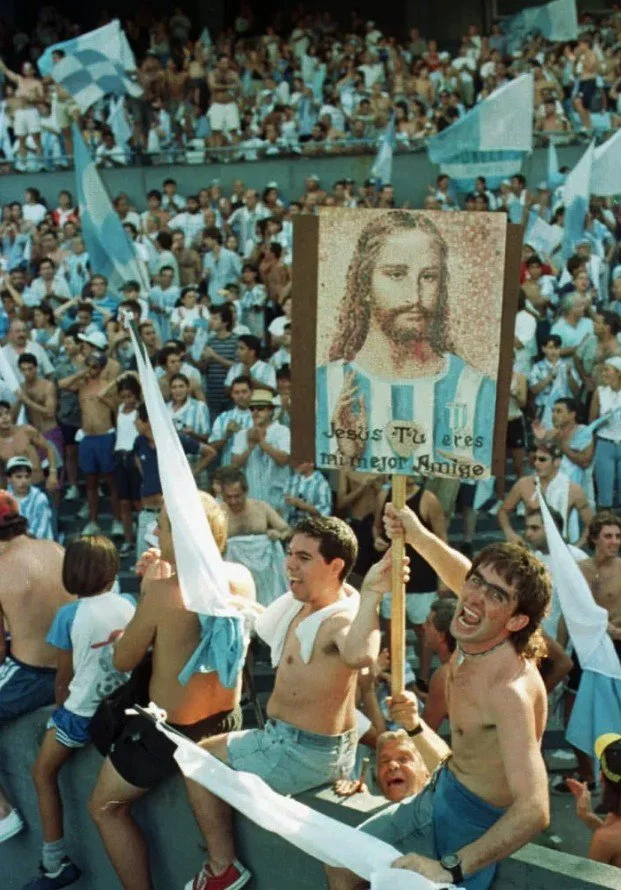
Racing Club fans protest the club's bankruptcy in 1999.
Photo Credit: Associated Press
Even before inexplicably spending $30,000 USD on the whole ‘exorcism’ saga, financial troubles had been looming over Racing for many years. But in July 1998, mere months after their latest attempt to rid the curse, a bankruptcy process was initiated. Not only had the club been absent from the list of Argentinian champions for 30 years, they now faced the prospect of extinction.
It wasn’t just Racing who were struggling under mounting debt - financial turmoil went well beyond the confines of El Cilindro, and the whole of Argentina began to feel the squeeze as wages stagnated and inflation became untameable. In a country where football is so often used as a distraction from social ills, the thought of not even having their club to support was incomprehensible for the Racing faithful.
However, as legal proceedings slowly edged along, Racing fans were finally served the news that they had been dreading: On the 4th of March 1999, a statement from a court-appointed administrator was issue:
"Racing Club has ceased to exist."
For a club now accustomed to dark days, this was the darkest by far. One of the country's biggest institutions, with nearly 100 years of history, looked like it would be consigned to the history books.
To their eternal credit, though, the Racing fans refused to let their club die. They fought legal battles, demonstrated outside parliament, and even occupied the club’s headquarters in order to prevent administrators from taking over. Often the fans' fight for their club became a literal one: many of their demonstrations brought them into direct confrontations with the police, who seldom shy away from violence.
Racing fans were not to be deterred, and, eventually, a deal was struck to save Racing. The deal in question meant that the club was ordered to be run by a private company for the next 10 years so that the mounting debts could be repaid; hardly ideal, but at least they survived.
As the year 2000 ushered in a new millennium, a series of events were put in motion that would finally see the curse lifted.
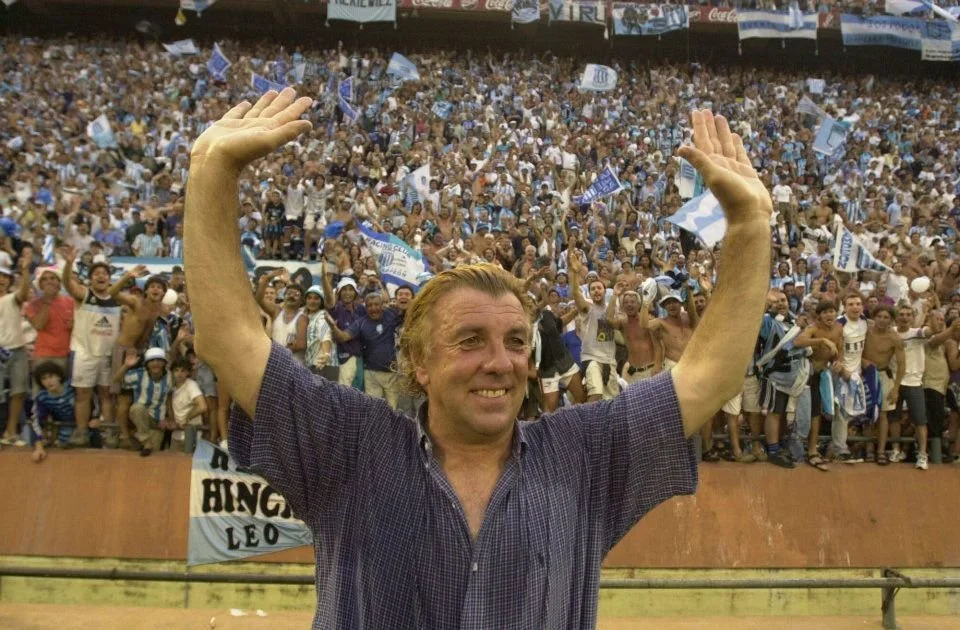
Reinaldo ‘Mostaza’ Merlo kickstarted the process of lifting the curse.
Photo Credit: Nueva Rioja
The first step in lifting the curse came when Racing appointed the former River midfielder Reinaldo ‘Mostaza’ Merlo as manager. Merlo wasn’t just known for his motivational and tactical acuity; he was also a deeply superstitious man. From certain hand gestures to his aversion to flowers (associated with death), Merlo was a firm believer in Cábala. This, arguably, made him the perfect fit for Racing.
Merlo genuinely believed that while the elusive 7th dead cat was still unaccounted for, Racing would never be champions again. He ordered another excavation to be carried out. This time the concrete covered sections behind the goals were included, and there, amongst the rubble, a feline skeleton was discovered. They’d finally found the last of the black cats. Now, surely, Racing would be free from their supernatural shackles.
Racing had gone into the 2001 Apertura without much expectation; it had been 35 years since their last title after all. But with a shrewdly assembled squad, alongside Merlo’s paso a paso (step by step) approach, Racing kept grinding out results - they may not have been particularly entertaining (they only scored 34 goals; 2nd place River managed 51) but they were solidly consistent. Fans started to believe again, and a 1-0 victory over closest rivals River Plate meant they only needed a draw at Velez Sarsfield to finally win their 16th title.
Of course, this is Racing Club - nothing is ever simple. With the financial crisis in Argentina reaching breaking point, the government began freezing bank accounts and limiting withdrawals. Understandably, the people weren’t best pleased with this; demonstrations and protests inevitably turned violent, and on the 19th December, as cities across the country descended into anarchy, the government postponed all football games. Maybe the curse wasn’t broken after all?
Despite the government stating that football would resume in February of the new year, Merlo was vociferous in his belief that Racing's final game should be played in December (due to his belief in Cábala). He got his wish. The games were scheduled for December 27th. Maybe, just maybe, this would be it - 35 years of pain, put to rest.
25,000 racing fans travelled across Buenos Aires to Velez Sarfield’s Estadio José Amalfitani, while 40,000 filled El Cilindro to watch the game on a giant screen (Racing fans boast about it as the day they filled 2 stadiums). With River having already obliterated Rosario Central 6-1, Racing needed a point to clinch the title.
In the 52nd minute, Racing centre back Gabriel Loeschbor, gave his team the lead with a header. Obviously, it wouldn’t be quite that simple, and Velez equalised 24 minutes later to move the Racing fans back to the end of their seats for a nail biting finale.
In the end, Racing prevailed. A sea of jubilation swept from Liniers to Avellaneda; chants and songs were sung, and tears of joy were shed. Back at El Cilindro, fans unveiled a banner which said:
‘What ghosts? No ghosts. Merlo already said: Racing are Champions!’.
Racing had finally done it. Champions again after 35 long and painful years.
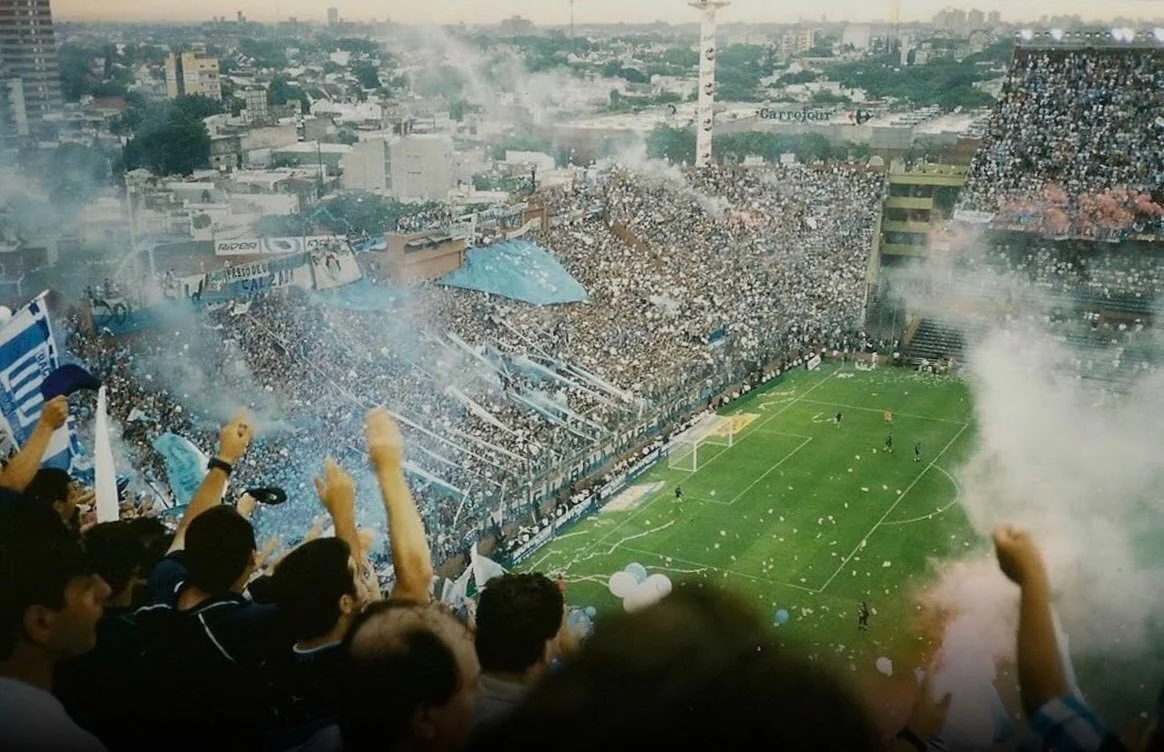
Racing fans celebrate the title at Velez.
Photo Credit: De Primera
Whether you are a believer in Cábala, or whether you think it was all merely a coincidence, the Curse of Racing is undoubtedly a fascinating story.
But, how much of it is actually true?
Writing in the Buenos Aires herald, Fernando Romero Nuñez cast doubt on the veracity of the story. According to him, significant facts, and events, keep changing depending on who by, or when, the story is told.
Even the only quote regarding the curse and the cats buried beneath the Racing goal, is dubious. The quote in question has often been attributed to cult striker José Raúl “Toti” Iglesias, but when asked about it, the former player denies all knowledge, stating that the quote is a fabrication.
Another fact that seems to be conveniently omitted from the ‘Curse of Racing’, is the fact that they didn’t go trophyless for all those years: in 1988 they won the Supercopa Libertadores. It may not have been a league title, but it was still a trophy.
It’s quite possible that nothing was buried beneath the Racing goals, and the whole thing was a myth, born out of Argentinians belief in Cábala, combined with Racing’s woeful run of poor fortune (although much of it seems to have been self-inflicted).
But, as the saying goes, don’t let the truth get in the way of a good story.