

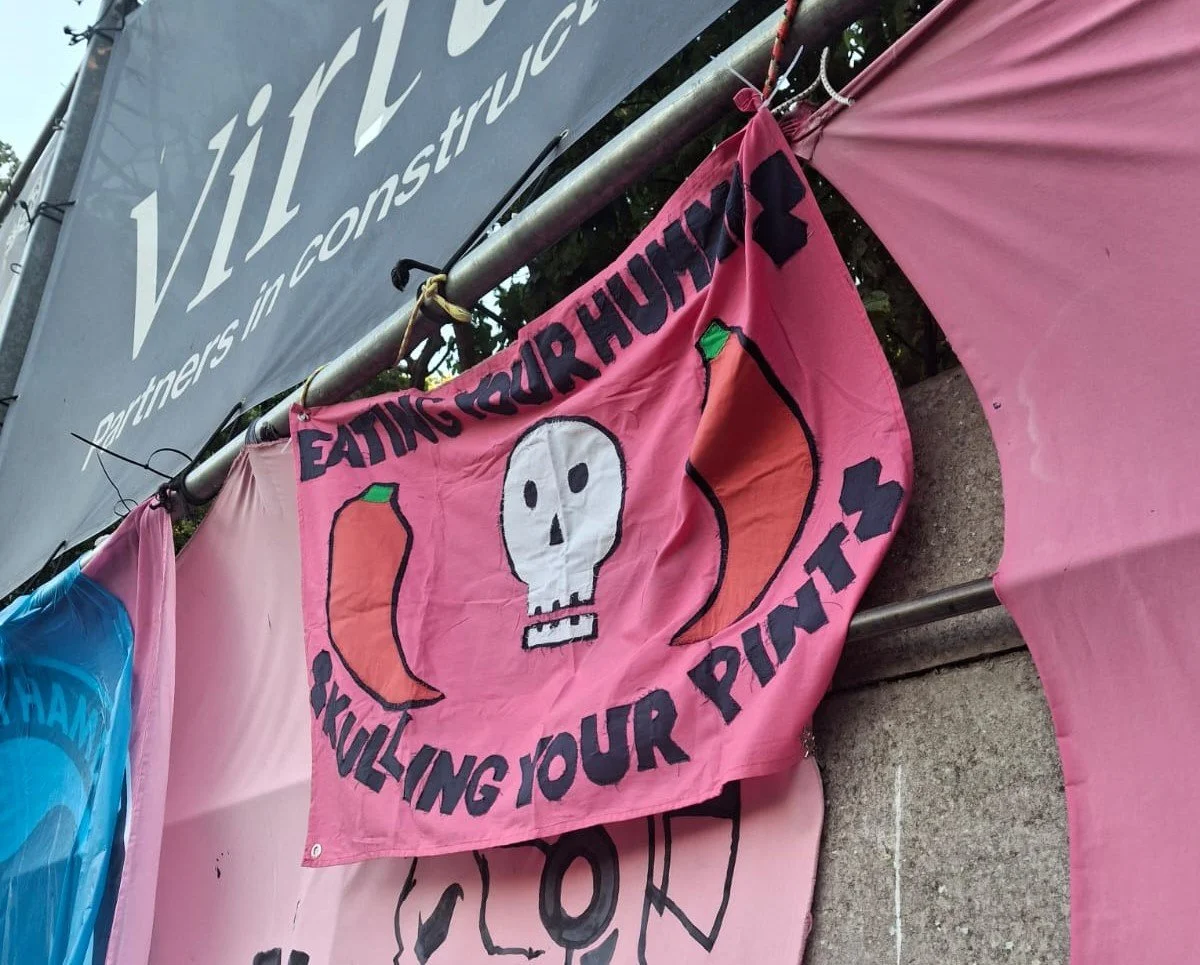
Words by Jayne Dent | Published 06.06.2026Growing up, I thought football wasn’t for me. With my Grandad’s radio piping a constant hum of commentary from Liverpool games into their living room I knew that as long as I hated Man United I was on the right side of history, and that was about as deep as it got.
I never really had friends interested in football and the girls didn’t get to play it at my school. Family outings with my parents centred around a community activity of a different kind, a world of traditional folk music and dance, ceilidhs and pub singing sessions.
My childhood consisted of being dragged around the UK to folk festivals with the North West Morris group my Mum danced in, while my Dad played concertina in the band. It cultivated a lifelong affection for marching bands and silly songs, banners and processions, collecting badges and colour-coordinated costumes, intergenerational joys and sorrows shared and processed through creative, communal storytelling. A world I thought was a million miles away from football, through the passing glances of Premier League matches I’d caught on TV.
I found out how wrong I was a couple of years ago when I attended my first games at Champion Hill with friends I met through the DIY music scene, catching both Dulwich Hamlet’s men and women playing at home across one weekend.
What I saw then and immediately understood was how folky it all was.
Beer soaked, sunburnt gaiety, shouts and sudden eruptions of song. I felt quite emotional and so at home, like a kid again surrounded by a community of adults who were giving themselves permission to be daft, creative and loud, to express a range of emotions without fear of being called dramatic or childish.
It ignited a new passion in me. I’ve thrown myself into this vibrant and existing folk culture by spending the last couple of years groundhopping and going to as many Dulwich Hamlet games as I can during visits to London.
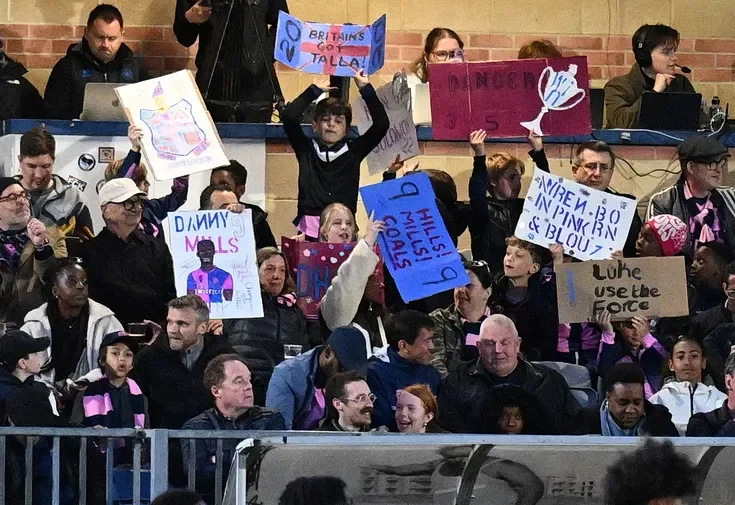
Handmade Dulwich Hamlet signs at the London Senior Cup Final, Champion Hill, 2026.
Photo Credit: Brixton Buzz
I’m not the first person to make this observation, with one of the British folk scene’s most prominent musicians Martin Carthy describing terrace chanting as “the one surviving embodiment of an organic living folk tradition.” While I’d not go as far as to say it’s the only survivor, it is true that it fits quite neatly within what folklorists would understand to be folk tradition, despite it being largely left out of folk discourse.
‘Folk’ is of the people; a community with a shared culture. It is not just the artefacts themselves, like costumes, rituals and songs, but the intangible elements too, with Faye Hield describing ‘tradition’ as a link between community and practice, and a feeling of connection.
Crucially, this culture is organically grown, owned by the collective, built and maintained outside of institutional support. It is a shared community responsibility to keep the culture alive, to pass on stories and tell new ones, to welcome new people into the fold and to decide the shape of the community and future of its traditions.
This rings true for fans across all tiers of the football pyramid, but for me, non-league is where that community-led aspect really shines. The barriers to participation are relatively low especially at non-league level, membership of the community is not based on background, experience or knowledge but on a willingness to show up and participate, to be enthusiastic and engaged.
Football fans are a community fundamentally brought together by a shared love of an activity. While geography often plays an important part in the identity of a club and its fan community, being born a street away from the ground is not a prerequisite to becoming part of the collective. This means that football communities have this inherent potential to be inclusive and welcoming, because if the requirement for membership is just to be present and passionate, it’s not so hard to become part of the crowd.
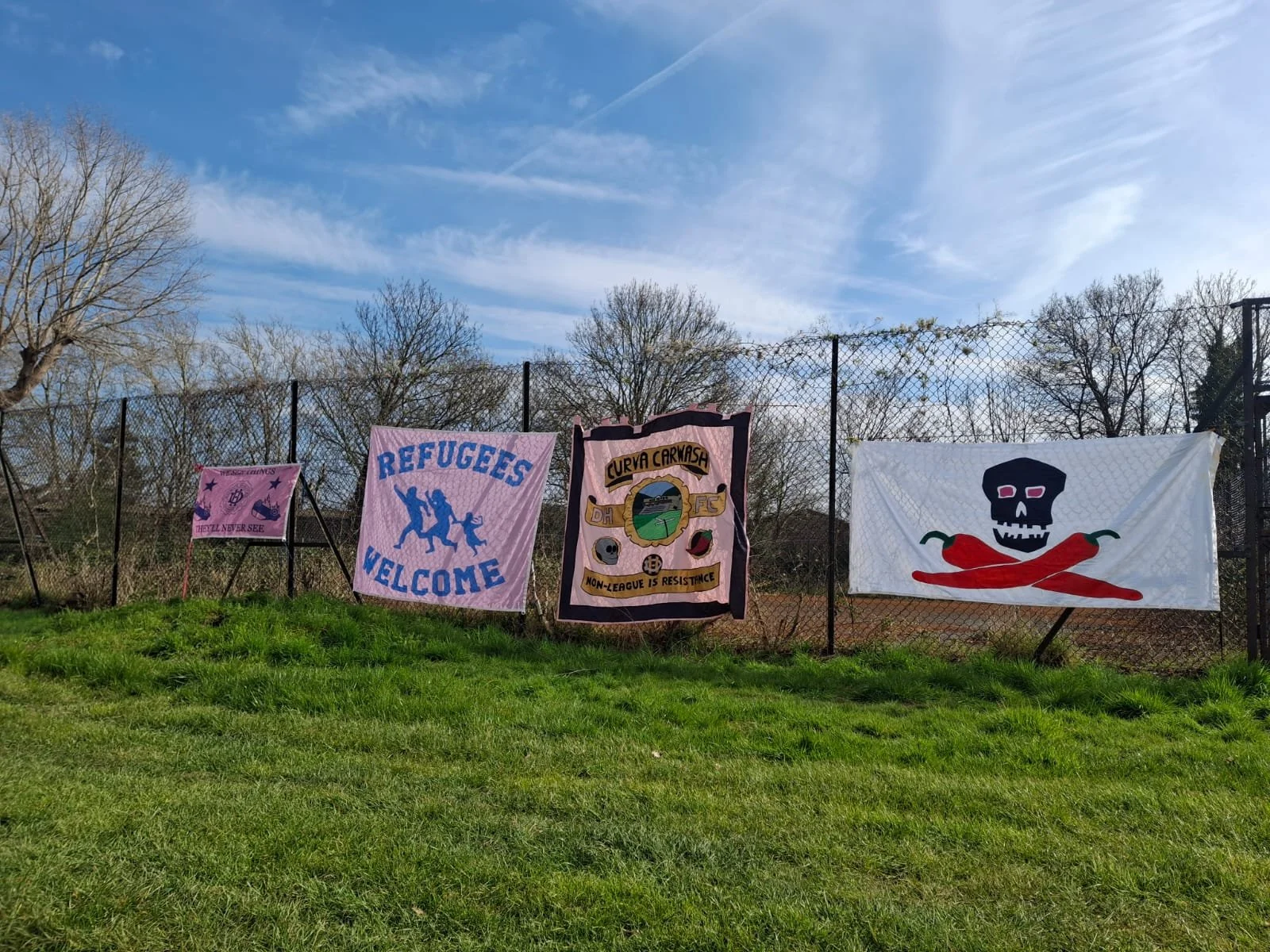
Dulwich Hamlet banners at a game between DHFC Reserves and Clapton Community FC.
Photo Credit: Adam Turner-Heffer
To be clear I do not wish to ignore the problematic aspects of football fan culture, which is well documented. As a member of the trad music community, I am all too aware of the constant struggle against the appropriation of folk culture by right wing nationalists to sow seeds of division and hatred. I know not all people feel welcomed at every club, and do not wish to diminish that experience.
However, it is also true that many fan groups are working hard to build their communities, striving to be more accessible and inclusive, and are delighted to find common ground with newcomers in their shared love of the game.
At that first match at Champion Hill I found myself stood behind the goal among the Curva Carwash, Dulwich Hamlet’s quasi-ultras group. When I told those around me that I was new to football, I was brought up to speed on the lore behind each song, the symbols and references and in-jokes, and had all my most basic questions enthusiastically answered by strangers nearby, who are now friends. This is the infectious enthusiasm and welcoming spirit of folk culture that I recognised, and the kind I want to highlight here.
Comparisons can easily be drawn between what is canonically considered British folk tradition and the folk art of football. The folk ethos naturally lends itself to a certain adhoc, hand-crafted aesthetic, created with the resources that are to hand, with football fan groups, morris dancers and village churches alike chipping in to cover costs of materials and volunteering their time, skills and labour. The clearest manifestation of the culture is in song, using your voice is free and fundamental to building the atmosphere at games: it gives maximum impact at minimal cost.
Football chants are often constructed around known tunes and songs reflecting fan tastes, borrowed and filled with stories and names relevant to the community who are shaping it. This is how folk music has worked forever, passing around stories to memorable, accessible melodies, adding verses here and there, removing ones that aren’t relevant anymore. It is a living tradition with the potential to change in an instant.
“The songs live and die on the terraces”, a Dulwich Hamlet fan said to me, remarking on how the chants come into being; they must be sung into existence. It is a very democratic way of building an oral tradition, trying something new out on the terrace might not catch on for whatever reason, but when a song clicks with everyone it can stick around for a long time, becoming part of a shared repertoire.
Crucially, these chants are not owned by one person, even if they tend to be led by a certain instigator, there is nothing stopping others from leading it or altering it, and nothing stopping fans from other clubs deciding to make their own version of the chant. This is evident across the world particularly in the digital age as songs are passed among different clubs, sometimes left intact and sometimes tweaked to fit the specific community singing them, taking on an entirely new life.
Textiles also play a huge part in the folk art of football communities. Banners and flags of all shapes and sizes adorn non-league clubs around the country, some hand painted and stitched, others designed by fans and digitally printed.
Whether made to last and decorate the terrace week in week out, or in response to a specific match or event as part of a tifo or temporary display, these form a crucial part of the visual identity of a fan group.
They are designed to create a spectacle, a bold visual accompaniment to the chants and songs, creating a multisensory feast in the stands. These banners, whether static or used in more elaborate choreographies are a way a community performs its identity for others, shows support for the players on the pitch. It also contributes to a sense of belonging within the gathered community, as people band together around a large visual marker.
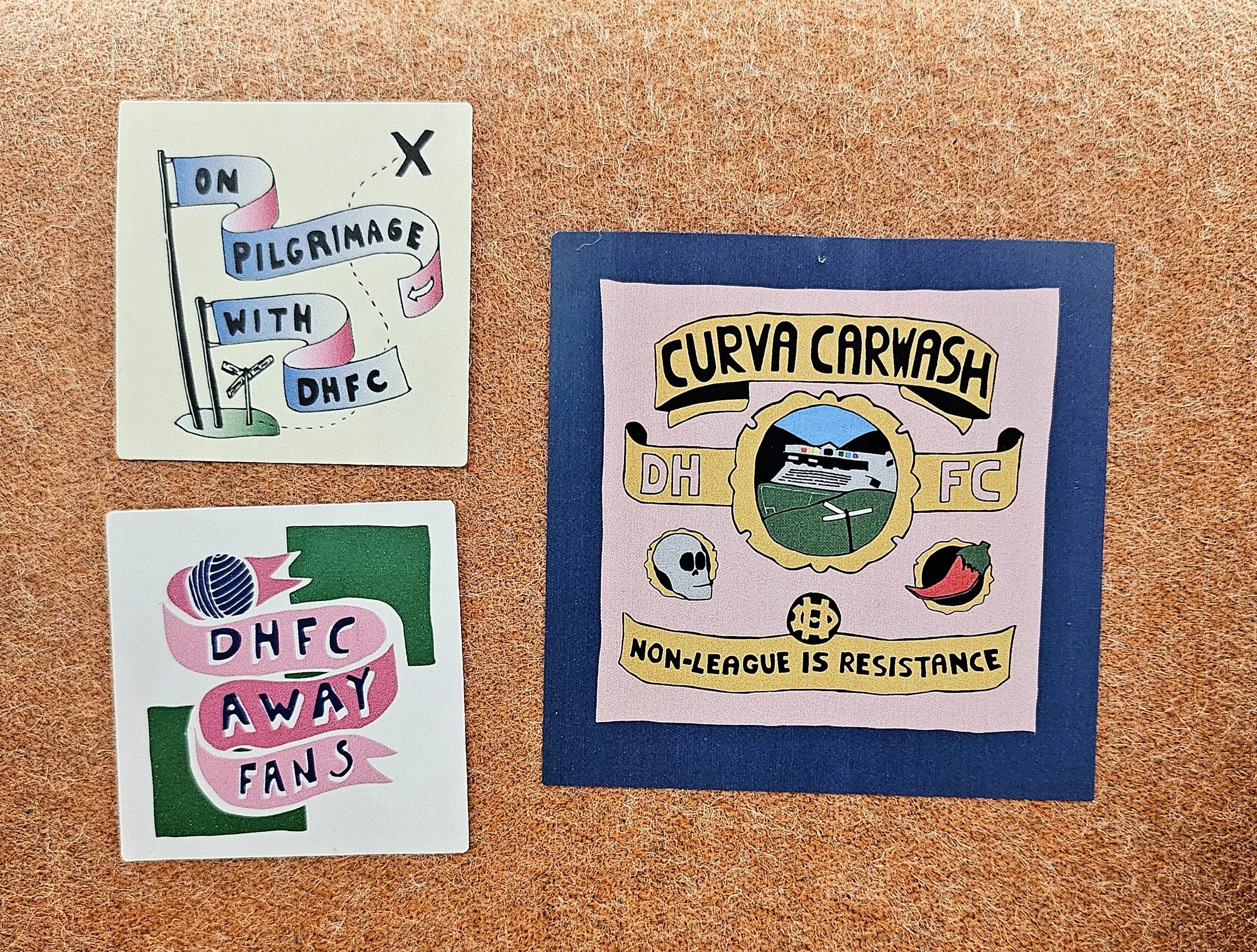
Recent DHFC Stickers including the Curva Carwash banner illustration.
Photo Credit: Jayne Dent
A flag’s basic function is to convey messages about the collective identity of a group through carefully chosen colours, symbols and slogans. In this instance however, it is the coordination, cooperation and labour of love needed to create these large objects that is remarkable, and an example of the folk ethos.
Last year I made a 2.5m Durham Miners Gala style banner for Curva Carwash, bringing to life a design that was put together in a group chat, with the community collectively deciding on the words, symbols and aesthetic they wished to represent themselves. It is owned collectively by the group, and can be seen decorating Champion Hill and occasionally other grounds when taken on away days in a show of support further afield.
Stickers have been made of that same design, a miniature version that can be passed among supporters and spread wherever they see fit to stick a marker of their identity. Fan stickers are another creative manifestation of football folk culture that perform a similar function to banners on a micro scale, sharing these visual markers and slogans.
However, because they are relatively quick and easy to produce, knocked together in editing software and sent to print, they can capture smaller stories too. Due to their ephemeral nature, their messaging can be more casual, political, or responsive to a current trend; they don’t need to be timeless.
Often cheeky and humorous, you can get away with things you wouldn’t necessarily want to put on something as big and permanent as a banner. If a banner is a song’s chorus, stickers are the verses in between, elaborations on the main theme. They spread like wildfire across lampposts and toilet doors without the coordinated choreography of banner waving or unison singing. Stickers are a folk artifact with a particular ability to live a life beyond the moment of creation, they say “our community was here” without the group needing to be physically present.
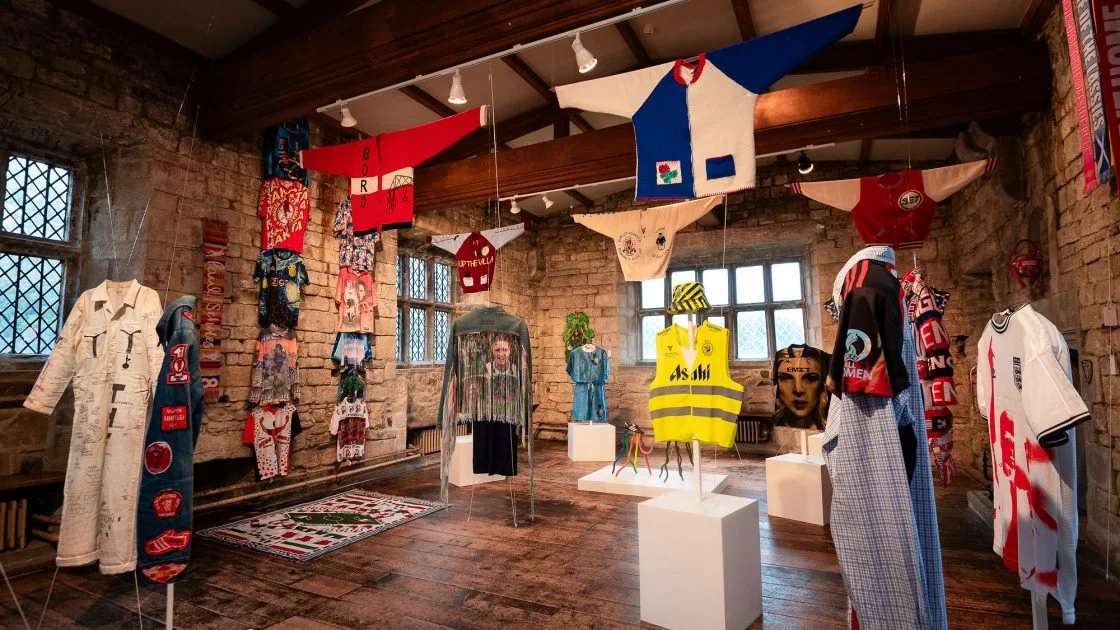
‘100% UNOFFICIAL: The Fabric of Fandom’ OOF Gallery x British Textile Biennial exhibition at Turton Tower, 2025.
Photo Credit: British Textile Biennial
Clothing is another way of creatively expressing your identity, and wearable items are another huge part of football fandom and folk tradition. Clubs have their own merch of course, often bought and worn with pride by fans, however there are many instances of ultras groups who produce and sell their own unofficial merch.
On a recent trip to see Red Star in Saint-Ouen I specifically chose a scarf from the ultras pop-up merch stand over the club’s official shop. Some fans get even more hands on with the personalisation, by knitting their own scarf or jumper in team colours, or carefully curating a collection of patches and pin badges on a battle jacket.
OOF Gallery’s ‘100% UNOFFICIAL: The Fabric of Fandom’ exhibition for the 2025 British Textile Biennial captured a beautiful snapshot of this culture. It immediately conjured morris dancers and their musicians dressed in a colourful uniform, often decorated with the badges and patches of folk festivals and various morris dancing teams, customised exactly like a battle jacket.
These are all ways we signify membership of a community, whether on the street or gathered on the terrace, a solid block of team colours.
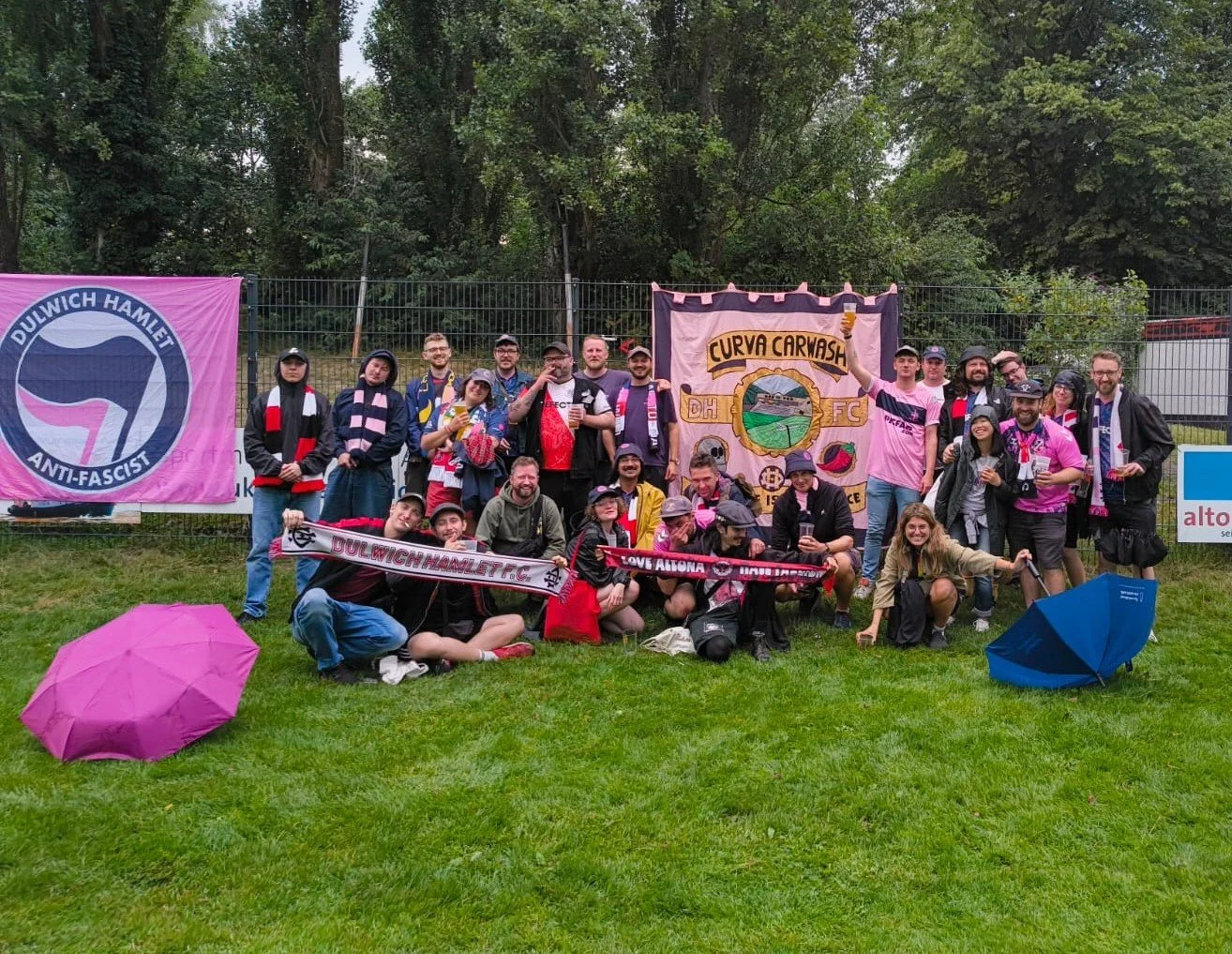
Me sitting among Dulwich Hamlet and Altona 93 fans gathered in front of banners during a friendly between the two clubs in Hamburg.
Photo Credit: Ellice Stevens
Another parallel in wearable textile culture across folk and football are mascot-like costumes, often featuring real or mythical animals that are brought out at parades, gatherings and celebrations. For example, many morris dance teams have a ‘mast’ which is unique to them, though often a horse or stag, that goes around the crowd while the dancers perform. They engage the crowd in the performance, teasing them and sometimes collecting change in a bucket towards the team’s expenses.
This anonymous, fantastical figurehead contributes to the vibrant communal spectacle, they lean into a sense of collective joy and encourage participation, much like mascots at football clubs. Mascots are a ringleader, a jester, and a reminder to not take it all so seriously. That being said, there is a serious point to be made here, about the importance of collective silliness, shared passions and creative expression in what is a pretty bleak world. In an increasingly secular society, we are striving for meaningful connection outside of traditional religious institutions.
It is a trope to say that going to a match is like going to church, talking about football fandom in terms of ritual practice and spiritual experiences. Participation in folk culture is a form of secular communion, connecting us to those in the present moment, and to a past and future through shared stories.
It has the ability to facilitate a sense of belonging, providing us with an anchor and a sense of spiritual wellbeing. In a practical sense, the football calendar follows seasonal shifts, providing us with a way of marking the passage of time. It gives us things to look forward to, a way of shaping the year, causes for celebration, reasons to gather, a pilgrimage destination.
Sometimes our communities are synchronised, on the terraces with voices in unison, and sometimes we connect asynchronously, as we prepare a banner for the next fixture or get lost in a memory of the last one. When I wear my Dulwich Hamlet scarf that features the bus routes of South London, I get our bus route song that lists them all stuck in my head again, and I am transported back to that moment of connection, to singing in the congregation.
Football fans wear their hearts on their sleeves. We see a stranger on the bus in a replica shirt and immediately know our shared history and hopes for the future. We may never speak, but a sense of belonging and connection can be found in those moments, and in those artefacts we hold dear.
For something to be folk culture it should ultimately remain in the hands of the communities creating it and sharing it, with fan owned clubs particularly being a great example of this community centred ethos.
Non-league football clubs provide an environment that can encourage folk culture to flourish in contrast to larger clubs that are increasingly divorced from the fans, who put profit before people and push out fans who can’t afford a season ticket or a replica shirt.
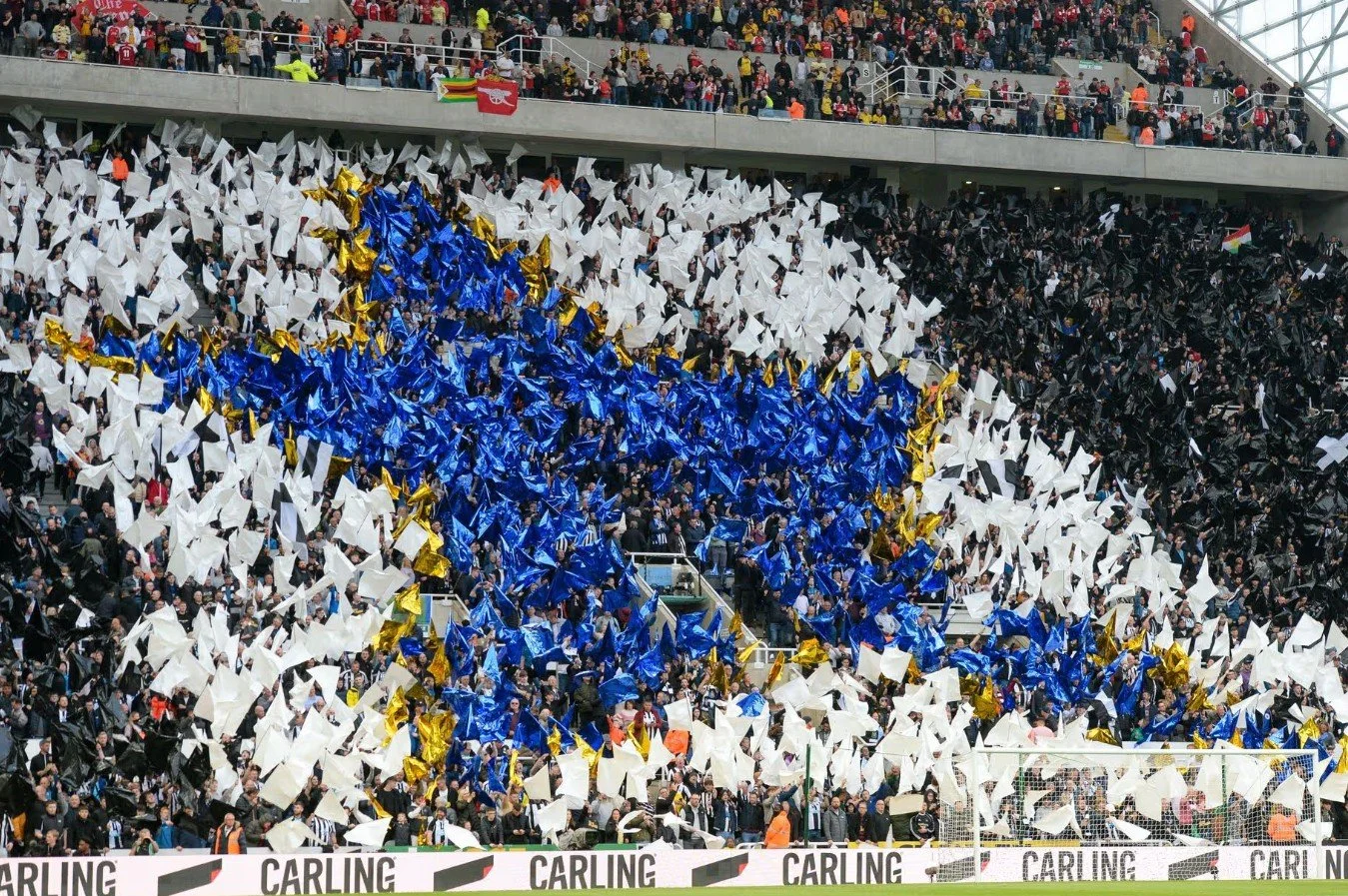
Newcastle United Display by Wor Flags, 2023.
Photo Credit: ChronicleLive
That isn’t to say that supporters of premier league clubs are not able to be involved in the folkier aspects of football fandom. Take the incredible displays at Newcastle United’s St James Park for instance, the work of hundreds of local volunteers coordinated by Wor Flags.
However such displays are subject to a more rigorous set of barriers and red tape from larger clubs, and when they are allowed to occur they fit within a system that is designed to maximise profit, that sees every opportunity to take credit for that community effort before selling this culture back to the fans at a marked up price.
There are countless examples of clashes between fans and the clubs they support, with banners and songs being made specifically to call out clubs on decisions their fans disagree with. It is crucial that we protect the ability to do this, and don’t allow this method of collective expression to be sanitised or stamped out.
There is a long history of British folk culture being picked apart by taste-makers, with its prettier and more marketable aspects championed, and its less palatable, anti-authority stances intentionally forgotten, often leaving out the voices and stories of marginalised communities. Football is no different here. All of this fits into the broader political context we find ourselves in right now, one in which we are expected to be consumers of culture and not the creators of it.
Hobbies are seen as things to monetise, side hustles that are only worth doing if you’re ‘good enough’ to be paid to do them. Being creative is a luxury of the rich, and the voices of working class people are simply deemed less important by those hell bent on stamping out any DIY community spirit.
Increasingly there is a sense of being pulled apart from each other and from what makes us human in service of productivity and profit. Technologies are being designed to replace and negate our creative and critical thinking, to divide and control, instead of connecting us and enhancing our quality of life. In amongst all the noise and strain of modern life, doing-it-yourself, grassroots folk culture stands against that.
When culture is made by the community, for the community, it stands against capitalist interests, bland AI and corporate aesthetics. This is why I think it is so important that we treat terrace culture as a precious thing, a valuable community tradition and a practice that supports communal wellbeing.
If we frame terrace tradition as a form of folk art and celebrate the DIY ethos and its aesthetic, perhaps we can give ourselves permission to cherish it and fight harder for it, to participate in our communities with intention and passion, to continue to tell our stories in a creative, inclusive and human way.
So, I urge you to get involved. Knit yourself a scarf in your team colours, paint a banner on bedsheet, squeeze the name of your favourite player into the chorus of your favourite song and teach everyone the new lyrics, design some stickers and hand them out, turn your favourite away day anecdote into a meme. Collaborate with the people around you to make something meaningful, something silly, something outrageous, something for the terrace or something for the group chat, because we are human and it’s what we do, far better than AI ever could.
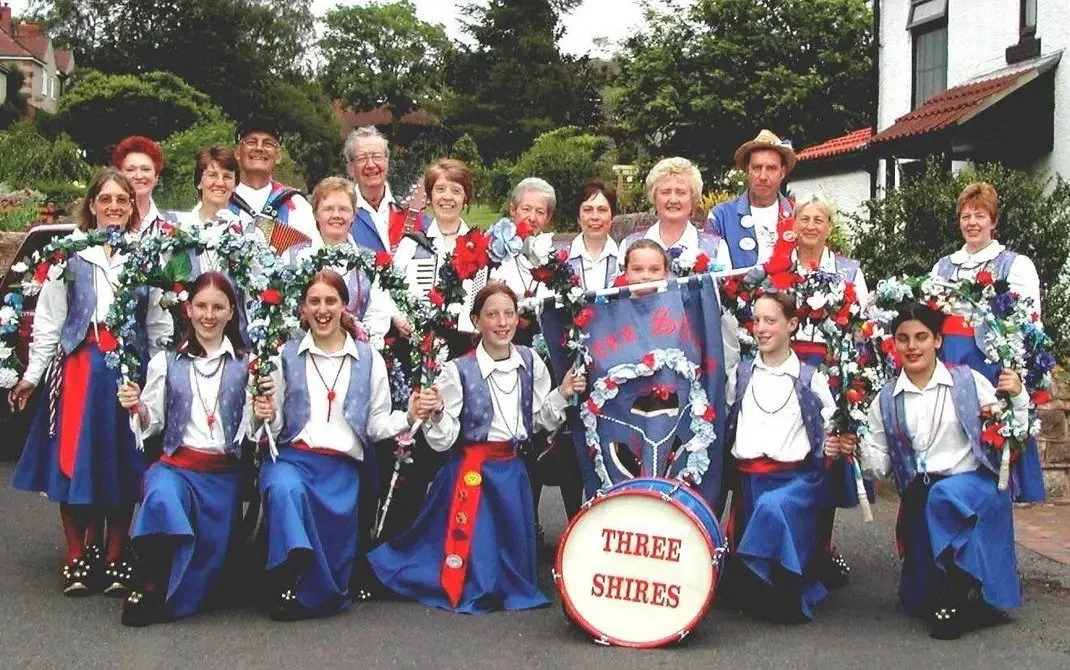
Carrying the banner of the morris dancing team I grew up with, surrounded by everyone dressed in the colours of the team, with some displaying patches and badges of a variety of morris festivals and events, 2003.
Photo Credit: Three Shires Clog