

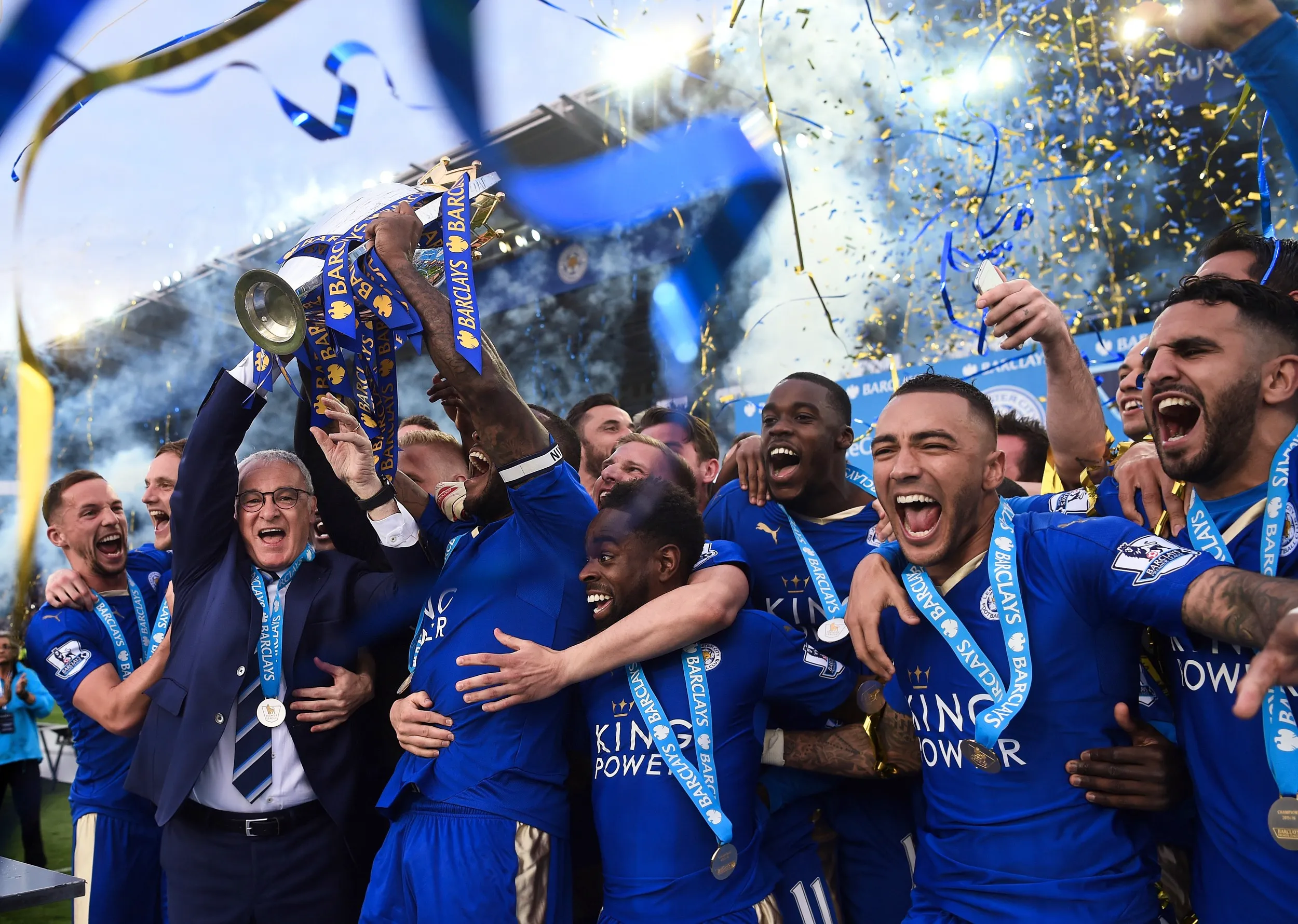
Words by Jonee | Published 02.05.2026In the grand, monetised theatre of the Premier League, where television revenue distorts gravity and the established order tends to reassert itself with remorseless predictability, the 2015–16 season was supposed to follow a familiar script. The wealthiest clubs would compete for the title; the merely affluent would jostle for European places; the rest would look anxiously over their shoulders.
Instead, English football experienced a rupture in its assumed logic. Leicester City, a club that had narrowly escaped relegation twelve months earlier, won the league. Not by accident, not by a late-season fluke, but across 38 matches, finishing ten points clear. It was not merely surprising; it was structurally disobedient. By the economic and competitive standards of the division, it was close to impossible.
To understand the scale of the upheaval, one must begin with cost. In an era when squad assembly at the top of English football resembled arms procurement, Leicester’s title-winning group was, by comparison, inexpensive to the point of austerity. Their starting XI on many afternoons had been acquired for sums that, individually and collectively, would barely have secured a single marquee signing for one of the established giants. N’Golo Kanté had arrived from Caen for a fee that felt speculative rather than transformative.
Riyad Mahrez, signed from Le Havre for a modest sum, had been a promising but hardly celebrated recruit. Jamie Vardy had been plucked from non-league football only a few seasons earlier. Wes Morgan had been a dependable Championship defender. Kasper Schmeichel had rebuilt his career outside the spotlight that once followed his surname. Even the more seasoned additions, such as Robert Huth, had been acquired without fanfare. By Premier League standards, this was a cheap squad, assembled not by extravagance but by sharp identification and a willingness to trust unfashionable profiles.
The financial modesty of the group did not mean a lack of talent. What it meant was that the talent had been undervalued. This distinction is crucial. Leicester’s recruitment department and managerial staff did not conjure ability out of thin air; they recognised traits that larger clubs either overlooked or mispriced. Kanté’s capacity to devour space, to intercept and recover with preternatural timing, was evident in France, yet not enough to trigger a bidding war. Mahrez’s balance and unpredictability were present in Ligue 2. Vardy’s pace had always been searing; his edge, psychological as much as physical, had always been sharp. What changed in 2015–16 was the environment. These players were were optimised.
At the centre of that optimisation stood Claudio Ranieri. When he was appointed in the summer of 2015, the reaction bordered on incredulity. His recent tenure with Greece had been brief and unsuccessful. In English memory he was associated with tinkering at Chelsea, a genial figure often cast as an amiable nearly-man.
The narrative suggested that Leicester, having flirted with relegation, had chosen sentiment over strategic clarity. Yet the appointment proved uncannily suited to the moment. Ranieri’s geniality masked a clarity of purpose. He inherited a squad that had finished the previous season with a remarkable run of victories under Nigel Pearson, built on defensive resilience and rapid counter-attacks.
Ranieri did not dismantle this foundation, but refined it. His genius, if one may use the term, was restraint. He recognised that this group did not require reinvention. It required belief, structure, and an absence of panic.
Tactically, Leicester were not revolutionary in shape. They operated primarily in a 4-4-2, a formation considered almost antiquated among elite clubs increasingly seduced by hybrid systems and possession-heavy structures. But within that simplicity lay precision.
The back four, marshalled by Morgan and Huth, defended deep and narrow, protecting central spaces and inviting opponents to advance. In midfield, Kanté’s extraordinary range allowed Danny Drinkwater to play progressive passes early, often diagonally into the channels. On the flanks, Mahrez and Marc Albrighton provided width but also disciplined tracking. Ahead, Vardy stretched defensive lines with relentless runs into space. The approach was direct, vertical, and unapologetic.
This clarity of identity proved devastating in a season defined by uncertainty elsewhere. The traditional powers faltered in synchronised disarray. Chelsea, defending champions, imploded amid internal discord and a dramatic loss of form that ultimately cost José Mourinho his position.
Manchester United were in a period of stylistic stasis under Louis van Gaal. Manchester City, while dangerous, were inconsistent and distracted by the announcement of Pep Guardiola’s impending arrival. Arsenal flattered and frustrated in equal measure. Tottenham Hotspur emerged as Leicester’s principal challengers but carried the weight of youth and expectation. The league table, usually stratified by financial hierarchy, loosened. In that looseness, Leicester capitalised.
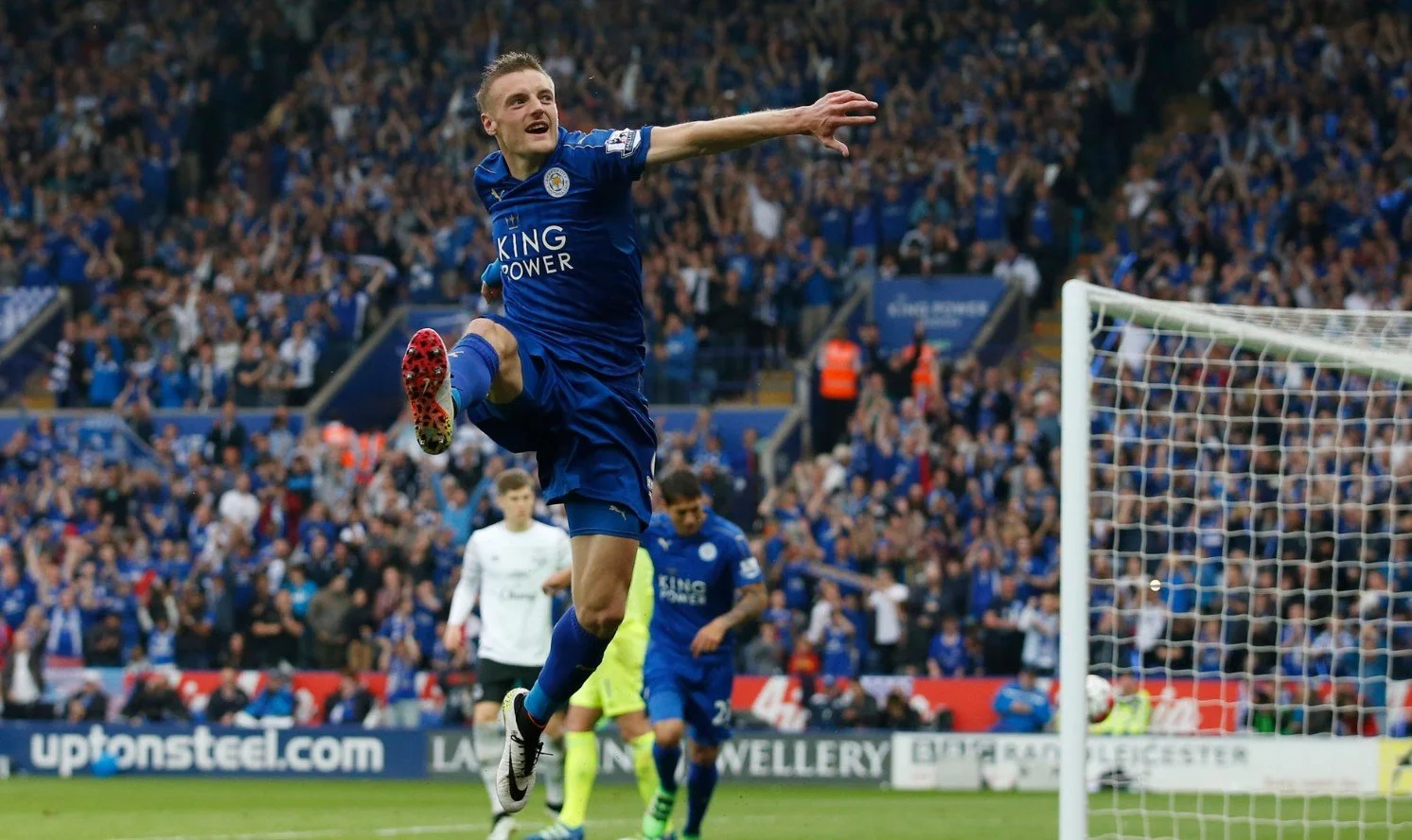
Jamie Vardy typified Leceister's title win in 2016.
Photo Credit: The Guardian
Surprise, however, is not a constant condition. It evolves. In August, Leicester’s victories were charming anomalies. By October, they were an intriguing subplot. When Vardy began scoring with such regularity that he equalled and then surpassed Ruud van Nistelrooy’s record for scoring in consecutive Premier League matches, curiosity hardened into attention. The moment Vardy scored in eleven straight league games, the improbable demanded examination. What had once seemed raw now appeared refined. Vardy did not simply outplay his previous seasons; he redefined the ceiling of his own career.
Mahrez’s transformation was equally striking. In prior campaigns he had shown flashes of invention, yet in 2015–16 those flashes became sustained illumination. He drifted inside onto his left foot, gliding past defenders with a composure that bordered on insolence.
Where Vardy was combustion, Mahrez was artistry. Together they formed a partnership of contrasts, underpinned by Kanté’s omnipresence. The French midfielder’s performances that season remain among the most influential in modern English football. He intercepted, tackled, recovered, and recycled with an energy that seemed inexhaustible. Observers began to ask whether one player could tilt a league; Kanté suggested that, in the right ecosystem, he could.
Each individual player appeared to exceed prior expectations. This collective overperformance was not random. It reflected confidence, clarity of roles, and the psychological freedom that accompanies low external expectation. Leicester were not burdened by the assumption of entitlement. They were liberated by doubt.
As winter gave way to spring, the narrative shifted from “Can they?” to “Will they?” Each fixture acquired heightened significance. Victories away at Manchester City and Tottenham became statements of intent. Clean sheets accumulated. Leicester conceded few goals and rarely lost shape. Ranieri’s sideline persona concealed a ruthless focus on marginal gains. There was minimal rotation. The starting XI became familiar to the point of ritual. Continuity bred understanding.
The wider impact across the league was complex. For rival supporters, Leicester’s ascent provoked a mixture of admiration and unease. If a club assembled at comparatively low cost could outperform the superpowers, what did that imply about the efficiency of the established model?
For neutrals, the story revived a romantic ideal of competition. Broadcasters revelled in the narrative. Pundits oscillated between scepticism and wonder. The odds offered by bookmakers at the season’s outset—so long as to be treated as a novelty—became shorthand for improbability. Yet the deeper impact lay in recalibrating belief. Clubs outside the traditional elite glimpsed possibility. Recruitment departments reconsidered value. Tactical orthodoxy was questioned. The league, often criticised for predictability at its summit, rediscovered suspense.
Context is essential. The 2015–16 season did not occur in isolation. The Premier League had, since its inception in 1992, cultivated global reach and financial disparity. Title races were frequently dominated by a narrow cadre of clubs with structural advantages in revenue and brand power. Leicester’s triumph did not dismantle these structures permanently, but it exposed their permeability.
It also arrived at a moment when English football grappled with broader anxieties—about competitiveness in Europe, about youth development, about financial sustainability. In that environment, Leicester’s ascent felt both nostalgic and radical. Nostalgic, because it evoked older narratives of community clubs defying hierarchy; radical, because it unfolded within the hyper-commercial modern era.

Riyad Mahrez lifts the Premier League trophy.
Photo Credit: BBC Sport
Statistically, Leicester’s season was not dominant in the conventional metrics of possession or shot volume. They often ceded the ball. They were content to absorb pressure. Yet their efficiency was extraordinary. They converted chances at a high rate, defended set-pieces with discipline, and maintained remarkable consistency in selection. They lost only three league matches all season. Such resilience, sustained over nine months, undermines any suggestion of fluke. Luck may influence individual matches; it cannot account for a ten-point margin across 38 games.
Ranieri’s suitability for the role becomes clearer in retrospect. His previous experiences—across Italy, Spain, France, and England—had exposed him to varied footballing cultures. He understood dressing-room psychology. He neither overcoached nor underprepared. Crucially, he shielded his players from external noise. When journalists pressed him on title ambitions, he deflected. The objective, he insisted for much of the season, was survival. Forty points. Safety. This rhetorical modesty reduced pressure. It allowed focus to remain internal. By the time the language shifted towards the title, the foundation was unshakeable.
The economic contrast between Leicester and their rivals sharpened appreciation of the feat. Wage bills, often correlated with league position, were dwarfed by those of the traditional powers. Transfer expenditure, while not negligible, was targeted rather than extravagant.
This did not represent a rejection of modern analytics or scouting networks; rather, it illustrated their potency when aligned with coherent strategy. Leicester’s ownership, led by Vichai Srivaddhanaprabha, provided stability and support without indulgent interference. Investment in infrastructure and recruitment was measured. The club was neither reckless nor timid. It was purposeful.
The ripple effects extended beyond England. International audiences, accustomed to the dominance of financial heavyweights, were captivated. Commentators invoked parallels with sporting miracles elsewhere, yet Leicester’s achievement retained distinctiveness because of the league’s depth. Unlike cup competitions, the Premier League’s format rewards consistency. There are no two-legged reprieves, no single-match upsets to conceal structural weakness. To top the table in May is to have navigated every variety of challenge—form slumps, injuries, tactical adjustments from opponents determined to decode your methods.
Opposition managers attempted precisely that. As the season progressed, teams defended deeper against Leicester, wary of Vardy’s runs. They pressed Kanté more aggressively. They sought to isolate Mahrez. Yet Leicester adapted subtly. When space diminished behind defences, they demonstrated patience. When Vardy was suspended late in the season, others contributed goals. The collective proved more robust than the caricature of a counter-attacking novelty act.
The heroes of the campaign occupy enduring places in English football folklore. Vardy’s journey from non-league obscurity to international recognition challenges linear assumptions about talent development. Mahrez’s elegance provided moments replayed endlessly in highlight reels. Kanté’s subsequent moves to elite clubs reinforced retrospective appreciation of his Leicester performances. Morgan became the first Jamaican-born captain to lift the Premier League trophy. Schmeichel, echoing his father’s achievements in a different era, forged his own legacy. Yet heroism, in this context, was communal. The squad functioned as a symphony rather than a solo recital.
There is an academic temptation to reduce Leicester’s title to a case study in variance, to analyse expected goals and regression curves, to argue that the confluence of underperformance among giants and overperformance among underdogs created a statistical anomaly. Such analysis has merit, but it risks overlooking human agency. Confidence is not easily quantified. Nor is cohesion. Leicester’s players spoke frequently of unity, of clarity, of enjoyment. These are not mystical properties; they are competitive advantages when aligned with tactical discipline.
The aftermath complicates the narrative without diminishing it. Leicester did not inaugurate an era of sustained dominance. The structural forces of the league reasserted themselves in subsequent seasons. Key players departed. The following campaign brought the harsh education of Champions League participation and domestic inconsistency. Ranieri himself would depart less than a year after the triumph. Yet the transient nature of the success enhances its poignancy. It was a season that refused replication, a convergence of circumstance and preparation that, once passed, could not be summoned at will.
For the Premier League, the 2015–16 season remains a touchstone in discussions of competitiveness. Whenever the title race appears predictable, Leicester are invoked as evidence that unpredictability endures. For supporters of clubs outside the established elite, the memory sustains hope. For analysts, it offers a reminder that efficiency and clarity can outperform expenditure. For romantics, it stands as proof that football, even in its most commercialised form, retains capacity for astonishment.
In stadiums accustomed to rehearsed coronations, this felt spontaneous. The crowd’s disbelief blended with euphoria.
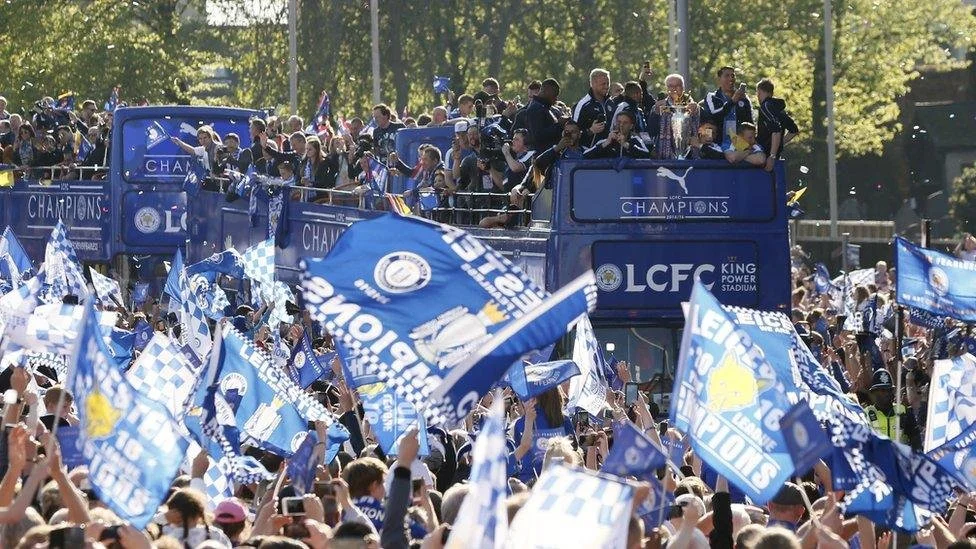
Leicester and their supporters celebrated with an open top bus parade.
Photo Credit: BBC Sport
If one seeks a singular explanation for why Ranieri was the man for the job, it lies in temperament. A more dogmatic coach might have imposed complexity. A more insecure one might have rotated excessively in pursuit of marginal advantages. Ranieri trusted his players. He trusted repetition. He understood that momentum, once established, should not be disrupted lightly. His career, often characterised by near-misses, perhaps prepared him for this moment more than a résumé glittering with recent triumphs would have. He carried neither arrogance nor fear.
In retrospect, one can identify turning points: Vardy’s record-breaking goal; Mahrez’s virtuoso display at the Etihad; the disciplined draw at Old Trafford; the narrow victories secured by defensive concentration in March and April.
Yet the true turning point may have been psychological, the moment when the squad collectively accepted that the improbable was achievable. That shift, intangible yet decisive, separated them from hopeful challengers of seasons past.
The 2015–16 title was not an accident. Above all, it reminded English football that inevitability is an illusion. In the long ledger of the Premier League, crowded with predictable champions, Leicester City’s triumph endures as an emphatic anomaly—historical, surprising, and, by the standards of its environment, profoundly disruptive.
And yet, to stop at disruption is to understate the cultural resonance of what Leicester achieved. For decades, the gravitational pull of money had bent English football towards predictability. Broadcast revenue had widened the chasm between divisions, and within the Premier League itself the elite had grown accustomed to insulation. Leicester did not dismantle that architecture, but for one incandescent season they slipped through its seams and revealed that structure is not destiny.
The weeks that followed confirmation of the title deepened the sense that something unusual had occurred. The trophy presentation at the King Power Stadium was not choreographed grandeur but communal catharsis. When Andrea Bocelli sang before kick-off against Everton and the ground shimmered in blue and white, the occasion carried a note of disbelief. Supporters who had watched their club oscillate between divisions, who had endured administration, now witnessed their captain lift the most lucrative domestic prize in world football. It was a civic celebration as much as a sporting one. Leicester found itself at the centre of the global game.
There is also value in examining the campaign through the lens of leadership beyond the manager. Wes Morgan’s captaincy deserves sustained attention. Centre-halves often embody conservatism, but Morgan’s influence was progressive in its steadiness. He and Huth formed a partnership that thrived not on speed but on positioning and mutual understanding. They were rarely drawn into the frantic pressing that characterised other teams; instead, they held their line, cleared decisively, and trusted Kanté to sweep up the second ball. Leadership here was not rhetorical but spatial. The defence organised itself around clarity.
Kasper Schmeichel’s contribution similarly resists easy quantification. Clean sheets are collective achievements, yet while forwards win you games, goalkeepers win you titles. In interviews, he articulated belief without bravado, reinforcing the dressing room’s equilibrium. The son of a treble winner with Manchester United, Schmeichel might have been burdened by comparison; instead, he authored his own chapter.
Danny Drinkwater’s role illustrates how systems elevate individuals. Prior to the title season, he was viewed as competent but unspectacular; a safe choice. Within Ranieri’s framework, his diagonals into channels became fundamental. Leicester’s transitions depended on speed of thought as much as speed of foot. Drinkwater received from defence and released early, often first time, into Vardy’s path. The timing was surgical. His partnership with Kanté was complementary: one disruptor, one distributor. Together they compressed and expanded the pitch according to need.
One cannot ignore the psychological dimension of momentum. Early in the campaign, Leicester developed a habit of scoring first. This altered match dynamics. Opponents, compelled to chase, advanced their lines. Space emerged. Vardy’s pace became more lethal. Confidence compounds in sport; each narrow victory fortified belief.
Leicester conceded only 36 goals across the season, the second-best tally in the league. This was achieved without monopolising possession. The compactness between lines reduced central penetration. Opponents were funnelled wide, where crosses were contested robustly. Set-piece organisation was meticulous. In a league often seduced by attacking metrics, Leicester illustrated that defensive reliability remains foundational.
The economic argument, however, remains central to the mythos. Comparisons of wage bills and net transfer spend circulated widely. Leicester’s outlay paled beside that of their competitors. Yet it would be reductive to portray the triumph as purely anti-capitalist romance.
The club’s Thai ownership had invested significantly in infrastructure and stability. The training ground environment improved. Recruitment networks expanded. What Leicester avoided was conspicuous consumption. They did not chase reputational signings. They pursued fit. In this sense, the title can be read as a case study in efficient resource allocation within a distorted market.
Media discourse during the run-in oscillated between celebration and scepticism. Pundits searched for regression indicators. Expected goals models suggested overperformance. The debate itself reflected discomfort. Modern analysis, grounded in probability, struggled to accommodate sustained deviation.
Leicester did not invalidate analytics; rather, they highlighted that models operate within parameters that can be stretched by exceptional alignment of factors. Finishing skill, goalkeeping excellence, and psychological resilience can temporarily outrun predictive baselines.
There is also a sociological layer. The squad’s diversity coalesced into unity. Kanté from France via Mali; Mahrez from France via Algeria; Morgan from Nottingham via Jamaica; Fuchs from Austria; Okazaki from Japan; Schmeichel from Denmark.
This cosmopolitanism mirrored the league’s global character, yet the cohesion suggested integration rather than fragmentation. In a period of broader societal debate about identity, belonging and race within Britain, Leicester’s dressing room offered a quietly powerful counter-narrative: collective purpose transcending origin.
Ranieri’s public persona contributed to the season’s texture. His humour in press conferences, his light-hearted references to pizza rewards for clean sheets, his insistence on incremental targets — these gestures humanised a campaign that might otherwise have been crushed by scrutiny. Behind the levity was experience. Ranieri had navigated title races before, often falling short. Those disappointments perhaps tempered his approach. He did not transmit anxiety. He transmitted steadiness.
In the seasons since, historians of the game have debated whether Leicester’s triumph altered structural dynamics or merely provided interlude. The subsequent reassertion of financially dominant clubs suggests the latter. Yet influence need not be permanent to be profound. Leicester expanded the realm of conceivable outcomes. Supporters of mid-sized clubs now invoke 2016 not as fantasy but precedent. Recruitment departments reference it when advocating patience and fit over glamour. Managers cite it when defending pragmatic systems against aesthetic critique.
The Champions League campaign that followed, in which Leicester advanced to the quarter-finals, reinforced the idea that the title was not accidental. European opponents accustomed to English wealth underestimated English thrift. Leicester’s disciplined approach translated effectively. Although domestic form dipped and Ranieri eventually departed, the European run extended the narrative beyond a single season’s anomaly.
It is also instructive to consider what Leicester did not do. They did not chase possession statistics for their own sake. They did not rotate excessively in pursuit of squad harmony. They did not abandon their principles when confronted by fashionable tactical trends.
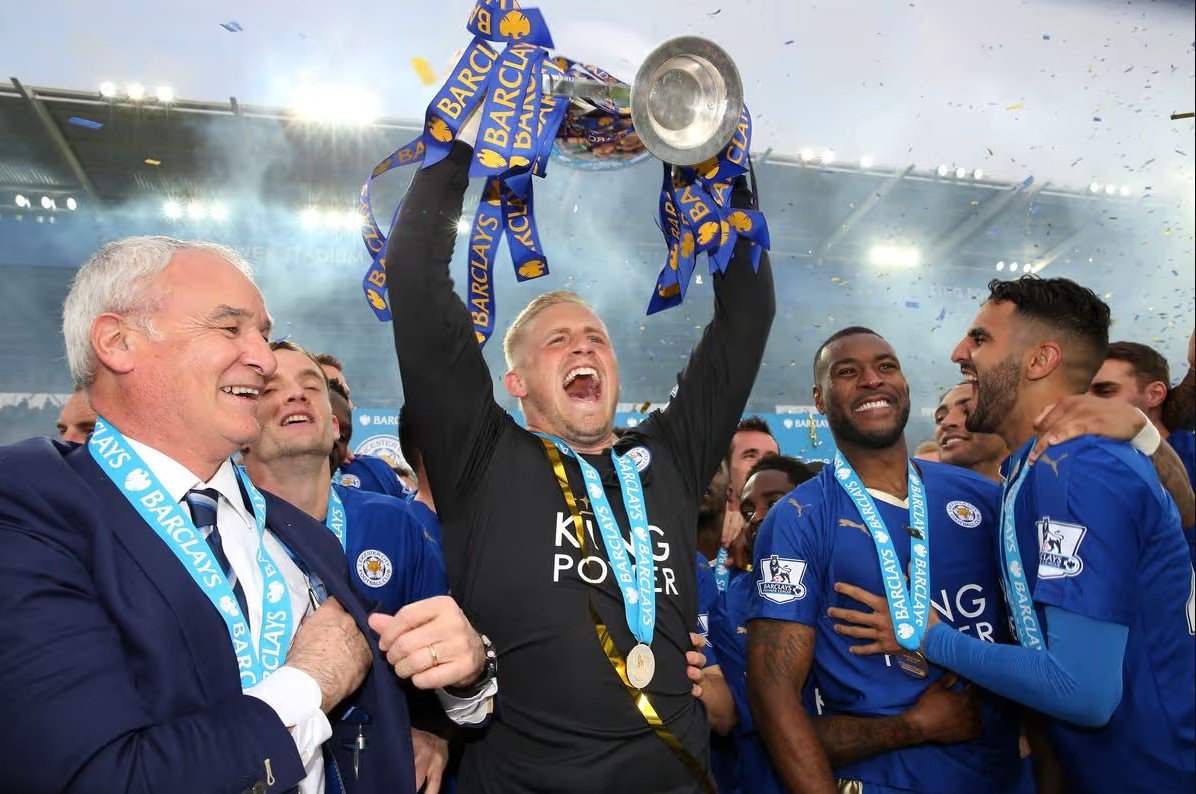
Kasper Schmeichel enjoyed one of the best spells of his career in Leicester's title-winning season.
Photo Credit: Leicestershire Live
The phrase “the man for the job” attached to Ranieri acquires richer meaning when one considers timing. Appointed after Pearson’s controversial departure, he inherited a squad bonded by adversity. His temperament soothed potential fractures. A more authoritarian figure might have disrupted harmony. Ranieri’s authority was relational rather than coercive. He commanded respect through experience and empathy.
Jamie Vardy’s narrative arc warrants further reflection because it intersects with themes of meritocracy and perseverance. Released by Sheffield Wednesday as a teenager, working in a factory while playing non-league football, he ascended through persistence. His scoring streak during the title season was not merely prolific; it was symbolic. Each goal seemed to defy assumptions about pedigree. When he ran onto Drinkwater’s passes, shrugging off established defenders, he embodied possibility. The Premier League, often criticised for narrowing pathways, momentarily appeared porous.
The historiography of English football often privileges dynasties: the Liverpool of the 1980s, the Manchester United of the 1990s and 2000s, the Manchester City of the Guardiola era. Leicester’s 2015–16 side resists categorisation because it stands alone. There was no preceding dominance, no immediate succession. It is a singular spike on the graph. That singularity enhances its mythic quality.
Ultimately, the season invites reflection on why sport captivates. If outcomes were predetermined by expenditure, interest would wane. Leicester restored volatility. They reminded audiences that preparation can intersect with opportunity to produce shock. The league table at the end of May 2016 was not merely a ranking; it was a narrative artefact.
In long form, one returns to the opening premise: by Premier League standards, Leicester’s squad was cheap. Several players outperformed prior seasons dramatically. Ranieri proved the ideal steward. The wider league felt the tremor. The surprise endured from August to May. The heroes multiplied. These elements, when braided together, produced a campaign that transcended its statistical footprint.
Years hence, when debates arise about the greatest achievements in English football, Leicester City’s title will remain central. Not because it inaugurated supremacy, but because it interrupted it. In a competition calibrated towards hierarchy, they authored dissent. And in doing so, they left an imprint not only on record books, but on belief itself.
A decade on, distance alters texture. What felt breathless and suspended in the spring of 2016 now settles into history. Ten years is long enough for myth to harden, for careers to arc and fall, for stadiums to change managers and philosophies several times over. It is also long enough for the Premier League to reveal its deeper tendencies. And in that longer view, Leicester City’s title appears even more extraordinary — not because it has been replicated, but precisely because it has not.
In the ten seasons since that improbable coronation, the gravitational pull of wealth has reasserted itself with emphatic clarity. The title has, once again, become the near-exclusive property of clubs whose revenues dwarf the median. The financial stratification that Leicester momentarily seemed to disrupt has, if anything, intensified. Broadcast deals have grown. Commercial partnerships have globalised further. Squad costs have ballooned to figures that would have appeared fantastical in 2016. The league’s summit has hardened into a citadel.
This is not to say that Leicester’s triumph was illusory. It was real, concrete, recorded in gold lettering and blue ribbons. But its singularity becomes more pronounced with each passing season dominated by economic superpowers. The clubs that have lifted the trophy since 2016 have done so with squads assembled at immense cost, supported by infrastructures engineered for sustained success. Recruitment departments have become more sophisticated; data analysis has deepened; depth has become a weapon as potent as any tactical innovation. Leicester’s model — lean, cohesive, lightning in transition — has not been replicated at the same scale by another outsider.
Why? The answers are structural as much as sporting. In 2015–16, several traditional giants faltered simultaneously. Chelsea collapsed under internal strain. Manchester United were in transition. Manchester City were awaiting a new era. Arsenal hesitated at critical junctures. Tottenham, vibrant but youthful, were not yet hardened. Such convergence is rare. Modern elite clubs have since fortified against vulnerability. Managerial appointments are more strategic. Succession planning is more deliberate. Financial compliance mechanisms, while imperfect, have not eroded the advantages of those already ahead.
Moreover, Leicester themselves became a case study in the difficulty of sustaining disruption. The immediate aftermath of triumph was exhilarating. The Champions League adventure extended the romance. Yet domestic inconsistency crept in. Key figures departed. N’Golo Kanté moved on; Riyad Mahrez would follow in time. Claudio Ranieri, the steward of equilibrium, left less than a year after the title. The squad that had seemed invulnerable to regression discovered that equilibrium is delicate.
There is a quiet poignancy in this arc. The miracle felt momentous at the time — and it was. Streets filled, strangers embraced, and the league’s established hierarchy appeared permeable. But the very conditions that enabled the ascent were transient. Cohesion can be sustained only so long before success attracts attention, bids, and ambition. Financial gravity operates not only between clubs but within them. When undervalued players become properly valued, retention becomes costly. Leicester’s recruitment brilliance could identify gems; retaining them amid global interest proved another challenge entirely.
The Premier League of the mid-2020s is a more polarised landscape. Wage bills at the summit stretch into realms that render comparison almost abstract. Title races, while occasionally dramatic, tend to orbit a narrow axis of the ultra-wealthy. The language surrounding contenders often begins and ends with net spend, commercial reach, and squad depth measured in international caps. Tactical sophistication remains crucial, but it is underwritten by resources. Leicester’s 2015–16 side, by contrast, functioned as an alignment of optimisation rather than accumulation.
In retrospect, perhaps the most honest word for that season is anomaly — not in the dismissive sense of fluke, but in the statistical sense of rare deviation. Anomalies illuminate systems by diverging from them. Leicester exposed the permeability of hierarchy without dismantling it. They proved that under specific conditions — synchronised underperformance among giants, exceptional internal harmony, recruitment that outstrips cost — a breach is possible. But they did not rewrite the economic logic of the league.
And yet, if reality has reasserted itself, the memory resists diminishment. The miracle endures precisely because it was not built upon. Had Leicester evolved into perennial contenders, the romance might have faded into routine. Sustained dominance breeds admiration, but not disbelief. What gives 2015–16 its enduring shimmer is that it stands alone. It is a peak unconnected to a mountain range.
Ten years on, the key protagonists occupy varied trajectories. Some have retired. Others have moved into coaching or punditry. Their careers, like all careers, have been subject to time’s erosion. But when footage replays — Vardy racing clear, Mahrez gliding inside, Kanté intercepting with uncanny timing, Morgan lifting the trophy — the sensation returns. It is not nostalgia in the saccharine sense; it is recognition of rupture. For one season, the league’s script was seized and redrafted.
There is also a lesson in impermanence. Modern football is often obsessed with legacy as accumulation — titles stacked; eras defined by sustained superiority. Leicester reminds us that legacy can be episodic. A single, incandescent campaign can reverberate more deeply than a sequence of expected triumphs. Scholars of sport sometimes speak of “punctuated equilibrium”: long periods of stability interrupted by brief, transformative shocks. Leicester were the punctuation mark.
The city itself has changed in the intervening decade, as cities do. The club has experienced relegation battles, managerial shifts, and rebuilds. Success has not insulated it from vulnerability. If anything, the oscillation underscores how fine the margins are outside the financial elite. Competing sustainably against clubs with exponentially greater spending power requires near-perfection in recruitment and development. Leicester achieved near-perfection once. Expecting repetition was perhaps always unfair.
And so we arrive at a sober but not cynical conclusion. The 2015–16 title was, in the truest sense, a miracle — not supernatural, but extraordinary beyond rational expectation. It was constructed through diligence, intelligence, and unity, yet it relied upon a confluence unlikely to recur. The subsequent decade, dominated once more by rich giants, clarifies that the league’s default setting remains hierarchical. The playground belongs, overwhelmingly, to those who can afford it.
But football’s beauty lies in its resistance to absolute certainty. Even if Leicester’s achievement proves a one-off, it lingers as possibility. Supporters of ambitious outsiders still whisper its name when seasons begin. Analysts still reference it when debating probability. Executives still cite it when arguing for coherent recruitment over scattergun extravagance. The miracle did not dismantle the system; it haunted it.
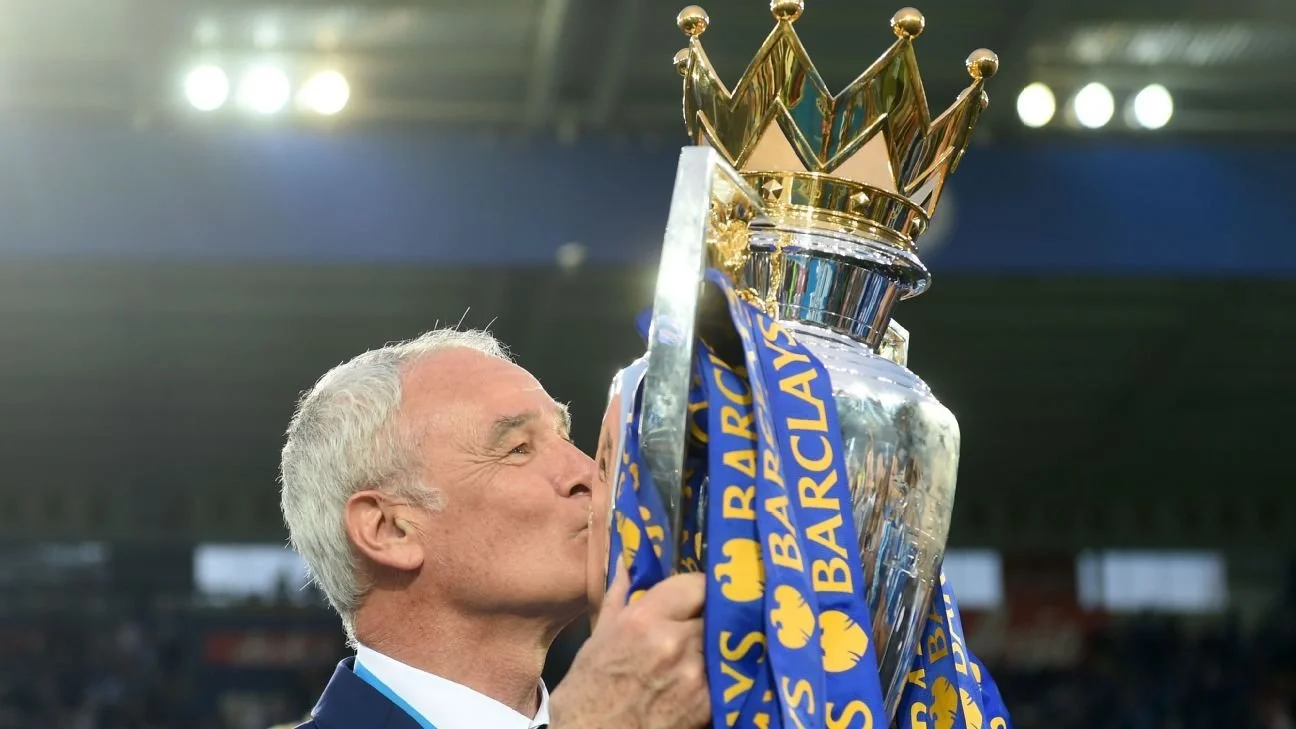
Claudio Ranieri with his deserved Premier League trophy.
Photo Credit: ESPN
Perhaps that is its true legacy. Not that it inaugurated a new egalitarian era, but that it reminded a commercialised sport of its volatility. Ten years on, the blue ribbons remain a testament to a season when hierarchy blinked. The reality since has been stern, almost corrective. Wealth has consolidated. Giants have reclaimed their ground. Leicester have navigated the ordinary turbulence of a club outside the elite.
And yet, when we look back, the feeling endures. For nine months, belief outpaced budget. For nine months, a cheap squad by Premier League standards outperformed empires. For nine months, Claudio Ranieri’s calm stewardship held chaos at bay. It was momentous then; it is luminous now. Not a foundation for dynasty, not a blueprint easily copied, but a singular eruption of possibility.
A miracle, in other words, exactly that: a one-off event we can revisit with fondness and analytical fascination — aware, with the clarity of hindsight, that it was never likely to be built upon, and perhaps was never meant to be.