

Words by Tomas Rothaus | Published 29.07.2026“no me hablen de la suerte,
no creo en eso, señor.”
don’t talk to me about luck
I don’t believe in that sir.”
-La Furia de Petruza, “Santos de mi Devocion
“The looting had been multiplying for a week, but on the 19th of December, the same morning in which the Racing fans were trying to obtain their match tickets, the bomb exploded.
They were thousands upon thousands, driven by misery, trying desperately to get their daily bread from mini-markets, super markets, or wholesale markets. It was happening across the country, but the epicenter was the greater Buenos Aires region.
The Argentina which for years had been kept hidden under a veneer of supposed prosperity suddenly came to light. The news channels captured the events with their cameras in breathless tones as if they were covering the apocalypse.
Shutters pried open, barely lifted just enough so as to enter and exit with bags and boxes; men and women crashing into each other, making the most of every second to take what they could: anything, from food to drink; bathroom items; dairy and fruits; televisions, refrigerators, or appliances.
The press reported in horrified tones because they weren’t taking from the shops only basic food items and the basics of subsistence, but rather also boxes of beer or expensive wines. As if poverty somehow eliminated human desire.
People were taking what was available. What they could. What capitalism made them desire.”
- Alejandro Wall, Academia Carajo, 2011
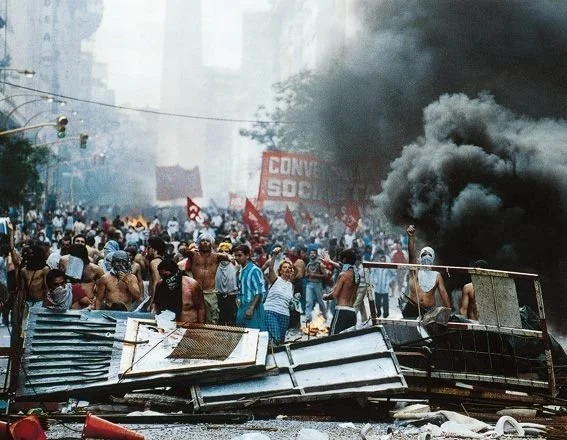
Thousands of workers in Argentina protest during the 2001 economic crisis.
Photo Credit: Fernando Marturet
“Cant. Breathe. Not dying for this.”
Jose struggles to say the words audibly, clearly gasping for air under the pressure of thousands of bodies. He and Carlos are both tough kids, lifelong friends of mine whose footballing adventures over the years have included being shot at, chased through the streets by rival gangs, a few fights, and more than enough confrontations with police.
He isn’t easily frightened and it is impossible to overemphasize the significance to us of the golden tickets we are currently apparently quite literally dying to try to get our hands on. So I’m not sure which is worrying me more, his fear or that he is consciously saying that this can’t be worth it.
We’re only meters away from the ticket booth, maybe ten or twenty or so. But nothing has ever been closer and yet still so far.
Jose starts to panic, his face flushed bright red, and his flailing can’t be described as wild only because the crush of people has his arms pinned to his body, making flailing impossible.
He looks like a dying fish writhing in somebody’s hand, and it’s not a pretty sight. We’re being crushed by the weight of thousands of bodies pushing us against the little cement building that is the stadium’s ticket booth.
A literal human avalanche, and those who know about footballing history know that these can and will kill you. I mean, it also happens to be how we celebrate goals in the popular, the Argentine word for terraces, launching ourselves wildly down the steps into a frenzied human heap of joy and celebration, but even those sometimes result in sprained ankles or broken bones.
But when the press of human bodies has nowhere to go at its end point, things can end tragically and we know this very well.
Jose begins trying to push his way towards the sides, out of the stampede. It crosses my mind that we might very well die here. Of all the confrontations, riots, and general wealth of life threatening situations I’ve successfully navigated, apparently I’m going to die attempting to get a ticket to a football match.
It’s not the death I was expecting. Not a fascist’s knife or a policeman’s bullet. Not only is it a horrible way to die, crushed to death, but for an anarchist militant it’s also not particularly glorious.
I’m actually more than a little afraid, and yet in another worrying display of my self-preservation instincts possibly not being what they ideally should be, the next sentence out of my mouth is “Jose, Jose…give me your money,” which he is luckily somehow able to do.
We had already lost Carlos at the beginning of the chaos, and I need Jose’s cash to have any chance of buying three tickets.
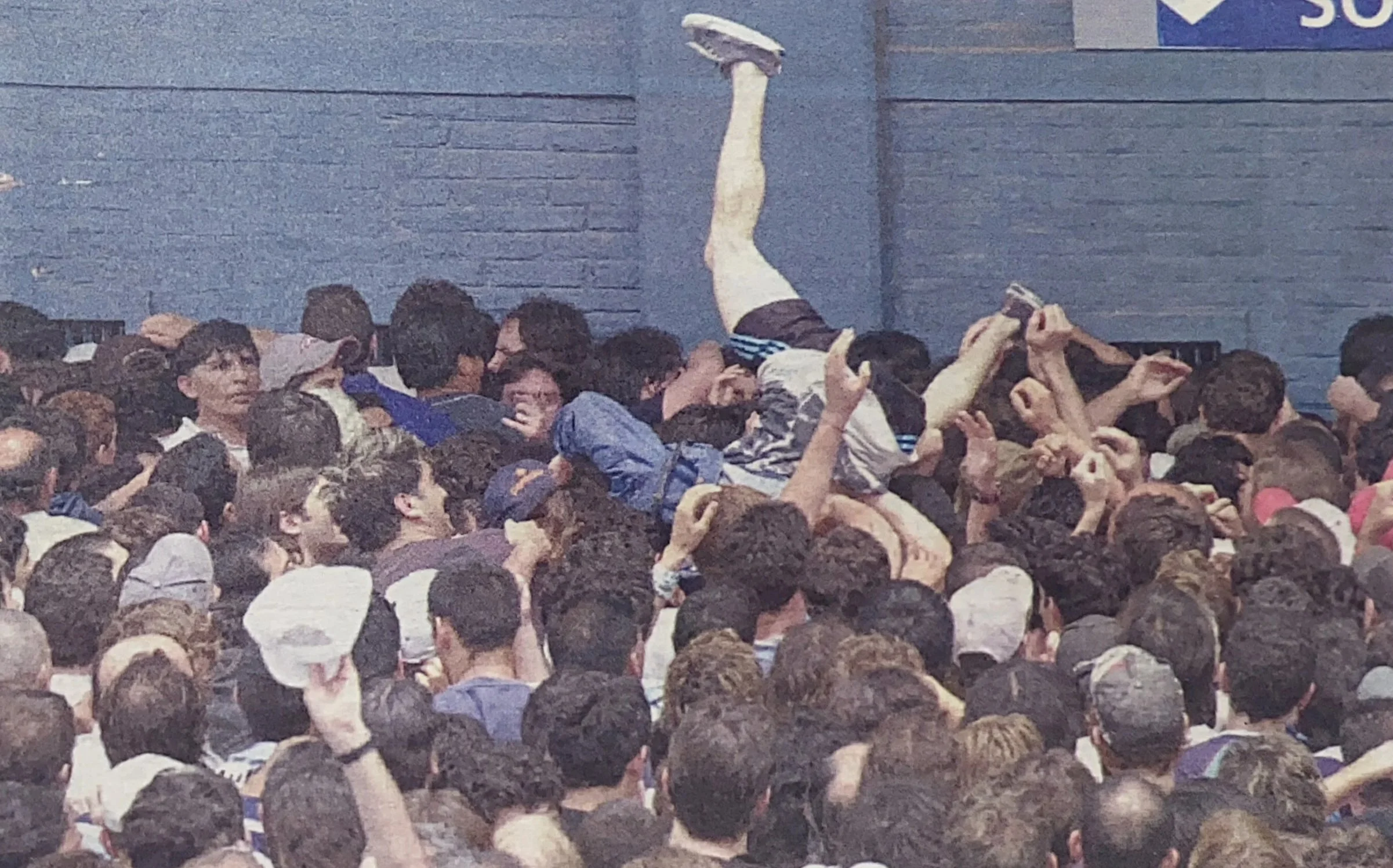
A crush ensued as fans of Racing Club de Avellaneda queued for tickets to their potential title-winning match against Vélez Sarsfield.
Photo Credit: Todo Valle
As I lose sight of Jose, another crushing wave of pressure from people further back trying to reach the ticket booth hits me.
Whatever mental image you might have of some sanitized and modern structure on the outside of a first world sports stadium — imagine the exact opposite of that. As much as I love our club’s stadium, this is South America, where football fans are treated worse than cattle and the infrastructure is usually anywhere from simply unpleasant to flat out deadly.
This is a small cement structure, not three meters high, with a few small “windows” through which to do business. And by “windows”, I of course mean small openings with no glass, just vertical steel bars.
On both sides of the structure there is a chain link fence on metal poles, probably at least six meters high, a fence whose purpose on game days is precisely to act as one of many lines of defense to keep the ticketless hordes at bay.
I don’t know what miracle happened, but as I gasp increasingly frantically for air, the wave carries me to within arm’s reach of the ticket booth’s metal bars. I manage to grab onto them for dear life, while still holding the money in one hand. Don’t ask me how, but I managed to use the leverage from the bars to pull myself upward, and weirdly ended up parallel to the ground, above the crowd.
Like a crowd surfer, but holding on to the bars so as to avoid being swept away by the ebbs and flows of the human tide. I yell at the ticket seller for “three tickets please!” “Sorry kid, maximum two per person.” On the verge of tears I respond, “Please we're dying here, I need three, please. Just keep everything” were my last words to him as I let go of one bar to slip the money to him.
This being Argentina, the tip did the trick and without another word I had the three tickets in my hand.
I’m pulled up out of the crowd by the arms, lifted upward by those standing on the roof of the ticket booth who are frantically rescuing people, some with tickets but most without, in a scene reminiscent of saving people from a sinking ship.
As I’m taking a moment to catch my breath and compose myself, I take in the enormity of the scene around me from my elevated position. It’s the culmination of thousands of people standing in line, or more precisely camping in line, for days for tickets to a match which, for the record, is neither today nor at this stadium.
We find ourselves in Avellaneda, officially its own city on the south side of the greater Buenos Aires area, but Buenos Aires’s urban sprawl being what it is, it’s essentially a suburb with a population of several hundred thousand people, connected to downtown Buenos Aires by a highway and a bridge.
Most importantly, it is the home of Racing Club de Avellaneda — a club of which I am a fanatical supporter and which, in a twist of fate unimaginable little more than a year earlier, with just a tie at the last match of the season, in an away game at Velez Sarsfield four days from now, can obtain its first national championship in thirty five years.
Behind me, separated from the crowd by the ticket booth, the fence, and a distance of maybe forty meters, is our stadium, the Estadio Presidente Juan Domingo Peron.
A postcard picture of stoic enormity, a sixty five thousand spectator capacity behemoth and the second largest stadium in the country.
Directly behind it, quite literally less than one city block away and only possible because Argentina is an insane country, lies the forty thousand spectator capacity stadium of Club Atletico Independiente, our neighbors and arch nemesis.
We play home games on staggered weekends to avoid fans from both clubs running into each other, and even with that precaution trying to ambush groups of opposing fans as they head to or from matches is a sadly popular neighborhood pastime.
Just last night as the three of us sat on the sidewalk, in our case about five blocks away from the ticket booth which was how long the line already stretched when we arrived over forty eight hours prior to the start of ticket sales, word spread that we would be paying the ashtray (as we derogatorily refer to Independiente’s stadium due to its architecture, which lacks stands on the corners of the structure) a visit.
As excitement about this prospect spread amongst the young and criminally minded amongst us (not going to lie, my childish mind was very excited at the prospect of taking home a piece of their stadium as a souvenir), Carlos raised a not irrelevant concern: “Are you crazy? What if the cops show up? Imagine if we get arrested and don’t get tickets because of something stupid like that!”
The concentration of clubs with professional soccer teams in the greater Buenos Aires area is unimaginable to most people. The first division alone is currently composed of fourteen teams from the area, there are another seventeen in second division, eighteen in third division, and another nineteen in fourth.
Sixty eight in total, all of which have some degree of hooligan or ultra factions whose game day movements criss crossing the city police used to have to coordinate in order to avoid confrontations.
This is no longer the case only because there are essentially, with few exceptions, no visiting fans allowed at Argentine football matches since 2013, precisely because of the constant outbreaks of violence, a “pastime” which in on February 17th of 2002 claimed the life of Independiente supporter Gustavo Rivero, in the hours prior to an Avellaneda derby, during an armed confrontation between barrabravas of both clubs in the vicinity of the stadiums.
A woman sitting in line a few meters down from us, who had a little portable radio she kept putting to her ear to pass the time, overheard us and chimed in. “I don’t think any cops are coming. I keep hearing on the radio about more and more looting in the area. They seem busy with that. Pretty sure it’s also why there’s no cops here either.”
I took note of the news approvingly, as an anarchist should, but didn’t think much of it at the time. Sporadic holiday season looting is a bit of a tradition in Argentina, and it didn’t seem surprising that it would be somewhat more widespread this year.
Not only was the country experiencing record rates of unemployment and poverty, but in an attempt to prevent further panic runs at the bank as rumors spread of an imminent devaluation of the peso - which had been tied to the US dollar at a rate of one to one since 1991 - the center-left government of Fernando De la Rua had a few weeks earlier established something called “el corralito,” a series of economic measures severely limiting the amount of cash individuals were able to withdraw from their bank accounts.
As Barricada, the Boston-based anarchist monthly magazine I at the time co-edited, reported:
“These entailed that for a period of 90 days, people would be allowed to withdraw no more than $250 per week from the banks, that one could leave the country with no more than $1,000 (and that leaving the country was not an excuse to be allowed more money from the bank…). A cap was also placed on money transfers outside the country, and people were limited to two bank accounts (in order to prevent people from opening multiple bank accounts and thus sidestepping the $250 limit.)”
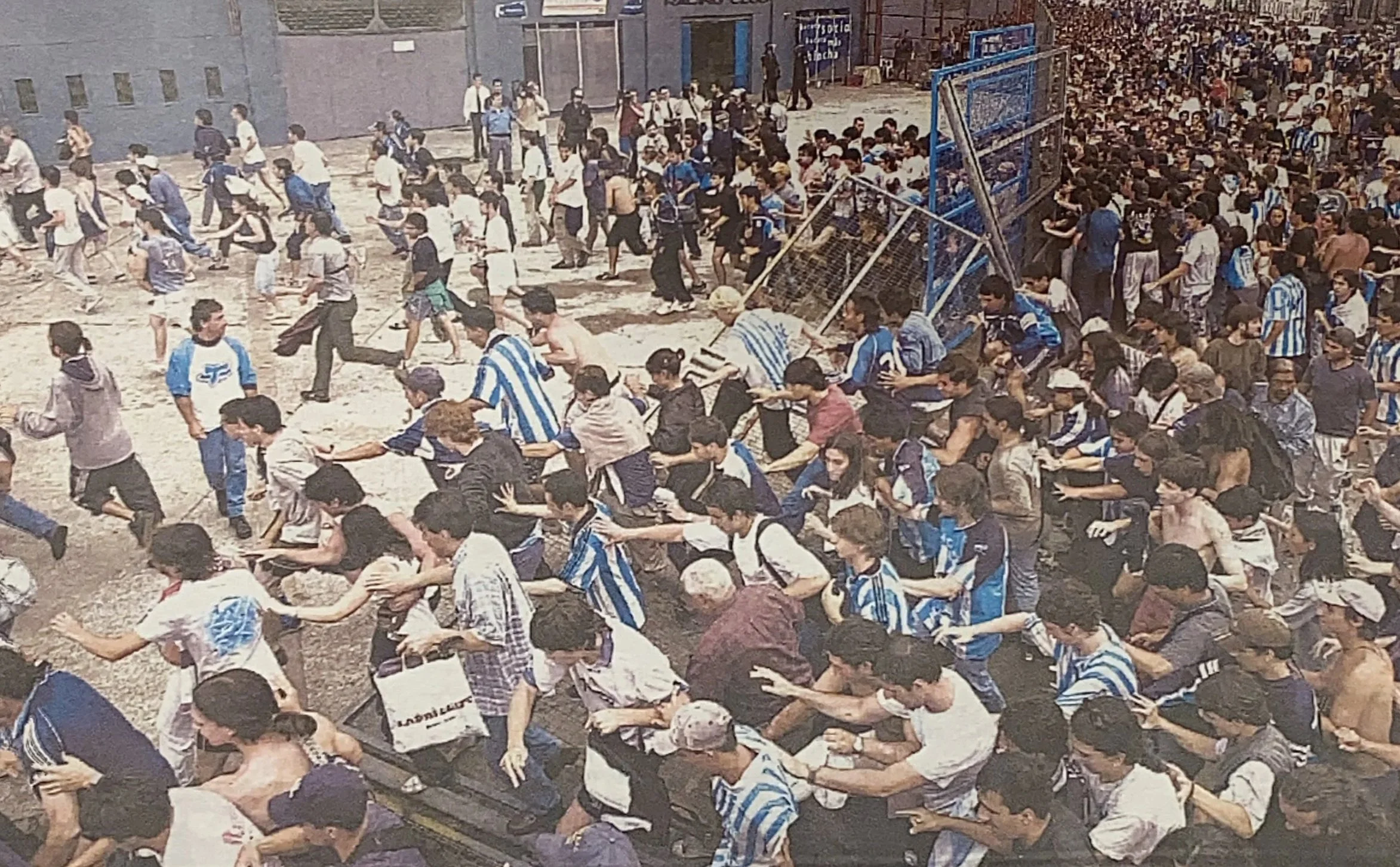
Fans rush the ticket booths at El Cilindro.
Photo Credit: La Nacion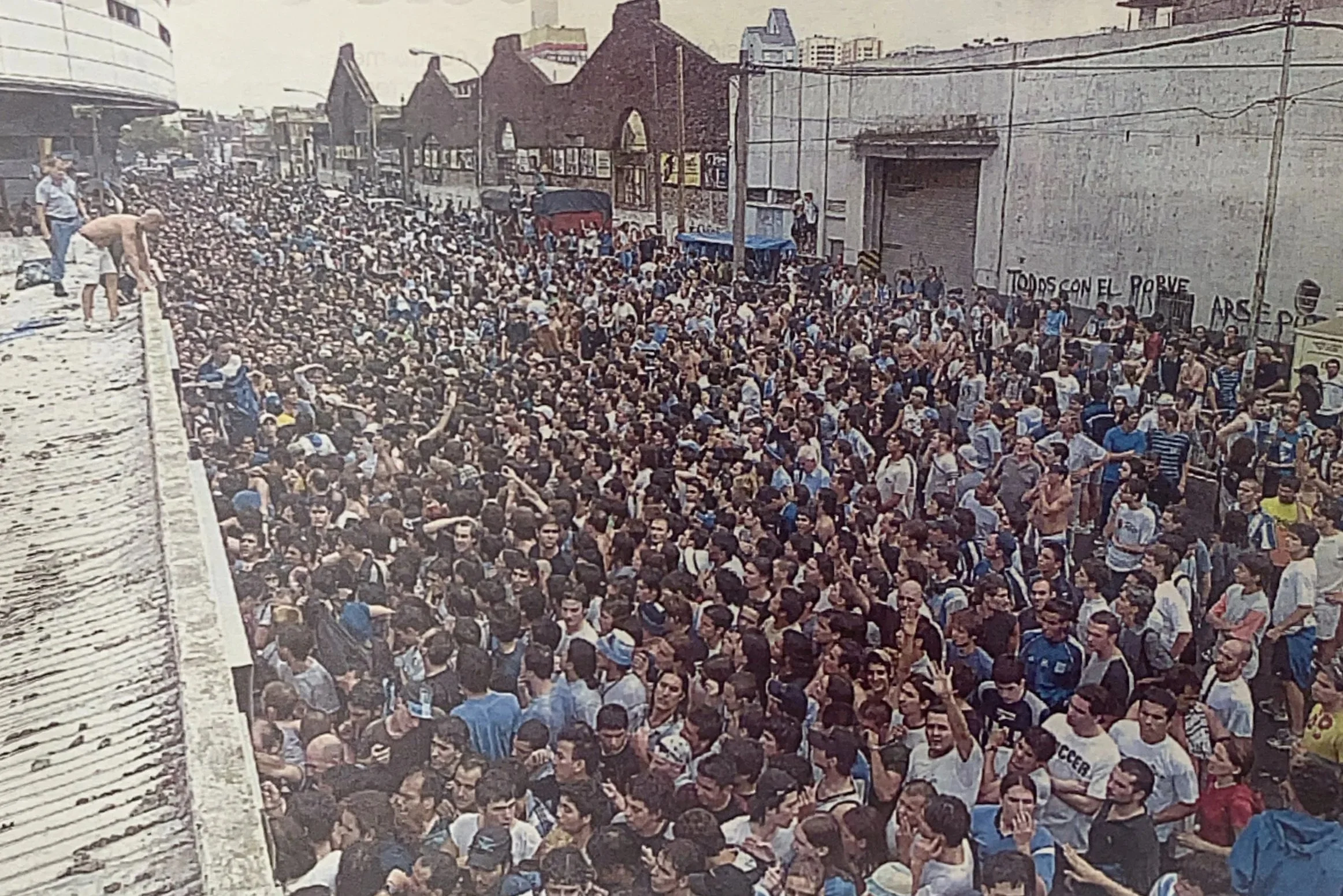
The scale of the crowd which had gathered to buy tickets at Racing Club.
Photo Credit: Deportivo
These moves had triggered a bit of an uprising from middle- and upper middle-class “ahorristas” (a term that can be translated roughly as “those with savings”) who could be seen protesting with their pots outside banks, fearful of losing their savings in a potential upcoming currency devaluation.
But the move triggered, or at the very least accentuated, another crisis. Large sectors of Argentines exist outside the formal economy, and depend on the flow of cash from those slightly better off for their day-to-bay bare minimum of existence.
If you make your money to survive by selling snacks or small items at traffic lights to middle class folks in their vehicles, but the middle class people in those vehicles no longer spend any cash because they are concerned about their access to it — your situation goes from dire to untenable very quickly.
And so it was that hunger, anger, and looting became even more than usual the theme around Buenos Aires that holiday season. So when we did eventually pay a visit to the ashtray later that night (because you know, adventure over intellect I guess), the cops who were usually so eager to chase us on horseback or randomly shoot at us were nowhere to be seen.
If we had succeeded at opening one of the gates, I’m pretty sure we could have busted out a football, picked teams, and played a pick up game on the field and no cops would have appeared. It was the first clue that something was definitely very, very much off.
As I turned again towards the chaos from which I had just emerged, the second indication that something out of the ordinary was afoot, not just here but around the city, was strikingly obvious.
The throng of people swaying back and forth in waves against the ticket booth and the fence numbered comfortably in the several thousands. It was what remained of what had for days been a relatively orderly line, until the moment tickets went on sale and many of those towards the back began to panic, and eventually all hell broke loose as we arrived at the human stampede like scenes I was lucky enough to have just escaped.
Not that their presence would necessarily have been very helpful, as Argentine cops usually tend to add to the chaos by riding their horses through crowds and indiscriminately beating, gassing, and shooting people, but whether we thought of it as a positive thing or not — from my perch above the crowd I could maybe make out five police officers, not the several hundred something like this would normally draw.
I eventually succeeded in reuniting with Carlos and Jose, each with his golden ticket in hand. As we walked away, still wondering to each other where all the cops might be, my last memory of the scene is of the gigantic fence finally being toppled by the crush of the crowd. The club would later put out a statement, making clearer what we were still unaware of, but starting to suspect:
“The Pueyrredon bridge (note: one of two bridges leading from downtown to Avellaneda) was blocked by piqueteros and there was looting taking place only a few blocks from there. We requested police presence and they sent us what they could. The country is in a critical situation, and we did the best we could in that context.”
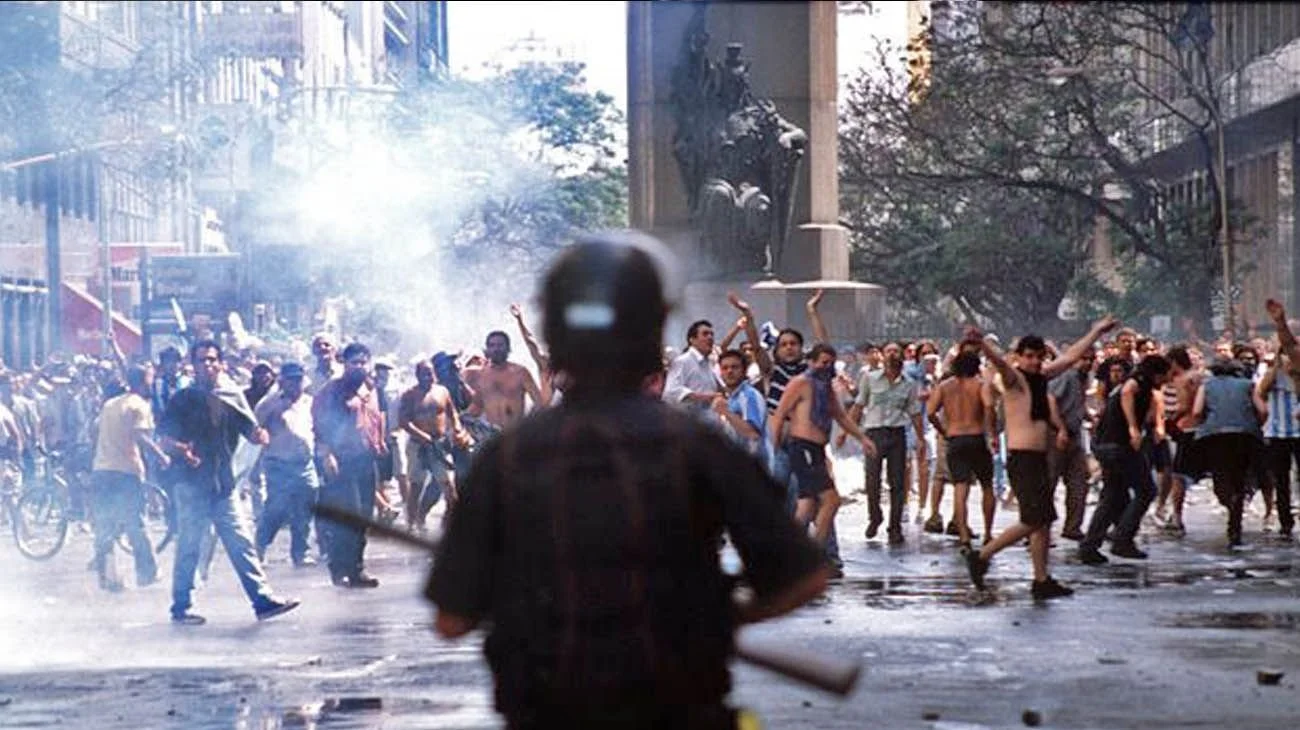
The riots of December 2001 in Argentina led to the resignation of then-president Fernando de la Rúa.
Photo Credit: BA Times