


Words by Jonee | Published 30.05.2026For much of the past three decades, the Premier League has sold itself as the most competitive domestic competition in world football. Its global appeal has been built not only on technical quality and commercial reach, but on the promise of unpredictability: the notion that, on any given weekend, the established order can be disrupted, reputations can be challenged, and outcomes remain uncertain deep into the season.
From dramatic title races to improbable survival campaigns, the league’s identity has been shaped as much by its capacity for surprise as by the excellence of its leading clubs.
Yet beneath that surface narrative, a quieter structural shift has been taking place. The Premier League has become, by a considerable margin, the richest football league in the world, fuelled by successive broadcasting deals, expanding international audiences, and increasingly powerful ownership models.
Financial growth on this scale has transformed not only the league’s global standing, but its internal dynamics. As revenues have risen, so too has spending—particularly on player transfers and wages—creating an environment in which economic strength plays an ever more decisive role in shaping competitive outcomes.
This raises a fundamental question about the modern Premier League: has its financial success come at the cost of its competitive balance? While individual matches may still produce moments of unpredictability, there is growing reason to believe that the broader arc of a league season is becoming more predictable, with the same clubs consistently occupying the upper reaches of the table and newly promoted or lower-resourced sides struggling to keep pace. The issue is not simply one of dominance at the top, but of widening separation across the league as a whole.
Over the past 25 years, transfer spending in the English top flight has increased at a rate that far outstrips the league’s early-era baseline, reshaping expectations of squad quality, depth, and consistency. At the same time, key indicators of competitive balance—such as points totals among relegated teams, the performance of promoted sides, and the aggregate gap between the top and bottom of the table—suggest a league that is gradually stretching apart. The data points towards a system in which financial power is translating more directly, and more reliably, into sporting success.
This article examines that relationship in detail, drawing on long-term trends in spending and performance to assess whether the Premier League is becoming less competitive over time. By analysing changes in transfer expenditure alongside shifts in points distribution—particularly at the extremes of the table—it seeks to move beyond anecdote and isolated seasons, offering a broader perspective on how the league has evolved. In doing so, it asks not only whether the gap between rich and poor clubs is widening, but what that means for the future character of the competition itself.
To understand the scale and implications of modern spending in the Premier League, it is necessary to distinguish between two distinct phases of financial development: early growth and later acceleration. While the league has been commercially successful since its inception in 1992, the transformation of its economic landscape over the past 15 years in particular has been far more dramatic, both in magnitude and in consequence.
In the early 2000s, the Premier League was already establishing itself as Europe’s most marketable domestic competition. Broadcasting agreements—particularly those negotiated with Sky—had begun to inject substantial revenue into the game, while the first wave of international rights deals expanded its global footprint. Clubs benefited from rising incomes, but spending remained relatively contained by modern standards.
Transfer fees, while significant in context, were not yet operating at the scale or frequency seen today, and there remained a degree of financial compression across the league. The gap between the highest and lowest spenders existed, but it had not yet become structurally entrenched.
A key feature of this earlier period was that competitive performance could still be meaningfully shaped by factors beyond financial power alone. Tactical innovation, managerial influence, and effective recruitment strategies allowed certain clubs to outperform their budgets with greater regularity.
While wealthier sides held clear advantages, the relationship between spending and success was less rigidly defined. In practical terms, this translated into a league table that, while not perfectly balanced, allowed for greater fluidity, particularly in mid-table and among newly promoted teams.
The shift from growth to acceleration began in the early 2010s and intensified sharply in the years that followed. A new cycle of domestic and international television deals dramatically increased central revenues, while the globalisation of the league’s brand opened up lucrative commercial opportunities for its biggest clubs.
At the same time, ownership models evolved, with state-backed investment, private equity involvement, and billionaire benefactors reshaping the financial capabilities of select teams. The result was not simply an increase in overall wealth, but a divergence in how that wealth was distributed and deployed.
This period also saw a fundamental change in transfer market behaviour. Spending became not only higher, but more concentrated and more strategic. Elite clubs increasingly operated with the capacity to invest heavily across multiple positions, often within a single transfer window, while also absorbing the financial risk associated with unsuccessful signings.
Squad building shifted towards depth as well as quality, reflecting the demands of competing across domestic and European competitions. In this environment, financial strength began to underpin not just ambition, but resilience—the ability to sustain performance over time rather than merely achieve it intermittently.
Crucially, the rising cost of competitiveness did not affect all clubs equally. While broadcasting revenue continued to provide a relatively even financial baseline, disparities in commercial income and ownership funding allowed the top tier of clubs to pull away. For those outside this group, keeping pace required either exceptional efficiency or significant external investment, both of which were difficult to sustain. Newly promoted teams, in particular, entered a league in which the financial threshold for survival was steadily increasing, forcing them to bridge a widening gap in resources within a limited timeframe.
What emerges from this evolution is a league that has not simply grown richer, but more stratified. The early promise of broadly distributed financial gains has, over time, given way to a system in which advantages compound.
Wealth facilitates better players, deeper squads, and more consistent results; those results, in turn, reinforce financial strength through prize money, broadcasting exposure, and commercial appeal. It is within this feedback loop that the modern Premier League operates.
This historical context is essential when assessing the statistical trends that follow. The sharp rise in transfer spending over the past decade is not an isolated phenomenon, but the product of structural changes that have altered the competitive fabric of the league. As the next section will show, those financial shifts are increasingly reflected in how points are won, distributed, and concentrated across the table.
The financial ascent of the Premier League has not occurred in isolation. Over the same period in which domestic spending has accelerated, English clubs have also reasserted themselves in European competition, particularly at the highest level. That success, however, has been far from evenly distributed, instead concentrated among a relatively small group of teams whose continued presence in continental tournaments has reinforced their structural advantages at home.
Since the 2000/01 season, Premier League clubs have been a consistent force in the UEFA Champions League. Liverpool have won the competition twice and reached a further three finals, while Manchester United have secured one title and appeared in two additional finals. Chelsea have also won the tournament twice, alongside another final appearance, and Manchester City have added a title and a further final of their own.
Even clubs without victories, such as Arsenal and Tottenham, have reached the final stage of the competition, underlining the sustained presence of English sides at the sharp end of European football.
A similar pattern emerges in the UEFA Europa League, where success has again been concentrated among familiar names. Tottenham and Liverpool have each lifted the trophy once, with the latter also finishing as runners-up, while Chelsea have secured two titles. Manchester United have won the competition and reached two additional finals, further demonstrating the recurring involvement of the same elite clubs. Even among runners-up, there is a mix of both established and less consistent European participants—Arsenal, Middlesbrough, and Fulham—though such appearances have tended to be isolated rather than sustained.
More recently, the UEFA Europa Conference League has provided further evidence of English strength in depth, with both West Ham and Chelsea claiming the trophy. While this competition operates at a lower tier, its outcomes nonetheless reinforce the broader trend: English clubs, backed by significant financial resources, are consistently competitive across all levels of European football.
What is most striking about this record is not simply the volume of success, but its concentration. A core group of Premier League clubs accounts for the majority of deep runs and trophy wins, repeatedly qualifying for European competition and, in doing so, repeatedly benefiting from the financial and sporting rewards it offers.
Progression in tournaments such as the Champions League brings substantial prize money, increased global exposure, and enhanced attractiveness to elite players—all of which feed back into domestic performance.
This creates a self-reinforcing cycle. Clubs that are already among the wealthiest in the Premier League are also those most likely to succeed in Europe; that success, in turn, further increases their financial capacity and competitive edge. Over time, this dynamic contributes to a widening gap within the league itself, as those regularly competing on the continental stage consolidate their position while others struggle to break into that upper tier.
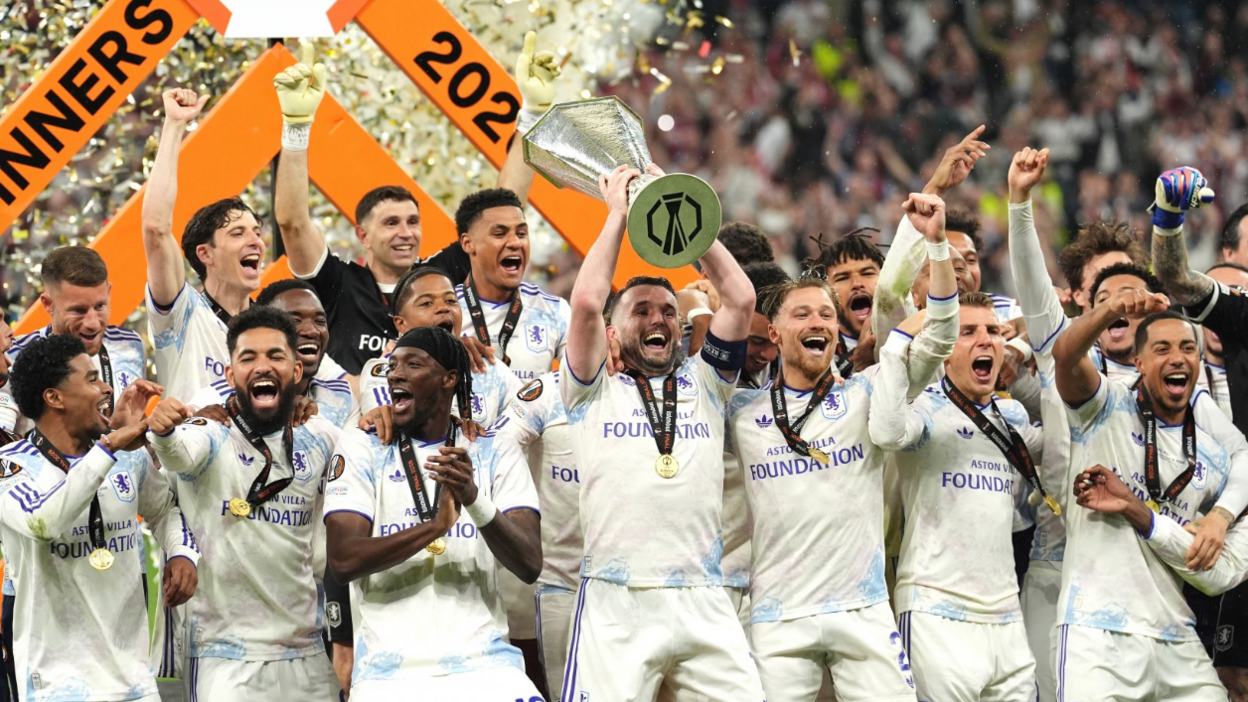
Aston Villa won the 2026/26 Europa League.
Photo Credit: BBC Sport
In this context, European performance should not be viewed as separate from domestic inequality, but as one of its key drivers. The same financial power that enables English clubs to dominate in Europe is also reshaping the competitive balance at home, strengthening a select group while leaving the rest of the league to contend with an increasingly steep hierarchy.
The relationship between financial strength and European success in the Premier League is not merely coincidental; it is structural, and it has profound implications for competitive balance at home. As transfer spending and wage bills have increased—particularly among a small group of elite clubs—so too has their capacity to compete deep into continental tournaments such as the UEFA Champions League.
Crucially, this is not a one-directional trend, but a feedback loop in which financial power enables European progression, and European progression in turn reinforces financial power.
At the most basic level, greater financial resources allow clubs to assemble squads of higher overall quality. However, the more significant advantage lies in depth rather than just talent. Competing in Europe requires navigating congested fixture schedules, rotating line-ups without significant decline in performance, and maintaining intensity across multiple competitions.
Clubs with the highest spending capacity are better equipped to meet these demands, able to field strong sides in both domestic and European matches while absorbing injuries and dips in form. This structural resilience makes consistent progression to the latter stages of European tournaments far more achievable.
The benefits of such progression are substantial. Prize money from the Champions League alone represents a significant revenue stream, supplemented by broadcasting exposure and commercial opportunities tied to global visibility. Regular participation at this level also enhances a club’s ability to attract and retain elite players, creating a virtuous cycle in which success breeds further success. Over time, a relatively small group of Premier League clubs has been able to entrench itself within this cycle, repeatedly qualifying for Europe, advancing deep into competitions, and consolidating its financial and sporting advantages.
What makes this dynamic particularly consequential is its impact on domestic competition. While elite clubs are strengthening themselves through sustained European involvement, those outside this group are not only excluded from these benefits but must also compete against their effects.
The result is a widening gap in squad quality, depth, and consistency. Over the course of a 38-game league season, this disparity becomes increasingly visible in the distribution of points, with top clubs able to maintain high performance levels even when balancing multiple competitions.
At the lower end of the table, the effects are equally pronounced. Clubs without European revenue streams—and with significantly lower spending power—face opponents whose resources allow them to mitigate the very challenges that often undermine smaller sides.
Injuries, fatigue, and squad limitations tend to have a more severe impact on these teams, reducing their ability to take points consistently. This contributes to declining totals among relegation-threatened clubs and reinforces the broader pattern of competitive separation.
In this sense, European competition acts as both a stage and a catalyst. It reflects the existing hierarchy within the Premier League, while simultaneously deepening it. The same clubs that dominate domestically are those most likely to benefit from continental success, and the rewards of that success feed directly back into the league.
Financial power, therefore, is not simply producing better teams—it is creating a system in which advantages are accumulated, sustained, and amplified over time.
Despite the profound financial transformation that has reshaped the Premier League over the past two decades, its reputation as the most competitive domestic league in world football remains largely intact. In many respects, this perception is not simply a marketing construct, but a reflection of genuine features embedded within the structure and style of the competition itself.
The Premier League continues to produce a level of week-to-week volatility that distinguishes it from most other major European leagues, and this volatility plays a central role in sustaining the idea of competitive balance.
At the most immediate level, the league remains defined by its capacity for unpredictability in individual matches. Lower-ranked sides regularly take points from clubs at the top end of the table, and even dominant teams rarely experience sustained stretches of complete control over matches in the way seen elsewhere in Europe.
The intensity of the league, both physical and tactical, compresses margins between teams on a game-by-game basis, ensuring that outcomes are frequently decided by fine details rather than structural superiority alone. This creates a competitive environment in which surprises are not only possible, but routine enough to feel characteristic of the league itself.
This perception is reinforced by the way the Premier League is consumed and presented. Broadcasting coverage, particularly through global partners such as Sky and other international distributors, places significant emphasis on drama, parity, and unpredictability as defining features of the competition. Narrative framing tends to highlight shocks, comebacks, and late goals, while the league’s global marketing strategy has long promoted the idea that any team is capable of beating any other on a given day. Over time, this messaging has become deeply embedded in how the league is understood, both domestically and internationally.
There is also a structural reason why this perception persists: unpredictability at match level is real. Unlike some leagues where financial disparities translate into frequent one-sided contests, the Premier League’s physical intensity, tactical diversity, and scheduling demands create conditions in which weaker sides can and do compete effectively in isolated fixtures. Even heavily favoured teams are regularly forced into difficult, narrow-margin games, and the frequency of draws and single-goal margins reinforces the impression of parity.
However, the crucial analytical distinction lies in separating match-level competitiveness from season-level hierarchy. While individual results remain volatile, the accumulation of outcomes over a full campaign tells a more stable and increasingly consistent story. The randomness of a single fixture does not necessarily disrupt the longer-term ordering of the league table. Over time, the same clubs tend to reappear in the upper reaches of the standings, while others remain confined to mid-table stability or repeated relegation battles. In other words, short-term unpredictability can coexist with long-term structural predictability.
This is where financial disparity becomes particularly important. The increasing concentration of resources among a small group of clubs means that match-level volatility is often absorbed rather than translated into broader instability. Clubs with greater financial power are able to mitigate the effects of isolated poor results through squad depth, rotation, and consistency across multiple competitions. A defeat in one fixture can be offset by strength in another, and over the course of a season these corrections tend to restore the underlying hierarchy.
For less well-resourced clubs, the dynamic operates differently. Without comparable depth or flexibility, the impact of individual setbacks is often amplified. Injuries to key players, fixture congestion, or periods of poor form can have cascading effects on results, making it more difficult to recover lost ground. As a result, while these teams may still produce isolated strong performances, sustaining that level across 38 matches becomes significantly more challenging.
The consequence is a league that remains narratively compelling precisely because it is structurally uneven. The tension between unpredictability and hierarchy is not a contradiction, but a defining feature of the modern competition. The Premier League continues to produce dramatic individual moments that reinforce its reputation for competitiveness, even as broader patterns suggest increasing stratification in outcomes over time.
This duality is essential to understanding why the league’s competitive reputation has proven so durable. The visibility of surprise results obscures the gradual consolidation of power at the top end of the table, while the emotional immediacy of individual matches outweighs the statistical reality of seasonal trends. In effect, the Premier League is both highly competitive and increasingly stratified—but at different levels of observation.
It is within this tension that the following data should be interpreted. The question is not whether the league still produces unpredictability, but whether that unpredictability is sufficient to offset a longer-term drift towards structural separation. The statistical trends that follow suggest that, beneath the surface of weekly drama, a more persistent hierarchy is taking shape.
The growing stratification within the Premier League is not simply the result of higher spending in abstract terms, but of the specific ways in which financial resources are converted into competitive advantage. Money in modern elite football does not operate as a direct guarantee of success; rather, it functions as an enabling structure that increases the probability of sustained performance across a long and demanding season. The key lies in understanding the mechanisms through which that advantage is expressed on the pitch.
The most immediate mechanism is squad depth. At the highest level, the difference between clubs is no longer solely defined by the quality of their best eleven, but by the quality of their second and third options in each position. Clubs with greater financial resources are able to maintain multiple players of high calibre for each role, allowing for rotation without significant drop-off in performance.
This becomes particularly important in a league where fixture congestion is intensified by domestic cup competitions and, for the elite, regular participation in European tournaments such as the UEFA Champions League. Depth ensures continuity; continuity ensures points accumulation.
Closely linked to this is injury resilience. Over the course of a 38-game season, all clubs experience periods in which key players are unavailable. However, the impact of those absences varies dramatically depending on the resources available to replace them. Wealthier clubs are able to mitigate injuries through high-quality replacements who can maintain tactical coherence and performance levels.
In contrast, less well-resourced sides often experience sharp declines in output when key individuals are missing, as the gap between first-choice and backup players is significantly wider. This structural difference compounds over time, translating isolated injuries into sustained drops in results.
A further mechanism is tactical flexibility. Financially stronger clubs not only possess more players, but more types of players—allowing them to adjust style, formation, and game management depending on opponent and context. This adaptability is particularly valuable in tight matches, where marginal gains across different tactical approaches can determine outcomes. It also enables elite clubs to control games in multiple ways: through possession, through transition, or through direct attacking play, depending on the demands of the fixture schedule. Over a season, this flexibility reduces variance and increases consistency in results.
Recruitment strategy also plays a central role. Higher spending power allows clubs to acquire not just established talent, but also to absorb the risk associated with expensive signings that may not immediately succeed. This reduces the cost of recruitment failure and encourages a wider net in talent acquisition.
Lower-ranked clubs, by contrast, must operate with far narrower margins for error, where a single unsuccessful transfer window can have lasting consequences for squad balance and performance. The result is an asymmetry in risk tolerance: elite clubs can afford experimentation, while others must prioritise survival and efficiency.
In addition to these structural advantages, financial strength also shapes psychological and competitive dynamics within matches. Teams with sustained success and deeper squads often approach fixtures with greater control over game states, particularly in the latter stages of matches. The ability to introduce high-quality substitutes or adjust tactics without weakening the team allows stronger clubs to sustain pressure or protect leads more effectively. This contributes to the accumulation of “late points” over a season—draws turned into wins, and losses turned into draws—subtle but decisive differences in the final league table.
Finally, there is the reinforcing effect of success itself. Clubs that consistently finish in higher positions benefit from increased broadcasting revenue, greater commercial exposure, and more frequent participation in elite competitions. These revenues are then reinvested into the squad, further widening the gap between those at the top and those attempting to break into that group. In this way, financial advantage is not static but cumulative, compounding over time as success generates the conditions for further success.
Taken together, these mechanisms explain why financial disparities within the Premier League translate so consistently into sporting outcomes. The relationship is not simply one of “rich clubs win more often”, but of a system in which resources shape every layer of competitive performance: from squad construction and injury response, to tactical adaptability and long-term squad evolution. It is through these interconnected processes that financial power becomes structural advantage—and structural advantage, over time, becomes the points gaps and hierarchical separation observed in the data that follows.
If the structural mechanics of modern dominance in the Premier League explain how financial power translates into sustained advantage, the long-term data on spending and points distribution illustrates the scale at which that process has intensified.
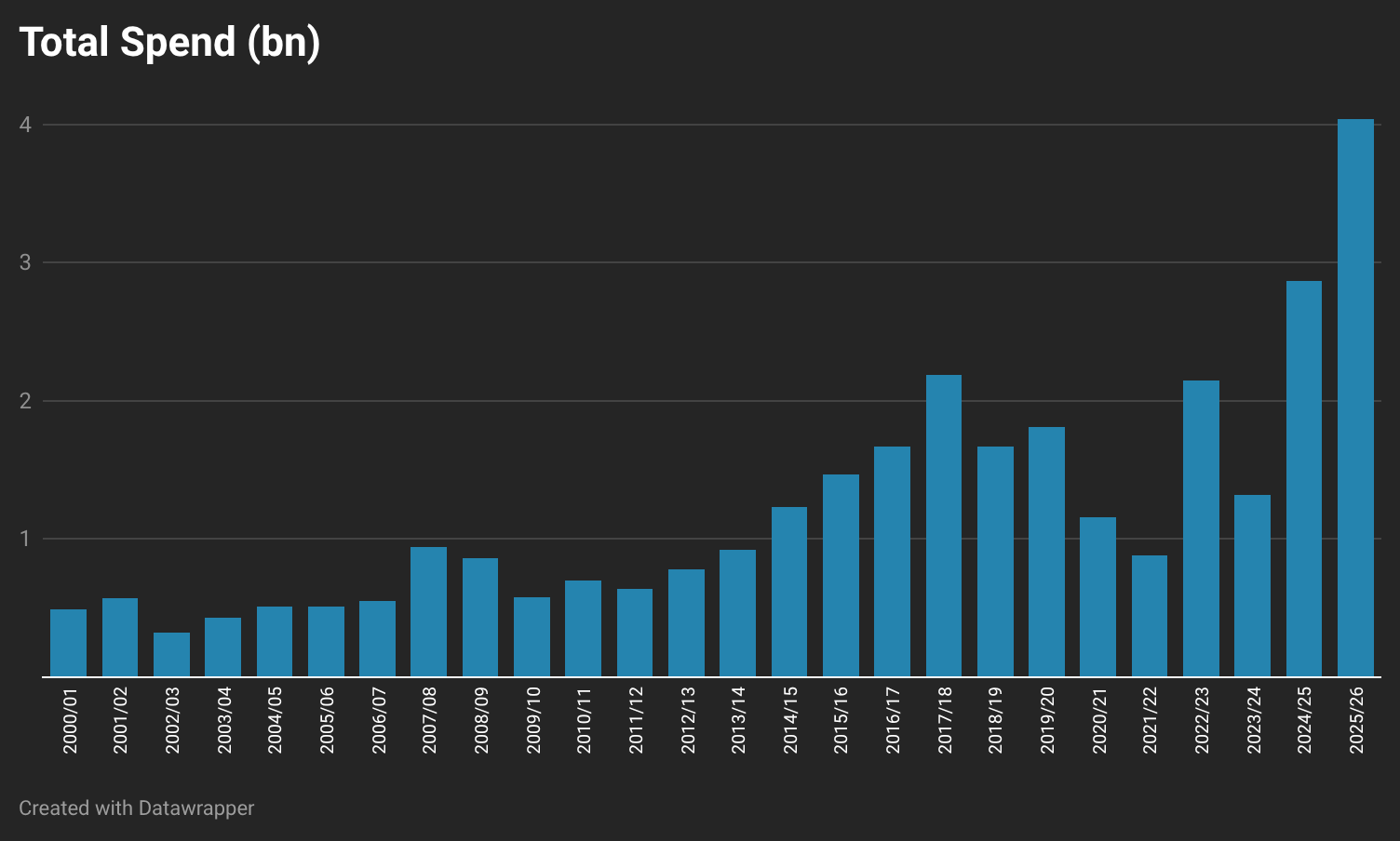
Over the period from 2000/01 to 2025/26, clubs in the English top flight have spent an average of €1.35 billion per season on player transfers. However, this figure conceals a dramatic shift in spending behaviour over time. In the first ten seasons of this era, total transfer expenditure across the league averaged €574 million per season.
In the last ten seasons, that figure has surged to €2.37 billion, while in the most recent five-season window it has risen further still to €2.94 billion. The trajectory is not linear growth but clear acceleration, reflecting both increased revenue streams and a growing concentration of financial power among the league’s wealthiest clubs.
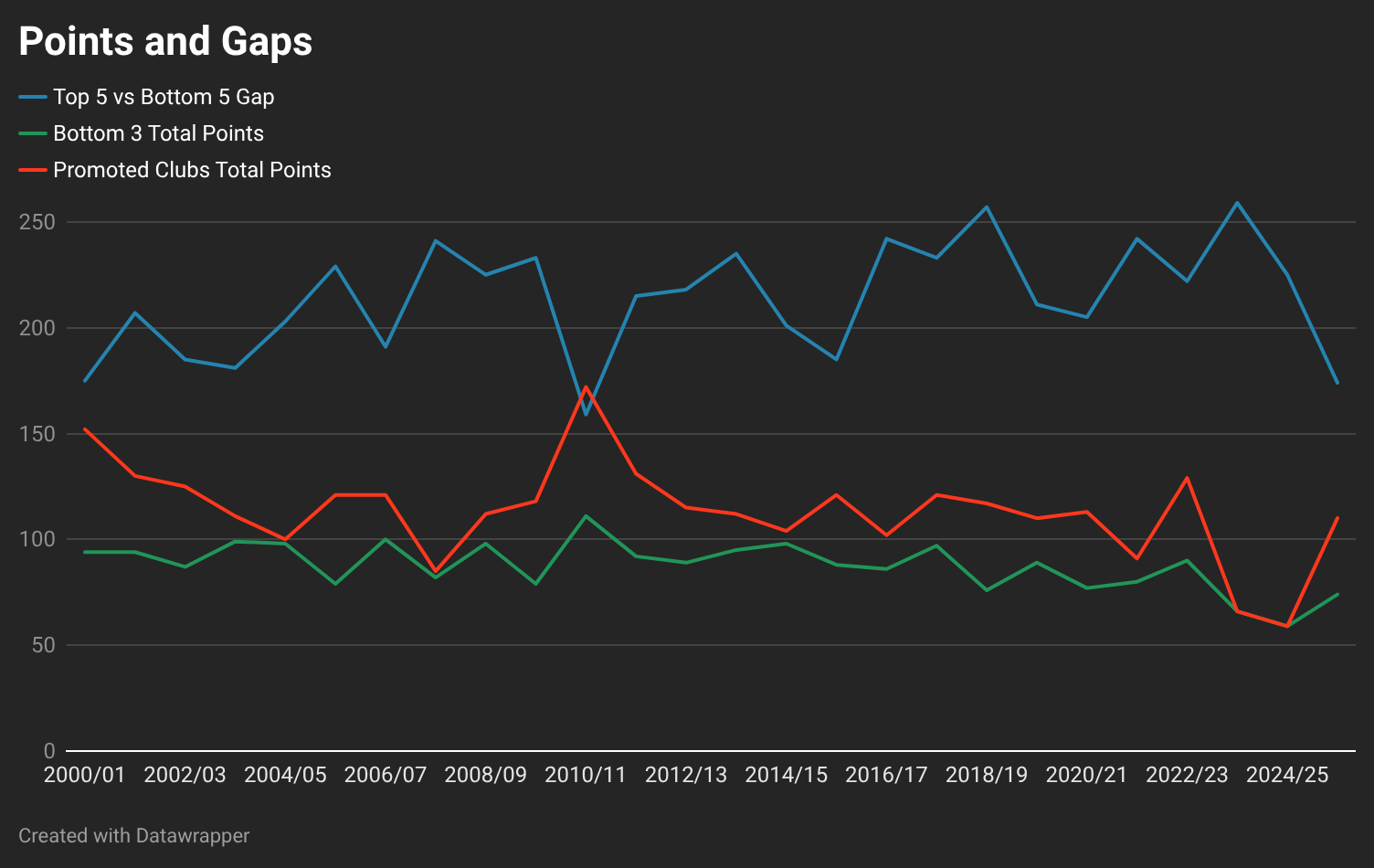
This escalation in spending coincides with a notable divergence in competitive outcomes, particularly at the lower end of the table. During the first ten seasons of the period analysed, the combined points total of the bottom three clubs averaged 91 points. In the last ten seasons, that figure has fallen to 79.4 points, and in the most recent five seasons it has declined further to 73.8 points.
This trend suggests that relegation-bound sides are not only failing to survive more frequently, but are also accumulating fewer points across the season as a whole, indicating a reduced capacity to compete consistently even outside the very top of the league.
The widening gap is also visible when comparing the top and bottom halves of the table. In the first ten seasons, the difference in total points accumulated by the top five clubs compared to the bottom five averaged 207 points.
In the last ten seasons, that gap has increased to 227 points, and in the most recent five seasons it stands at 224.4 points, a figure that is likely to rise further once the current campaign concludes. While the change may appear incremental in isolation, across multiple seasons it represents a persistent and compounding separation between the league’s most and least successful sides.
These figures are particularly significant when considered alongside the spending data. The period of fastest financial growth corresponds directly with the period in which competitive separation becomes more pronounced. As transfer expenditure has increased—especially among a concentrated group of clubs with sustained access to elite revenues—the distribution of points has shifted in a way that suggests reduced parity across the league as a whole.
In other words, financial acceleration has not merely increased the overall level of investment, but has altered how that investment translates into outcomes.
The performance of promoted clubs reinforces this pattern. In the first ten seasons of the sample, newly promoted sides collectively averaged 117.5 points. That figure falls to 101.8 points over the last ten seasons, and declines further to 94.6 points in the most recent five-year period. This downward trend indicates that entry into the Premier League has become increasingly difficult to translate into competitive stability.
Rather than establishing themselves as regular contributors to the league’s mid-table ecosystem, promoted clubs are more frequently confined to the lower reaches of the table, struggling to accumulate points across the season.
These datasets point towards a consistent direction of travel. Rising financial input has not been evenly distributed in its effects. Instead, it has coincided with a widening gap between the league’s strongest and weakest performers, both in terms of survival outcomes and overall points accumulation. While the Premier League continues to produce variability in individual matches, the aggregate data suggests a growing structural separation in how seasons unfold.
What is significant about these trends is not only their direction, but their consistency across different layers of the league structure. The same period that has seen a sharp increase in transfer expenditure has also produced widening separation between the top and bottom of the table, declining output from relegation-threatened clubs, and a progressive reduction in the competitiveness of newly promoted sides. Taken individually, each dataset might be interpreted as cyclical variation. Taken together, they point towards a structural shift in how the Premier League distributes competitive performance over time.
Importantly, this is not simply a case of the league becoming more top-heavy in isolated terms. The data suggests a cascading effect through multiple tiers of competition. At the very top, increased spending capacity enables clubs to assemble deeper and more resilient squads, which translates into more consistent accumulation of points.
At the bottom, reduced competitive capacity manifests not only in lower survival rates but in a decline in overall points accumulation, suggesting that even intermittent competitiveness is becoming harder to sustain.
Between these two poles, the league’s middle structure also becomes more relevant, even if less directly visible in headline figures. As the gap between elite and non-elite clubs widens, mid-table sides are increasingly defined not by their proximity to the top, but by their distance from relegation. This creates a stabilising effect in the middle of the table, where relative security replaces upward mobility. Over time, this can contribute to a league structure that is less vertically fluid, even if individual seasons still contain variation in mid-table positions.
The most important implication of the data, however, is that these changes are not isolated to a single metric. Instead, they reinforce one another. Rising transfer expenditure does not only improve the performance of top clubs in isolation; it reshapes the competitive environment in which all clubs operate.
As elite teams become more consistent, the margin for error for lower-ranked sides narrows. As promoted teams struggle more to accumulate points, the lower end of the table becomes increasingly separated from the rest of the league. The result is a system in which inequality is not confined to the top, but embedded throughout the structure of the competition.
Alongside rising spending and widening points gaps, perhaps the most revealing indicator of long-term change within the Premier League is the extraordinary stability of its upper tier. While much of the discourse around competitiveness tends to focus on unpredictability and occasional disruption, the distribution of final league positions over the past quarter-century tells a far more rigid story—one defined by sustained concentration among a small group of clubs.
Since the 2000/01 season, just five clubs—Manchester United, Arsenal, Liverpool, Chelsea, and Manchester City—have dominated not only the winning of league titles, but the entire structure of elite league positions. Between them, they have secured 24 of the last 25 league championships and 24 of the last 25 second-place finishes. This alone would indicate a high degree of continuity at the very top of English football. However, the pattern becomes even more pronounced when extended beyond the top two positions.
The same group of clubs has also occupied 23 of the last 25 third-place finishes, and 16 of the last 25 fourth-place finishes. Taken together, this means that across a 25-season period, the vast majority of top-four positions have been retained within a fixed cluster of clubs. The implication is not simply that these teams are successful in isolation, but that access to the upper tier of the table itself has become highly concentrated.
What emerges from this distribution is a hierarchy that is remarkably stable across time. While individual seasons may feature variation in exact finishing order, the identity of the clubs occupying the upper echelon remains largely unchanged. Even when one member of this group drops out of the top positions in a given year, another typically replaces them, preserving the overall structure of elite dominance. In effect, the composition of the top of the league has become more significant than its internal ordering.
This stability suggests that entry into the Premier League’s upper tier is no longer a purely performance-based achievement within a single season, but a function of sustained structural advantage. Once established within this group, clubs benefit from a range of reinforcing mechanisms—financial scale, commercial reach, wage capacity, and regular access to European competition—that collectively increase the likelihood of remaining there.
Conversely, clubs outside this group face a far more constrained pathway into the top four, requiring not only exceptional seasons but also sustained overperformance against structurally stronger rivals.
The inclusion of fourth place within this pattern is particularly revealing. While title wins and second-place finishes reflect direct competition for the highest honours, fourth place represents the threshold of elite participation through qualification for European competition. The fact that this position is also heavily concentrated among the same group of clubs underscores how access to the sport’s most valuable competitive and financial environments has become increasingly restricted.
Taken together, this data reinforces the broader pattern observed throughout the league: competitive outcomes are not evenly distributed across the table, but increasingly clustered around a small group of structurally advantaged clubs. The Premier League remains capable of producing variability within individual matches and seasons, but the long-term distribution of success suggests a system in which elite status is both durable and self-reinforcing.
At first glance, the distribution of transfer spending within the Premier League appears to have become marginally less concentrated over time. In the first ten seasons of the period analysed, the so-called ‘Big Five’ clubs accounted for an average of 43.3% of total league-wide transfer expenditure. This share declines slightly to 40.9% across the last ten seasons, before falling further to 39.8% in the most recent five-year window.
However, this apparent reduction in concentration does not indicate a weakening of elite financial dominance. Instead, it reflects a broader inflation of spending across the league as a whole. Total expenditure has increased dramatically over the same period, meaning that even clubs outside the traditional elite group are now operating at significantly higher financial levels than in the early 2000s. The result is not a narrowing of the gap, but a widening baseline.
Crucially, this diffusion of spending power has not translated into a corresponding diffusion of competitive success. As previous sections have shown, the same group of clubs continues to dominate title wins, top-four finishes, and European qualification, while also benefiting disproportionately from sustained participation in elite competitions such as the UEFA Champions League. In other words, while financial activity has become more widespread, its conversion into consistent sporting advantage remains highly concentrated.
This distinction is essential. It suggests that the modern Premier League is not characterised by a simple concentration of spending, but by a more complex system in which financial inflation is broadly distributed, yet competitive efficiency is not. The ability to convert expenditure into sustained points accumulation, European qualification, and long-term stability remains heavily skewed towards a small group of structurally advantaged clubs.
The most important implication of the financial and competitive trends within the Premier League is not simply that inequality exists, but that it is increasingly self-sustaining. The relationship between spending, performance, and revenue has evolved into a feedback loop in which early advantage generates the conditions for further advantage, making structural mobility more difficult over time.
At the core of this system is the interaction between domestic performance and access to European competition, particularly the UEFA Champions League. Clubs that consistently finish in the top positions of the Premier League gain entry into the most financially lucrative competition in club football. This participation provides significant additional revenue through prize money, broadcasting distributions, and commercial exposure on a global scale. Crucially, this income is not distributed evenly across the league, but concentrated among those clubs already operating at the top end of the domestic hierarchy.
This creates the first layer of reinforcement. Financial gains from European participation are reinvested into squad development, wage structures, and transfer spending, allowing these clubs to maintain or improve their competitive level relative to domestic rivals. In practical terms, success in Europe does not simply reflect domestic strength—it actively contributes to sustaining it.
The second layer of reinforcement emerges through domestic performance itself. Increased financial capacity allows elite clubs to build deeper squads, better absorb injuries, and rotate players without significant loss of quality. This translates into greater consistency across a 38-game league season, where marginal gains accumulate into higher points totals. Over time, this consistency reduces the likelihood of finishing outside the top positions, thereby increasing the probability of repeated qualification for European competition.
The result is a cyclical process. Domestic success leads to European qualification; European participation generates additional revenue; additional revenue enhances squad strength; and enhanced squad strength increases the likelihood of further domestic success. Once established within this cycle, clubs become increasingly embedded within it, while those outside it face structural barriers to entry that are difficult to overcome within a single season or even a single managerial cycle.
This dynamic also helps explain why increased spending across the league as a whole has not translated into greater competitive parity. Even as total expenditure within the Premier League has risen sharply, the efficiency with which that spending is converted into sustained success remains uneven. Clubs outside the established elite may be able to increase investment, but they do so without the reinforcing benefits of regular European participation or long-term access to the same revenue streams. As a result, their spending operates in a more isolated context, lacking the compounding effects available to the league’s most successful sides.
Over time, this creates a system in which financial and sporting success become increasingly correlated and increasingly self-perpetuating. The same clubs that dominate the upper reaches of the table are also those most likely to benefit from European competition, and therefore most likely to reinforce their position through reinvestment. Meanwhile, clubs outside this group must attempt to compete within a structurally asymmetric environment, where short-term improvements are often insufficient to overcome long-term disparities.
In this sense, the modern Premier League does not operate as a static hierarchy, but as a dynamic system of accumulation. Advantage is not merely maintained; it is compounded. And once established, it becomes progressively more difficult to disrupt.
The evidence across spending, performance, and distribution of league positions within the Premier League points towards a consistent conclusion: the competition has not become less entertaining or less volatile on a match-by-match basis, but it has become more structurally ordered over the course of a season. Beneath the continued presence of shocks, upsets, and short-term unpredictability lies a longer-term pattern of consolidation, in which success is increasingly concentrated among a small group of clubs and increasingly difficult to access from outside it.
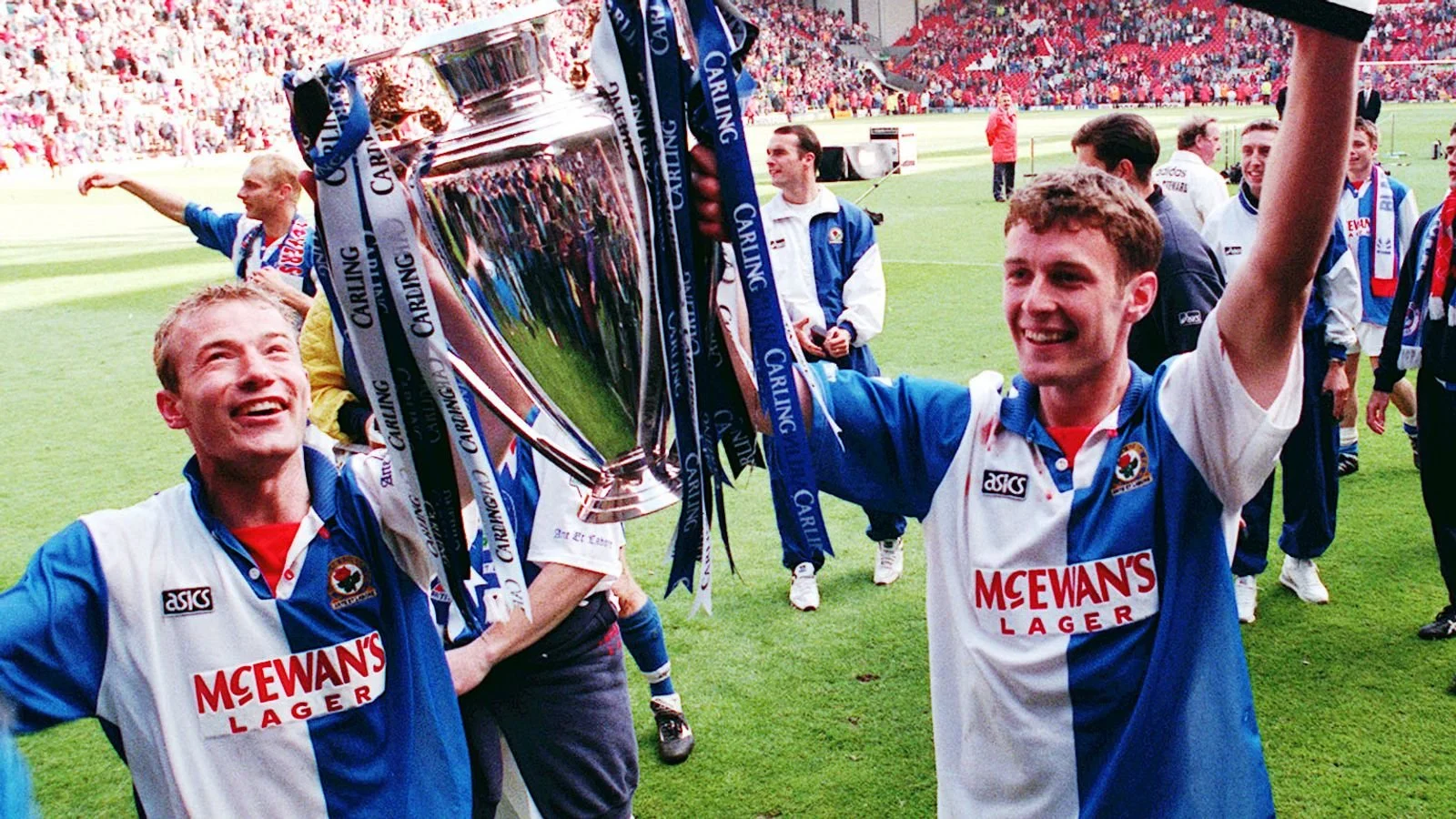
In 1994, the average wage of a Premier League player was £2,700.
Photo Credit: Sky Sports
The acceleration in transfer expenditure over the past two decades has not been evenly translated into competitive parity. While spending has risen across the league as a whole, the ability to convert that spending into sustained performance remains heavily skewed. The same core group of clubs continues to dominate title races, occupy the majority of top-four positions, and secure consistent qualification for European competition, particularly the UEFA Champions League. At the same time, lower-ranked clubs and newly promoted sides are accumulating fewer points and facing greater difficulty establishing themselves within the division.
What emerges from the data is not a simple story of dominance, but of reinforcement. Financial strength enables squad depth, squad depth enables consistency, consistency enables European qualification, and European qualification further enhances financial strength. Over time, this creates a feedback loop in which early advantage compounds rather than dissipates, gradually narrowing the pool of clubs capable of sustained success at the top end of the league.
Importantly, this structural evolution does not eliminate competitiveness in the narrow sense. Individual matches remain unpredictable, and even elite clubs are regularly tested across a demanding season. However, the distinction between isolated competitiveness and systemic competitiveness is crucial. A league can retain excitement in its weekly outcomes while simultaneously becoming more predictable in its final outcomes. The data suggests that this is precisely the trajectory the Premier League has followed over the period in question.
The result is a competition that remains globally compelling, but increasingly stratified in its underlying structure. The illusion of parity created by individual results coexists with a more stable hierarchy defined by financial capacity and its compounding effects over time. While the league continues to present itself as open and fluid, the long-term distribution of success tells a more constrained story—one in which access to the very top has become progressively more conditional.
Ultimately, the modern Premier League is defined by this tension: between narrative competitiveness and structural inequality. It is a league that can still produce drama at any moment, but one in which the boundaries of sustained success are becoming more clearly drawn. The question moving forward is not whether the league remains entertaining—it clearly does—but whether the gap between participation in that entertainment and control over its outcomes continues to widen.
Looking ahead, the trajectory suggested by these trends points towards an increasingly stratified version of the Premier League, in which a small group of clubs operate within a materially different competitive environment to the rest of the division. As financial power continues to compound through mechanisms such as European qualification, commercial expansion, and sustained squad investment, the league risks developing what is, in effect, a competition within a competition. The traditional idea of a single unified table may remain intact in form, but in practice the upper tier of clubs—those consistently competing for titles and Champions League qualification—will increasingly exist in a parallel reality, defined by different resources, different objectives, and a different baseline of expectation. In such a system, the league does not cease to be competitive, but rather becomes layered, with access to its highest level of competition determined less by seasonal performance alone and more by long-term structural position within the game’s financial hierarchy.