

Words by Jonee | Published 27.06.2026Nearly three decades have passed since the summer of 1998 and yet France’s last World Cup still refuses to settle quietly into football history, still refuses to become merely another sequence of results and statistics folded into archive footage and trivia quizzes, because unlike so many World Cups that seem to fade once their immediate drama evaporates, France 1998 continues to exist in memory with extraordinary clarity, as though it belonged not simply to football but to a particular emotional moment in global culture, a brief period before the sport became fully consumed by tactical standardisation, relentless commercial saturation and the endless digital churn that now devours almost every sporting spectacle within days of its conclusion.
And perhaps that is why so many supporters who watched it still speak about it with unusual warmth and conviction, because the tournament felt expansive in ways modern football rarely does, crowded with personalities, colours, contradictions, styles and stories that seemed to represent the entire footballing world compressed into one luminous month of summer.
Every generation believes its football memories are special and nostalgia alone cannot be trusted as evidence, because memory softens flaws and sharpens beauty, yet France 1998 possesses a stronger claim than most to greatness precisely because the tournament brought together so many strands of football history at the exact same moment, creating an atmosphere in which old legends, emerging superstars, fading powers, new nations and radically different footballing philosophies all collided on the same stage, giving the competition an almost novelistic richness that still feels astonishing in retrospect.
Watching the tournament now is to realise how densely populated it was with footballers who either already possessed mythological status or stood on the edge of it. Ronaldo was only twenty-one years old yet already appeared less like a footballer than a force of nature, terrifying defenders with a mixture of speed, balance and violence that seemed almost futuristic, while Zinedine Zidane, at twenty-five, stood between elegance and immortality, not yet quite the universally acknowledged icon he would become but already carrying the aura of a man capable of bending entire matches to his imagination.
Around them existed an astonishing concentration of talent and possibility, while simultaneously the tournament still contained the fading but magnificent remnants of earlier footballing eras, meaning that France 1998 often felt less like one generation’s World Cup than several generations sharing the same stage before handing football over to the future.
That coexistence of eras gave the tournament emotional depth before a ball had even been kicked, because every match seemed to contain some hidden tension between emergence and decline, between football’s past and football’s future, and the expanded thirty-two team format only amplified that sensation by creating a genuinely global landscape in which almost every nation arrived carrying a distinctive footballing identity.
This was still an era when national teams often looked unmistakably like themselves, before globalised academies, tactical convergence and elite club football gradually blurred stylistic borders. Brazil still represented joy, improvisation and attacking freedom in the imagination of the footballing world, even if beneath the flair there already existed signs of anxiety and discipline. Italy still embodied calculation, structure and emotional restraint.
Germany carried the authority of accumulated tournament experience even as age began to weigh upon them. England arrived carrying the familiar contradiction of youthful optimism and psychological fragility. Romania still played with the fading elegance of eastern European creativity. Nigeria moved with fearless spontaneity. Denmark combined Nordic discipline with sudden flashes of fury and imagination. Argentina remained combustible, brilliant and emotionally volatile.
The Netherlands pursued beauty while simultaneously threatening internal collapse. Even smaller footballing nations retained sharply defined identities. Norway were physical, direct and ruthlessly organised. Morocco mixed technical sophistication with unpredictability.
Paraguay relied upon defensive resistance and the commanding presence of José Luis Chilavert. South Korea brought relentless energy and intensity. Jamaica arrived with exuberance and celebration. Croatia appeared carrying the emotional weight of a newly independent nation desperate to announce itself to the world.
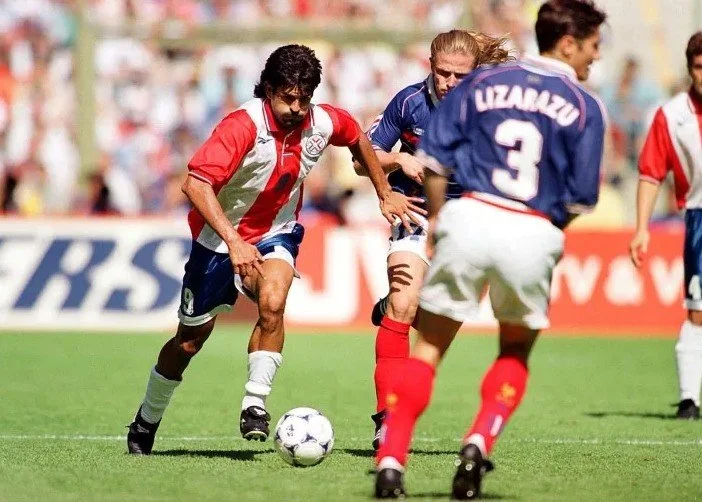
Paraguay gave a good account of themselves at France '98.
Photo Credit: SO Foot
That diversity of footballing personality made the group stage feel unusually rich because almost every group contained not merely teams but competing visions of how football should be played. Group A alone captured this beautifully. Brazil, with Ronaldo, Rivaldo, Bebeto and Cafu, represented the glamorous centre of world football, yet they found themselves facing Scotland’s directness and emotional stubbornness, Norway’s physical order and Morocco’s immensely gifted golden generation led by Mustapha Hadji and Noureddine Naybet.
Brazil’s eventual defeat against Norway remains one of the defining surprises of the tournament because it punctured the aura of inevitability surrounding the defending champions and hinted at something stranger and more enduring, namely Norway’s peculiar ability to disrupt Brazilian rhythm, a phenomenon that would continue in later years and make their victory seem less accidental in hindsight. Morocco meanwhile played some of the tournament’s most attractive football yet still departed cruelly early, becoming one of those teams remembered less for achievement than for atmosphere and possibility.
Group B contained a completely different footballing conversation. Italy approached matches with the cold precision and defensive intelligence that had long defined them, while Chile relied heavily upon the brutal attacking partnership of Iván Zamorano and Marcelo Salas, whose aggression and finishing gave every Chilean attack a sense of danger. Cameroon brought romance and chaos in equal measure, capable of moments of extraordinary athleticism and invention before collapsing into disorder, while Austria drifted through the group almost like a fading memory of central European football.
Italy against Chile perfectly captured the tension between structure and instinct, caution and emotion, one side measuring space mathematically while the other attacked through force and feeling.
Group C perhaps reflected the spirit of the host nation itself. France were tactically disciplined yet technically graceful, a team capable of suppressing opponents physically while still producing moments of elegance through Zidane, Djorkaeff and Henry, and because they represented a multicultural France at a moment of growing debate around national identity, their eventual triumph would later acquire significance beyond football itself. Denmark brought emotional coldness mixed with explosive attacking quality, while South Africa’s debut only a few years after the end of apartheid gave the group quiet political resonance. Saudi Arabia completed the quartet but the emotional centre remained France gradually growing into belief while Denmark produced football of startling intensity.
Group D felt unstable from the beginning. Spain arrived carrying talent and expectation as they so often do, yet almost immediately descended into uncertainty when Nigeria defeated them 3-2 in one of the tournament’s most exhilarating matches, a result that seemed to announce to the footballing world that Nigeria’s Olympic triumph two years earlier had not been a romantic anomaly but evidence of genuine quality.
Finidi George, Okocha, Oliseh and Kanu played with freedom and confidence while Spain looked simultaneously gifted and vulnerable, a familiar combination that has haunted them through much of their footballing history. Spain’s eventual 6-1 destruction of Bulgaria felt almost cruel in its symbolism, as though the curtain had finally come down on the Bulgarian golden generation that had enchanted the world in 1994, with Stoichkov and Balakov no longer capable of resisting time.
Group E produced one of the tournament’s strangest and most revealing matches when the Netherlands and Belgium opened with a goalless draw between neighbouring nations whose football cultures have long reflected different interpretations of the sport. Dutch football traditionally sought beauty, movement and tactical sophistication, while Belgium often appeared more restrained and practical, and though the match itself lacked goals it carried an underlying cultural tension that made it compelling nonetheless.
South Korea’s endless running and commitment added another stylistic layer to the group while Mexico remained dangerous and unpredictable, eventually qualifying with typical emotional turbulence.
Group F belonged partly to the old guard. Germany still possessed experience, authority and tournament intelligence even if the athleticism of earlier generations had begun to fade, while Yugoslavia arrived carrying one of the competition’s most haunting narratives.
This would be the final World Cup appearance under the Yugoslav name, a footballing identity fractured by war and political collapse, yet the team still contained the unmistakable technical quality and emotional steel associated with Balkan football for decades. Their 2-2 draw against Germany felt almost historical in atmosphere, a meeting between ageing powers attempting to preserve relevance in a changing game.
The United States brought energy and fitness but little subtlety, while Iran’s famous victory over the Americans transcended football entirely and became one of the most politically charged moments in World Cup history.
Group G perhaps best captured England’s eternal relationship with the World Cup, namely the uneasy coexistence of hope and dread. England possessed a fascinating mixture of youth and experience. Owen represented explosive possibility, Beckham celebrity and precision, Scholes intelligence, Shearer authority and Sheringham craft, yet even before the knockout stages there lingered the suspicion that England would somehow find a path towards disappointment.
Romania, led by Hagi and Popescu, still possessed enough imagination and composure to expose England’s anxieties, and their 2-1 victory to secure first place in the group felt less like an upset than a reminder that tournament football often rewards emotional maturity over noise and expectation. Colombia meanwhile played with passion and sadness intertwined, still haunted by the trauma of 1994 and carrying an emotional heaviness that contrasted sharply with the joy they had once inspired.
Group H completed the tournament’s extraordinary diversity. Argentina arrived with Ortega, Verón, Batistuta and a generation of players presented as heirs to Maradona’s emotional kingdom, while Croatia appeared at their first World Cup carrying the confidence and technical sophistication of a football culture determined to prove itself under a new flag.
Japan made their debut as football’s global map continued expanding eastwards, bringing discipline and organisation if not yet genuine competitiveness, while Jamaica’s presence transformed every stadium they entered into celebration.
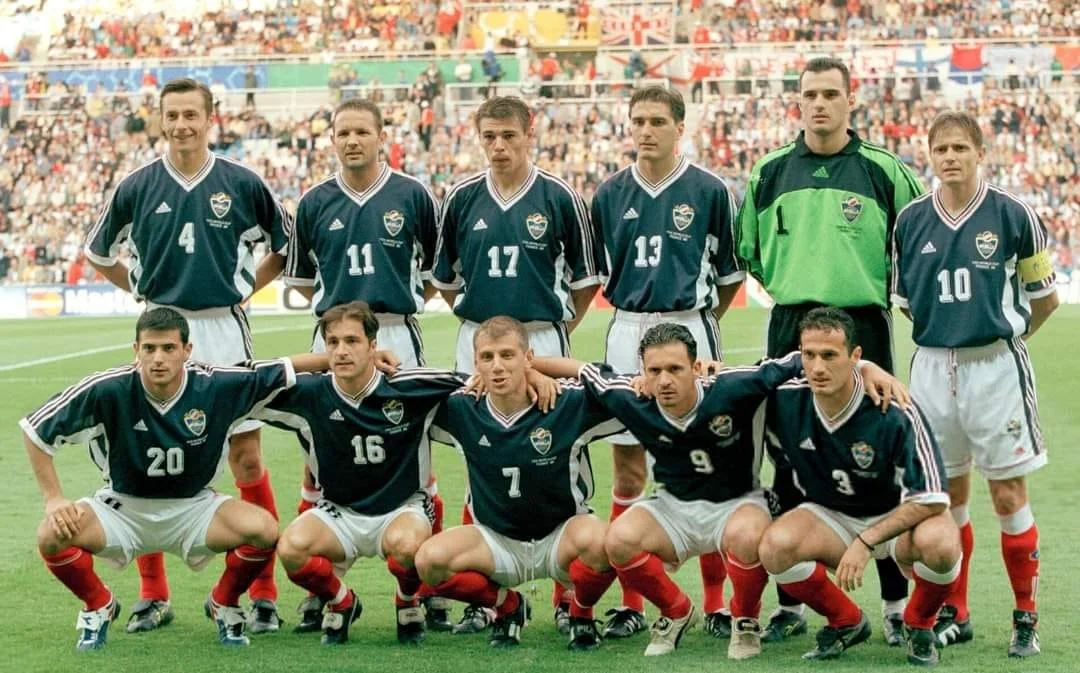
France '98 was the last time a national team under the name Yugoslavia competed at a World Cup.
Photo Credit: 90s Football
By the time the knockout stages began the tournament already felt crowded with stories, but it was in the final rounds that France 1998 truly acquired mythological status. Denmark destroying Nigeria 4-1 was shocking not simply because of the scoreline but because Nigeria had seemed capable of almost anything, thrilling and infuriating in equal measure, while the Netherlands ending Yugoslavia’s final World Cup journey under that name carried a sense of historical closure extending far beyond football.
Argentina against England meanwhile became one of the defining matches of the modern World Cup era, weighted with political memory, national pride and enormous pressure before finally descending into penalties after Beckham’s red card transformed him overnight from glamorous young captain-in-waiting into the villain of English football.
Yet even amid the chaos there existed moments of pure beauty, none greater than Owen’s astonishing solo goal, still one of the finest goals ever scored by an Englishman at a World Cup, a burst of acceleration and confidence that seemed to announce the arrival of football’s next great star.
Brazil against Denmark in the quarter-finals represented another reason the tournament endures so strongly in memory because it showcased elite football played without fear. Modern knockout football often collapses into caution and risk management, yet Brazil and Denmark attacked one another openly in Marseille, producing a glorious 3-2 match filled with technical brilliance, ambition and momentum swings.
Croatia’s destruction of Germany the following day felt seismic. The old masters of European football were dismantled by a nation playing its first World Cup, and yet Croatia’s victory did not feel accidental because Šuker, Boban and Prosinečki carried themselves with the assurance of men inheriting a much older footballing tradition, proving that the collapse of Yugoslavia had not destroyed the Balkans’ extraordinary ability to produce gifted footballers.
The semi-finals deepened the emotional complexity further. France defeating Croatia 2-1 through Lilian Thuram’s only international goals transformed the hosts from contenders into something larger, a national story gathering force and inevitability, while Brazil against the Netherlands produced ninety minutes of tension and exhaustion before penalties finally separated two exhausted giants.
Taffarel’s saves and Brazil’s survival ensured that the final many had anticipated since the opening week would eventually take place in Paris, Ronaldo against Zidane, the defending champions against the hosts, football’s unstoppable future against football’s emerging artist-king.
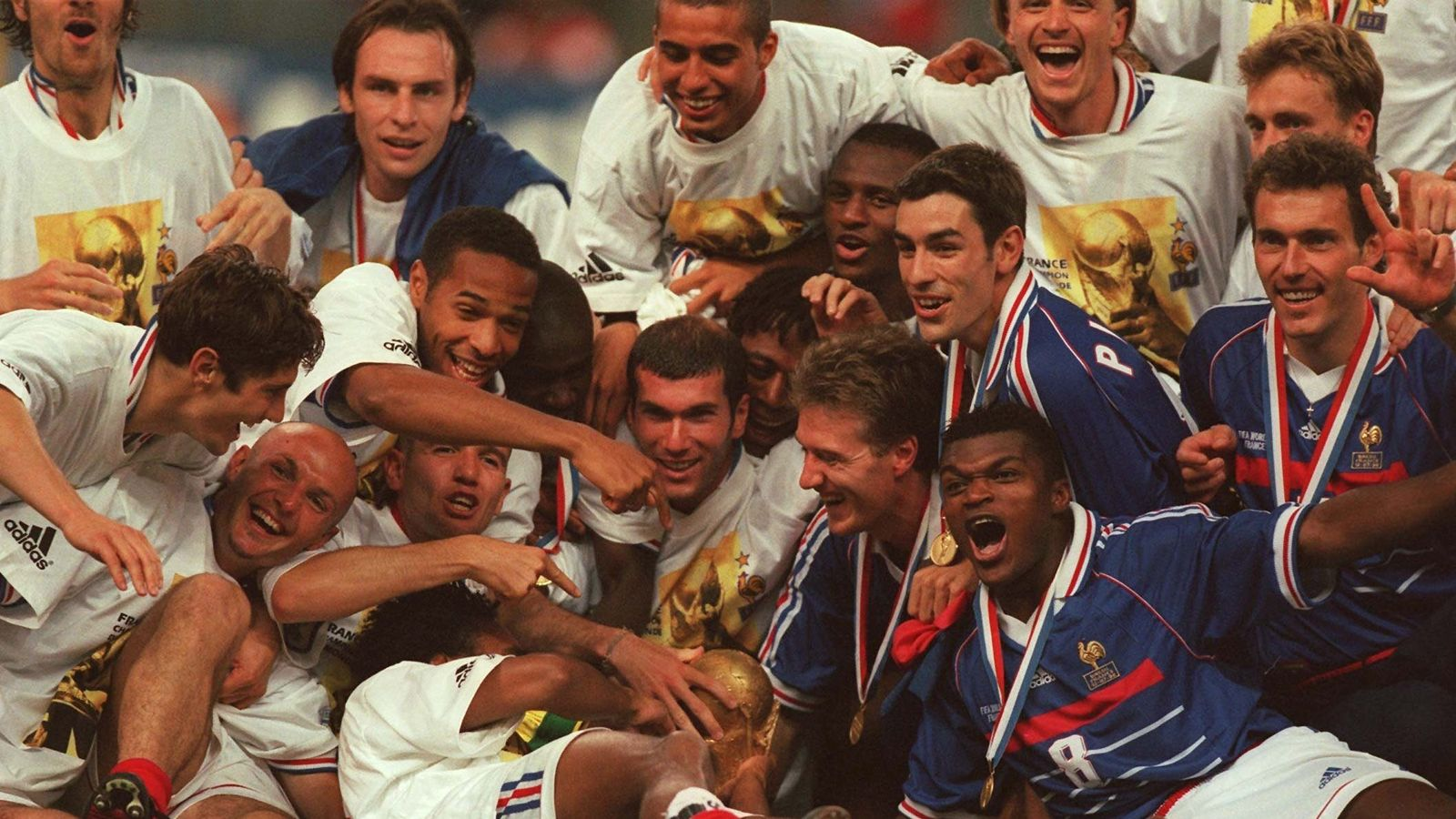
Yet the final itself remains unforgettable precisely because it refused to conform neatly to expectation. France defeated Brazil 3-0 in a match forever suspended between celebration and mystery. Zidane rose twice to score with his head and became immortal beneath the Paris night sky, while France’s multicultural squad offered a vision of national unity that politicians and commentators would spend years attempting to interpret and appropriate.
At the same time, however, the match remains permanently haunted by Ronaldo’s strange disappearance. Reports of convulsions, rumours of food poisoning, confusion surrounding the team sheet and the unsettling sight of the world’s greatest footballer wandering anonymously through the biggest match of his life created an atmosphere of unresolved uncertainty that still surrounds the final today.
Brazil did not merely lose. They seemed absent, disconnected, almost spectral, while France played with calm authority and emotional momentum.
Perhaps that unresolved quality is one reason France 1998 still lingers so vividly in memory. The tournament possessed beauty but also mystery. It contained glorious football and emotional collapse, emerging nations and fading empires, youthful innocence and tactical sophistication, joy and melancholy existing side by side.
It arrived before football became entirely consumed by algorithmic analysis and social media acceleration, meaning that many of its images acquired mythological permanence through repetition, memory and collective storytelling rather than endless digital overexposure.
People remember the colours of the kits, the brightness of the stadiums, the summer sunlight, the sticker albums, the magazine covers, the noise, the feeling that every match mattered and every squad contained at least one player capable of creating something unforgettable.
And perhaps that is ultimately why France 1998 still matters twenty-eight years later, because it felt like the final World Cup in which the entire footballing world remained visibly distinct from itself while still sharing the same stage, a tournament where styles, cultures, generations and histories collided without yet being smoothed into uniformity, and where football still seemed broad enough to contain elegance and chaos, innocence and cynicism, artistry and brutality all at once.
Whether it was truly the greatest World Cup may never be settled conclusively, because such arguments belong partly to emotion rather than evidence, but few tournaments have ever captured the global imagination so completely or left behind such a rich emotional afterglow, and fewer still continue to feel this alive nearly three decades after the final whistle sounded in Paris.
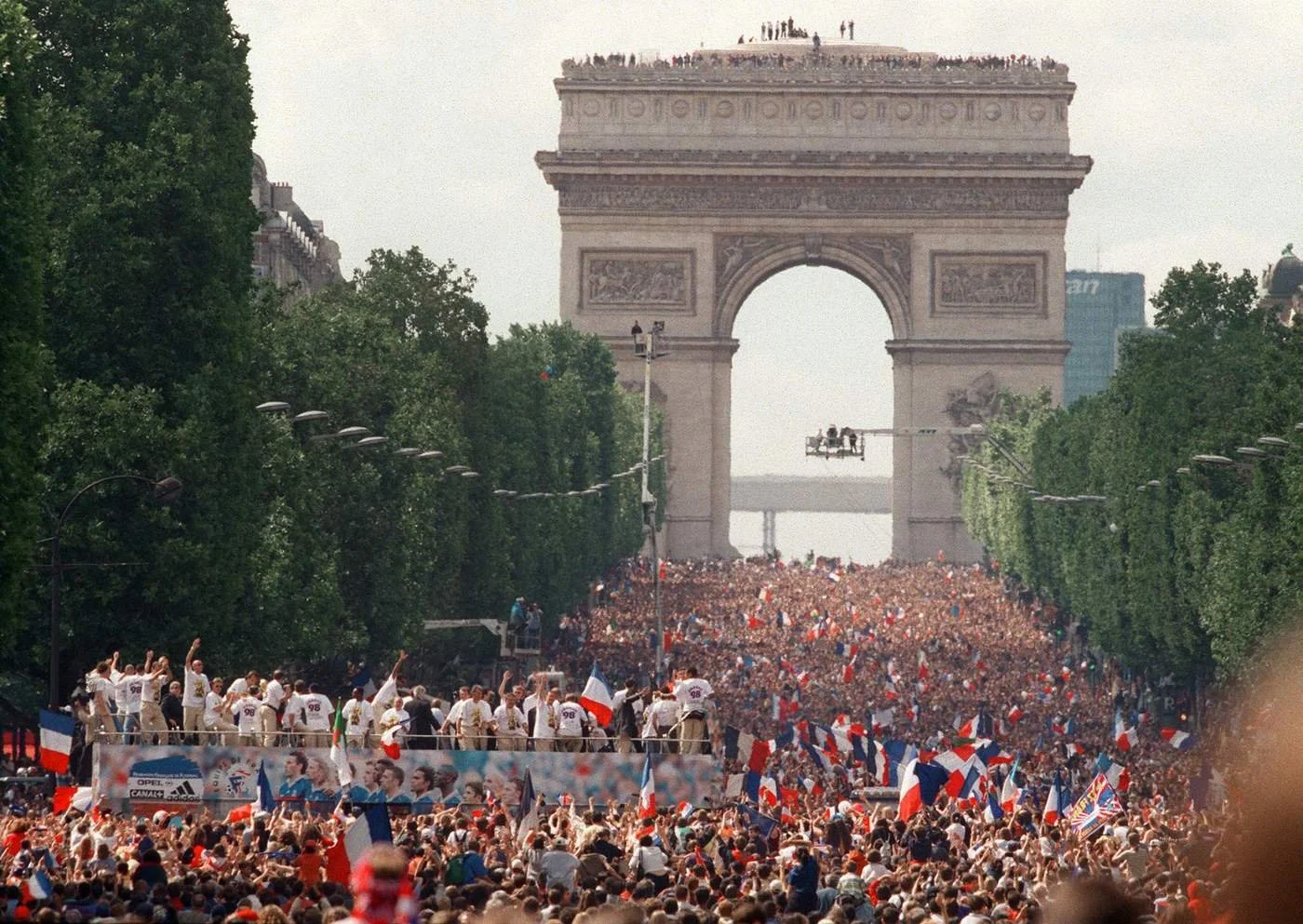
France '98 is often remembered for its cultural impact as well as results on the field.
Photo Credit: BBC News
There are certain sporting events that remain alive long after the details should reasonably have faded, tournaments that continue to occupy space in the imagination not simply because of who won or which goals were scored, but because they seemed to capture an entire cultural moment before it disappeared.
For many people who grew up loving football during the late 1990s, the 1998 World Cup in France belongs unmistakably in that category, still glowing with an unusual warmth and clarity nearly three decades later, still provoking arguments about greatness, still producing memories that feel strangely immediate rather than historical, as though somewhere beneath modern football’s endless flood of content, analysis, branding and tactical uniformity there remains the echo of a competition that represented the game at a particular and perhaps unrepeatable peak.
Nostalgia alone cannot explain it, because every generation mythologises the football of its youth and every supporter believes the game once possessed a purity that has since vanished, yet France 1998 feels different even when viewed critically and from a distance, partly because it arrived at the precise intersection between football’s old world and its new one, between mystery and total exposure, between national identities and global commercialisation, between romantic individuality and the increasingly systematised structures that would later dominate elite football, and perhaps that is why the tournament still feels so rich in memory, because it contained so many contradictions at once, so many beginnings and endings unfolding simultaneously beneath the summer skies of France.
For me, France 1998 was not the first World Cup I followed closely. That had been USA 1994, a tournament of impossible colours, strange kick-off times, Roberto Baggio’s heartbreak and Romário’s brilliance, but four years later football felt different because I was different.
At fourteen years old, completely obsessed with the sport, following players and clubs as intensely as possible, France 1998 arrived at exactly the right age, old enough to understand football intellectually and emotionally yet still young enough for the tournament to feel almost magical, and crucially this was still a football world untouched by social media, endless highlight clips and instant information.
The internet existed only faintly for most ordinary supporters, certainly not in the form that would later transform football into a permanently accessible global conversation. That meant national teams, especially those from outside Europe, still carried an aura of mystery and surprise. One could know certain famous names from European leagues, particularly Serie A, La Liga or the Premier League, but entire football cultures still felt partially hidden from view until the World Cup suddenly brought them into focus.
That mystery mattered enormously. Modern football supporters often see every promising teenager, every tactical trend and every overseas league dissected instantly online, but in 1998 there were still players who arrived carrying the weight of rumour and imagination rather than overexposure.
Marcelo Salas, at twenty-three, still played in South America and felt almost mythical to many European viewers despite his growing reputation. Carlos Valderrama represented not merely Colombia but a type of football personality already beginning to disappear from elite club football, a player whose individuality, rhythm and theatrical presence seemed too large and too chaotic for the increasingly rigid tactical structures of Europe’s biggest teams.
Jorge Campos looked unlike any goalkeeper in world football, dressing in fluorescent colours while charging recklessly from his area with the confidence of a street footballer. José Luis Chilavert transformed the position entirely, equal parts goalkeeper, captain, provocateur and playmaker. Jay-Jay Okocha played as though improvisation itself had become a tactical philosophy.
Ariel Ortega drifted through matches with the balance and unpredictability of a playground genius. These players felt larger than life because they emerged from football cultures still partially inaccessible, still capable of surprising audiences.
European club football, although unquestionably the highest level of the game by then, had already begun moving towards stricter tactical systems and greater athletic discipline following the Bosman ruling and the concentration of elite talent inside a handful of financially dominant leagues, yet international football in 1998 still allowed room for eccentricity, for emotional chaos, for footballers who thrived on instinct rather than structure, and because of that the World Cup became more than a tournament. It became a meeting point between footballing worlds.
That sense of collision existed everywhere throughout France 1998. Looking back at the squads now almost feels absurd because of the sheer density of talent gathered in one competition. Ronaldo. Zidane was twenty-five and approaching immortality.
Del Piero. Nesta. Buffon. Vieira. Rivaldo. Henry. Raúl. Eighteen year old Michael Owen. Seedorf. Kluivert. Beckham. Rio Ferdinand. Crespo. Verón. Ortega. Okocha. Nakata.
Yet surrounding them stood the fading giants of previous footballing eras: Hagi, Matthäus, Klinsmann, Stoichkov, Valderrama, Maldini, Dunga, Bebeto, Schmeichel, Costacurta, Popescu, Batistuta, Deschamps and countless others. France 1998 did not belong to one generation. It belonged to several at once.
That layering of generations gave the tournament emotional depth before a ball had even been kicked because every match carried hidden tension between youth and experience, future and decline, continuity and change. Watching Michael Owen burst through the Argentine defence in Saint-Étienne felt like witnessing the arrival of football’s future in real time, while seeing Stoichkov labour through Bulgaria’s collapse against Spain felt like watching time finally catch one of the game’s great rebels.
The expanded thirty-two team format only intensified the sense that the entire footballing world had gathered in France. Japan made their debut, symbolising the sport’s accelerating growth across Asia. South Africa appeared at a World Cup for the first time after the end of apartheid, carrying enormous political symbolism even before taking the field.
Jamaica brought joy, noise and celebration to every stadium they entered. Croatia embodied national rebirth after the trauma of the Yugoslav Wars. Yugoslavia itself appeared one final time under that name, a team haunted by fragmentation yet still overflowing with technical intelligence and emotional steel. Even the composition of the groups seemed to produce fascinating clashes of footballing identity.
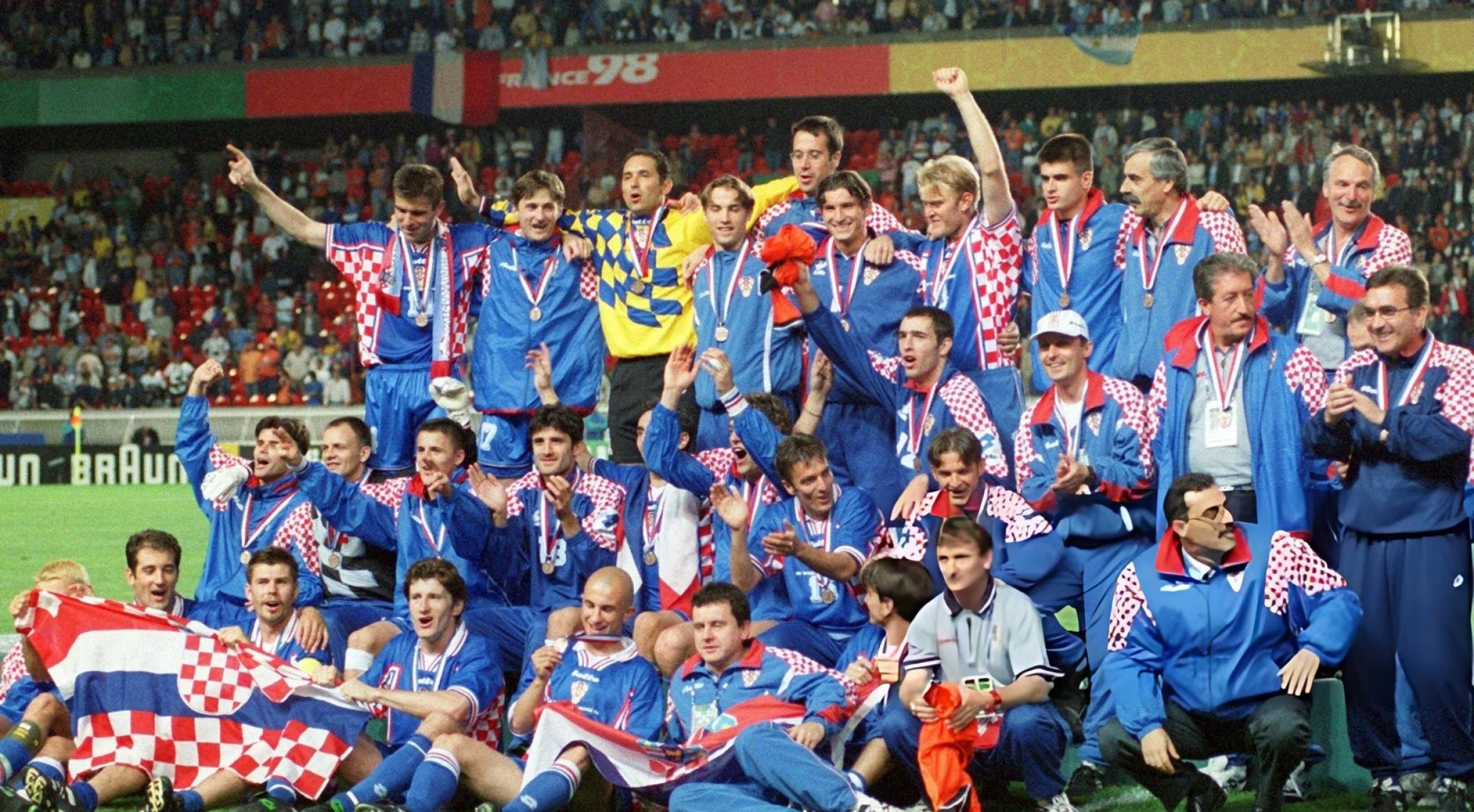
France '98 was Croatia's first World Cup.
Photo Credit: Getty
And perhaps that unresolved quality explains why France 1998 still lingers so powerfully in memory twenty-eight years later. The tournament contained brilliance and melancholy simultaneously. It represented football before complete global homogenisation, before social media overexposure, before every player became permanently accessible through endless clips and commentary. It was experienced rather than consumed. Entire teams still carried mystery. Entire football cultures still felt partially unknown. Watching the World Cup meant discovery.
As time passes, it becomes increasingly tempting to describe the period between roughly 1996 and 2010 as football’s modern golden age, a stretch where tactical sophistication, global visibility, technical quality and emotional unpredictability balanced each other almost perfectly before hyper-commercialisation and tactical standardisation hardened the edges of the sport. France 1998 stands near the centre of that era.
And perhaps that is what remains most difficult to explain, even after all these years, even after rewatching the goals and revisiting the squads and placing the tournament back into its historical context, because France 1998 does not survive in memory as a neatly defined argument about tactics or even as a simple celebration of great players, but instead as a feeling that football, for a brief moment in time, contained everything at once without yet having been reduced to the sharper edges it would later acquire, and it is that sense of totality, of abundance, of a game still capable of surprising even those who thought they knew it intimately, that continues to give the tournament its strange staying power.
It is tempting, with time, to place tournaments into hierarchies, to declare one the greatest and another merely memorable, but France 1998 resists that kind of reduction because it was not simply a competition of outcomes, it was a convergence of eras, a meeting point between the last generation of football that still felt partially unknowable and the first generation of players who would become fully globalised icons, and in that narrow space between what football had been and what it was about to become, something unique was formed, something that felt, at the time and still feels now, unrepeatable.
There is also the personal truth of it, which cannot be separated from the historical one, because for those who were young enough to experience it without irony, without analysis, without the constant mediation of modern football culture, France 1998 was not content to be observed, it was absorbed, lived through summer afternoons and late-night highlights, through newspaper reports and word of mouth and fleeting television images that could not yet be replayed endlessly, and in that scarcity of access there was a kind of imaginative space that allowed players to become larger than themselves, matches to become myths, and entire national teams to feel like distinct worlds colliding rather than collections of professionals executing systems.
And so it remains, not as a flawless tournament, because no World Cup ever is, but as something fuller than that, something closer to a memory of football at its most expansive and emotionally open, a moment when Brazil could still be undone by Norway, when Nigeria could still overwhelm Spain, when Croatia could still rise from nothing to defeat Germany, when England could still break hearts in familiar patterns, when Romania could still stand at the top of a group through intelligence and composure, when even the smallest details felt capable of becoming part of a larger story that the tournament itself seemed to be writing in real time.
Looking back now, it is possible to acknowledge how much has changed, how football has become faster, more analysed, more global, more polished, more commercially immense, and in many ways more perfect, yet still recognise that something was present in France in the summer of 1998 that feels harder to locate today, a sense of mystery that surrounded players before they became endlessly visible, a sense of discovery that came from watching rather than knowing, a sense that football was still wide enough to contain contradiction and surprise without immediately resolving them into explanation.
Perhaps that is why it continues to linger, why it refuses to fade into the background noise of history, because France 1998 was not only watched, it was felt as a kind of unfolding world, and in that world Zidane could become immortal, Ronaldo could become enigmatic, Owen could become sudden, Croatia could become historic, Nigeria could become defiant, and football itself, for a brief and shining moment, could feel as if it belonged to everyone and no one at the same time.
And when all attempts at ranking, defining and comparing have finally exhausted themselves, that is what remains most difficult to dismiss, the simple, enduring impression that for those who were there, at the right age, at the right time, France 1998 was not just another World Cup, but the moment when football briefly felt complete, before time moved on and everything began to change again.