

Words by Dave Proudlove | Published 22.04.2026“Football is war”
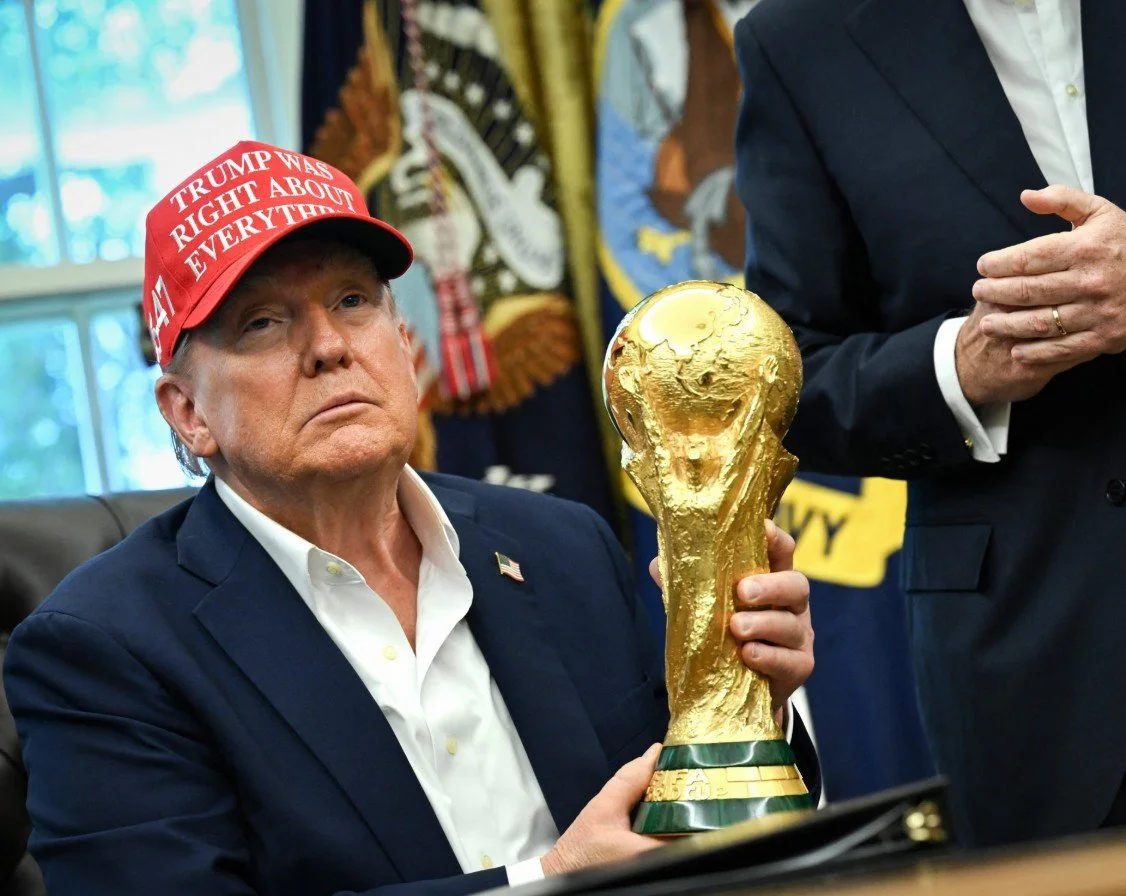
Rinus MichelsApril 2026. Just over two months until the 2026 World Cup finals get underway in the USA, Canada and Mexico, and United States President Donald Trump in cahoots with Israel has started a war with Iran that has quickly spread across the wider region. It’s a mess, a Trump created mess, possibly designed to help save his own skin, which is quite ironic the number of times that he suggested that Barack Obama would initiate war with Iran for the same sort of reason.
And it’s only a few months since FIFA president Gianni Infantino handed Trump the inaugural FIFA Peace Prize in Washington, something that you would imagine Infantino now feels deeply embarrassed about – peaceful man Trump has recently said that it will be ‘fun’ to carry on bombing Iran – though if I was a betting man, I wouldn’t see that as being a sure fire thing.
A few weeks back, Iran was the only nation missing from a planning session for World Cup participants held in Atlanta, and when asked his views on their absence and whether he thought Iran would compete in the summer finals, Trump responded, “I really don’t care. I think Iran is a very badly defeated country. They’re running on fumes”, while a little over a week later, he stated that it would be “inappropriate” for Iran to compete, suggesting that it wouldn’t be safe for Iranian players, officials and supporters to enter the US.
You would think that if FIFA really cared about the integrity of the competition, they would strip the USA of their host nation status and work with Canada and Mexico to extend the tournament within their territories. However, the time to enact that may well have been and gone.
The World Cup has always been more than a sporting competition. From its early years in fascist Europe to its modern incarnation in a globalised, media-saturated world, the tournament has functioned as a political stage as much as a footballing one. While finals often draw the most attention, some of the most politically sensitive matches in World Cup history have occurred in earlier rounds, where geopolitics, war, ideology, nationalism, and identity collide under the gaze of billions.
Although there is often a political edge to World Cup finals in some form or another – think the human rights abuses that overshadowed the last finals in Qatar, or the celebratory nature of the 2010 finals in South Africa – all of this – alongside the ongoing tensions between Trump and Canada – gives this year’s World Cup finals a genuinely dark political edge for the first time in decades.
Of course, this is not the first time that there has been severe political conflict between the United States and Iran. Following the 1979 Iranian Revolution, the two countries severed diplomatic relations, and there have been flashpoints ever since. And all of this hung over the meeting between the two in the group stages of the 1998 World Cup finals in France, the first time they’d met since the revolution.
Political rhetoric between the two nations had been hostile for years, but in a powerful gesture, Iranian players presented white roses to their American counterparts before kick-off, a symbol of peace. Iran’s 2–1 victory was celebrated domestically as a triumph of dignity on the global stage, while the fixture demonstrated how football can soften political antagonism, if only on a temporary basis.
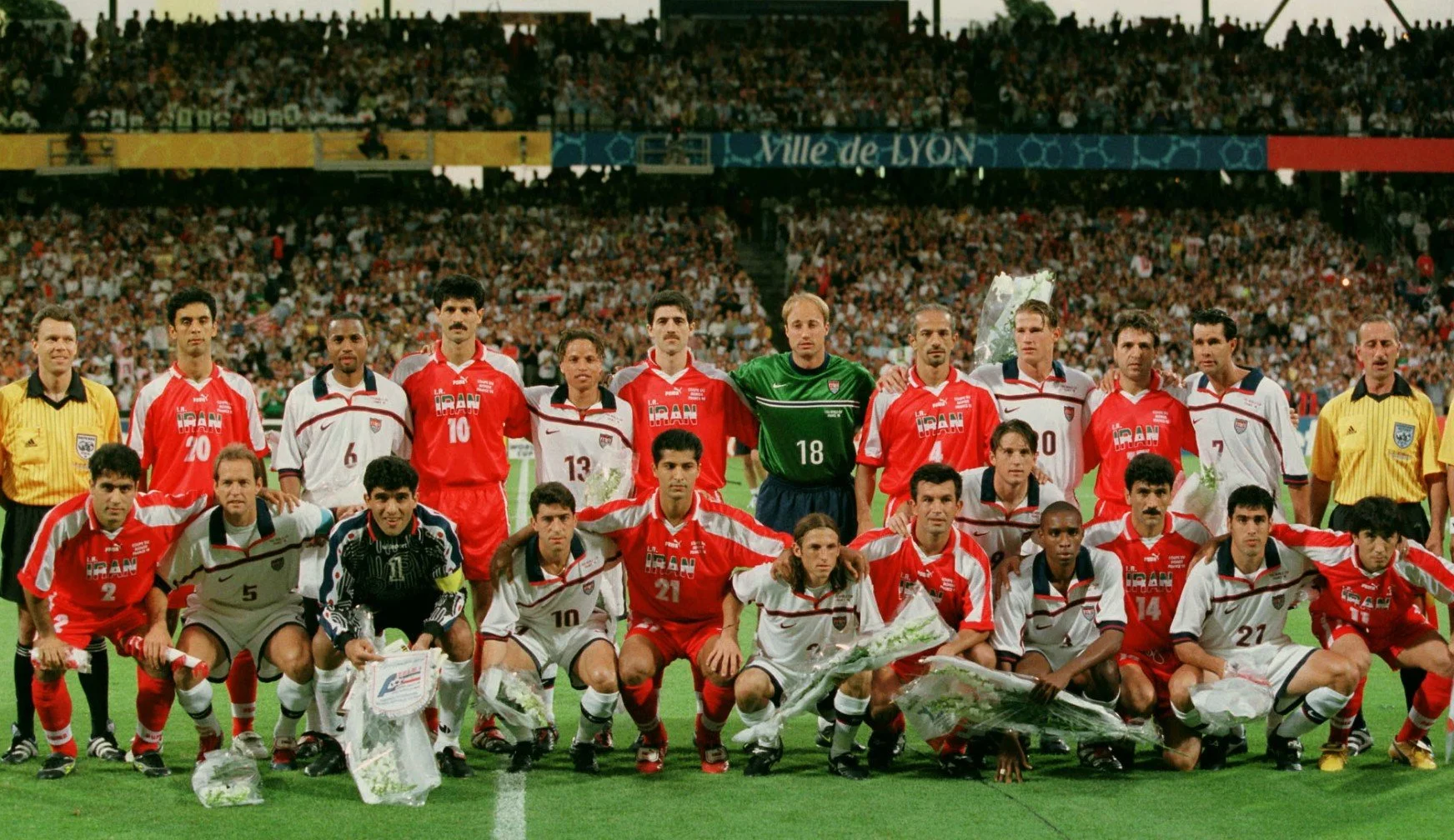
Iran vs. USA at the 1998 World Cup finals in France.
Photo Credit: The Guardian
The darkest of decades for World Cup football was the 1930s as fascism rose across Europe, most notably in Germany and Italy. And it was in Italy where football was seen as an important propaganda tool by dictator Benito Mussolini.
The 1934 World Cup finals were hosted by Mussolini’s Italy, and his fascist regime saw the tournament as the perfect opportunity to project the strength and unity of fascist Italy.
The semi-final between Italy and Austria was particularly sensitive from a political perspective. Austria’s ‘Wunderteam’ was celebrated for its technical brilliance, while the nation represented a democratic alternative to fascism in Central Europe.
Italy’s narrow 1–0 victory was clouded by accusations of biased refereeing and political pressure, but although definitive proof of manipulation has always remained elusive, the broader atmosphere of intimidation was undeniable.
Mussolini reportedly involved himself directly in organisational matters, while Italy’s eventual triumph in the final – a 2-1 victory over Czechoslovakia – reinforced fascist propaganda narratives about national superiority.
Four years later in 1938, while Italy were preparing to defend their World Cup title in France, Europe stood on the brink of war. The FA had rejected the opportunity for England to enter international competitions, but ahead of the 1938 finals, the national team travelled to Berlin to face Germany in a pre-tournament friendly on 14 May.
During the national anthems prior to kick-off, the England team – after being instructed to do so by the British Ambassador and FA officials – raised their arms and performed the Nazi salute.
It wasn’t the first time that an England team had acknowledged fascists in such a manner – ahead of fixtures with Italy in 1933 they gave similar fascist salutes – and it wouldn’t be the last: despite the growing threat of war, the England team once again gave a fascist salute before a friendly with Italy in Milan in 1939.
At the time, the actions of the England team were largely viewed in the UK as diplomatic gestures, though in hindsight, they have become regarded as among the most shameful moments in English sporting history.
Italy’s defence of its title in France commenced shortly after the Anschluss, Nazi Germany’s annexation of Austria. Italy progressed to the final once again, and this time they faced Hungary, running out 4-2 winners, though it was a contest that was once again infused with fascist symbolism.
Hungarian players later recalled feeling political tension around the showpiece, with Italy’s success once more serving Mussolini’s messaging campaign at a time when authoritarian regimes were consolidating power across Europe.
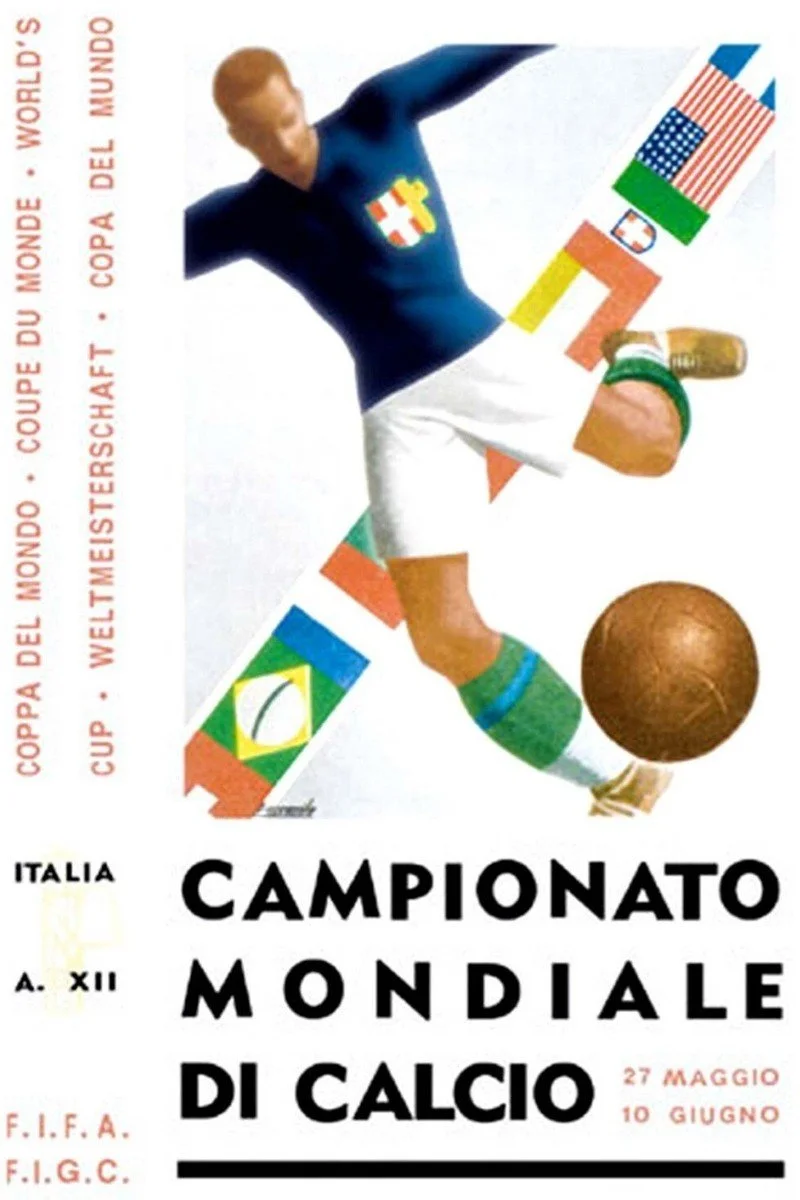
Official World Cup finals poster, Italy 1934.Following the outbreak of World War II, both the 1942 and 1946 finals were cancelled, and the tournament resumed in Brazil in 1950. But it was four years later in Switzerland when once again, Europe’s political dramas came to the fore on the football field.
By the 1950s, the Third Reich had fallen, Hitler was dead, and Germany had been split into East and West. West Germany was rebuilding as a Westernised democracy, whereas East Germany was a Soviet-aligned socialist state.
Another Soviet-leaning state was Hungary, and their national team – the ‘Magnificent Magyars’, led by the legendary Ferenc Puskás – went into the 1954 finals as favourites. They were renowned for what was a revolutionary 3-2-5 formation, and went 31 games unbeaten between 1950 and 1954, won the Olympic gold medal in 1952, and famously humbled England 6-3 at Wembley and 7-1 in Budapest.
Hungary only lost once in all between 1950 and 1956, and that was the 1954 World Cup final, where they were beaten 3-2 by West Germany after leading 2-0. The game became known as the ‘Miracle of Bern’, and the result reverberated both from a footballing perspective and politically, symbolising psychological renewal for West Germans, and a securing subtle ideological victory for the West during early Cold War tensions.
And in Hungary, public disappointment following the shock defeat fed into broader dissatisfaction with their political regime, contributing to the atmosphere that would explode in the 1956 uprising.
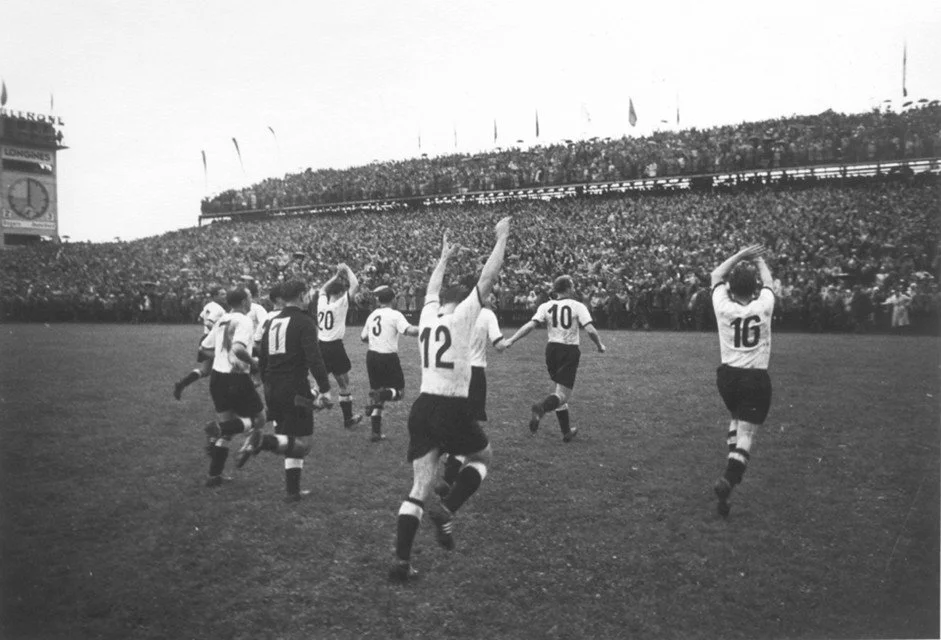
The West German team celebrates the ‘Miracle of Bern’.
Photo Credit: BPK Berlin
While it was more often than not in Europe where political tensions bubbled to the surface at major tournaments, during the 1960s and 1970s, Latin America gave Europe a run for its money, most notably following World Cup qualifiers in June 1969 between Honduras and El Salvador, the last of which provided the spark for the so-called ‘Football War.’
On 27 June 1969, Honduras and El Salvador faced each other for the third time in as many weeks with qualification for the 1970 World Cup finals in Mexico on the line.
Honduras had won the first fixture, El Salvador the second, while the third was a tiebreaker held at the Azteca Stadium in Mexico City. El Salvador progressed to the finals – their first – winning 3-2 after extra time, but all three games had been marred by violence. Incredibly, within a couple of weeks of El Salvador’s triumph, the two countries were at war.
There had been tensions between El Salvador and Honduras for some time, related to immigration, economic issues, border disputes and land reform, which led to the deportation of thousands of Salvadorans by the Honduras government. The Salvadoran government struggled to cope with those returning, while the press published stories alleging persecution, and even rape and murder which led to rising anger.
And it was within this context that the World Cup qualifiers were held.
As the players prepared for the third and deciding game, El Salvador severed diplomatic ties with Honduras as the relationship between the two nations deteriorated, and 1,700 Mexican police were deployed in a bid to quell the violence.
In the aftermath of the game, border skirmishes grew heavier, and on 14 July, El Salvador launched bombing raids on Honduras and ordered its armed forces to invade. The war lasted four days, cost thousands of lives, displaced thousands more, and affected the region for years.
Although the conflict is still known as the Football War, some 50 years after the match, Mauricio Rodríguez – the man who scored the winning goal for El Salvador – reflected on events, and concluded that war was the inevitable outcome, regardless of whatever had happened during those World Cup games.
"People abroad stigmatised it as the goal that started the war," said Rodríguez. "The war would have happened with or without that goal."
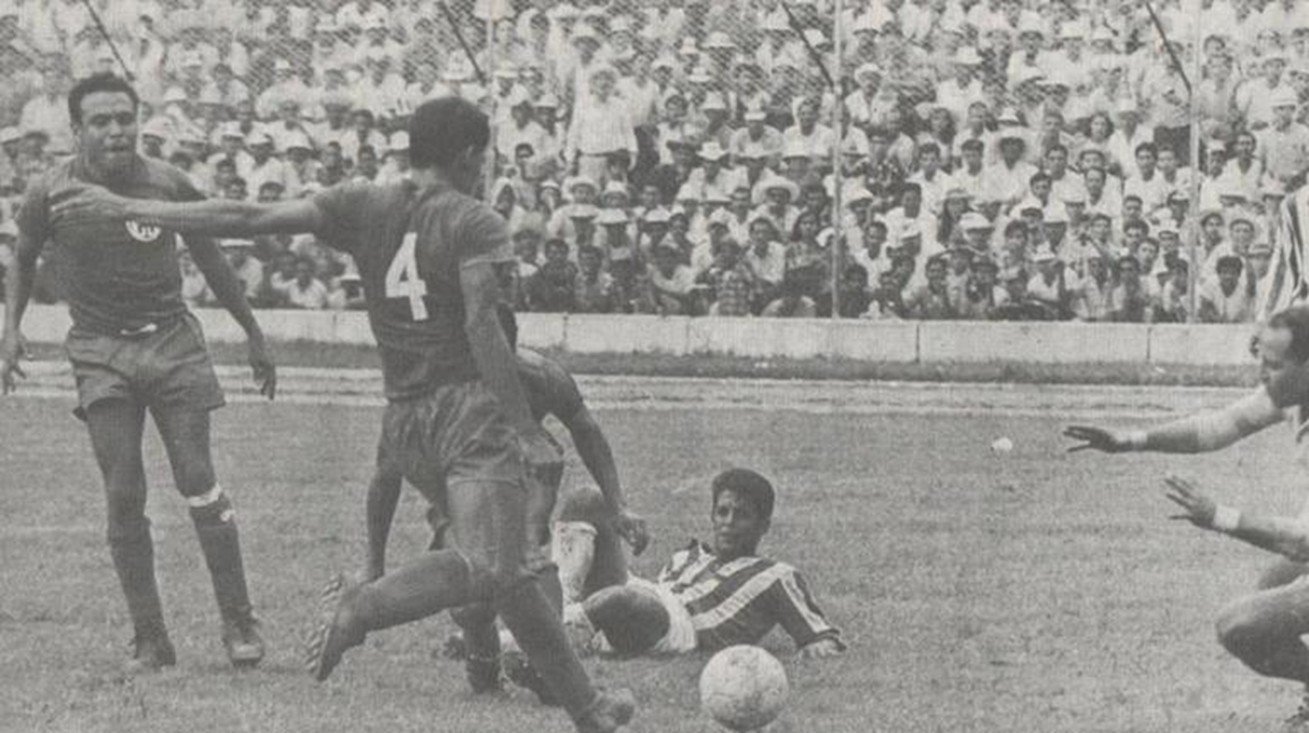
El Salvador and Honduras face off in the game that sparked the ‘Football War’.
Photo Credit: The Independent
Back in Europe, Cold War tensions were building during the 1970s, and in 1974, West Germany hosted the World Cup finals; it was a huge moment for the country and its post-war resurrection. And it featured two matches that perhaps best captured Cold War division, and the ghosts of World War II.
The first of them was a group stage meeting between the hosts and their neighbours East Germany. Since 1949, Germany had been divided into two ideologically opposed states, and when the two collided in Hamburg, the match carried huge symbolic weight.
Despite being underdogs, East Germany came out on top, beating their illustrious neighbours 1-0, thanks to a goal from Jürgen Sparwasser. The result is regarded as one of the biggest upsets in World Cup history, and the victory was celebrated as a propaganda coup by East Germany’s socialist government, the image of East German players defeating their western counterparts proved politically potent – an ideological moment on grass.
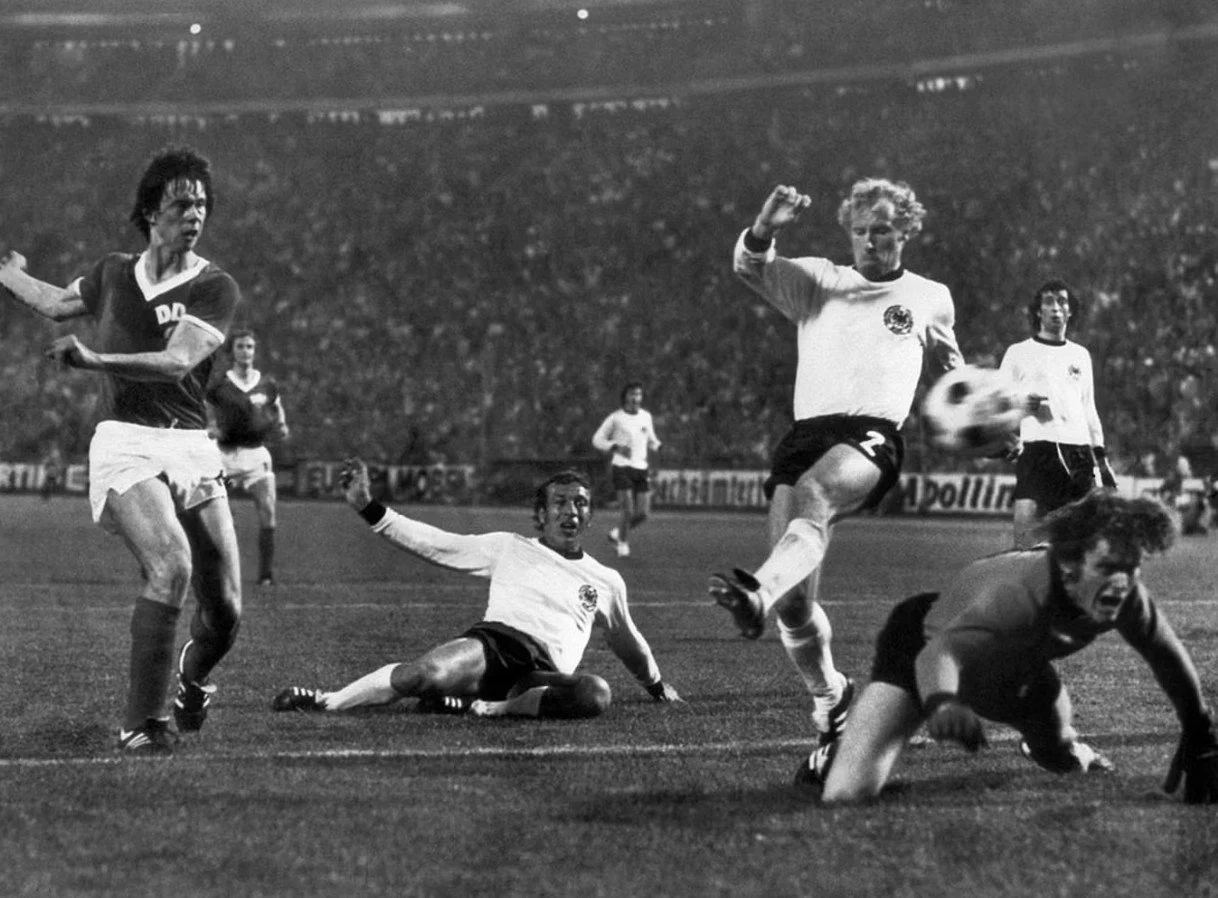
Jürgen Sparwasser scores the winning goal as East Germany beat West Germany 1-0 in the 1974 World Cup finals.
Photo Credit: The Guardian
Ironically, the result arguably benefited West Germany strategically, placing them in a more favourable second-round group, which they battled through on their way to the final, which brought out those old wartime ghosts.
The dark legacy of World War II hung heavy over the 1974 final in Munich between West Germany and the Netherlands, though it was less tension and more the ghosts of the conflict. During the war, parts of the Netherlands had endured brutal Nazi occupation.
Facing West Germany in a final less than 30 years later stirred complex emotions. Dutch star Johan Cruyff symbolised Rinus Michels’ progressive, free-flowing Total Football, while West Germany – led by captain Franz Beckenbauer – represented pragmatic efficiency.
Though the Netherlands took an early lead from the penalty spot with the Germans not having even touched the ball, their Total Football was nullified by Beckenbauer and his team mates who went on to become the first nation to lift the new FIFA World Cup after Brazil retained the Jules Rimet Trophy in 1970.
West Germany’s 2–1 victory may have been an important triumph, but it wasn’t sporting revenge or a political statement; however, it was layered with historical memory. Though both nations were now democratic European allies, wartime scars had not fully healed or faded, something which came to the fore when the two nations met in the semi-finals of the 1988 European Championship finals.
The next World Cup finals in 1978 were held in Argentina for the first time, with the country ruled by a military junta led by General Jorge Rafael Videla who were conducting their so-called ‘Dirty War’, disappearing thousands of their own citizens and political opponents. Reflecting on this, the finals were subsequently branded the ‘Blood on the Crossbar’ finals by author Rhys Richards in his 2022 book of the same name which documented Argentina’s triumph.
The hosts progressed to the second round of the finals where they eventually faced Peru needing to win by at least a four-goal margin to reach the final. The Argentinians managed this, beating Peru 6-0 to clinch a place in the final where they would beat a Cruyff-less Netherlands 3-1 to become world champions for the first time.
The extraordinary result against Peru prompted allegations of political pressure or inducements involving Peru’s government. But while no conclusive evidence has proven the accusations of match-fixing, the optics were damaging, and the match became emblematic of how authoritarian governments can instrumentalise sport, while their eventual victory over the Netherlands in the final allowed the junta to stage mass celebrations.
Captain Daniel Passarella lifting the trophy became an image of regime triumph, even as repression continued away from the cameras.
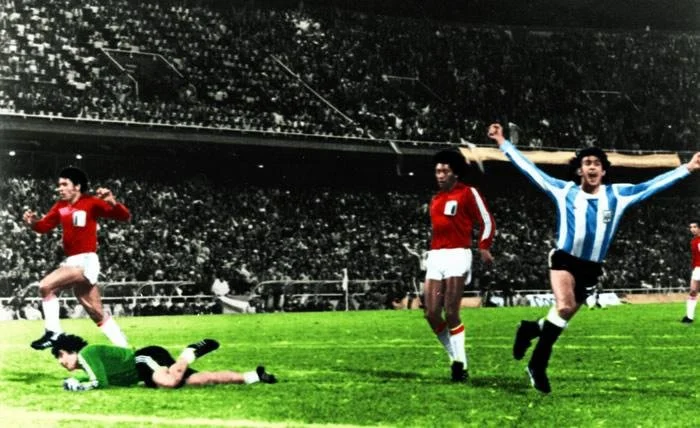
Mario Kempes nets during Argentina’s controversial 6-0 win over Peru in the 1978 World Cup finals.
Photo Credit: Latinta
In the run-up to the next World Cup finals in Spain in 1982, political issues were dominating the domestic agenda in Argentina, with economic stagnation driving widespread dissatisfaction with the military junta running the country. In response, there was a change of power in March 1981 when Videla handed over control to General Roberto Eduardo Viola.
Further change followed in December 1981 when a new junta took control, headed by General Leopoldo Galtieri. Most crucially, given what was to arise over the next few months, was the role of Admiral Jorge Anaya, who was architect and promoter of a military solution for Argentina’s long-standing claim over the Falkland Islands – an overseas British territory – with Anaya favouring such an approach in the expectation that the United Kingdom would not respond militarily.
Anaya believed that by pursuing military action over the Falkland Islands, it would mobilise patriotic feelings of Argentinians towards the islands, and distract from the country’s ongoing economic challenges and human rights violations of the junta.
And so on 2 April 1982, Argentina invaded the Falkland Islands, and though a fierce defence was launched by the governor of the islands Sir Rex Hunt, their resources were limited and shortly afterwards – following an emergency meeting of the United Kingdom Cabinet and sitting of the House of Commons – a task force was formed in order to take back the islands.
The conflict lasted for 74 days, and on 14 June, Argentina surrendered and the islands were returned to British control. The war cost the lives of 649 Argentinians, 255 Britons, and three Falkland Islanders.
The aftermath of conflict saw a positive bounce for the Thatcher government which led to a triumph in the following year’s General Election, while in Argentina, the country returned to democratic control for the first time since 1973 while the military’s image as the “moral reserve of the nation” was destroyed, having a major social impact.
The war in the Falkland Islands also cast a long footballing shadow.
In July 1978, just two weeks after winning the World Cup with Argentina, Ossie Ardiles and Ricardo Villa signed for Tottenham Hotspur for a combined £750,000 fee, a move that shocked the football world.
The two had a huge impact at White Hart Lane, and helped the club win the FA Cup in 1981, becoming firm fan favourites. They were eventually inducted into the club’s Hall of Fame. But the war between their country and adopted home affected them greatly.
Ardiles described the war as “terrible” and a “crazy conflict” and after the death of his cousin who was a pilot, left White Hart Lane for a loan spell with Paris Saint-Germain. And when he returned home to Argentina to prepare for the 1982 World Cup, Ardiles was put under intense pressure by the press. Despite being distraught by the war, Villa remained in England.
Both Ardiles and Villa were absent from the Argentinian squad for the 1986 World Cup finals in Mexico, captained by Diego Maradona who was at the peak of his powers and carried Argentina to their second triumph in two finals. On their way to the final with West Germany, they, perhaps inevitably, met England.
The two nations collided in the quarter-finals at Mexico City’s Azteca Stadium, in a clash loaded with geopolitical tension just four years after the Falklands War.
In Buenos Aires, the conflict remained an open wound, so when Diego Maradona scored his infamous ‘Hand of God’ goal followed minutes later by the ‘Goal of the Century’ – one of the greatest solo goals ever scored – the symbolism was immediate.
Maradona later described the first goal as “a little with the head of Maradona and a little with the hand of God,” but in Argentina it was interpreted by many as poetic justice against a former wartime adversary. Their 2–1 victory transcended sport; it became a cultural catharsis, and sealed Maradona’s place as a national icon.
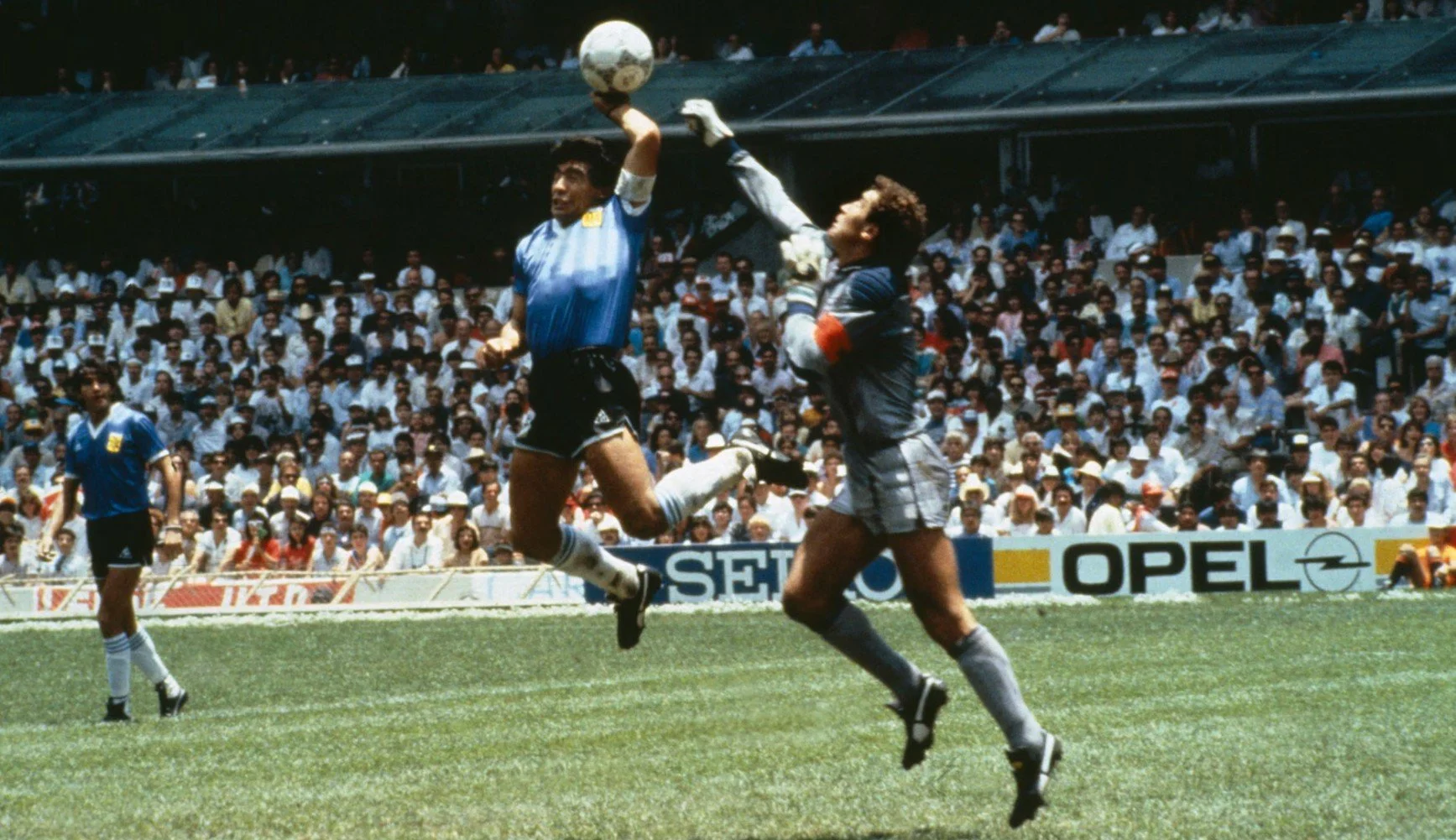
A little with the hand of God.
Photo Credit: These Football Times
Over the years, a number of patterns have emerged when it comes to politics and the World Cup. Authoritarian regimes often use football and its grandest stage for legitimacy, Cold War rivalries transformed games into ideological drama while recent wars can infuse games with symbolic revenge.
But while the World Cup does not create political conflict, it most certainly magnifies it. Matches become stages where unresolved tensions play out symbolically. Victories can heal, divide, legitimise, or sometimes destabilise.
In some cases, like the USA vs. Iran in 1998, football provides a rare moment of mutual respect. In others, like Argentina vs. Peru in 1978, it deepens suspicions.
The most politically sensitive World Cup matches are not necessarily the most violent or controversial on the field. They are the ones where context transforms 90 minutes into something far larger, where history, ideology, and identity converge under stadium lights and before TV cameras.
As long as nations compete under flags and anthems, the World Cup will remain inseparable from politics. The pitch may measure goals and record results, but the audience reads meanings – football on the biggest stage and politics often come together and create theatre.
And so back to this summer’s World Cup finals. Whatever happens in the Middle East over the coming months, it is clear that they will be imbued with a broader meaning laced with political drama.