

Words by Leire Martinez | Published 25.11.2026The 1982 World Cup, held in Spain, is remembered, amongst other things, for being the first tournament in which 24 national teams took part; for the outstanding performance of Italy’s Paolo Rossi, who had not played for two years following the ‘Totonero’ scandal; or for matches such as ‘the tragedy of Sarrià’, in which the Brazilian team were knocked out by Italy, and ‘the Disgrace of Gijón’, infamous for the pact between the Austrian and German teams to leave Algeria out.
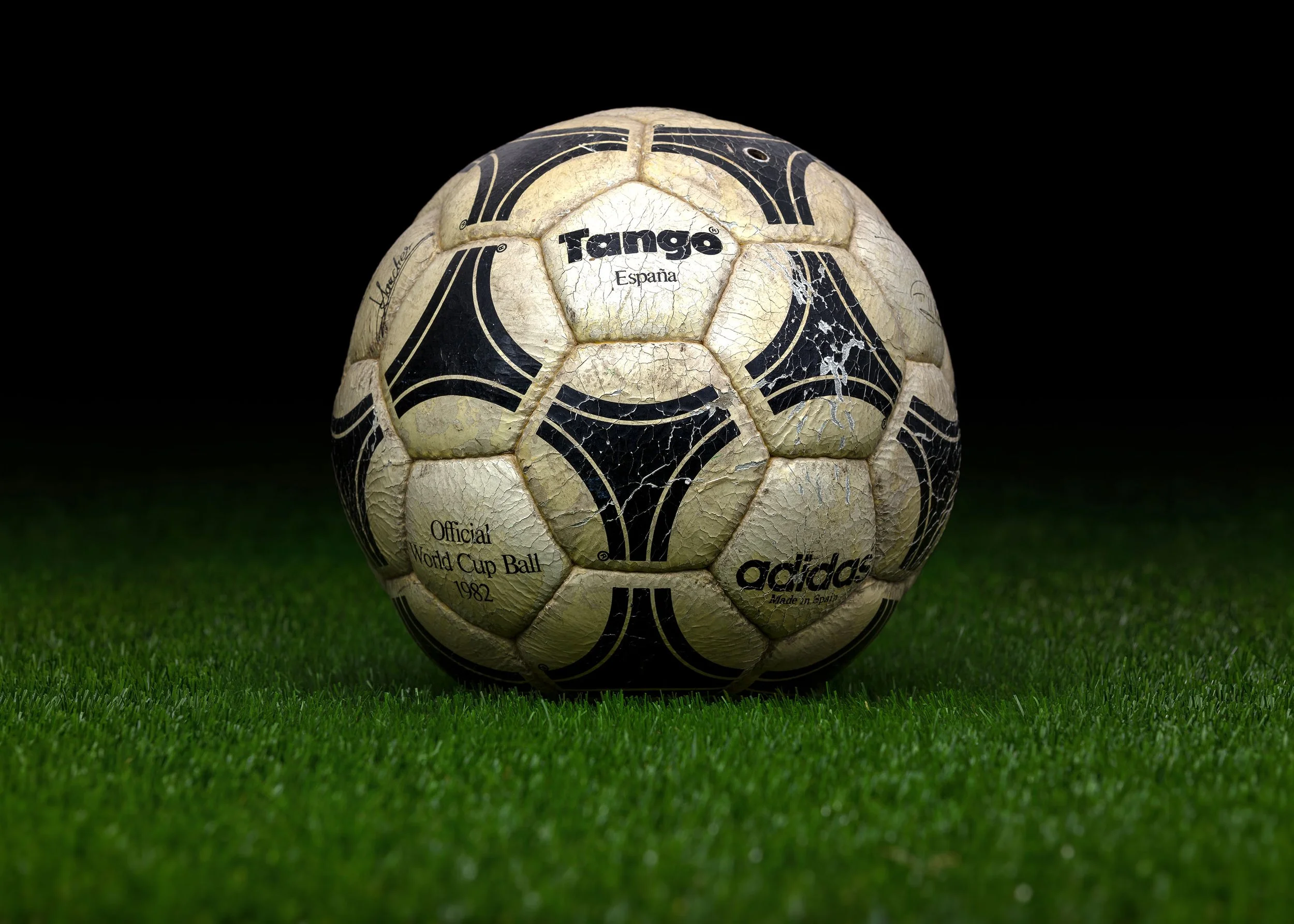
But none of that will be discussed today. The star of this story is the ball itself; the Adidas Tango España.
Or rather, the entire journey leading up to that ball, the culmination of a story that began twenty years earlier, in the 1960s.
In 1962, to be precise, Horst Dassler, son of Adi Dassler, founder of Adidas, was on holiday in Alicante, on Spain’s Mediterranean coast, when he learnt of the existence of NITRAM footballs.
These were footballs that were then used in some Spanish league matches and were sold exclusively at ‘Deportes Martín’, a sports shop in Barcelona that mainly sold football-related articles.
‘Deportes Martín’ had been founded in 1943 by two former FC Barcelona footballers: Benito García Cano, a defender who played for the Blaugrana between 1940 and 1945 and with whom he won the 1942 Copa del Rey and the Spanish league in 1945, and Mariano Martín Alonso, a striker who played for Barça between 1939 and 1948 and is considered one of the best centre-forwards the club has ever had.
They opened the business on Avinguda de la Llum in Barcelona, an underground shopping centre, which no longer exists, that had only just been opened in the city.
At a time when footballers’ wages were often not enough to make a living, both saw a good business opportunity in selling football merchandise: Benito, who had a greater flair for business, immediately threw himself into it and took charge of the administration; Mariano, for his part, acted as the shop’s figurehead, and it is after him that the shop was named.
In December 1944, seeing that business was going well, ‘Deportes Martín’ moved to Plaça d’Urquinaona.
At that time, there were no sports products as we know them today and, as a result of the Spanish Civil War and the Second World War, there was a shortage of raw materials.
However, Catalonia had a very significant textile and manufacturing industry since the 19th century and, capitalising on this context and on the owners’ expertise, the shop began to manufacture and sell its own sports equipment.
It was during those years, well into the 1950s, that they began selling NITRAM balls (‘Martín’ spelled backwards). And it was at this point that the paths of Horst Dassler and ‘Deportes Martín’ converged.
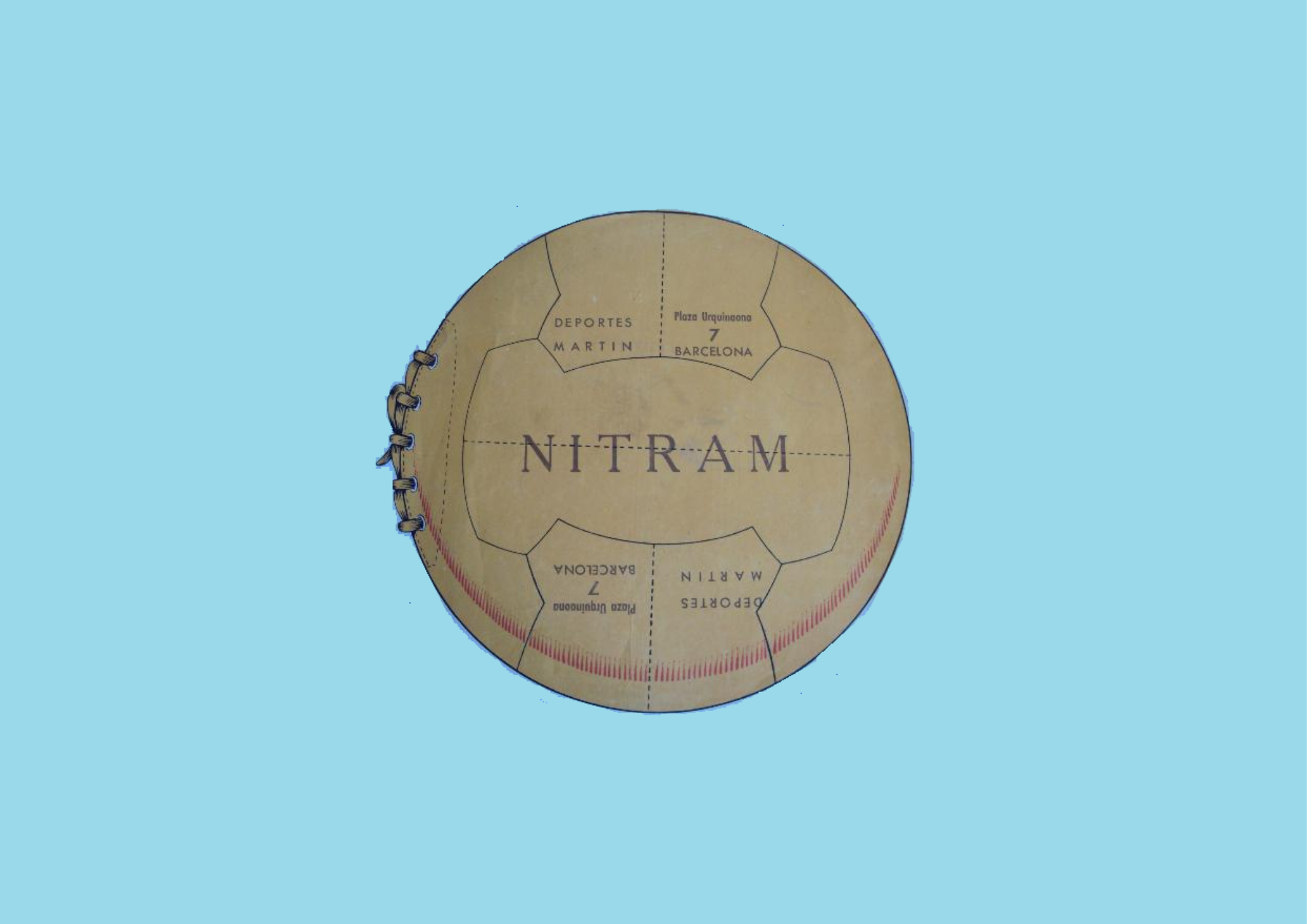
A 1955 advert for the newly developed NITRAM football.
Photo Credit: Barcelofilia
Dassler had been impressed by the quality of that leather football he had come across during his holiday in Alicante in 1962 and, determined to market this essential piece of football equipment under the Adidas brand, he visited the shop at number 7 Plaça d’Urquinaona in Barcelona to find out where it came from.
There, Benito García Cano directed him to Fabara, a town in the province of Zaragoza, in Aragon, which at that time had a population of around 1,700 and was home to ‘Manufacturas Meseguer’, a factory that had been producing leather footballs for several decades.
Once again, we must take a detour through time and space. This time, to the early 20th century in Fabara.
At that time, Alfonso Meseguer Balaguer worked as a saddler, that is, his way of making a living was producing and repairing horse harnesses and saddles, using the leather from the skins of animals that livestock farmers discarded after they had died.
It so happened that one day a Frenchman got off the train at Fabara station on a whim, because his wife was feeling unwell. Alfonso Meseguer and his wife, Susana Bielsa, looked after them, and the French couple returned to their country shortly afterwards.
However, it seems the place made a deep impression on the man because, sometime later, after being widowed, the Frenchman, whose name was Paul, returned to Fabara and married one of Meseguer’s sisters.
It was also around this time that Paul suggested to his brother-in-law that, making the most of his knowledge of saddlery and, above all, the availability of leather, he should start making and selling leather balls for the sport which, since the turn of the century, had been attracting an ever-growing audience: football.
Meseguer travelled to Barcelona to learn how to make footballs. He learnt to do it in the simplest way possible: by taking one apart and seeing how it had been made.
On his return, he set up a small workshop and began manufacturing the classic balls we all know, those which were fastened with a leather strap.
Thus began, in this region of Bajo Aragón, a thriving industry that would develop and flourish throughout virtually the entire 20th century, from 1915 to 1994.
As the business grew, Meseguer built a larger factory and, due to rising demand, switched from buying cowhides in the surrounding villages to sourcing them from Santander.
He introduced a series of innovations too. He developed a technique whereby he stretched the hides on frames of his own invention, forcing the leather to withstand tensions of 20,000 kg to give it the elasticity needed to take on a spherical shape.
Meseguer was a true pioneer in this sector, as he patented the first ball without a mouth, meaning it did not require a leather strap to seal it.
Some sources suggest, though, that it was actually a woman from Fabara who found a way to replace this archaic method of sealing the balls; she began using what in Spain is known as the ‘Russian stitch’, which allowed the seam to be concealed as the ball was being sewn.
In any case, Meseguer continued to innovate and later modified the patent so that punctures could be repaired without having to unstitch the ball.
To get an idea of the importance of football production in Fabara as early as the mid-20th century, one need only consider this fact: in 1953, when Fabara still had neither running water nor a telephone line, 25 footballs were produced by hand every day.
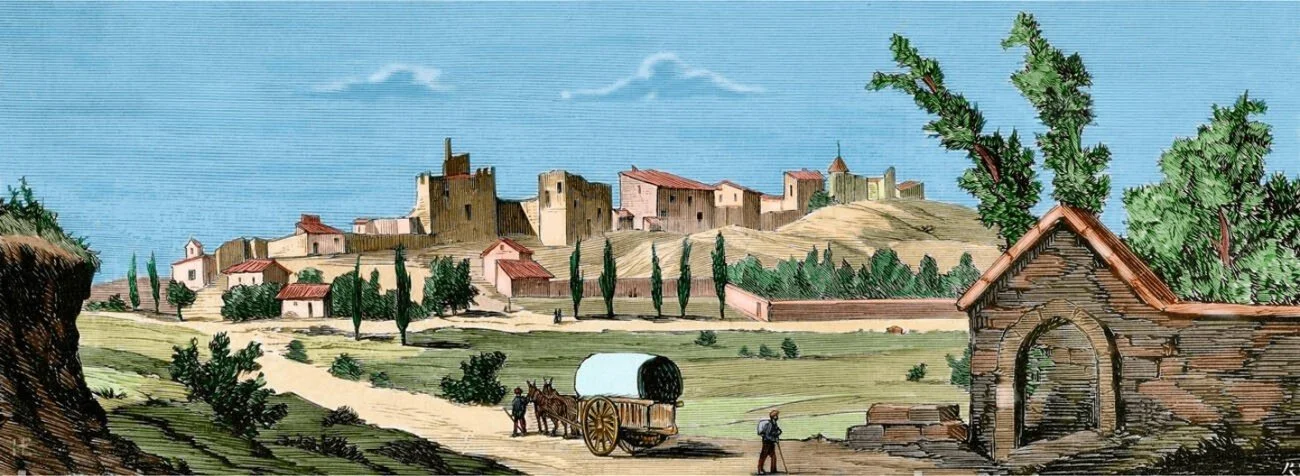
Engraving of Fabara from the Spanish American Illustration, 1875.
Photo Credit: Alamy
The football-making industry in Fabara continued to grow at pace throughout that decade, and really took off in the early 1960s with the arrival of the Adidas brand.
Meseguer, who since the turn of the century had time and again demonstrated a keen business acumen, was this time unable to recognise the opportunity before him.
In 1962, through the mediation of Horst Dassler, representatives from Adidas visited Manufacturas Meseguer with the intention of buying it and starting to mass-produce footballs, which the German brand had never done before.
However, they were unable to reach an agreement with either Meseguer or his son-in-law, Paulino García, regarding the terms of the potential deal, and that was when Pedro Albiac, an employee at Manufacturas Meseguer, stepped in.
Albiac, who spoke a little French, travelled to France with representatives of the German brand.
Through him, Adidas managed to establish a presence near Fabara via a commission, Arena Sport, and its first move was to double the wages of all those who sewed footballs who, at that time, were mostly women and children.
Seeing that the new wage was 60 pesetas, a substantial sum at the time, the men, who had previously been engaged in farming or livestock rearing, in many cases began to devote themselves exclusively to sewing footballs.
Generally speaking, it was said that in every household in the village, people would work for one or two hours in the evening sewing footballs after returning from working in the fields, particularly in autumn and winter, when there were hardly any other pastimes.
Adidas, established in the nearby town of Caspe through the Arena Sport commission, was just one of the five factories which, at the industry’s peak in the 1970s, were manufacturing footballs in the region.
Three others emerged from Manufacturas Meseguer and were founded by workers from that company who set up their own businesses: ‘Manufacturas Baldomero Bañeras’, set up by the first employee of Manufacturas Meseguer who, after spending some time working in Barcelona, came up with the idea of distributing footballs to people’s homes, so that eventually all the inhabitants of Fabara became involved in the manufacturing process; ‘Millán y Bielsa’, later known as ‘Legar-Millán’; and ‘Manufacturas Sentís’.
All but Arena Sport were based in Fabara and employed local people, and even Arena Sport, despite not being located in the town, employed workers from Fabara, who were held in high regard.
It is estimated that by the 1970s, the five factories together were producing more than half a million footballs a year, which were exported all over the world and used in major competitions.
Among them was perhaps the most famous creation of all the footballs produced by Adidas, at least for Spanish football fans: the Adidas Tango series.
To mark the 1978 FIFA World Cup, held in Argentina, Adidas created the Adidas Tango Durlast, a ball made of leather and coated with a glossy synthetic layer that made it waterproof in the rain.
It was composed of twelve pentagons and, most innovatively, twenty identical hexagons featuring ‘Tango triad’ patterns, which created the optical illusion that it was made up of twelve identical circles.
The ball’s new design was not only aesthetically unique but also offered greater durability and better control for the players. Furthermore, by coating the Tango with a rain-resistant layer, the ball’s performance improved significantly in adverse weather conditions.
Before the Tango, balls tended to absorb water, becoming heavy on rainy days. However, the Tango was coated with a water-resistant layer, making it more reliable on any surface.
Furthermore, thanks to its geometric design and the uniform distribution of the panels, it offered greater accuracy in shots and better control for players.
This revolutionary design helped raise the standard of play during the tournaments in which it was used, which were primarily the 1978 (Adidas Tango Durlast), and 1982 (Adidas Tango España) World Cups; the 1980 (Adidas Tango Italia), 1984 (Adidas Tango Mundial), and 1988 (Adidas Tango Europa) European Championships; and the 1984 Los Angeles (Adidas Tango Sevilla), and 1988 Seoul (Adidas Tango Séoul) Olympic Games.
It also came in numerous variations, such as the Tango River Plate, the Tango Barcelona and the Tango Madrid, which was the official ball of the Spanish first division in the 1984–1985 season.
Why such an emphasis on the Tango series of footballs? Well, quite simply, because it was one of Horst Dassler’s most cherished creations.
He insisted that they could only be made by the finest ball-sewers and finishers from Fabara and the surrounding area, because if they were rushed, the stitches on the balls would come undone, a small bubble would form in the bladder and the ball would burst at the next kick. Spain began to play a very significant role for Adidas from 1969 onwards, as from that date until 1994 all Adidas footballs were manufactured in this country for export all over the world.
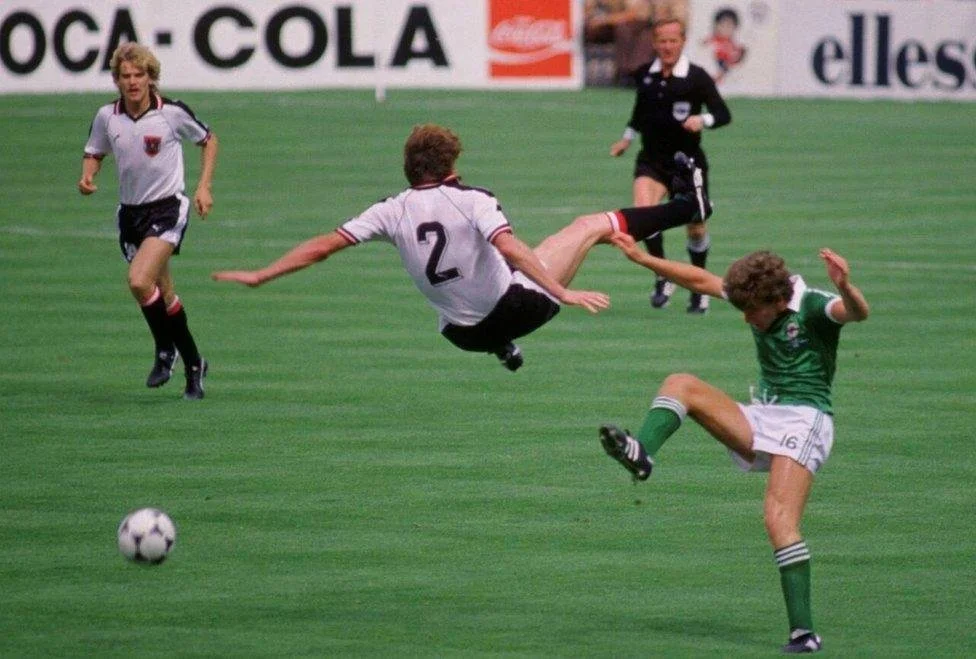
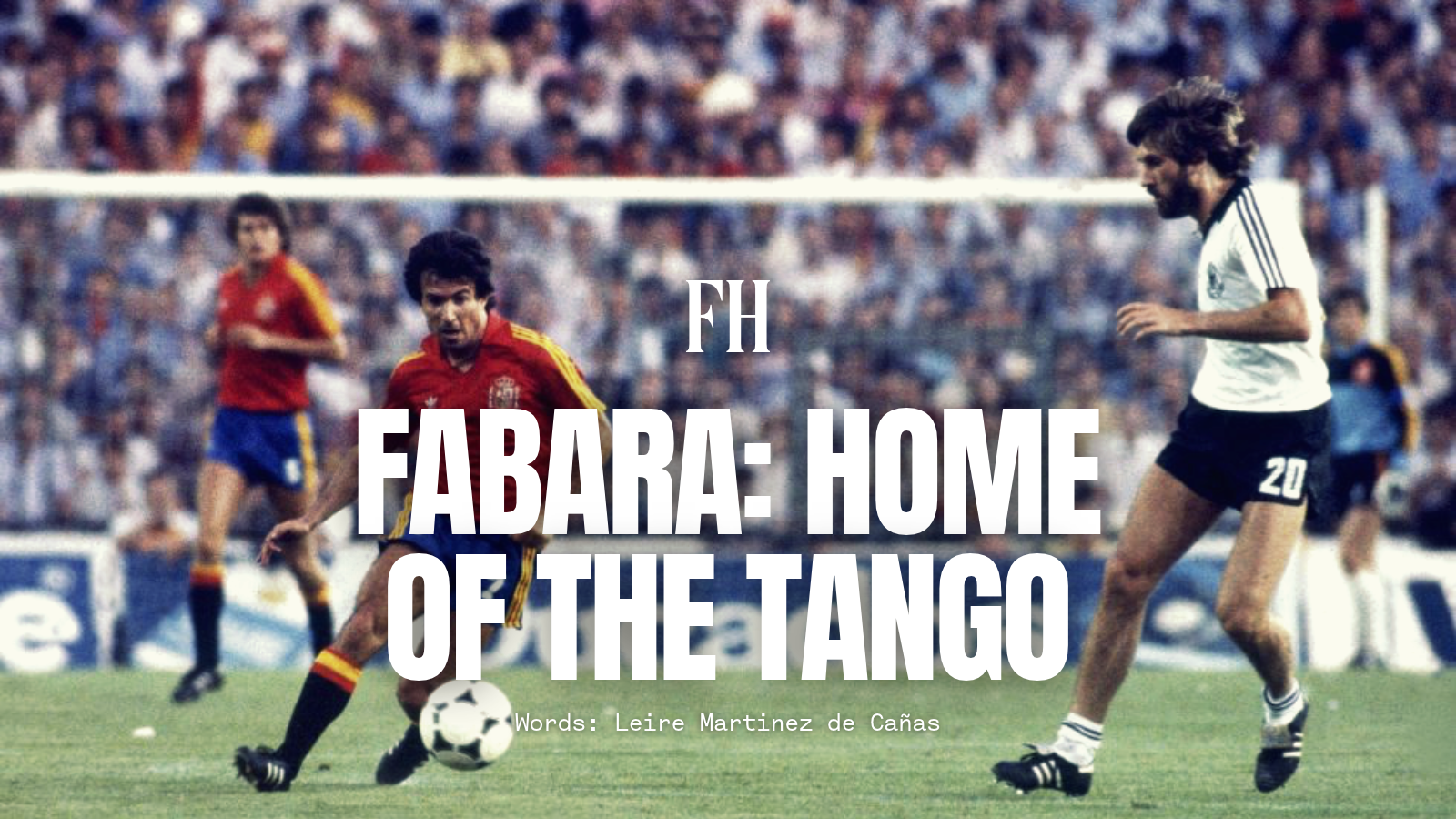
The Tango was the offical ball used for the World Cup in Spain, 1982.
Photo Credit: BBC News
The rapid growth of the football manufacturing industry in Bajo Aragón, however, had a dark side: the poor working conditions faced by the workers. Or rather, by the men, women and children of Fabara, because during the 1970s, the five factories mentioned above officially employed only 93 people.
Clearly, it was impossible for 93 people, producing around three footballs per day, to manufacture more than half a million footballs a year.
What was the trick? Well, it was that those employees on the payroll did not sew a single ball. Their job consisted of tanning the leather and preparing it for distribution in pre-cut pieces to households throughout Fabara and the surrounding area, so that it was the local residents who had to sew and finish them at home.
The stitchers usually earned around 480 pesetas per working day, at a rate of 160 pesetas (around 14 euros) per ball stitched; the finishers, who were better regarded, could finish around 25 balls per working day, meaning they could earn up to 750 pesetas, at a rate of 30 pesetas (around 2.5 euros) per ball finished.
It was, however, a job for which they received no fixed salary and made no social security contributions; they were not entitled to holidays, bonus payments or sick leave, and were only paid for the days they worked.
With increasing globalisation, the demand for footballs during the 1970s became so massive that Adidas, in order to meet it, turned to labour from Spanish prisons.
To this end, after the company had contacted the Spanish Government of the time to seek permission to run a prisoner rehabilitation programme, Pedro Albiac, then managing director of Arena Sport, and one of his subordinates, Luis Panillo, visited prisons to train inmates in the manufacture of footballs.
Whilst the conditions faced by stitchers and finishers living free were already precarious, those of the prisoners at that time amounted to virtual slavery.
To begin with, the prisoners were paid 25 pesetas per stitched ball, compared with the 160 pesetas paid outside prison. Furthermore, the workshops where they worked were usually small and had little natural light, and some prisoners ended up with hands covered in ulcers and were forced to bandage them and carry on stitching.
This was the case in various prisons throughout Spain, such as the prison in El Puerto de Santa María, in the province of Cádiz; the prison in Ocaña, in Toledo; the prison in Burgos; and the Modelo prison in Barcelona.
In any case, football production in Fabara, driven by the huge popularity of the Tango series, continued throughout the 1980s and into the early 1990s.
The decline of the Tango, which, as we have mentioned, was last used for the 1988 European Championship and the Olympic Games, coincided with the gradual end of industrial activity in Fabara.
As a result of competition from other factories, certain labour laws affecting several of its workers, banking interests and decapitalisation, Manufacturas Meseguer closed in 1982. Its heirs, in an attempt to survive, set up ‘Manufacturas Oliver’, which also had to close shortly afterwards.
The remaining factories were gradually relocated, changed hands or disappeared one by one, until industrial activity in the football production sector in Fabara came to an end in 1994, when Adidas decided to relocate its manufacturing to Pakistan and Morocco, countries where labour costs were negligible by comparison.
What began as a chance occurrence, a French woman falling ill in the heart of Aragón in the early 20th century, led to the unexpected emergence of a thriving industrial sector that developed, produced and shipped footballs to every corner of the world for decades, turning Fabara into the football capital of the world.
By the mid-1970s, it is estimated that between 700,000 and 1,000,000 footballs were being produced in Fabara each year, including all those in the various Adidas Tango series. However, this period was also marked by economic and labour abuses, with child and prison labour being used for years.
In today’s economic climate, it is very difficult to understand how, practically out of nowhere, and given the situation in which a country like Spain found itself at the time, a thriving industry could develop over decades, one in which almost all the inhabitants of a single region were involved in one way or another. And yet, it happened. Yes, during the 1970s and 1980s, Fabara was the world capital of Tango.
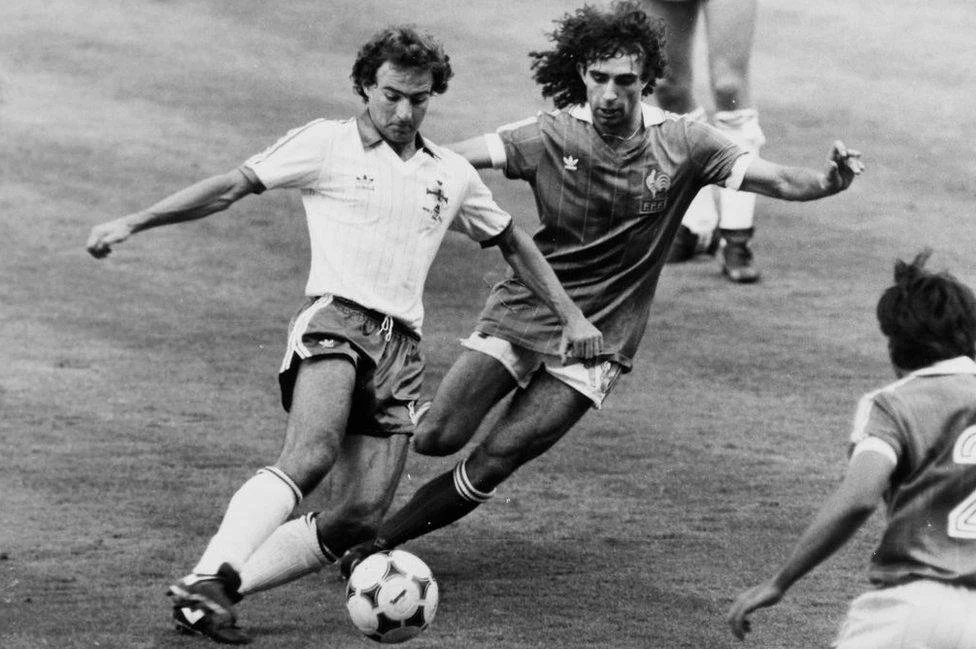
The Tango can be spotted in most if not all matchday photos from the 1982 World Cup.
Photo Credit: BBC News
Written by Leire Martinez.