

Words by Leire Martinez | Published 25.04.2026Alejandro Cao de Benós is a very odd personality, a Spanish aristocrat who allegedly works as a Special Representative of the Foreign Ministry of North Korea. He is, according to himself, also the Special Delegate of North Korea's Committee for Cultural Relations with Foreign Countries. He has been an advocate of North Korea since 1990.
In short, he is one of the very few, if not the only one, who from time to time opens a very small and heavily biased window into the Democratic People's Republic of Korea.
On the 8th of February, 2026, an interview with him was published on YouTube, the first one he has given in quite some time, since in May 2022 the FBI issued an arrest warrant for him after the US justice system determined that he had helped the North Korean regime evade economic sanctions through cryptocurrencies.
In fact, the FBI has him on its most wanted list for conspiracy to violate the International Emergency Economic Powers Act. Thus, Cao de Benós is a very controversial character that, on said interview, discussed many topics, including football.
He confirmed that football is the number one sport in North Korea, and that everyone in the country knows who the most famous players are because they see the games. And, in the most closed off country in the world, they see the games because the government pirates the signal from Japan, strips away the logos of the broadcasting companies, and broadcasts the beautiful game to the homes. “Everything pirated, eh, not a penny paid”, he says emphatically.
Football in the Democratic People's Republic of Korea is heavily influenced by the country's social, cultural and political structure. Few places come to mind, apart from other communist countries, of course, where factors external to the sport itself have had such an influence on its development throughout history.
The difference with football in North Korea and in, for example, the USSR, Hungary, Yugoslavia or Poland is, on the one hand and quite obviously, that in those countries communism gave way to other forms of politics decades ago, but not in North Korea, which has been a communist country for more than 80 years now; and, on the other hand, the Juche ideology, which permeates and shapes everything in North Korea since 1953, when the country was divided after the ‘end’ of the Korean War.
Juche ideology is the specific anti-revisionist adaptation of Marxism-Leninism to the material conditions and idiosyncrasies that are properly and exclusively Korean. It was conceptualised by Kim Il Sung, North Korea’s founder and first leader, and even though it was originally regarded as a variant of communism, Kim Jong Il, Kim Il Sung's son and successor, declared it a distinct ideology in the 1970s.
Juche system forces football to be amateur, and most teams to be controlled by state bodies. Throughout this article, we will see how that has shaped football in North Korea.
First things first. As in almost every country in the world, football arrived in the Korean peninsula at the end of the 19th century, brought by the British. In this case, it was via a British warship, the HMS Flying Fish, that arrived in 1882 to Incheon, in what is now South Korea. There are some accounts that challenge that version, though. The English version of Tongnip Sinmun, a historic newspaper published in the country between 1896 and 1899, suggested instead that football arrived in Seoul via a reverend or a guard sergeant, who introduced it at the Seoul Royal English Academy in late 1896.
In any case, it seems clear that football set root in Korea in 1904, when it was first introduced in the Seoul Foreign Language School as a subject. In 1905, the first ever formal football match held on Korean soil was organised between the Korean Athletic Club and the Hwangseong Christian Youth Association in Dongdaemun, Seoul.
From 1910 to 1945, the peninsula was occupied by Japan, and that is when the game started to really spread in the region. In the 1910s, football experienced a significant boom, and many clubs were created. In 1921, the first football match with internationally accepted rules was played, within the framework of the All Joseon Football Tournament, the first Korean national football competition and the predecessor of the current Korean FA Cup that nowadays is played in South Korea.
It is also during that time that the Kyungsung FC–Pyongyang FC rivalry, or Kyung-Pyong Football Series, developed, with encounters between football teams from the two biggest cities in Korea (Kyungsung, now Seoul, and Pyongyang) proving to be very popular. They were clashes that clearly reflected the antagonism that had existed between the two cities for over a century due to historical reasons. In the context of football, that intense rivalry kickstarted a nationwide passion for the sport that lasts until today, even after the peninsula was divided.
The first Kyung-Pyong Football Series was held in 1929 in Seoul, at the request of the local newspaper Chosun Ilbo. Two all-star teams made up of players from each city faced each other during the first two editions. However, it had to fold after 1930 because of the massive brawls between the fans of both teams. It was held again in 1933, this time with two clubs meeting, Kyungsung FC and Pyongyang FC, after they had been officially founded that same year. Unfortunately, later on other competitions took its place and it folded in 1946.
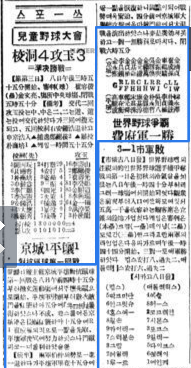
The sports section of an old Korean newspaper. Headlines show the 1-1 result between Kyungsung FC and Pyongyang FC on 8th of October, 1929.
Photo Credit: Tavern of the Taeguk Warriors
The subsequent years saw considerable political and social turmoil, and football’s development came to a halt. In 1940 club football had temporarily stopped after the Japanese abolished the Joseon Football Association that had been founded in 1933 to develop the sport.
After World War II ended in 1945, the Korean peninsula was divided in two and football associations for both countries were created: the DPR Korea Football Association in 1945 in North Korea, and the Korea Football Association in 1948 in South Korea. A few years after that, when the Korean War ended in 1953, North Korea came to be governed by the Communist Party.
And that is probably the single most influential event in the history of football in North Korea, because since then very little is known about club football in the country, even today. It is known that the DPR Korea Premier Football League is the men's top professional football division, that the North Korean football league system is comprised of three divisions (both in men’s and in women’s football), and that the competition has been held since 1960, even though this instalment was officially established in 2017.
It is also known that, despite it starting as an amateur venture, in 1977 sport in the country was reformed and, as a consequence, there are some professional teams with paid players. Which is not very Juche to say the least.
There are some domestic cup competitions too, such as the Hwaebul Cup, the DPR Korea Championship, the Mangyongdae Prize, the Paektusan Prize, the Pochonbo Torch Prize, and the Osandok Prize, but it is difficult to know when they were created, how often they are held, and who has won each edition.
It seems easier to know who each one is dedicated to, since they always refer to people or historical events that are relevant to the Kim family and, at the same time, within the country's communist context, both inextricably linked: the Mangyongdae Prize, for instance, is held to mark Kim Il Sung’s birthday; the Paektusan Prize, to mark Kim Jong Il’s birthday; the Pochonbo Torch Prize, to mark the anniversary of the battle of Pochonbo; and the Osandok Prize, to honour Kim Jong Suk, the first wife of Kim Il Sung, the mother of Kim Jong Il and, of course, the grandmother of current ruler Kim Jong Un.
The most important football teams are 4.25 Sports Club, which belongs to the Ministry of People's Armed Forces; Rimyongsu Sports Club, which is linked to the Ministry of People's Security; and Pyongyang Sports Club, which was founded by Kim Il Sung in 1956 (it has nothing to do with the already mentioned Pyongyang FC, which folded during the Korean War) and is the club of the Workers' Party of Korea.
4.25 Sports Club and Pyongyang Sports Club are bitter rivals, and they contest the Pyongyang Derby, but there are many rivalries between different clubs, a lot of them stemming from who each of those clubs belongs to.
The most important matches, such as tournament finals or international games, are played in the Kim Il Sung Stadium, which was built by the Japanese and inaugurated in 1926. It is the home ground for both North Korea men’s and women’s national football teams, for Pyongyang Sports Club, and for Kigwancha Sports Club, the club belonging to the Korean State Railway.
North Korea is, to this day, also home to the largest football stadium in the world, the Rungrado 1st of May Stadium, that can officially hold up to a maximum of 150,000 spectators. There is some controversy as to whether the national team's matches are currently played at this stadium as well. There is no clear information, but it seems that they used to play their matches here before moving to Kim Il Sung Stadium. Nowadays, however, it is mainly used by 4.25 to play international club matches, and for the mass gymnastics and artistic event known as Arirang Festival.
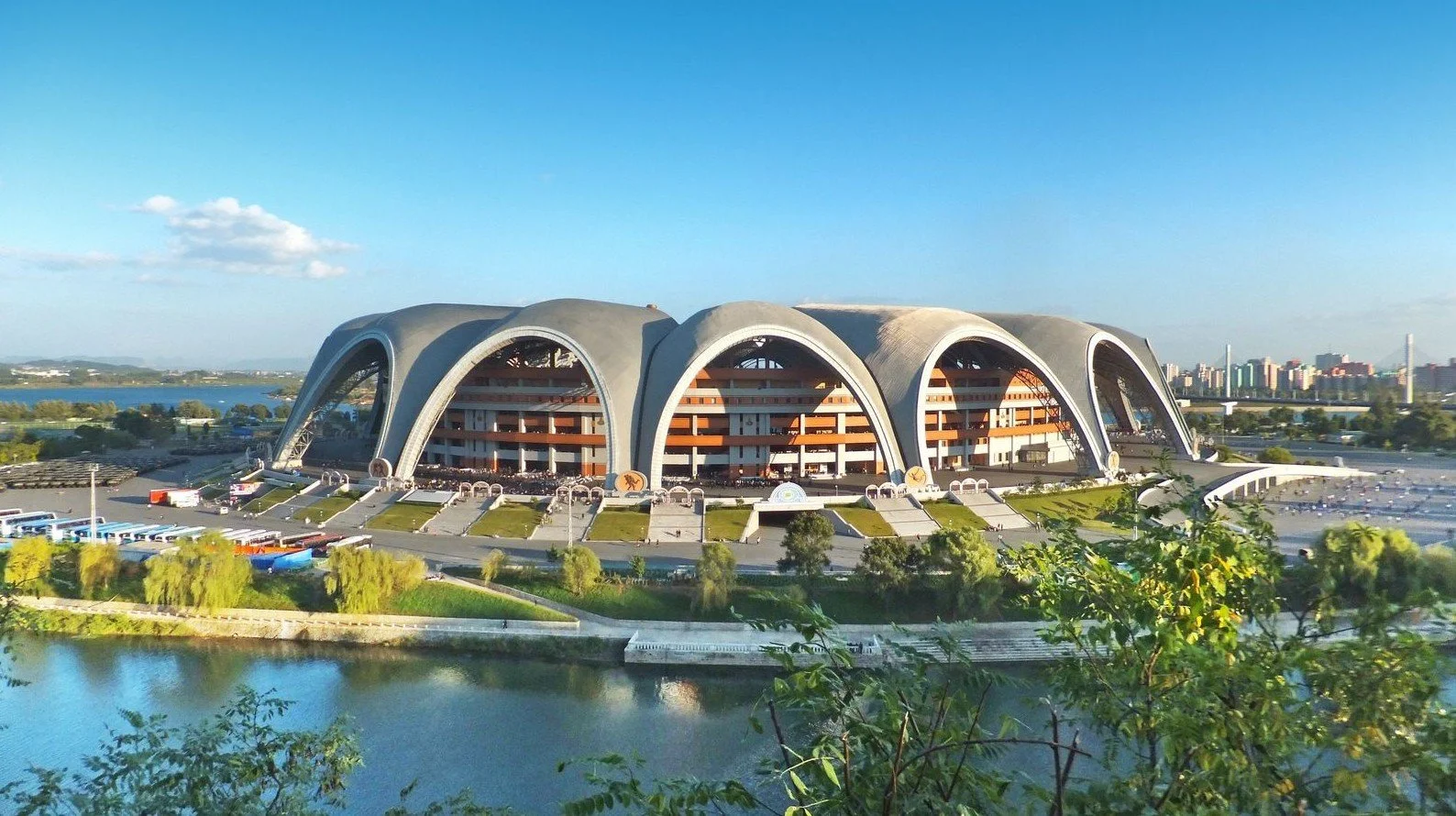
Rungrado 1st of May Stadium in Pyongyang.
Photo credit: Narvikk
One of the few occasions when we get a glimpse of the country is when its men’s and women’s national teams take part in international tournaments. The North Korea national football team’s first football match was played on the 22nd of March 1964 against Burma in Rangoon, which ended 0-0.
Soon after came the match for which the men’s team is probably best known: the run in the 1966 FIFA World Cup, hosted in England. It was the team’s debut in an international competition. At first, it seemed like their run was going to end before it even began, as they were placed in what at that time was considered the group of death, along with the USSR, Italy, and Chile.
The Chollimas, as they are nicknamed because of a mythical winged horse commonly portrayed in East Asian mythology, lost their first match against the USSR, but managed to draw 1-1 against Chile, with the forward Pak Seung-zin scoring North Korea's first goal at a World Cup.
They knocked Italy out of the tournament in their next game, when they won 1-0 thanks to a goal from Pak Doo-ik, a professional dentist, in what turned out to be one of the biggest upsets in the history of men’s international football. It was the first time that an Asian team progressed to the quarter-finals of a World Cup too.
By the next round, the public was in love with the North Koreans, especially in Middlesbrough, where the team was housed. They loved the enthusiasm, the dynamism, the running style, the mechanised-but-with-a-basic-instinct-to-attack-rather-than-defend, football of the North Korean team. It got to the point where more than 5,000 Middlesbrough fans accompanied the team to Liverpool, where they faced Portugal in the quarter-finals.
For anyone who knew anything about football at the time, it was clear that the North Koreans were going to suffer. Everyone thought that a team of amateur players from a closed communist country would hardly be able to take on Eusébio's Portugal, which had just eliminated the reigning world champions, Brazil, in the group stage.
However, in the 1st minute, Pak Seung-zin scored a goal, thanks to an unstoppable shot from outside the box that grazed the crossbar on its way in. On the 22nd minute, Li Dong-woon scored the second goal after poor play by the Portuguese defence.
Yang Seung-kook scored the third goal of the game in the 25th minute. After 25 minutes of play, North Korea were winning 3-0 against Portugal.
But then, the great Eusébio, one of the greatest football players in history, had the individual performance of a lifetime, at least as far as his international football career is concerned.
North Korea lost its discipline, and in the 27th minute Eusébio scored the first goal for Portugal. Before the end of the first half, in the 43rd minute, he scored again, through a penalty, to make it 3-2. After resuming the game, Eusébio scored his third goal of the match in the 56th minute, before doing it again in the 59th minute through another penalty. 3-4. Finally, José Augusto scored the fifth goal for Portugal, putting an end to the dream of the North Korean international team.
He could not, however, prevent the players from being welcomed back to their country as heroes, nor could he prevent North Korea's performance in this edition from being the most successful in the country's men's football history to date. In fact, the team has only managed to win two editions of the AFC Challenge Cup, in 2010 and in 2012, an international football competition for Asian Football Confederation member countries that were categorised as "emerging countries", and a gold medal in the 1978 Asian Games.
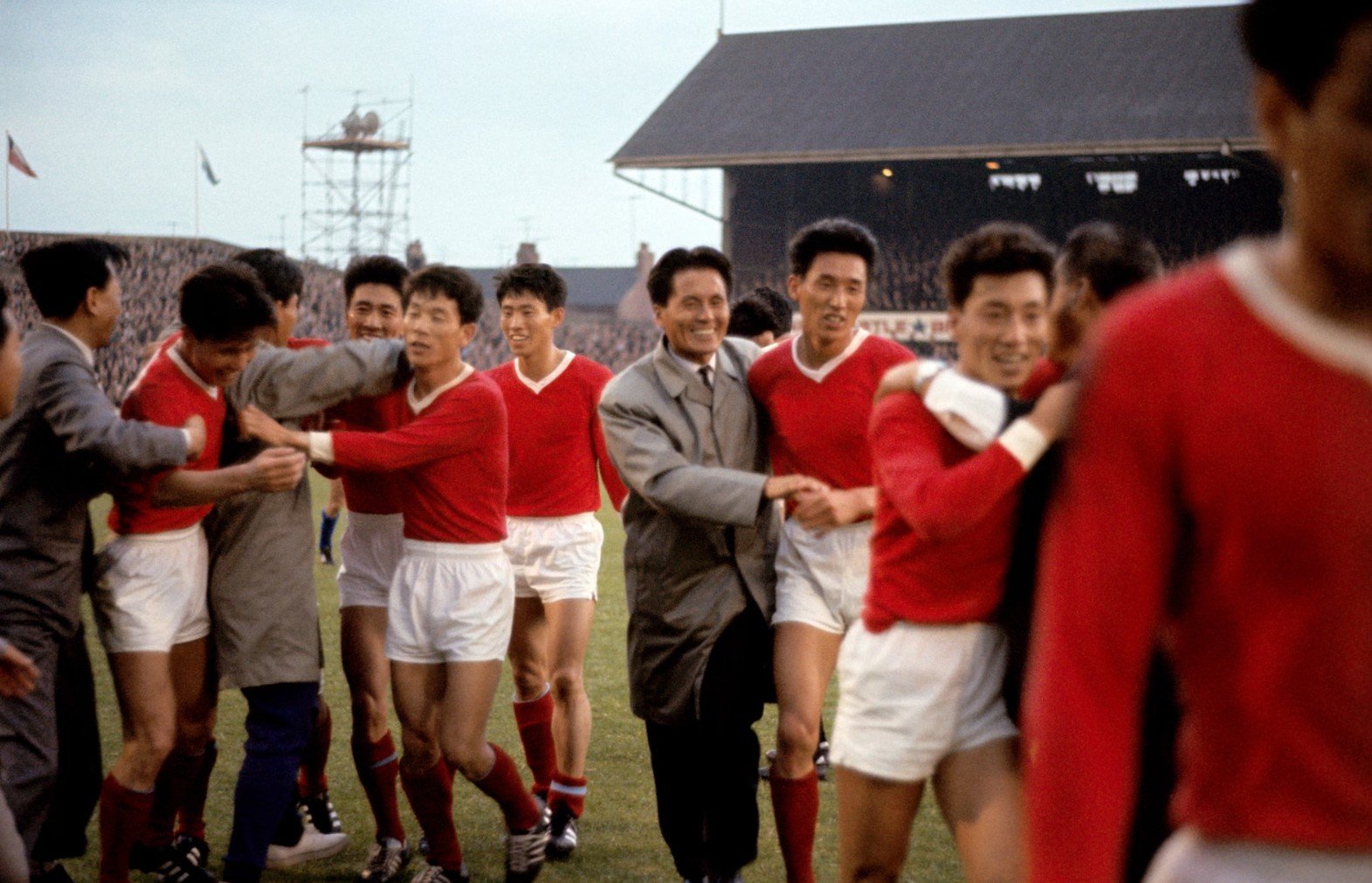
North Korea celebrate after their 1-0 win over Italy in the 1966 World Cup.
Photo credit: The Guardian
The women's team, on the other hand, has been much more successful. This is mainly because a major effort was made in the 1980s to promote women's football in the country, given that it seemed to be largely overlooked elsewhere in the world. It was therefore considered that North Korea would have a much better chance of success in a sport that was ignored in most other places. As it did not receive much attention, it was thought, North Korea could compete.
Women’s football in North Korea began to take shape in 1985, when the first football team was formed in the Society of Provincial Sports of South Pyongan Province. On the 19th of May 1986, the first exhibition match of women's football was played, and soon after, on the 21st of December 1989, the first national match of the North Korean women’s national team was played, against China, in the 1989 AFC Women's Championship. Even though they lost 4-1, they soon began to collect silverware in international tournaments. They won the bronze medal in the 1990 Asian Games, where they only lost once and, more importantly to them, they won 7-0 against South Korea.
Since then, the Eastern Azaleas have won the AFC Women's Asian Cup, the oldest women's international football competition and premier women's football competition in the AFC region for national teams, in 2001, 2003, and 2008, and finished second in the 1993, 1997, and 2010 editions; have won the gold medal in the Asian Games in 2002, 2006, and 2014, the silver medal in 1998, 2010, and 2022, and the bronze medal in 1990; and have been crowned champions in the 2013, 2015, and 2017 editions of the EAFF E-1 Football Championship, an international football competition in East Asia for national teams of the East Asian Football Federation, where they also have ended in second place in 2005 and in 2008.
The team also secured its participation in the last AFC Women's Asian Cup, which was held in Australia in March, 2026. Its qualifying phase had been flawless, as it had beaten Tajikistan (10-0), Palestine (0-10), Malaysia (6-0), and Russia (5-2) to progress to the group stage.
In the first quarter-final game, against Australia, the DPR lost 2-1, but the North Korean players did not give up and produced a very spirited performance in which they almost scored in the 5th minute, had a shot denied by the post, and incessantly high-pressed throughout the game.
In the Asian confederation, only China and Japan, countries with much larger populations and more developed economies, seem capable of standing up to them.
At this point, it is worth highlighting a somewhat murky chapter in the history of the Eastern Azaleas. In July 2011, during the 2011 FIFA Women's World Cup, five of the North Korean players (Song Jong-sun, Jong Pok-sim, Hong Myong-hui, Ho Un-byol, and Ri Un-hyang) tested positive for a rare kind of steroid.
The North Korean FA argued that the positive doping results occurred because they had taken a traditional medicine made from the glands of a musk deer. The officials explained it had been administered to the players after lightning struck their training ground in North Korea. That August, the team was fined US$400,000, and it was banned from the 2015 FIFA Women’s World Cup.
That is regarding the senior team. In the lower categories, North Korea women’s national team has had overwhelming success. The under-20s have won the FIFA U-20 Women's World Cup three times, in 2006, 2016, and 2024, and they are the ones who have won the tournament the most times since it was first organised in 2002, along with the United States and Germany.
The U-19s have been champions of the AFC U-20 Women's Asian Cup once, in 2007; runners-up in 2006, 2011, 2013, and 2015; and third place in 2004 and 2009. Where they have been most successful, though, is in the under-17 category: the U-17s of North Korea have been champions of the FIFA U-17 Women's World Cup, which was held biennially until 2024 (now annually), four times, in 2008, 2016, 2024, and 2025. They are the team that has won the competition the most times.
It looks like the future of the North Korea women's national team is assured.
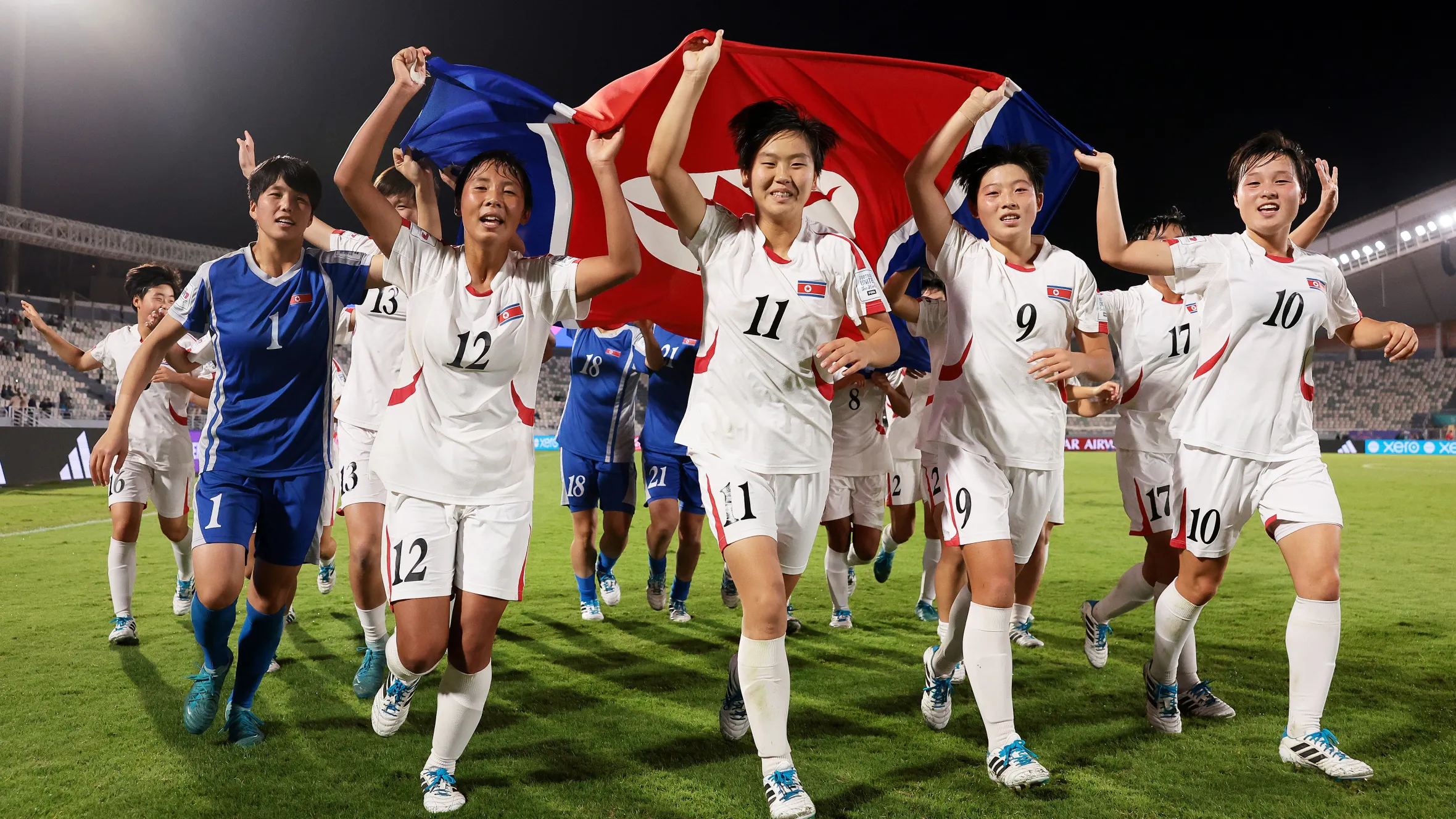
North Korea celebrate winning the 2025 u-17 World Cup in Morocco.
Photo credit: The Times
The fact that everything in North Korea is subject to Juche ideology, like we said before, also means that successes are always attributed to the team as a whole, not to individual players. For this reason, and because it is an isolated and secretive country, few North Korean footballers are known by name, and certainly none seem to be above the rest.
We already mentioned some of them, such as those who scored in the 1966 FIFA World Cup: Pak Seung-zin, Pak Doo-ik, Li Dong-woon, and Yang Seung-kook. Nobody seems to know what happened to them after they returned home. It looks like some of them were condemned for anti-government activities and exiled to the provinces, and it could even be that Pak Seung-zin ended up in a prison camp. In any case, it is difficult to know what status they enjoy in the country.
Hong Yong-jo is another famous football player, who is also the first one who left North Korea to play and develop abroad with the approval of the regime. He played as a number 10 for FK Bežanija Novi Beograd in Serbia, and for FK Rostov in Russia. He spent three years playing in Europe, from 2007 to 2010, always accompanied by a secret service agent, and he impressed the FK Bežanija president with his professionalism. He didn't drink, smoke or stay out late and, in the President’s words, he was very polite and dedicated. I suppose you have no choice when you're being watched by a secret service agent at all times.
The most famous player in recent years is Han Kwang-song, mainly because his career, perhaps more than any other footballer’s, has been significantly impacted by the North Korean government and the international sanctions against the country.
Early in life, Han attended the Pyongyang International Football School, a government-sponsored school that trains young athletes and facilitates opportunities for going overseas. In 2013, Han travelled to Barcelona to train in the Marcet Foundation, a football youth training organization. In 2014, after returning to North Korea, he moved to Italy and joined ISM Academy in Perugia, and in 2017 he signed a youth contract with Cagliari, becoming the second North Korean player to join a Serie A club, following Choe Song-hyok, who had signed with Fiorentina the year prior.
Between 2017 and 2020, he played for Cagliari, Perugia, and again Cagliari, before earning a deadline-day move to Juventus, initially on loan. On the January transfer market of 2020, Juventus bought Han from Cagliari, and six days later sold him to Qatari side Al-Duhail for more than twice what it had cost them.
This is when being born in North Korea had the greatest influence on Han's football career. Due to international sanctions against his country, Han had problems at Cagliari when it came to receiving his salary, as there were suspicions that the full amount was being funnelled directly to the North Korean regime, as was the case with the salaries of other North Korean workers abroad. At that time, however, it was decided not to take any action. After all, the player was receiving the minimum wage established by Italian law, €1,500 per month.
Those same sanctions forced Al-Duhail to terminate his contract in 2021 and that, coupled with Han's inability to return to Korea due to his country's borders being closed because of COVID-19, meant that nothing was heard from him for three years. There were rumours that he was staying at the North Korean embassy in Italy. Some people said that he spent that time stranded at the North Korean embassy in China.
In any case, during that time he kept training alone, to maintain his fitness. On 19th of March 2024, it was reported in a Japanese newspaper that Han was back in North Korea, and that he was playing for 4.25. Months before that, he played in a 2026 World Cup qualifier against Syria in 2023. His football career outside North Korea was over by then.
Among the most well-known female footballers in North Korea are Rim Sun-bong and Ri Hong-sil, who was a forward and was known as a “dagger” for her spectacular attacking power. They both had the right physique for playing football, with a robust build, great ability to anticipate the game, and natural speed.
Another is Kim Kum-sil, who had to leave home to play football because her parents were opposed to her playing a sport that was considered rough and masculine. She scored 92 goals in over 80 international games and came to be known as a “dark horse in Asia.” The three of them played in the country's first women's football team.
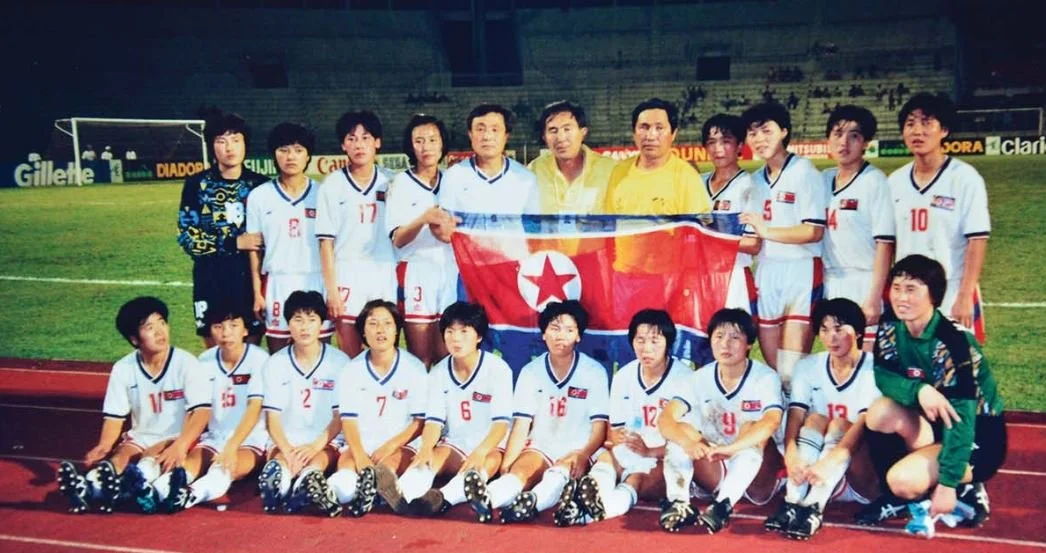
The North Korean women’s team that participated in the ninth Asian Women’s Football Championship in 1993.
Photo credit: Explore DPRK
A little later came Kim Sun-hui, who played as a defender. She captained the team at the 1998 Asian Games, where they achieved the silver medal, and was part of the team at the 1999 FIFA Women's World Cup.
Nowadays they all dedicate themselves to the development of the country’s sports, working as lecturers, coaches and officials in the sports sector to train future women football players. In addition to that, Ri Hong-sil and Kim Sun-hui have worked as international referees.
Football, like all aspects of life in North Korea, is tightly controlled by the state. Perhaps that is why, along with all the mystery surrounding this secretive country, it attracts so much attention. What is clear is that the country's football tradition, with stories as striking as those recounted here, is very interesting and, as far as possible, deserves to be told.
Written by Leire Martinez.