

Words by Chuck Carlson | Published 18.03.2026“…St Louis thought their football team was really up to date.
We journey down from Gillespie for to give them a defeat,
And show them that the Scotchmen was very hard to beat…”
A poem published 25 March 1908, The Gillespie (Illinois, USA) News, p.7
Scottish coal mining communities and high-quality association football have a long and storied history. The depth and breadth of that relationship can be found in some surprising places; for example, the coal fields of Illinois in the Midwestern United States.
Since Europeans first began exploring the central area of North America in the 1500’s, coal had been identified as an abundant resource. It was not until the late 19th and early 20th century however, that mining coal on a commercial scale occurred. Railroad companies, the titans of American industry, realized locomotives ran cheaper on coal than wood, and the industrial business of coal mining in the United States took off. Illinois, a state established in 1818, sat on the second largest coal deposit in the United States, and the coal mining industry needed workers to fully exploit this resource.
Immigrants with mining experience from throughout Europe and the poorer Southern states of the US flocked to Illinois. Scottish miners, too, were looking to the US as a land of opportunity. As letters back to Scotland from early American arrivals demonstrated, unlike Scottish mines, where the miner most often had to lie down to get at the coal face, a miner stood on his feet in Illinois mines. Overall immigration to the United States exploded during the first decade of the 20th century, and where Scottish immigrants went in the US, the short-passing game and soccer success followed.
The organization of coal miners in the United States into a strong, effective union was a positive step in the labor movement in the late 19th century. Initially, the United Mine Workers of America (UMWA) had advocated strongly for worker rights and decent wages. However, by the 1930’s it had stagnated, and in September 1932, the Progressive Miners of America (PMA), a radically democratic and anti-authoritarian labor organization, was founded in Gillespie, Illinois, USA.
The PMA had split off from the long-established UMWA which had become, in the eyes of many, a dictatorship under the presidency of John L. Lewis. During the late 1920’s and early 1930’s, the newspaper of the Illinois branch of the UMWA, The Illinois Miner, had become increasingly hostile to Lewis. The writers at the Illinois Miner were advocating the recruitment of Black miners and women’s auxiliary groups into the labor movement. Lewis rejected these inclusive advances. Sprinkled among Illinois Miner news stories of union politics were sports stories, and, more specifically, articles related to soccer (association football) in the Illinois coal fields.
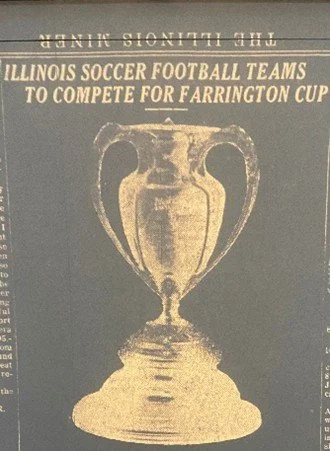
The Farrington Cup trophy.
Photo Credit: Illinois Miner Newspaper
Gillespie, in Central Illinois, is about 40 miles from St. Louis, Missouri, USA, and it was founded in the 1850’s as a farming community. At the turn of the 20th century, it was a sleepy town of 873 souls. By 1920, Gillespie had grown to more than 4,000 and satellite towns such as Eagerville, Wilsonville and Benld had sprung up on the surrounding Illinois prairies. Benld became a sports and union stronghold. The expansion of coal mining in Central Illinois was the reason for this population explosion, and Scottish soccer players, including former professional players, immigrated to the Gillespie area.
In Illinois, before Gillespie became a soccer playing and mining community, players of Scottish descent had competed in coal mining communities near the northern Illinois city of Chicago. Braidwood, Illinois, about 200 miles north of Gillespie and 60 miles from Chicago, was one of those soccer playing and mining communities. Chicago soccer leagues in the late 1880’s and 1890’s regularly included competitive Braidwood teams. In an 1894 international match versus Toronto Thistles, Braidwood defeated the Canadians 7-1, and the Illinois team included one Belgian player, one native born USA player (the goalkeeper Robert Barrowman, who was also of Scottish decent), and nine Scottish immigrants.
When the industrial exploitation of coal in Central Illinois began in the early 1900’s, soccer competition and immigration from Scotland followed. Three individuals who emigrated from coal mining communities in Scotland to the Central Illinois coal fields and their soccer/life stories illuminate the unique experiences of Scottish immigration to the Midwest of the United States.
Charles Morrison Biggam (1882-1932), James “Jimmy” Hendren (1885-1915), and James Easton (1889-1975), came to the Gillespie area between 1905 and 1909. Each had worked as a coal miner in Scotland. Hendren had been mining since at least the age of 15, and Biggam and Easton immediately continued mining upon arrival in Central Illinois.
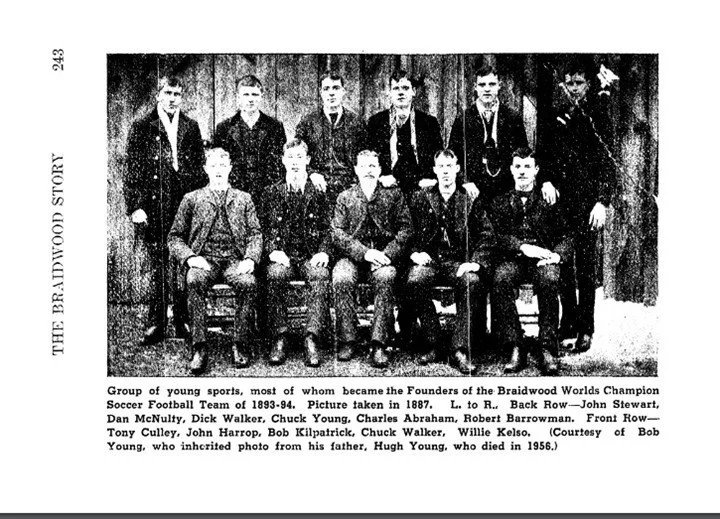
The Braidwood Story book by Modesto Joseph Donna.
Photo Credit: Bob Young
Charles Morrison Biggam | Miner Union Midfielder
“There’s Biggam on the outside left,
he really is the best
That ever in St. Louis in a football
suit was dressed.”
25 March 1908, The Gillespie (Illinois, USA) News, p. 7
Biggam was the first to arrive, and the longest to stay in the Gillespie area. He had been recruited to play for the semi-professional Blue Bells team of St. Louis. Shortly after his arrival in 1905, according to St. Louis newspaper clippings, he established himself as a top player in the region. Though married in Steventson, Scotland in 1903, Biggam, sometimes spelled Bigham or Bingham or Biggman, initially immigrated to the US alone. By saving his soccer earnings, working in a saloon in addition to his mining, he squirreled away enough to bring over his wife and young child in 1906.
A highlight of Biggam’s soccer career occurred in 1909. An “all-star” team of English amateurs, known as the Pilgrims, led by Sheffield United’s Fred Milnes and including players from West Ham, Notts County, and other first division teams, toured the United States for a second time. The Pilgrims compiled a record of 16 wins, 2 losses, and 4 draws, and they outscored opponents from large cities such as New York City and Chicago by 123 to 12. The Pilgrims played eight matches in the Midwest, four in St. Louis, two in Chicago, and two in the Illinois coal fields. Biggam played in two of those matches.
He lined up for St. Louis Blue Bells in their 0-5 loss on October 16, and he was in the midfield for Gillespie when they tied the vaunted Pilgrims 1-1 a couple weeks later. The quality of play in Illinois coal fields was clearly high as Pilgrims drew 0-0 with Coal City Maroons in their other coal fields match. While Pilgrims compiled an 88% winning percentage and outscored opponents by more than 100 goals on that 1909 tour, in the Illinois coal fields, they were 0-0-2 and 1-1 in goals.
Biggam’s activities off the field demonstrate the importance of coal miner union politics in Central Illinois. Coal mining is a dangerous job, and the risk of an early death is extremely high. The cost of a dignified burial was well beyond a miner’s salary in Gillespie, so in the early 1920’s, Biggam helped found the Union Funeral Association for coal miners and their families.
He recruited a St. Louis mortician to cut the cost of burial by over three-fourths, making burial affordable for working people. Highlighting just how unstable the social climate in the Gillespie area was just prior to the September 1932 founding of Progressive Miners of America, when Biggam passed on June 6, 1932, his family refused to have him waked at the Union Funeral Association as it was still under the control of the United Mine Workers.
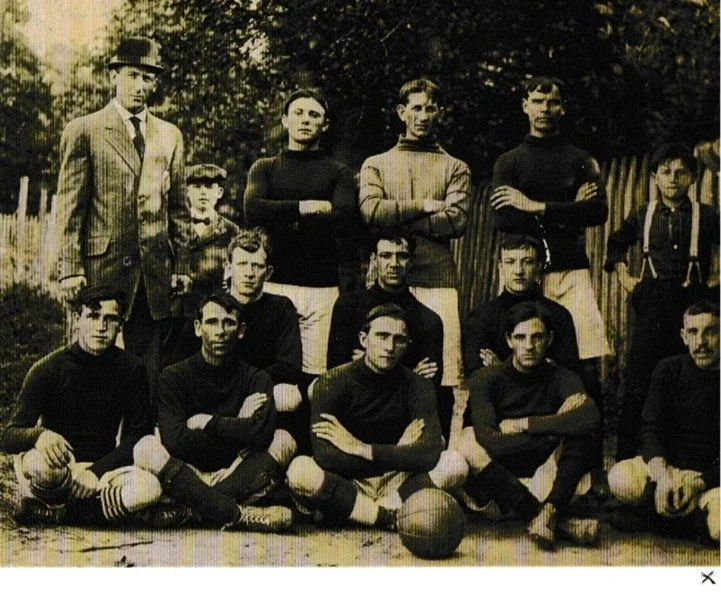
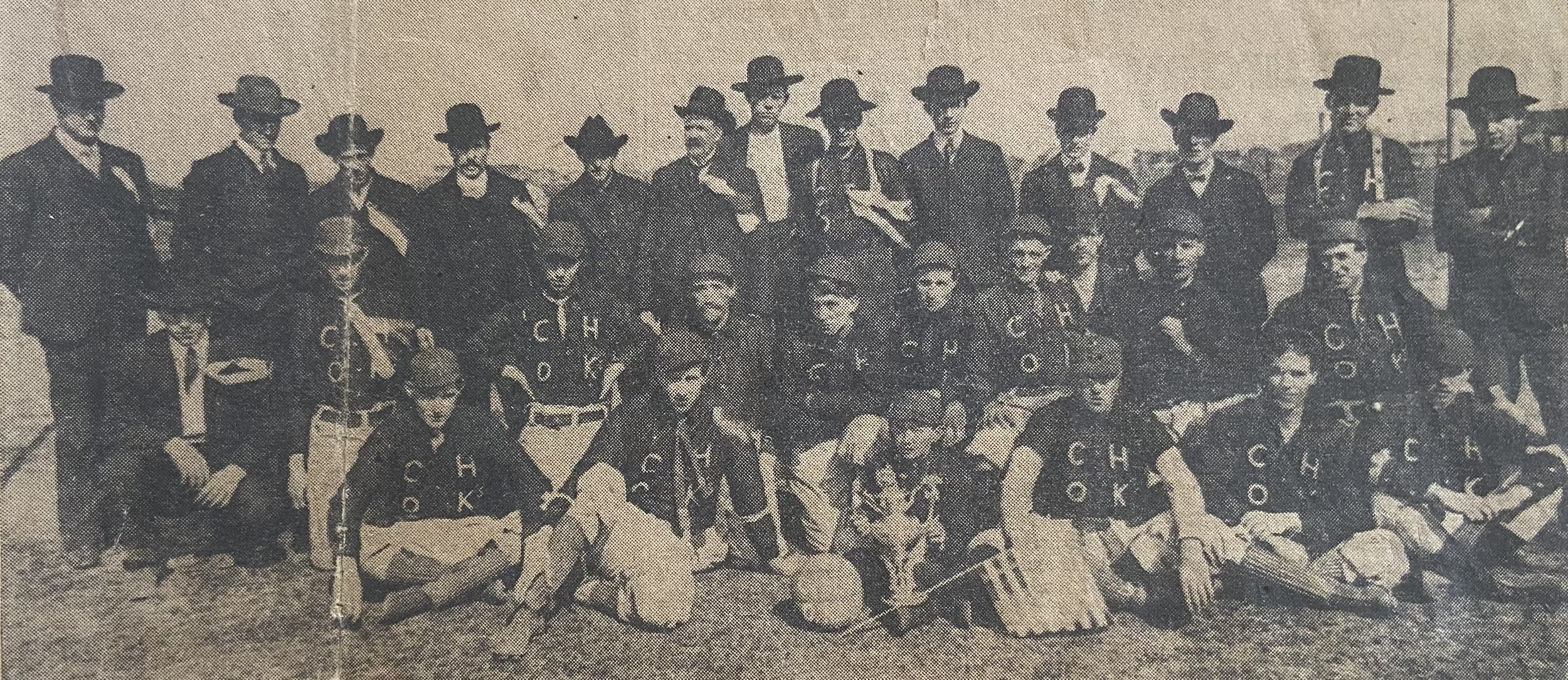
The Blue Bells side of 1908. Biggam is seated at the front far-left.
Photo Credit: Chuck Carlson
James “Jimmy” Hendren | From Scotland to Midwest Coal Fields and Back
“The last to come, Hen(d)ren of Illinois
Fame,
A bunch like that I guess today
Should leave St. Louis lame”
25 March 1908, The Gillespie (Illinois, USA) News, p. 7
Hibernian supporters with a knack for history know that pre-WW I Hibernian forward, James Hendren came to Easter Road from Cowdenbeath in 1910. That path from Collier’s Den to Hibs, though, had included an extensive detour. From mid-1906 to March 1908, “Jimmy” was tearing up the fields of Central Illinois as part of the Benld, IL team. During the 1907-1908 St. Louis Athletic League season, Hendren joined the Innisfails team. Innisfails, who took their team name from the Gaelic word for “Welcome to the Island,” had been competing in St. Louis leagues for many years. The year Hendren played for them, however, they called Benld home.
The town of Benld, Illinois, is geographically a stone’s throw from Gillespie, but it was a world away in culture and attitude when it was founded in December 1904. There were no coal mines in town, though the makeup of the community were predominantly miners and their families. Benld, unlike many early 20th century coal mining communities, was not a “company” town. Mining “company” towns forced miners and their families to live in company owned homes, shop in company owned stores, and educate their children in company run schools.
Benld was an independent community and the soccer players of Benld were playing competitive matches within months of the town’s founding. An indication of the town’s independent streak was apparent as early as 1911, when the locals in Benld were challenging not only company bosses, but the UMWA leadership with demands for better working conditions and higher wages.
It is unclear whether Hendren actually settled in Benld or Gillespie, but shortly after arriving in the area, he was playing in the Maroon and White of Benld Soccer team. The quality of Hendren’s play while in the US was obvious to all reporters covering matches. In an Innisfails game against a Chicago all-star team, the Chicagoans could not contain him, despite double-marking him throughout the match. Hendren scored the only goal in a 1-0 win for Innisfails. (30 Dec 1907 St Louis Post-Dispatch).
These Chicago players may have remembered Hendren during the following match as he was “badly injured,” some feared permanently damaged, when a Chicago team played in the St. Louis area in early 1908. There is no written record that this serious injury caused Hendren to leave the US and return to Scotland, but it was, given his excellent career with Hibernian, not the end of his playing days.
Perhaps it was his final US match on March 30, 1908, that pushed him on to an April 1908 boat back to Glasgow. His Benld based Innisfails team were thrashed 7-1 by St. Louis Athletic League rivals, St. Leo’s. Hendren did, though, get the single goal for Innisfails.
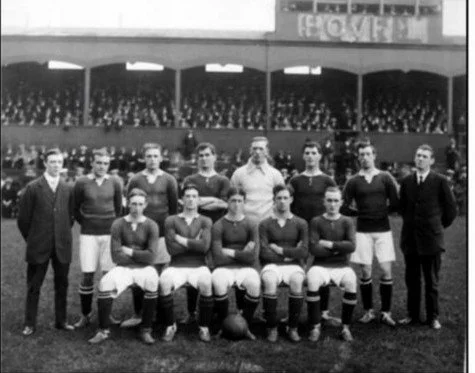
James Hendren is pictured in the back row, third from the right.
Photo Credit: Ancestry.com
James Brown Easton | The American Dream Centre Forward
James Brown Easton, unlike Biggam and Hendren, was not included in the 1908 Gillespie, IL soccer poem. Had that poem been written a few years later, there is no doubt Easton’s name would have been prominent. He was born in Kilmarnock, Scotland growing up in Crosshouse, as the 9th of 13 children. Unmarried at the time, he took the passenger ship California in July 1909, along with future Gillespie mayor Fullerton Fulton. Easton listed his “calling” as miner. James arrived shortly after Hendren had departed the area. Though it cannot be confirmed, as a soccer fan, Easton certainly witnessed Gillespie’s international success when they drew with the touring Pilgrims in Fall 1909.
Easton’s documented US-soccer playing career got underway with Chares Biggam at Blue Bells in St. Louis. However, as he had settled in Gillespie, he soon joined local Gillespie and Benld teams. He and his brother, Craig, were both acknowledged as excellent players, but it was a 1916 match between an all-star team of St. Louis area players and the Unites States’ national champion Bethlehem Steel team of Pennsylvania that altered James’ life enormously.
Bethlehem Steel remains tied for the most successful team in US Open Cup (the equivalent of the Scottish Cup) history. Between 1915 and 1925, the Steelmen captured five titles. In addition to this domestic success, Bethlehem Steel toured Scandinavia in the teens and were scheduled to bring their soccer to Brazil in the early 20’s. They are acknowledged as one of best club teams in North America from their founding in 1907 to their folding in 1930. In 1916, recognizing St. Louis area as home to competitive teams, the Steelmen toured the American Midwest. While there, they encountered James Easton on the opposing team. Easton’s skills were so impressive, that, as the story goes, at halftime of a Christmas match, Bethlehem Steel signed Easton. Whether the signing actually took place at halftime or not is debatable, but there is no doubt Bethlehem Steel secured rights to his soccer skills, and took him, and his spouse, East.
To give an idea of how popular soccer was in early 20th century US, Easton was the subject of a national story highlighting himself and 3 professional baseball players and their mining connections. Before heading to Pennsylvania with Bethlehem Steel, Easton had married a local Gillespie woman, Frances Aherns, and thanks to significant family ties, continued to visit Central Illinois. These visits included a 1924 Bethlehem Steel match versus the local Gillespie side. While Bethlehem Steel soccer team disbanded in 1930, Easton and Frances stayed in Pennsylvania, and Easton’s love of sport clearly carried on. In addition to founding a local amateur soccer league, he was a local promotor for Harlem Globetrotters basketball team in the 1950’s, before passing away in 1975.
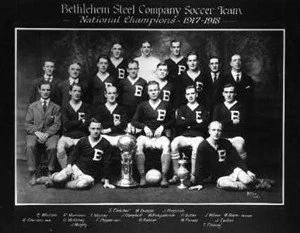
Easton is pictured sitting on the far-right in this photo.
Photo Credit: The Feist Collection
The early 20th Century in the coal fields of Central Illinois was a tumultuous and divisive time. The pro-authoritarian, white supremacist, anti-Catholic/anti-Semitic organization Ku Klux Klan (KKK) were governing nearby Southern Illinois coal towns. The KKK were so ubiquitous in the area that they even had a business office on the main street in Gillespie. At the same time, anti-Klan groups were also actively challenging intolerant Klan culture. The prohibition of alcohol by the US federal government in 1920 had allowed law-enforcement to openly harass and imprison anyone considered “undesirable”, as millions of Americans became criminals by doing something as simple as enjoying a glass of wine with dinner. In Central Illinois, these cultural fractures also lead to the split in the coal miner’s union. The Progressive Miners of America were a positive response to that fear, as it openly challenged racial and gender discrimination, while ensuring democratically elected miner union leaders.
Amidst this stew of social change and conflict, competitive local, national and international soccer was happening in the Illinois coal fields. Three players of Scottish descent, Charles Biggam, James Hendren and James Easton, demonstrate the types of experiences that existed in this place at that time. Biggam, the union man who lived out his life in the coal fields, Hendren, living a life few Americans learn about, the immigrant who returns to their home country, and Easton, who used his soccer skills to follow an “American Dream” path of sporting and business success.
Today, Gillespie, Illinois is a town of 3,100. It’s too far from St. Louis to truly be a suburb, but close enough that most folks support St. Louis sports teams. There is an excellent coal museum on the main street, though the coal mines are long gone. After some success in the mid 1930’s soccer in the Central Illinois coal fields declined precipitously. From World War II until very recently, it was almost non-existent. Gillespie now has a high-quality soccer complex, and though Biggam, Easton and Hendren never played on the same soccer fields at the same time, I am certain that these soccer pioneers would be pleased to know that the complex is fittingly situated right on top of a former coal mine.
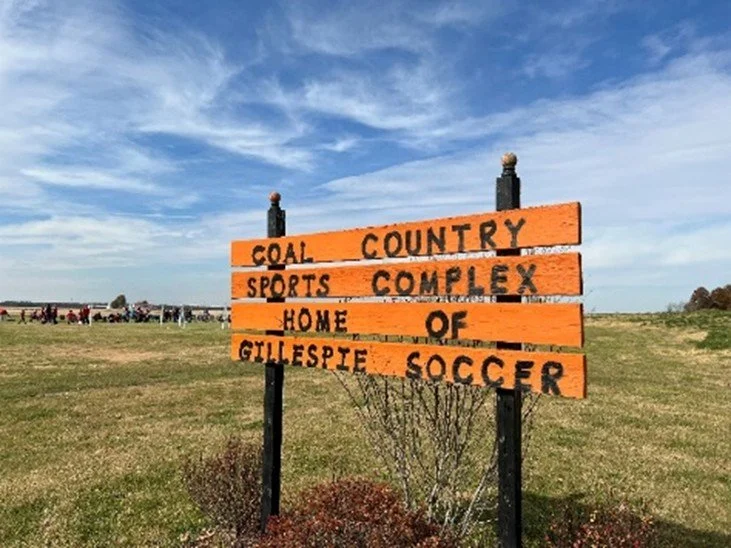
The soccer complex in Gillespie, IL, USA.
Photo Credit: Chuck Carlson
The above article quotes a few lines from a soccer related poem published on page 7 of the Gillespie, IL, USA News on 25 March 1908. Below is the entire verse.
Foot Ball in St. Louis
Twas March the 22nd in the year
of 1908,
St . Louis thought their football
team was really up to date.
We journeyed down from Gillespie
for to give them a defeat,
And show them that the Scotchmen
was very hard to beat.
There’s Robertson, the Goalkeeper,
his equal can’t be got;
There’s Faulkner and Nesbit, they
are always on the spot;
There’s Cairns, Marshall, Harris,
and Larry Pepper as well;
Their equal in St. Louis is very
hard to tell.
There’s Biggam on the outside left,
he really is the best
That ever in St. Louis in a football
suit was dressed.
There’s Murray on the inside, and
for tricks upon the field,
St. Louis people tell us they’ve
never seen him yield.
There’s Cowan in the centre, a
player tried and true;
And there’s none in all St. Louis
for to equal papa Trew;
The last to come, Henren of Illi-
nois fame,
A bunch like that I guess today
should leave St. Louis lame.
Reserve Men.
There’s Tinsey, a reserve man, he
can fairly crack the whip;
There’s Sandy Harriss, lineman,
and there’s Johnnie Gordan
sick;
There’s Johnnie Frew from No. 1;
I guess that is all,
So put the four together and they
couldn’t catch the caul.(Signed) THE HUNDRED DOLLARS.