

Words by Leire Martinez | Published 28.01.2026Deportivo Alavés is the most important football team in Araba.
However, with it being the smallest and least populated province in the Basque Country, in the north of Spain, and with two powerhouses in Athletic Club de Bilbao and Real Sociedad de San Sebastián in two nearby big cities, and an abundance of other football clubs spread all over the region, mostly in Bizkaia and Gipuzkoa, Alavés’ supporters hail mainly from Vitoria, the capital, and some small villages in the aforementioned province, which totals around 338,000 inhabitants.
Thus, it is considered a small and humble football club that, in addition to that, has never achieved silverware in its entire 104 years of existence.
On May 16th, 2001, the most important football match in the history of Deportivo Alavés took place.
It was the 2001 UEFA Cup Final, its first and only European final, and one of two times that the club has reached a tournament final, the other being the 2017 Copa del Rey final. A team founded in 1921, and which for the most part of its life has been bouncing between first and, mostly, second and third divisions, had one of the most important runs in its history in that competition, culminating in an epic final against one of the most successful English football clubs in the world; Liverpool.
That Alavés lost in the end was heartbreaking for the fans and, probably, for many neutral viewers, but it did not tarnish an extraordinary tournament for the club, with many highs and only one, very sad, low.
Deportivo Alavés was promoted to the Spanish football’s first division in 1998 under the guidance of the coach who would lead them to glory, José Manuel Esnal Pardo ‘Mané’, after 42 years of promotions and relegations between the second and third divisions. The first season back in the top flight ended with the team in sixteenth place, which gave no indication of what was to come in the following season. Indeed, during the 1999–2000 season, they finished sixth in the league table, qualifying for a European competition for the first time in its history.
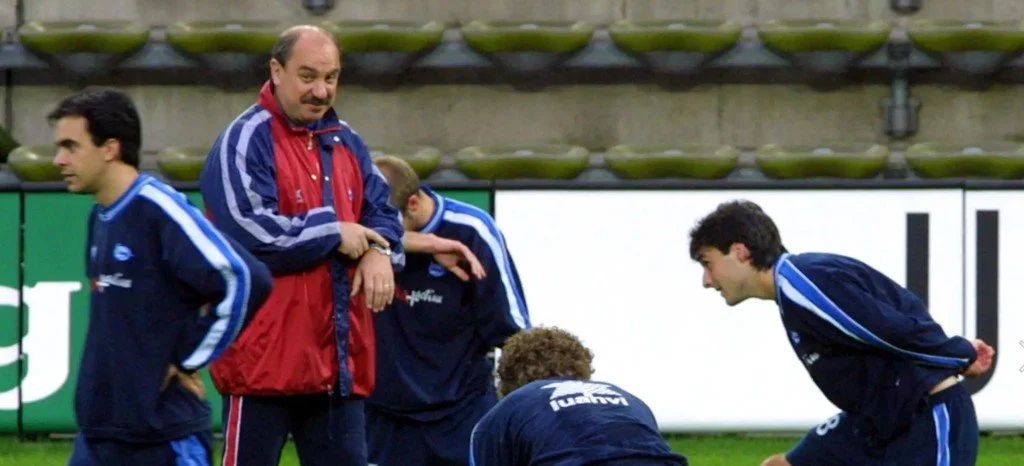
José Manuel Esnal, ‘Mané’.
Photo Credit: Clive Brunskill/Allsport.
The run in the 2000-2001 UEFA Cup began on September 14th, 2000, against Gaziantepspor, a Turkish football club that sadly disappeared in 2020. The first leg of the first round was played at Mendizorroza, Alavés’ home ground, and it ended 0-0. The second leg, played in Turkey, was full of goals, as the match ended 4-3 in favour of the El Glorioso, (The Glorious), as the team is also known despite, as said before, never having achieved any silverware. Alavés found themselves behind twice on the scoreboard, but managed to come back in the second half.
In the second round, the Basque team faced Lillestrøm, first at Åråsen Stadion in Norway and, later, for the second leg, in Vitoria. The first match was won by Alavés 3-1; the second match, on the other hand, was much more even. Glorioso opened the scoring, but the Norwegian team came back, at which point the aggregate score was level. Later in the game, Alavés ended up securing a draw and, as the second match ended 2-2, Alavés progressed to the third round with 5-3 on aggregate.
In the third round, another Norwegian team waited: Rosenborg, one of the most renowned football clubs in that Scandinavian country, winner of 26 Eliteserien titles and 12 Norwegian Cups. This time, the first leg was played in Vitoria, where the match ended 1-1. The second leg, at Rosenborg’s Lerkendal Stadion, ended 3-1 for Alavés, so they progressed to the next round with 4-2 on aggregate.
In the fourth round, the most fearsome rival up until that point awaited: Inter Milan, a team full of stars such as Javier Zanetti, Hakan Şükür, Álvaro Recoba, and Christian Vieri. The first leg, once again at Mendizorroza, ended in a draw, 3-3, after Alavés fought hard to bounce back from a 3-1 in favour of the Italians. The second leg, at Giuseppe Meazza, began with no goals for more than an hour; if the situation remained, Inter would go through on away goals. Finally, the game finished with a 2-0 win for Alavés, with goals scored at the end of the second half. That caused some disturbances in the stands.
In the quarter-finals, Alavés played against fellow Spanish side Rayo Vallecano. The Basques won easily at home, 3-0. Away, they scored first, meaning Rayo Vallecano needed to score five goals to progress to the next round. They managed to score two, but it turned out to be an impossible task so, even though Glorioso lost away 2-1, they progressed to the semi-finals with 4-2 on aggregate, where they faced 1. FC Kaiserslautern from Germany.
The Germans arrived in Vitoria as favourites, but the first leg in Mendizorroza ended 5-1 to an unstoppable Alavés, a football match where four penalties were awarded, three to Alavés and one to Kaiserslautern. In the second leg, at Fritz-Walter-Stadion, even though Kaiserslautern were the first to score a goal, Alavés scored four to take the tie to a very comfortable 9-2 aggregate victory.
That day, Deportivo Alavés confirmed its place in a European final, the first final in its history at the time. It would be against Liverpool on May 16th at the Westfalenstadion in Dortmund. Liverpool, for its part, had eliminated Olympiakos, AS Roma, Porto and Barcelona to get there, with a team full of players from the youth academy. It was the first European final the Reds played since the Heysel Stadium disaster in 1985.
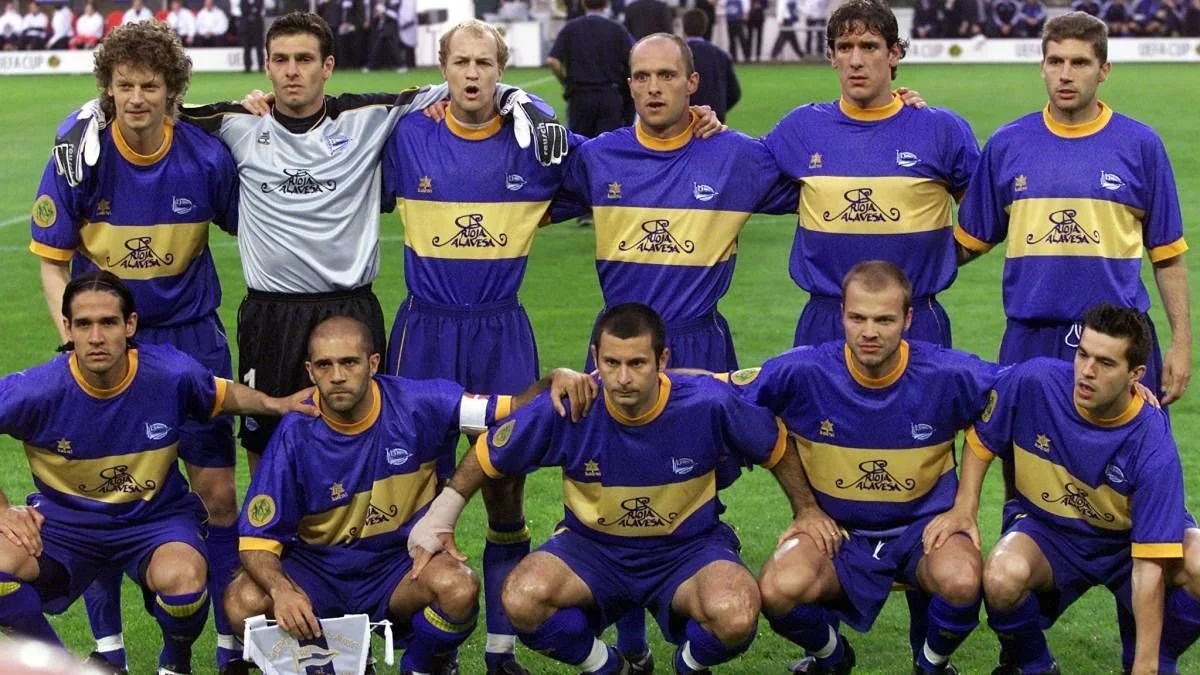
Deportivo Alavés line-up for the final.
Photo Credit: EFE.
Martín Herrera, Cosmin Contra, Antonio Karmona, Oscar Téllez, Dan Eggen, Delfí Geli, Jordi Cruyff, Ivan Tomic, Hermes Aldo Desio, Martín Astudillo, and Javi Moreno formed the starting lineup for Deportivo Alavés.
On the other side of the field, Sander Westerveld, Markus Babbel, Sami Hyypiä, Stéphane Henchoz, Jamie Carragher, Gary McAllister, Dietmar Hamann, Steven Gerrard, Danny Murphy, Emile Heskey, and Michael Owen were the players chosen by coach Gérard Houllier to start the match for Liverpool.
The favourite was clear from the outset, but the underdog wasn't going to make it easy.
However, Deportivo Alavés' inexperience in this type of competition soon became apparent: by the 16th minute, Liverpool was already winning 2-0, after both Babbel and Gerrard scored a goal each. In the 22nd minute, Mané, the Alavés coach, made a substitution that would change the game: he took off Eggen and brought on Iván Alonso, who scored a goal on the 26th minute to close the gap and to give Glorioso a chance. With the tactical change and the subsequent goal, the team was filled with confidence. However, a poor clearance by goalkeeper Herrera led to a penalty, which McAllister converted on the 40th minute. By the end of the first half, it was 3-1 for the scousers.
The score, however, did not fully reflect the reality of what was going on on the pitch; the match was far more even than what anyone thought. During half time, the Basque coach made the second substitution, bringing Magno on and taking Astudillo off.
At the beginning of the second half, Javi Moreno, the striker who, thanks to that extraordinary campaign, earned a move to A.C. Milan, scored two goals in two minutes to level the match by the 49th minute. 3-3. The rookie team had managed to equalise with the maestro.
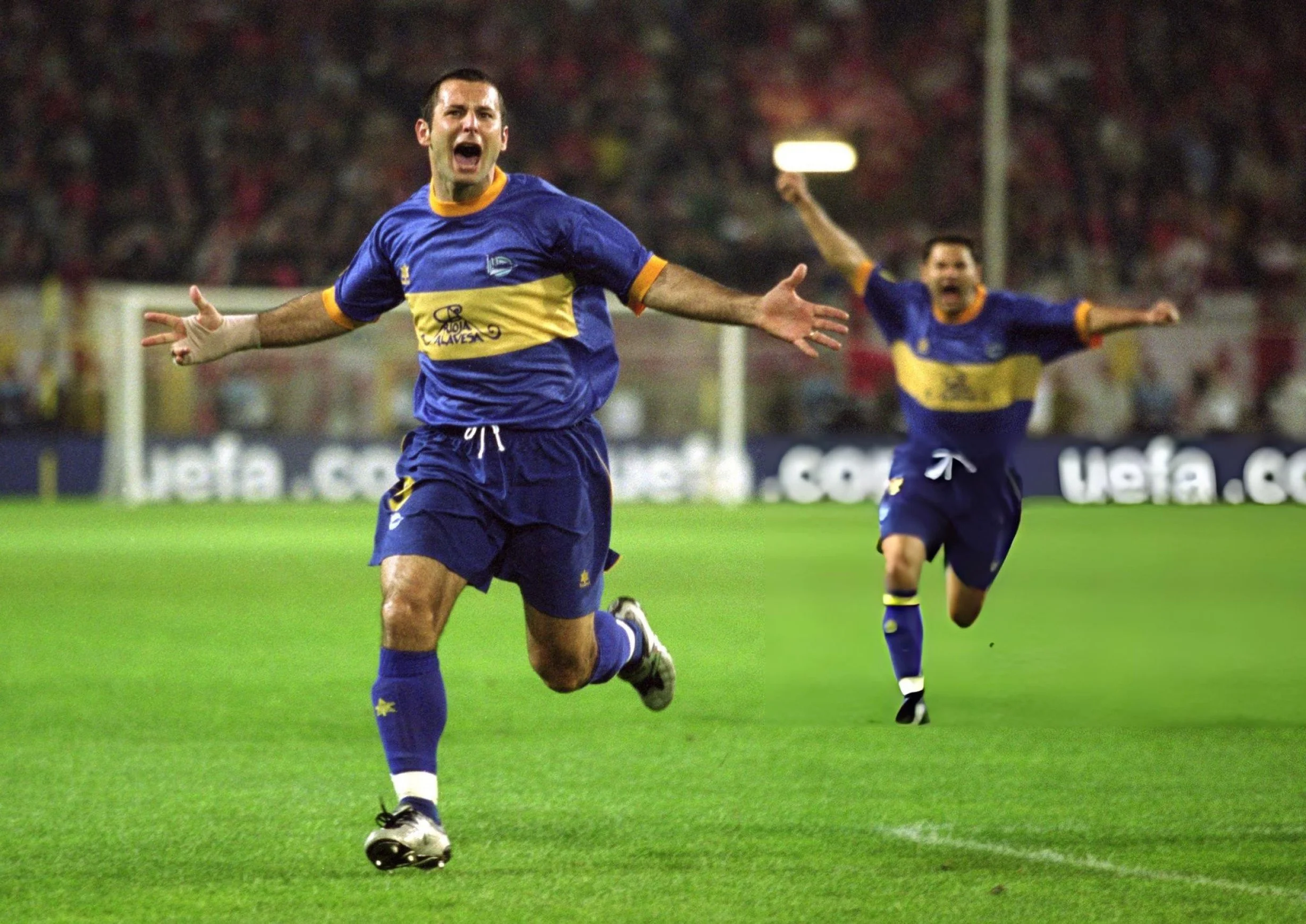
Javi Moreno celebrates scoring during the UEFA Cup Final against Liverpool.
Photo Credit: Gary M Prior/Allsport.
In the next quarter of an hour, Liverpool made two substitutions: on the 55th minute, Šmicer entered the pitch, replacing Henchoz; on the 64th minute, Heskey was taken off and Fowler was brought on. That same minute, Javi Moreno was incomprehensibly substituted, and Pablo Gómez entered the pitch. And those changes proved to be decisive. In the 72nd minute Fowler scored to make it 4-3. Despite the setback, Alavés did not give up, even though it was impossible to think they could score another goal, and even less so without its best striker. But then, in the 88th minute, the impossible happened: the Liverpool goalkeeper conceded a corner, and Jordi Cruyff, subsequently, headed the ball into the net to take the match into extra time. 4-4. Everything would be decided in extra time but, whatever the outcome, the match had already become one of the most exciting in the history of the tournament.
Extra time began. Nerves were on edge. At that time the golden goal rule was in force, which added even more tension to the situation: the first team to score would win. And within three minutes, it seemed the game was over, when Iván Alonso scored. Sadly, it was ruled offside. Later, with only a minute of the first half of extra time remaining, Fowler scored. It was ruled offside too. Between the two disallowed goals, Alavés were reduced to ten men in the 98th minute after Magno was sent off.
During the second half of extra time, the key play happened: on the 116th minute Alavés, for the second time during the match, got a player sent off with a red card. This time it was Karmona. The resulting free kick was headed by defender Delfí Geli into his own goal. With the golden goal rule, it meant that was it.
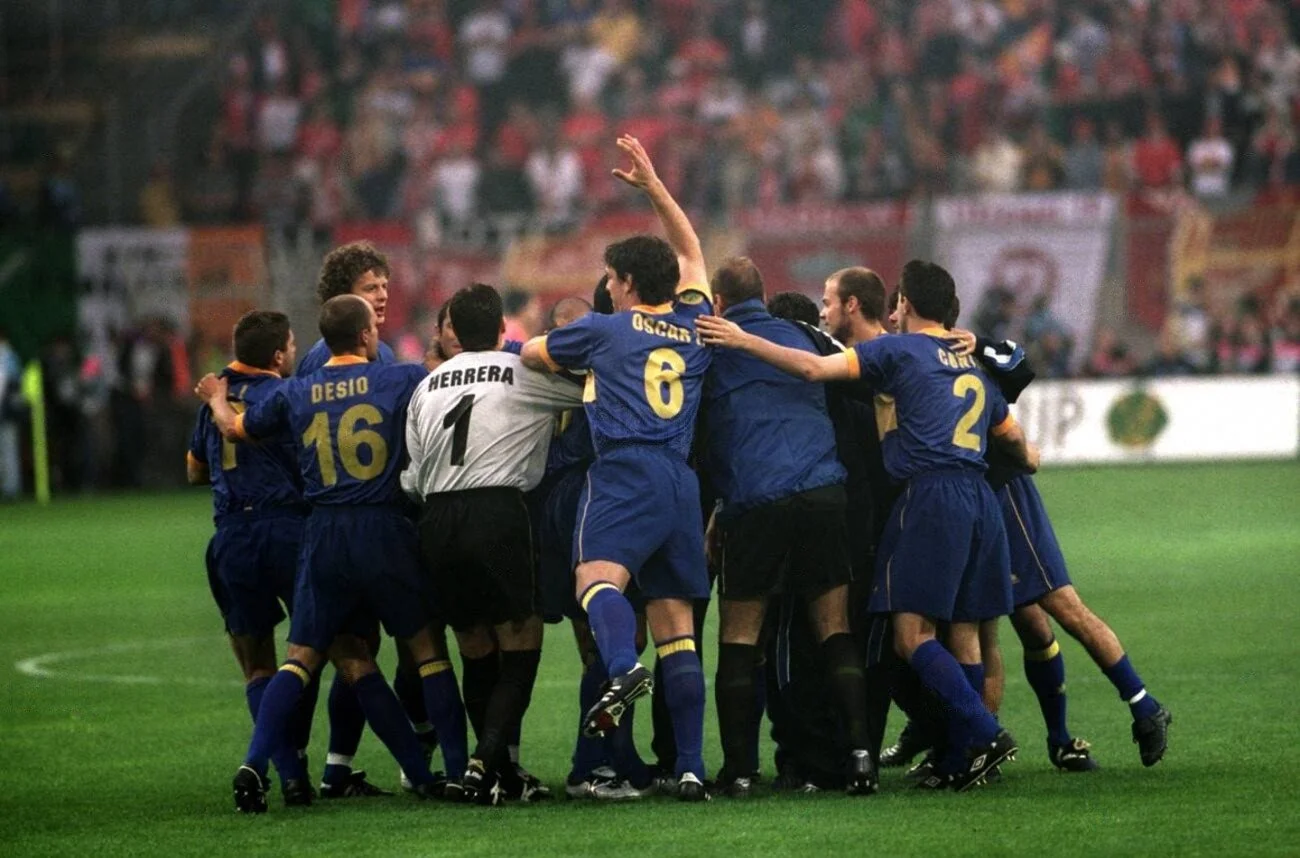
The end of the match. The end of the run of the century.
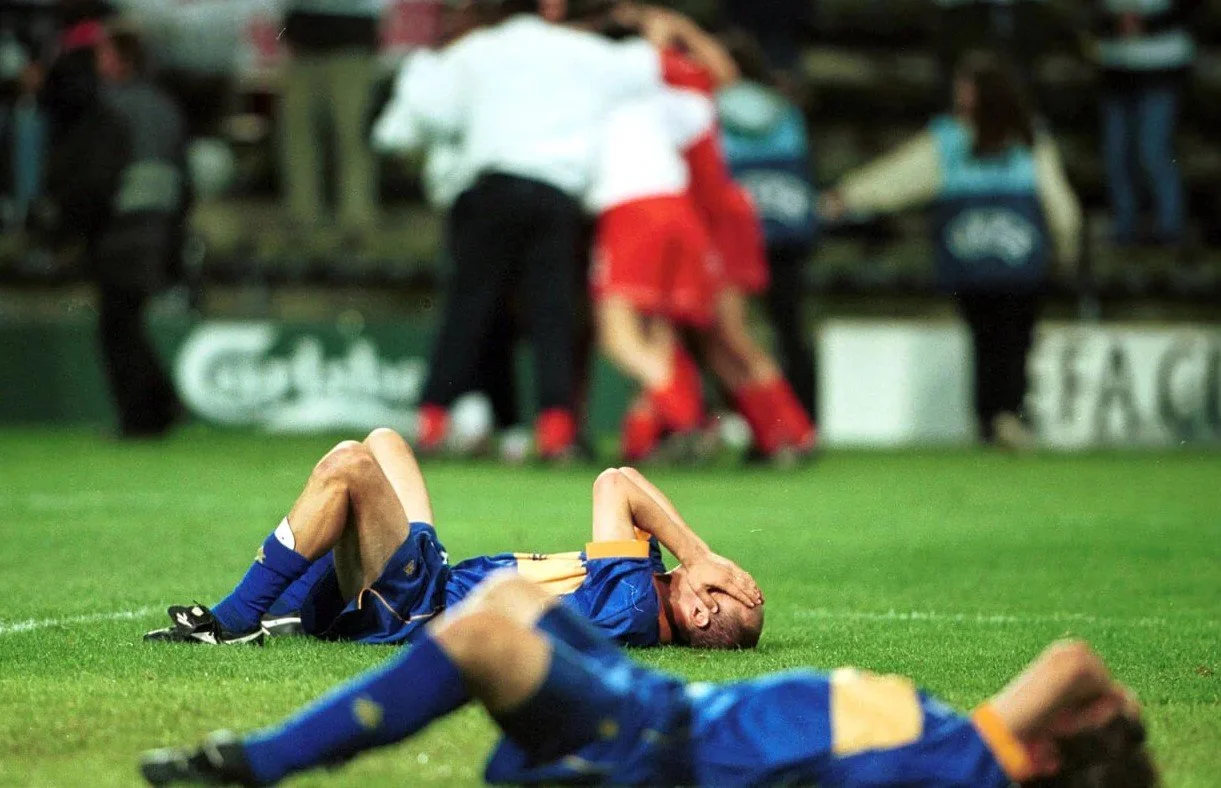
Deportivo Alavés players collapsed on the ground after losing the UEFA Cup Final against Liverpool.
Photo Credit: Marca.
The Glorioso players collapsed on the pitch, heartbroken and devastated, after they had lost the first and only European final Deportivo Alavés has ever played in its history. Liverpool won one of its most important trophies of those years, after winning practically nothing during the 1990s. From then on, the trajectories of both teams were completely opposite. Liverpool continued to achieve important trophies, such as several League Cups and an FA Cup, and most notably the Champions League in 2005.
Deportivo Alavés on the other hand, entered one of the darkest periods in its history. The momentum of reaching the UEFA final still remained during the following season, despite A.C. Milan arriving in the summer and taking Javi Moreno and Cosmin Contra with them. Glorioso qualified again for the UEFA Cup in the 2002-2003 season, but this time they were eliminated in the second round by Turkish side Beşiktaş. In 2003, the team was relegated to the second division; shortly before, in April, Mané had stepped down as coach following poor results.
And the worst was yet to come. In 2004, Ukrainian-American businessman Dmitri Piterman bought Deportivo Alavés with the intention of returning the team to the top flight of Spanish football. However, despite achieving promotion during the 2004-2005 season, Alavés was relegated again, this time with serious financial problems resulting from Piterman's mismanagement. After several problems within the club and various convictions for non-payment of wages, Piterman left Alavés in March 2007. During his four years in charge, the club’s debt tripled to €23 million, causing it to file for bankruptcy in 2007. This situation continued until the beginning of the summer of 2015, when the club emerged from insolvency proceedings. Fortunately, the team's situation has improved significantly in recent years. It has managed to consolidate itself in sporting terms, with the exception of its relegation to the second division at the end of the 2021–2022 season, and above all financially, with the arrival of several local businessmen whose capital has allowed it to achieve a certain degree of stability.
Reaching the UEFA Cup final remains a historic milestone that Deportivo Alavés has been unable to repeat. However, having achieved it once gives hope that in the future, somehow, it can be achieved again.
That's the thing about humble teams. There are no small victories, and the big ones go down in history.
Written by Leire Martinez.
This article was featured on Cultured Football 248 by Paul Grech.